How to find new restaurant openings before they open
New restaurant openings leave a public paper trail months ahead. Here's how to read liquor licenses, permits, and filings to reach a venue first, free or by API.
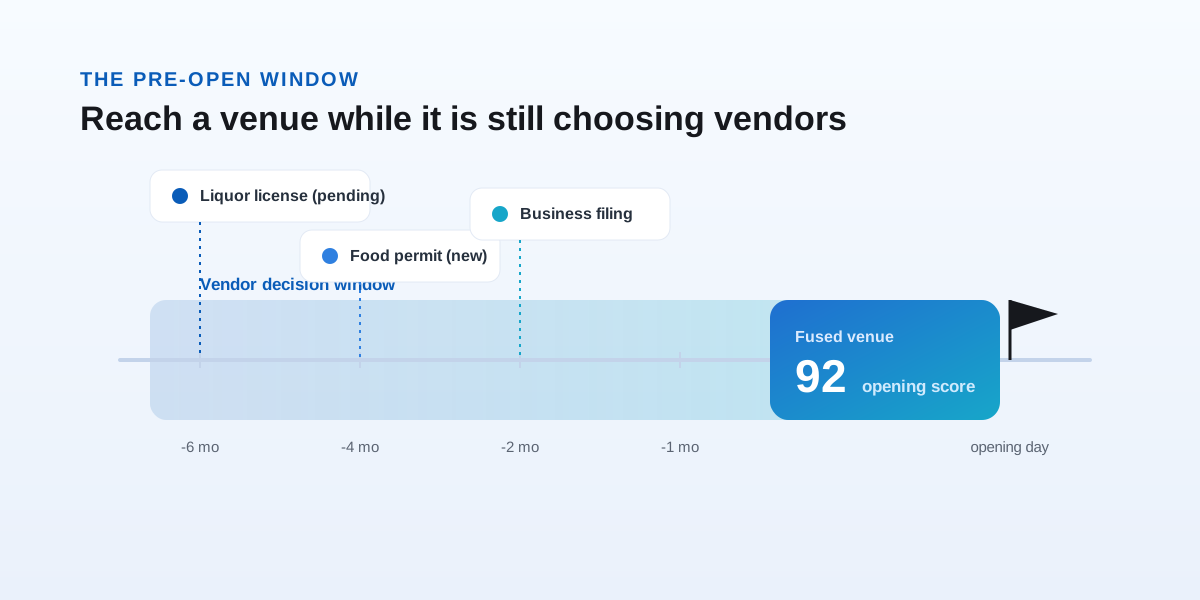
Every new restaurant you want to sell to is already leaving a trail. You just aren’t reading it yet.
By the time a place shows up on The Infatuation or Google Maps, it has a POS. It has an insurance policy. It bought its ovens six months ago. The deals are done.
New restaurant openings show up in public government records one to six months before the doors open: liquor license applications, building and health permits, and new business filings. You can search these yourself for free, or pull them pre-scored through an API. Reach the owner during that window and you’re first in the door instead of last.
That window is the whole game. Let me show you how to work it, whether you do it by hand or buy it.
What counts as a new restaurant opening?
A new restaurant opening is a venue that has committed to opening but hasn’t served a paying customer yet. The commitment is what matters. Someone signed a lease, filed for a permit, or applied for a liquor license, which means money is moving and vendors haven’t been chosen. That’s different from a place already open, where every buying decision is locked.
Think about who cares about this window.
If you sell point-of-sale systems, you want the owner before they sign with Toast.
If you do commercial insurance, you want them before the general liability policy renews for the first time.
If you distribute food, pour beer, or install kitchen hoods, the same logic holds. The first vendor in usually stays.
And there are a lot of these windows. About 16,718 new restaurants opened in the US in 2025, which is more than 80 a day, according to restaurantdata.com’s 2025 openings report. Roughly 88% were independents, the exact operators who don’t have a corporate procurement team already telling them what to buy.
Why the dining guides and Google Maps can’t help you
The lists that rank for “new restaurant openings” are built for diners, not for you. Resy, The Infatuation, Robb Report, and your local paper publish beautiful roundups of places to eat this weekend. Every one of them covers a restaurant at or after opening, which is exactly when it stops being a lead.
I checked the search results for that phrase while writing this. The first page is almost entirely consumer dining guides.
That’s the trap. Those pages answer “where should I eat,” not “who’s about to open so I can sell to them.” Same words, opposite intent.
A restaurant makes almost all of its vendor decisions in the months before it opens, not after. Reach it in month two and you’re a helpful option. Reach it in month eight and you’re asking someone to rip out something that already works.
And owners tend to remember who showed up early, back when the place was still studs and drywall and permit binders and nobody else was bothering to call.
One more thing worth killing here. You’ve heard 90% of restaurants fail in year one. It’s false, traced to a 2003 commercial, not a study. Bureau of Labor Statistics data puts real first-year closure around 17%, per DirectOrders, and Datassential measured just 0.9% for 2025 openings, its lowest since 2018. The venue you sold to last month is almost certainly still open and still paying you.
Where do new restaurant openings show up first?
New openings appear first in three kinds of public record: liquor license applications, building and health permits, and new business or LLC filings. Each is filed months before opening, and each is public by law. A liquor license application is usually the strongest single signal, because a place serving alcohol has committed real capital and a real timeline.
Here’s how the three stack up.
Liquor license applications are the gold standard. They carry the business name, the address, the applicant, and a filing date. In many states you can see them while they’re still pending.
Building and health permits confirm a physical buildout. A permit for a hood suppression system or a grease interceptor is a restaurant, not a nail salon.
New business filings and LLC registrations are the earliest signal but the noisiest. “Sunrise Hospitality LLC” could be a restaurant or a consultant. You use these to confirm, not to lead.
One source alone lies to you. A liquor license without a matching permit might be a renewal. A business filing without an address is useless. The signal gets real when two or three line up on the same venue. It’s the reason Restaurant Pipeline, one of the paid services, says it reviews more than 2,500 monitored sources to surface openings. One feed isn’t enough.
How do you read a liquor license application like a lead?
Read a liquor license application as a lead by pulling four fields: the business name, the street address, the applicant or owner name, and the application status. A pending or newly issued status on a fresh address is a pre-open venue. The applicant name is your contact path, and the address lets you cross-check permits and filings to confirm the project is real.
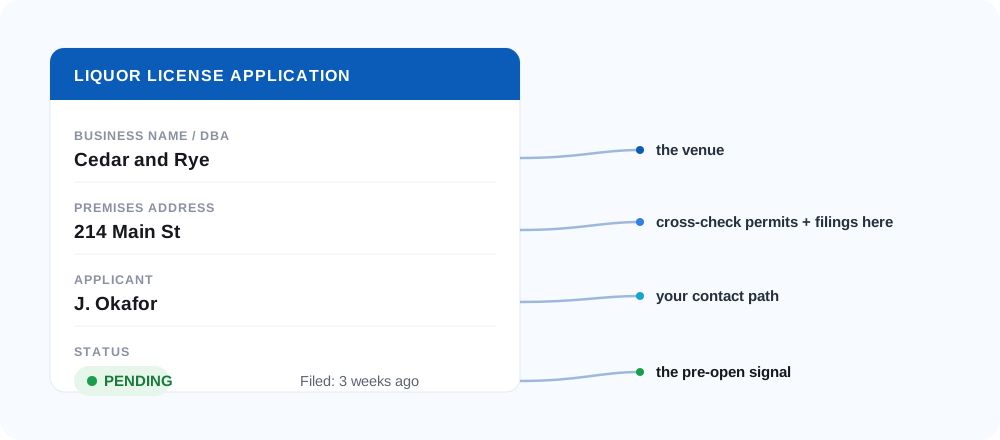
Liquor data is public in every state, and it strips the private stuff. There are no Social Security numbers in these files. That’s settled, and it’s why services can use it at all.
Where do you look? Each state runs an Alcoholic Beverage Control board with a lookup tool.
California’s ABC license lookup shows existing, pending, and former licenses, plus the applicant. Pending is the word you want.
Pennsylvania’s PLCB+ system covers 80 different license types. Some states, like Indiana, even offer bulk downloads. At the federal level, the Alcohol and Tobacco Tax and Trade Bureau publishes a List of Permittees under FOIA.
No official search page for your state? Search “[your state] ABC license search” and you’ll find it. The naming is that consistent.
How far ahead can you find a restaurant before it opens?
You can typically find a new restaurant one to six months before it opens, and the exact lead time depends on the state’s licensing speed. The liquor license application is the clock. It gets filed early because approval is slow, so the public record appears long before the venue does.
There’s an outside number on this. Restaurant Pipeline, which tracks openings for a living, measures roughly 82 days on average from a venue’s first public record to its opening, and adds about 437 new pre-opening projects a week. So the typical window is real, and it’s wide enough to work.
In New York, a liquor license typically takes 30 to 120 days, and up to 175 if something goes wrong. Owners are told to start 4 to 6 months before opening.
California is slower and, for you, better. Operators should plan for 3 to 12 months, and the state won’t issue a license until the city grants a Conditional Use Permit first. Two filings, both public, both early.
Here’s the lead window by state signal:
| State | Liquor license time | Extra pre-open filing | Your lead window |
|---|---|---|---|
| New York | 30–120 days | None required | 1–4 months |
| California | 3–12 months | Conditional Use Permit (filed first) | 3–12 months |
| Most states | 4–6 weeks to several months | Building + health permits | 1–6 months |
So the slower a state’s bureaucracy, the earlier you can find the lead. California being the single biggest source of new openings and one of the slowest to license is a gift if you sell there.
How do you score which openings are worth your time?
Score a new opening by how many independent public signals point at the same venue and how recent they are. One source is a maybe. A liquor license plus a matching building permit plus a business filing at the same address is a near-certain real project. Add recency, because a filing from last week beats one from eight months ago that may have stalled.
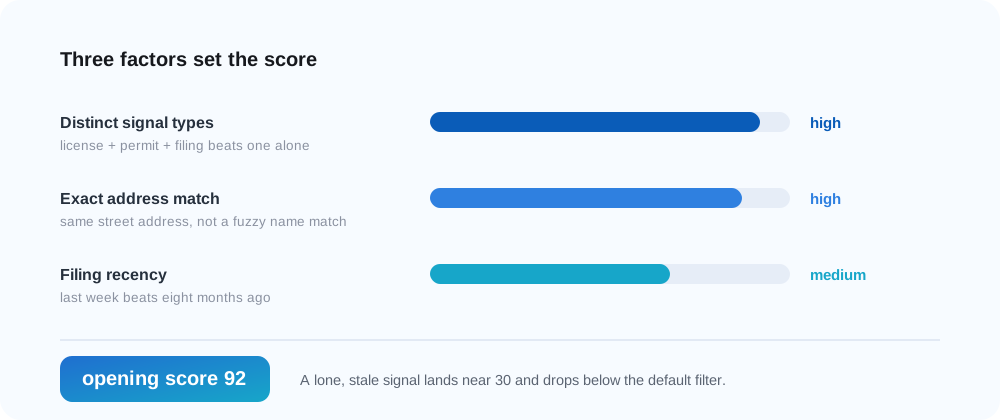
I learned this the annoying way. A single liquor license looks like a lead until you call and it’s a change of ownership on a bar that’s been open a decade.
So build a simple score.
Give a venue points for each distinct signal type. License, permit, filing. Three beats one.
Give it more points when the signals share an exact address. Fuzzy matches on business name alone will burn you.
Weight recent filings higher. A pre-open window is a moving target, and a stale signal often means a project that died.
Should you build a permit tracker yourself or buy a feed?
Build it yourself if you sell in one or two states, have a little engineering time, and want it free, since every record is public and the only cost is your effort. Buy a feed or use an API if you cover many states or don’t want to spend every week deduping renewals and stale filings by hand. The honest break-even is the week your manual pulling costs more than a subscription.
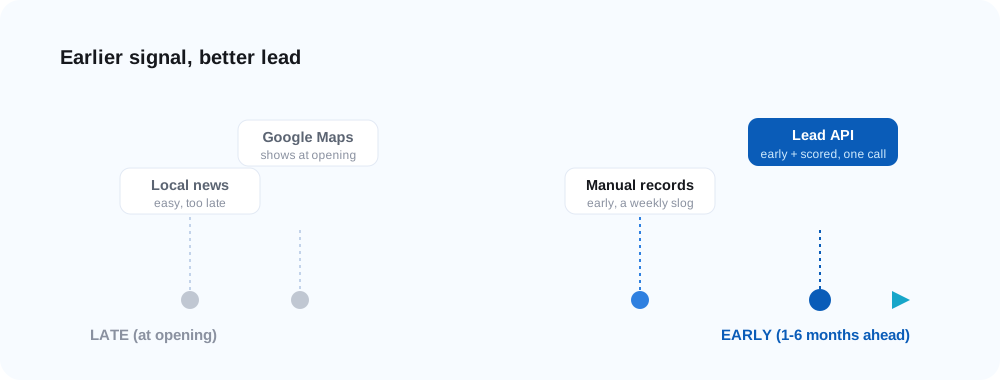
Here’s the honest comparison, because nobody selling you a feed will lay it out:
| Approach | Lead time | Effort | Cost | What you get |
|---|---|---|---|---|
| Dining guides / Google Maps | 0 (at opening) | None | Free | Too late to sell |
| DIY public-record search | 1–6 months | High, weekly, per state | Free | Raw records you dedupe and score yourself |
| List services (Restaurant Pipeline, restaurantdata, FLHIP) | 1–6 months | Low | Paid, usually demo-gated | A weekly list or dashboard, often with contact info |
| Lead API (RestoSignals) | 1–6 months | Low | Free tier, then usage-based | Fused, scored venues by API or agent |
The list services are genuinely useful, and some include owner contact details you’d otherwise chase down. What none of them give you is a scored venue you can pull straight into your own stack or hand to an AI agent.
What does a real pre-open lead look like?
A strong pre-open lead is one venue backed by two or three matching signals at the same address, filed recently. Picture a pending liquor license for “Cedar and Rye LLC” at 214 Main St, a building permit for a Type I kitchen hood at 214 Main St from three weeks ago, and a new LLC registration under the same name. Same address, three signal types, all fresh. That’s not a maybe. That’s a restaurant opening in the next few months.
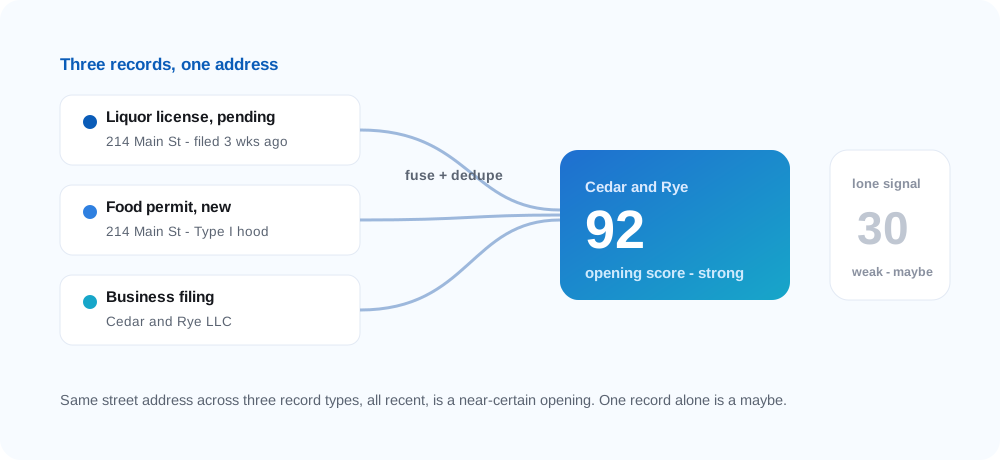
Now compare it to the weak version. One pending liquor license at an address with no permit and no filing. Could be real. Could be a renewal that stalls. You’d call it and find out, and half the time you’d waste the call.
The strong lead also hands you a contact path. The applicant name on the license is a person you can look up. The address tells your rep exactly where to drive.
This is why fusion beats any single list. A CSV of liquor licenses is raw. A venue with three aligned signals and a recency stamp is a lead you can act on today.
How RestoSignals does this in one call
RestoSignals fuses liquor license applications, food and building permits, and new business filings into one venue record with an opening score, so you get a ranked list of pre-open restaurants without touching a single state website. It runs as a REST API and a hosted MCP endpoint, covers seven states today, and scores every lead on signal count, address match, and recency.
The score is the part that saves your week. Instead of reading raw records and guessing, you get venues already ranked by how likely they are to be a real, soon-to-open restaurant.
Coverage right now is New York, Texas, Illinois, Oregon, Colorado, Washington, and California. We only list a state when the underlying government data is real, so the map grows honestly instead of on paper.
You can call it from code or point an AI agent at the MCP endpoint and ask for new openings in a metro. Same data, either way. That agent path is the one thing the weekly-list services can’t match.
The free tier is 100 leads, no card, and one credit equals one returned lead. That’s enough to test whether the venues in your territory are worth a workflow before you pay anything.
Start with one state this week
Pick the state where you already sell. Go to its ABC site, filter for pending liquor licenses in your top county, and pull the last 30 days. That’s your first batch of pre-open leads, free, in about an hour.
Then decide whether you’d rather do that every week by hand, across every county, forever, or let an API return it scored in one call. Either path beats waiting for a dining guide to tell you what your competitor already knew a month ago.
Mukul Dutt is the founder of RestoSignals, an API that surfaces restaurants and bars before they open by fusing public liquor, permit, and business-filing records into one scored venue.
FAQ
What is the best way to find out about new restaurants before they open?
Search your state's Alcoholic Beverage Control site for pending liquor licenses, then cross-check building permits and new business filings at the same address. Two or three records on one address is a real project, usually one to six months from opening. To skip the manual work, a lead API returns the same records already fused and scored.
How many new restaurants open each year in the US?
About 16,718 new restaurants opened across the US in 2025, roughly 80 a day, and independents were about 88% of them. California led all states at 19.2% of openings, with Florida close behind at 18.0%, per restaurantdata.com's 2025 openings report.
Are liquor license applications public record?
Yes. Liquor license data is public in every state and excludes private fields like Social Security numbers. You search it through each state's ABC board. California's ABC lookup even shows pending applications, so you can see a venue before it opens.
How far in advance can you find a restaurant before it opens?
Usually one to six months. Restaurant Pipeline, a lead service, measures about 82 days on average from a venue's first public record to opening. A liquor license alone takes 30 to 120 days in New York or 3 to 12 months in California, and it's filed early, so the record appears long before the doors do.
Should I build a permit tracker myself or buy a lead feed?
Build it if you sell in one state, have engineering time, and want it free, since the records are all public. Buy or use an API if you cover multiple states or want the renewals and duplicates filtered out for you. The break-even is roughly the point where the weekly manual work costs more than a subscription.
Is there an API for new restaurant opening leads?
Yes. RestoSignals exposes new-opening leads as a REST API and a hosted MCP endpoint, fusing liquor licenses, permits, and business filings into one scored venue. Most incumbents (Restaurant Pipeline, restaurantdata, FLHIP) deliver a weekly list or dashboard instead. The free tier is 100 leads.
Find venues opening near you
100 free leads, no card. One platform for restaurants & bars about to open.