Florida liquor license renewal: March 31 or September 30?
Florida liquor licenses renew on March 31 or September 30, depending on your county. The county list, 2COP and 4COP fees, late penalties and the 60-day cancellation rule.
Search a liquor license
Status, license type and expiration date, straight from the state's own records. Free, no sign-up.
More states and the free expiry reminder: liquor license lookup.
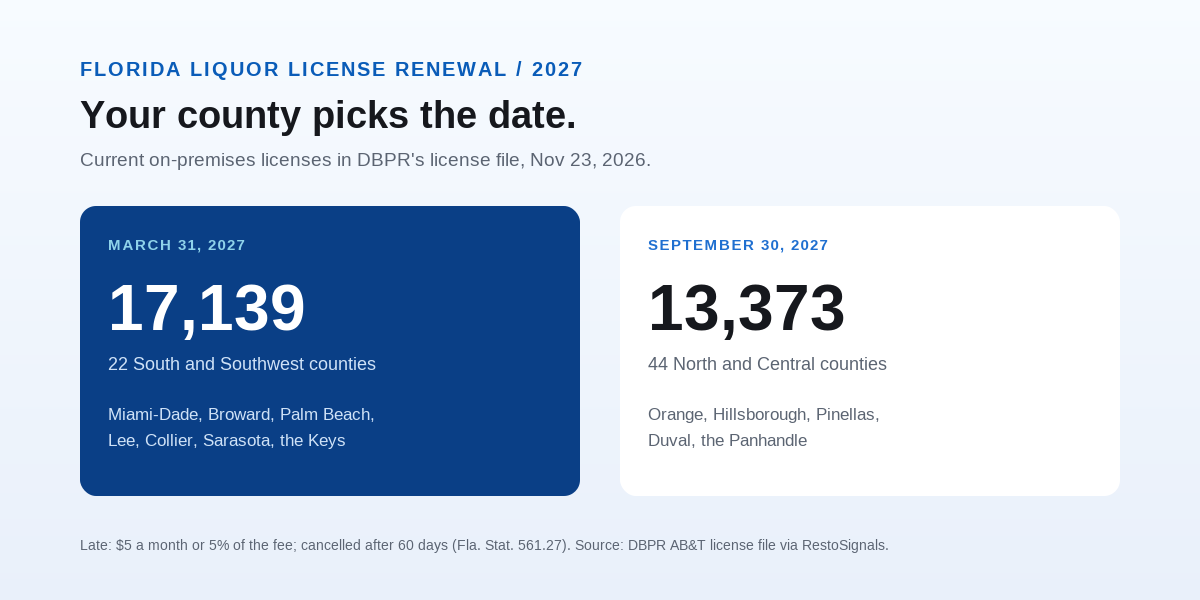
Florida renews its liquor licenses in two waves, and your county decides which one you’re in.
Miami and Fort Lauderdale renew by March 31. Orlando and Tampa renew by September 30.
Florida liquor license renewal works like this: you renew your annual beverage license with DBPR’s Division of Alcoholic Beverages and Tobacco before its expiration date, either March 31 or September 30. You pay the annual license tax for your license type and county. Late renewals carry a penalty, and a license not renewed within 60 days is cancelled.
I run RestoSignals and its free liquor license lookup, which reads DBPR’s license file every day. Use the search box above to check your license. Below: which date applies to your county, what renewal costs, and what Florida law says happens if you’re late.
When does a Florida liquor license expire?
A Florida liquor license expires once a year, on March 31 or September 30, depending on the county. Florida Statute 561.27 says licenses renew “from year to year” on a schedule the division sets. In DBPR’s license file, every current license in 22 South and Southwest counties expires March 31, and in the other 44 counties September 30.
I checked all 30,529 current on-premises licenses in DBPR’s file of November 23, 2026:
- 17,139 expire March 31, 2027.
- 13,373 expire September 30, 2027.
The split follows county lines almost exactly. In a few counties, one or two licenses sit on the other date.
That makes Florida unusual. In Texas and California, each license renews on its own anniversary. In Florida, thousands of bars and restaurants hit the same deadline on the same day.
Which Florida counties renew March 31, and which September 30?
South and Southwest Florida renew March 31. North and Central Florida, including the Panhandle, renew September 30. This is the split in DBPR’s license data on November 23, 2026, counting current on-premises licenses by county. Confirm your own date on your license record, because a handful of licenses don’t follow their county.
| Renewal date | Counties | Current licenses |
|---|---|---|
| March 31 | Miami-Dade, Broward, Palm Beach, Lee, Sarasota, Volusia, Brevard, Collier, Manatee, Polk, Monroe, St. Lucie, Martin, Charlotte, Indian River, Flagler, Highlands, Hendry, Okeechobee, DeSoto, Hardee, Glades | 17,139 |
| September 30 | Orange, Pinellas, Hillsborough, Duval, St. Johns, Seminole, Pasco, Bay, Escambia, Lake, Osceola, Okaloosa, Leon, Alachua, Marion, Walton, Citrus, Hernando, Nassau, Clay, Sumter, Santa Rosa, Putnam, Columbia, and 20 smaller counties | 13,373 |
A few surprises in there:
- Volusia and Brevard renew in March, even though they sit near Orlando, which renews in September.
- Polk renews in March, while its neighbors Hillsborough, Osceola and Orange renew in September.
- The Keys (Monroe) renew in March with the rest of South Florida.
The largest single counties are Miami-Dade (3,880 current licenses) and Broward (2,653) in the March wave, and Orange (2,174) and Pinellas (1,741) in the September wave.
How much does a Florida liquor license renewal cost?
A Florida renewal costs the annual license tax for your license type, which the Florida Statutes set by county population. A 4COP liquor-by-the-drink license costs $1,820 a year in counties over 100,000 people and $624 in counties of 25,000 or fewer, under section 565.02. Beer and wine taxes are set separately.
Here are the statutory annual taxes for on-premises sales, from the 2025 Florida Statutes:
| County population | Liquor (565.02), e.g. 4COP | Beer (563.02) | Wine (564.02) |
|---|---|---|---|
| Over 100,000 | $1,820 | $200 | $280 |
| 75,001 to 100,000 | $1,560 | $160 | $240 |
| 50,001 to 75,000 | $1,300 | $120 | $200 |
| 25,001 to 50,000 | $858 | $80 | $160 |
| 25,000 or fewer | $624 | $40 | $120 |
Sources: Florida Statutes 563.02, 564.02 and 565.02.
Three notes on reading this table.
A 2COP license is beer and wine on premises. The statute sets the beer and wine taxes separately, so in a large county the two together come to $480. Check your DBPR bill for the exact amount, since DBPR may combine or add charges.
Extra bars cost more. Section 565.02 adds $1,000 to the liquor license tax if the premises has more than three rooms with permanent bars.
Your county’s population sets the tier. Most bars and restaurants are in counties over 100,000, so the top row is the one most owners pay.
What are 2COP, 4COP and SFS licenses?
In DBPR’s data, the license series tells you what you can serve. Of the 30,529 current on-premises licenses:
- 4COP (13,805): beer, wine and liquor for consumption on premises. 9,052 of them carry the SFS modifier, a special food service license for restaurants that sits outside the quota. 2,957 carry no modifier: those are the quota licenses, capped by county population.
- 2COP (13,406): beer and wine for consumption on premises.
- 11C, 13CT and smaller series (about 3,300 together): other on-premises licenses.
Every one of them renews on the same March 31 or September 30 schedule as its county.
What happens if you renew a Florida liquor license late?
If you renew a Florida liquor license late, you pay a penalty of $5 for each month or part of a month you’re late, or 5% of the license fee, whichever is greater. That’s in section 561.27(2). If the license isn’t renewed within 60 days of expiration, DBPR cancels it, unless it’s tied up in litigation or an administrative action.
Here’s what that looks like in dollars, using the statute’s formula:
| License | Annual tax | Penalty in the first 60 days |
|---|---|---|
| 4COP, county over 100,000 | $1,820 | $91 (5%) |
| 4COP, county of 25,000 or fewer | $624 | $31.20 (5%) |
| Beer and wine, county over 100,000 | $480 | $24 (5%) |
The penalty is small. The cancellation is not.
After 60 days, the statute says DBPR may still allow renewal “after good and sufficient cause for the delinquency has been shown.” DBPR’s form for that is the Application for Delinquent Renewal (ABT-6015). It asks you to write out why you didn’t renew, and it needs a notarized affidavit, filed with your district office by mail, by appointment or in person.
DBPR decides. If it says no, the license stays cancelled.
Why losing a quota 4COP is the expensive mistake
A cancelled quota 4COP (a plain 4COP with no SFS modifier) is the worst case. Florida limits how many quota licenses each county can have, and new ones come out through DBPR’s annual quota license drawing. Section 561.19(5) sets a $10,750 fee for a new quota license, and says that fee isn’t charged on renewal.
In other words: renew on time and you pay the annual tax. Lose it, and replacing it means winning a drawing or buying an existing quota license from another holder.
What about selling alcohol while you’re late? Section 561.27 allows a late renewal with a penalty, but it doesn’t say outright whether you can keep serving while the license is expired. Don’t assume you can. If you’re already past the date, call your DBPR district office before you open.
How do you renew a Florida liquor license?
You renew a Florida liquor license by paying the annual license tax, plus any required bond, to DBPR’s Division of Alcoholic Beverages and Tobacco before the expiration date. Section 561.27 says that’s what entitles a licensee to renewal. DBPR’s online services are on MyFloridaLicense.com, and AB&T district offices handle licensing questions.
A simple routine:
- Find your date. Search your BEV license number above, or use DBPR’s license verification.
- Check your tier. Your license series and your county’s population set the tax.
- Pay early. File in the weeks before March 31 or September 30, not on the day.
- Keep the receipt until the new expiration date shows on your record.
DBPR’s Customer Contact Center is at (850) 487-1395 if your renewal doesn’t show up.
How do you check a Florida liquor license’s status?
You check a Florida liquor license’s status by searching its BEV number, owner or business name, either in the search box on this page or in DBPR’s license verification on MyFloridaLicense.com. Each record shows the license series, the expiration date and a status. In DBPR’s license file, a primary status code of 20 means the license is current.
Not every record says “current.” In the November 23 file, 1,403 on-premises records carried another code:
- 911 with code 45
- 267 with code 41
- 225 with code 21
DBPR’s data extract doesn’t define those codes, so I won’t guess what each one means. Our search shows them as “Not current (DBPR code 45)” and so on, exactly as the file has them. If your license shows one, call DBPR before you assume anything.
Two checks are worth doing on your own record:
- The date matches your county’s wave. If you’re in Broward and your record says September 30, find out why before March.
- The mailing address is right. It’s where DBPR sends licensing mail. An old address can mean you never see a notice.
One more thing about timing. A whole county renews on the same day, so you’re filing alongside thousands of other licensees. If your renewal needs anything beyond a payment, such as a change of address or a question about your bill, start in February or August, not the last week.
What should Florida restaurant groups watch for?
A Florida restaurant group should check which wave each location falls in, because a group with locations in both South and Central Florida has two renewal deadlines a year, six months apart. In DBPR’s data, 248 of the 746 Florida groups with three or more locations hold licenses in both the March and September waves.
That’s the trap. The finance team pays the March renewals for the Miami and Fort Lauderdale stores, and assumes renewals are done for the year. Then September 30 arrives for Orlando and Tampa.
A few habits help:
- List every location with its county and wave.
- Calendar both dates if you operate on both sides of the line.
- Budget by county tier. A 4COP in a small county costs about a third of one in Miami-Dade.
DBPR’s file lists each licensee’s mailing address. RestoSignals uses it to find the other licenses your group holds, even when each location is its own LLC. Our Group monitor watches every license at every location and emails you before each date, for $15 per location per month.
Frequently asked questions
When does my Florida liquor license expire?
Florida beverage licenses are annual and renew on a schedule set by DBPR. In DBPR’s license data, every current license in 22 South and Southwest Florida counties, including Miami-Dade, Broward, Palm Beach, Lee and Collier, expires March 31. Licenses in the other 44 counties, including Orange, Hillsborough, Pinellas and Duval, expire September 30.
How much does it cost to renew a Florida liquor license?
The annual license tax depends on license type and county population. Under Florida Statute 565.02, a 4COP liquor license costs $1,820 in counties over 100,000 people, down to $624 in counties of 25,000 or fewer. Beer and wine taxes are set separately in sections 563.02 and 564.02. DBPR’s renewal bill shows the exact amount due.
What is the late fee for a Florida liquor license renewal?
Florida Statute 561.27 charges a penalty of $5 for each month or part of a month you’re late, or 5% of the license fee, whichever is greater. On a $1,820 4COP license, 5% is $91, so that’s the penalty in the first two months.
What happens if I don’t renew my Florida liquor license?
Under section 561.27, a license not renewed within 60 days of expiration is cancelled by DBPR, unless it’s involved in litigation or an administrative action. DBPR can still allow renewal after 60 days if you show good cause, using its Application for Delinquent Renewal (form ABT-6015), which needs a written explanation and a notarized affidavit.
Can I sell alcohol after my Florida liquor license expires?
Section 561.27 allows a late renewal with a penalty but doesn’t say outright whether you may keep selling while the license is expired. Don’t assume you can. Renew before the date, and if you’re already late, ask your DBPR district office before you serve.
Do all my Florida locations renew on the same date?
Not if they’re in different parts of the state. A group with bars in Miami and Orlando renews the Miami licenses by March 31 and the Orlando licenses by September 30. In DBPR’s data, 248 of the 746 Florida groups with three or more locations hold licenses in both waves.
Mark March 31 or September 30 today
Search your license in the box at the top of this page and note which date it carries. If it’s March 31, you have about four months.
If you’d rather not track it by hand, set a free reminder and we’ll email you 90, 60 and 30 days ahead. Renewing elsewhere? Read the California ABC and Texas TABC renewal guides, or liquor license renewal rules by state.
Mukul Dutt is the founder of RestoSignals, which tracks liquor license status and expiration dates from public state records. Renewal, penalty and cancellation rules are from Florida Statute 561.27, the quota license fee from 561.19, and license taxes from 563.02, 564.02 and 565.02 (2025 Florida Statutes). The delinquent renewal process is from DBPR form ABT-6015. License counts and county renewal dates are from DBPR’s Division of Alcoholic Beverages and Tobacco license file as mirrored by RestoSignals on November 23, 2026 (current on-premises licenses, status 20). Sources checked November 24, 2026. This is general information, not legal advice. Confirm fees and deadlines with DBPR.
FAQ
When does my Florida liquor license expire?
Florida beverage licenses are annual and renew on a schedule set by DBPR. In DBPR's license data, every current license in 22 South and Southwest Florida counties, including Miami-Dade, Broward, Palm Beach, Lee and Collier, expires March 31. Licenses in the other 44 counties, including Orange, Hillsborough, Pinellas and Duval, expire September 30.
How much does it cost to renew a Florida liquor license?
The annual license tax depends on license type and county population. Under Florida Statute 565.02, a 4COP liquor license costs $1,820 in counties over 100,000 people, down to $624 in counties of 25,000 or fewer. Beer and wine taxes are set separately in sections 563.02 and 564.02. DBPR's renewal bill shows the exact amount due.
What is the late fee for a Florida liquor license renewal?
Florida Statute 561.27 charges a penalty of $5 for each month or part of a month you're late, or 5% of the license fee, whichever is greater. On a $1,820 4COP license, 5% is $91, so that's the penalty in the first two months.
What happens if I don't renew my Florida liquor license?
Under section 561.27, a license not renewed within 60 days of expiration is cancelled by DBPR, unless it's involved in litigation or an administrative action. DBPR can still allow renewal after 60 days if you show good cause, using its Application for Delinquent Renewal (form ABT-6015), which needs a written explanation and a notarized affidavit.
Can I sell alcohol after my Florida liquor license expires?
Section 561.27 allows a late renewal with a penalty but doesn't say outright whether you may keep selling while the license is expired. Don't assume you can. Renew before the date, and if you're already late, ask your DBPR district office before you serve.
Do all my Florida locations renew on the same date?
Not if they're in different parts of the state. A group with bars in Miami and Orlando renews the Miami licenses by March 31 and the Orlando licenses by September 30. In DBPR's data, 248 of the 746 Florida groups with three or more locations hold licenses in both waves.
Never miss a license renewal
Look up any license and get a free email reminder before it expires. No card.