Texas liquor license lookup: the TABC search, step by step
How to run a Texas liquor license lookup with TABC's free tools, find the 948 pending applications, and see any bar's monthly alcohol sales in public data.
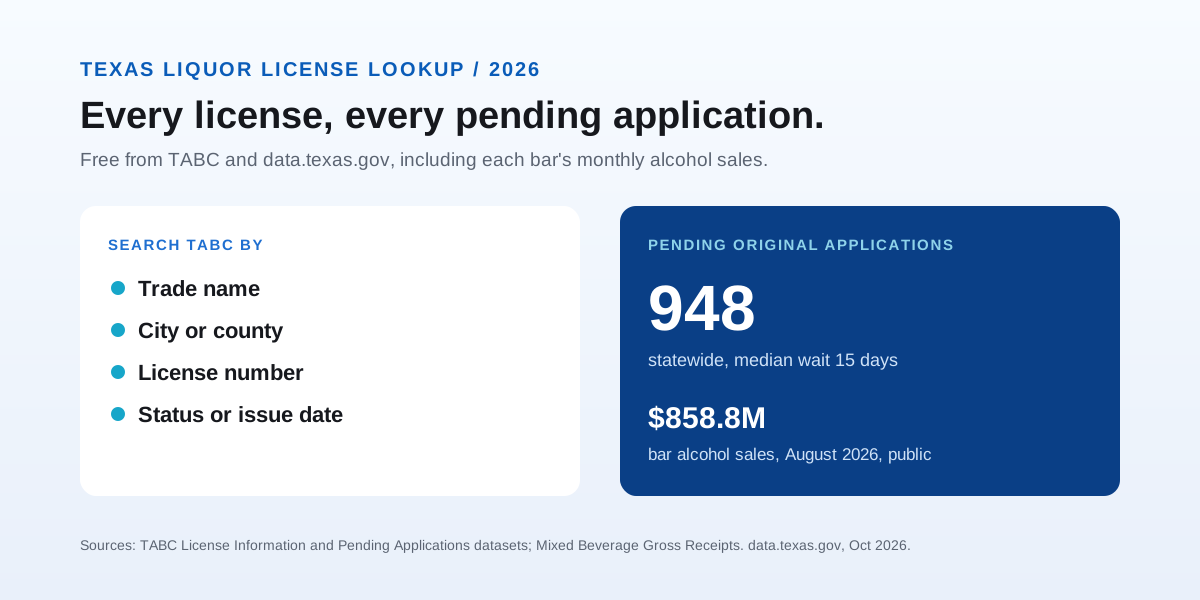
Texas publishes more liquor license data than any state I track.
Every license. Every pending application. Even how much alcohol each bar sold last month.
To run a Texas liquor license lookup, use TABC’s free Public Inquiry System or the license search in AIMS, and search by trade name, location or license number. Each record shows the permit type, status, owner and expiration. For anything bigger than one business, skip the search screens: TABC publishes every license, every pending application and every bar’s monthly sales free on data.texas.gov.
I run RestoSignals, which pulls those datasets every day to find Texas restaurants before they open. Here’s how to use all of it.
How do you look up a liquor license in Texas?
You look up a Texas liquor license through TABC, the Texas Alcoholic Beverage Commission. Its free Public Inquiry System checks the status of pending, active or inactive licenses and builds lists by location, type, status or issue date. The license search in AIMS, TABC’s licensing system, finds a single license by trade name or number without an account.
Here’s the short version:
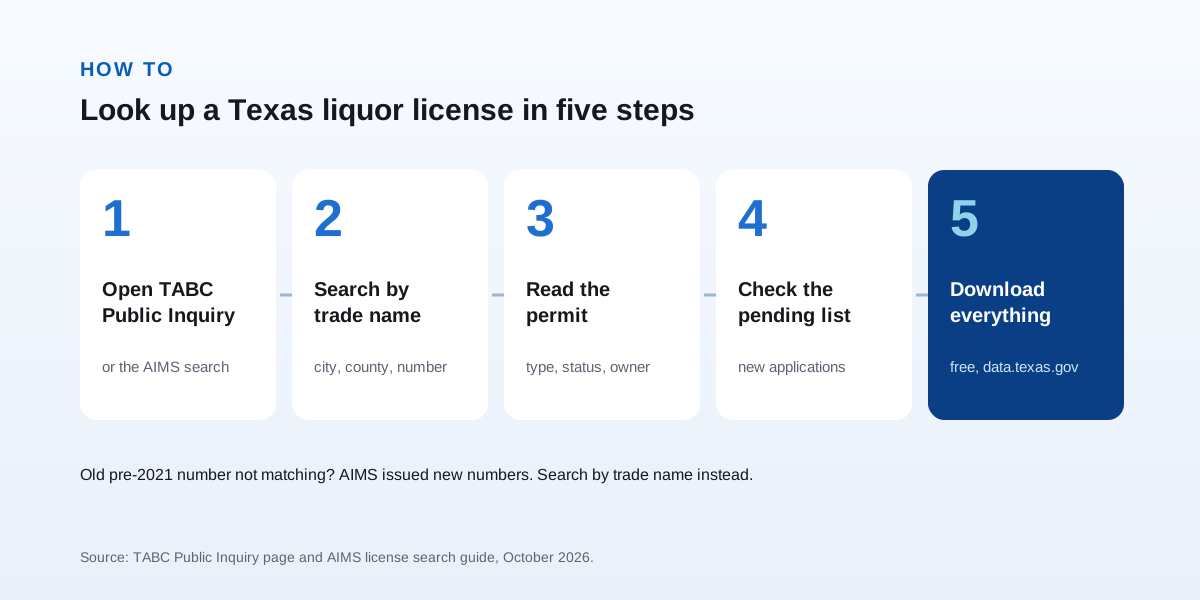
- Open TABC’s Public Inquiry System or the AIMS license search.
- Search by trade name, city, county or license number.
- Read the permit type, status, owner and expiration date.
- For businesses that haven’t opened, check the pending applications dataset.
- For the whole state, download the free License Information dataset.
One tip from TABC’s own AIMS guide: license numbers changed when AIMS launched in 2021. If a number doesn’t match, search by trade name instead.
The Public Inquiry System opens with an agreement page you accept before searching. That’s normal.
Is a “TABC license” a business permit or a server certificate?
“TABC license” means two different things in Texas. Businesses hold TABC permits, such as a mixed beverage permit, to sell alcohol. Bartenders and servers hold a TABC seller-server certification from an approved training course. A license lookup finds business permits. It won’t find a bartender’s certificate, which lives with the training provider and the person who earned it.
This trips up a lot of people.
On Quora, the questions mix both. “How do I get my TABC license online?” is usually a server asking about the course. “What are the TABC license requirements for businesses?” is an owner asking about permits.
This guide is about business permits. If you’re a server, you want a TABC-approved seller-server course, not the lookup.
What do TABC permit codes like MB, BG and BQ mean?
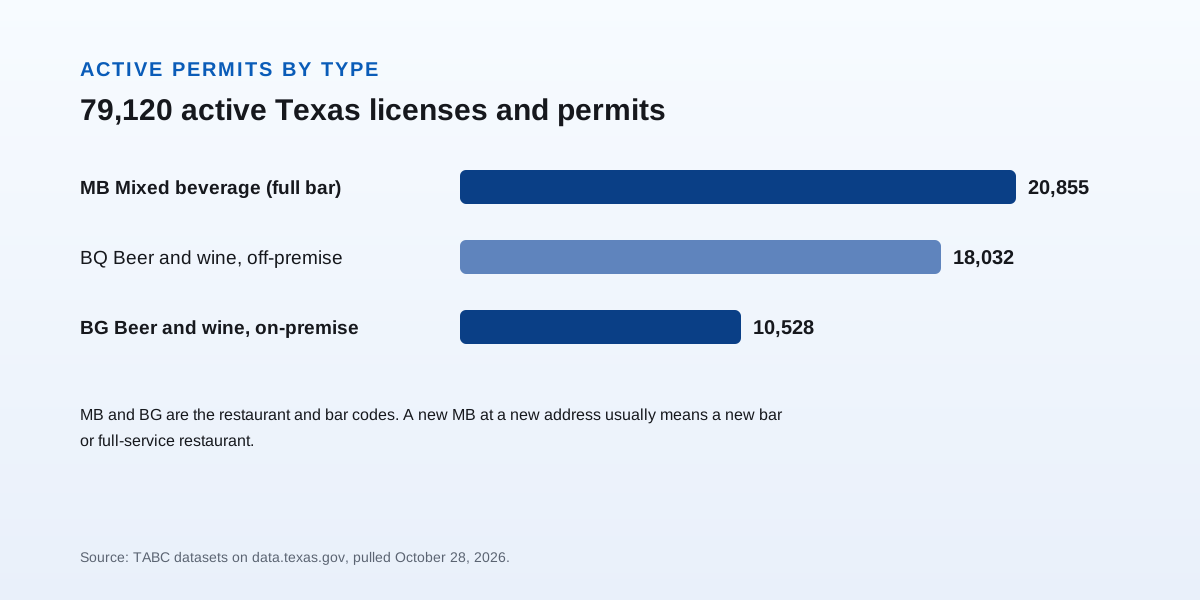
TABC permit codes tell you what a business can sell and where it can be drunk. MB is a mixed beverage permit, a full bar license for liquor, wine and beer on-premise. BG is the wine and malt beverage retailer’s permit, beer and wine only. BQ is the off-premise version for stores, and FB is a food and beverage certificate some MB holders need.
Here’s what’s active in Texas, from TABC’s License Information dataset on October 28, 2026:
| Code | What it is | Active in Texas |
|---|---|---|
| MB | Mixed beverage permit (full bar, on-premise) | 20,855 |
| BQ | Wine and malt beverage retailer’s off-premise permit | 18,032 |
| BG | Wine and malt beverage retailer’s permit (beer and wine) | 10,528 |
| FB | Food and beverage certificate (with some MB permits) | Pending: 184 |
In all, the dataset held 128,294 records, and 79,120 of them were active. Retail permits made up 71,520 of the active ones.
If you sell to restaurants and bars, MB and BG are the two codes to watch. A new MB at an address that never had one is usually a new bar or full-service restaurant.
How do you find pending TABC applications?
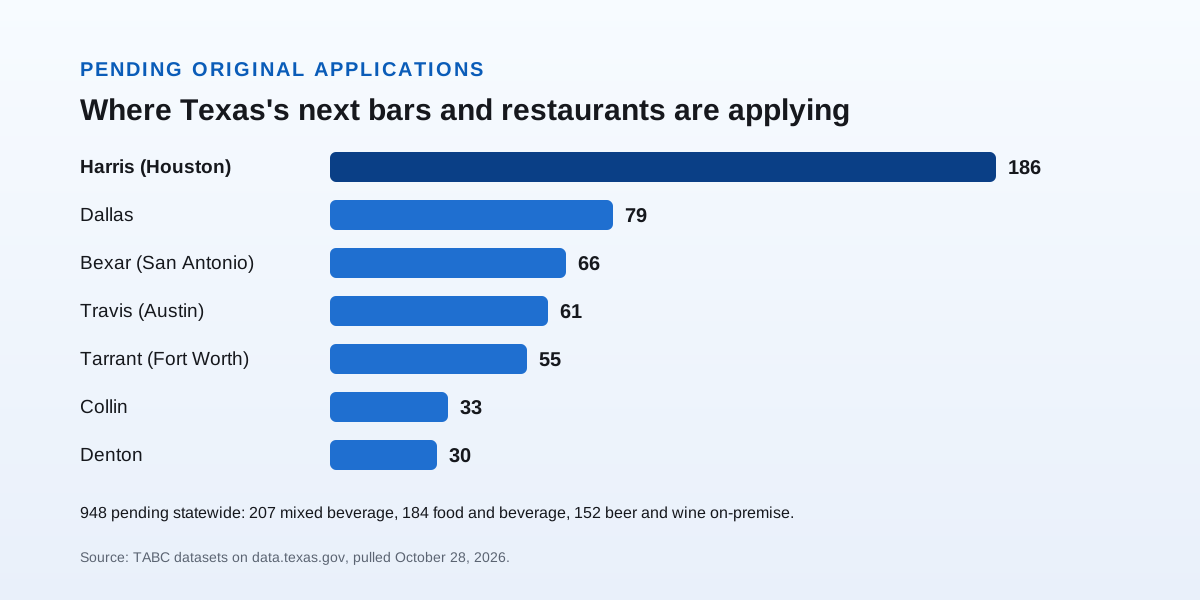
You find pending TABC applications in the free Pending Original New Primary and Subordinate License Applications dataset on data.texas.gov. It lists every original application TABC is reviewing, with the owner, address, permit type and submission date. On October 28, 2026, it held 948 pending applications, including 207 for mixed beverage permits and 152 for beer and wine permits.
That word “original” matters. This list covers new permits only, not renewals. In Texas a new owner needs an original permit too, so every row is either a new business or a new owner taking over one.
Here’s where they are:
| County | Pending original applications |
|---|---|
| Harris (Houston) | 186 |
| Dallas | 79 |
| Bexar (San Antonio) | 66 |
| Travis (Austin) | 61 |
| Tarrant (Fort Worth) | 55 |
| Collin | 33 |
| Denton | 30 |
Houston alone had 145 of them.
Locals watch this too. One Reddit thread I found opened with a new bar that “applied for their TABC license this week.”
How long does it take to get a liquor license in Texas?
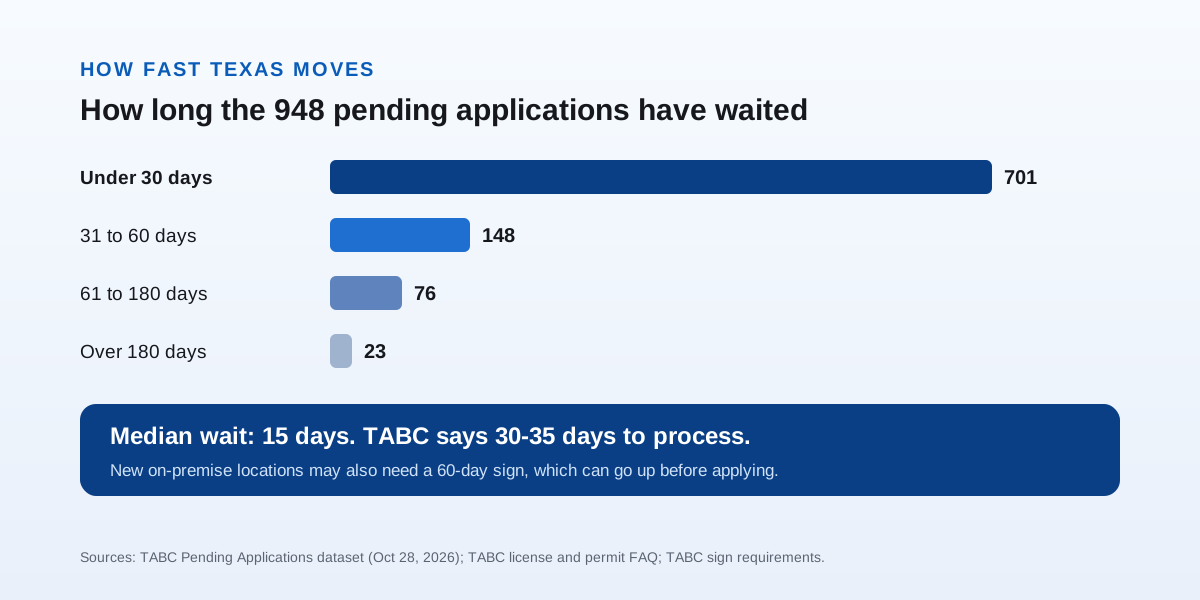
A Texas liquor license usually takes about one to three months. TABC says processing runs 30 to 35 days from a complete application. Many new on-premise locations must also post a 60-day sign before the permit issues, and some cities and counties sign off first. In TABC’s pending list on October 28, 2026, the median application had been waiting just 15 days.
The 30 to 35 days comes from TABC’s license and permit FAQ.
The 60-day sign is the part people forget. Under TABC’s sign rules, applicants for permits like MB and BG must post it outdoors if the location wasn’t licensed for on-premise drinking in the last two years. The clock can start before the application goes in.
Here’s what the pending list says about speed:
- 74% of pending applications (701 of 948) were submitted in the last 30 days.
- 90% (849) were submitted in the last 60 days.
- Only 23 were older than 180 days.
My read: most Texas applications clear within about two months, much faster than California, where most applications in our tracking were still pending after five weeks. Texas moves quickly once the paperwork is right.
Why can’t you find a license in the TABC lookup?
You usually can’t find a Texas liquor license because the search doesn’t match how TABC stored it. The permit may be under an LLC instead of the name on the sign, the number may be an old pre-2021 one, or the business may still be pending. Searching by trade name and city fixes most misses, and the pending dataset catches the rest.
Here’s the checklist I run when a search comes back empty:
- Search by trade name, not the owner. The owner is often a company with a different name.
- Try a shorter name. “Joe’s” finds more than “Joe’s Bar and Grill LLC.”
- Use digits only for an AIMS license number, per TABC’s guide.
- If you have an old number from before 2021, search by trade name instead. AIMS gave every license a new number.
- Check the pending dataset. A brand-new application won’t be an active permit yet.
If none of that works, contact TABC directly and ask them to confirm the record.
How do you download every Texas liquor license?
You can download every Texas liquor license free from TABC’s License Information dataset on data.texas.gov. It lists all 128,294 licenses and permits with the trade name, owner, premises address, mailing address, permit type, status, original issue date and expiration date. You can export it as a CSV or query it through the portal’s API, and it updates daily.
This is the file a Quora asker wanted when they asked, “How can I find the liquor license database list in Texas?” It’s right there, free, with no account.
The mailing address column is the one I’d point out.
Of the 31,383 active MB and BG permits, 31,370 carry a mailing address. That’s 99.96%. For a vendor, that’s an address on record for the owner, which may differ from the bar’s own address.
Texas permits also run two years now. TABC moved to two-year terms on September 1, 2021, so the expiration date on each record tells you when the next renewal is due.
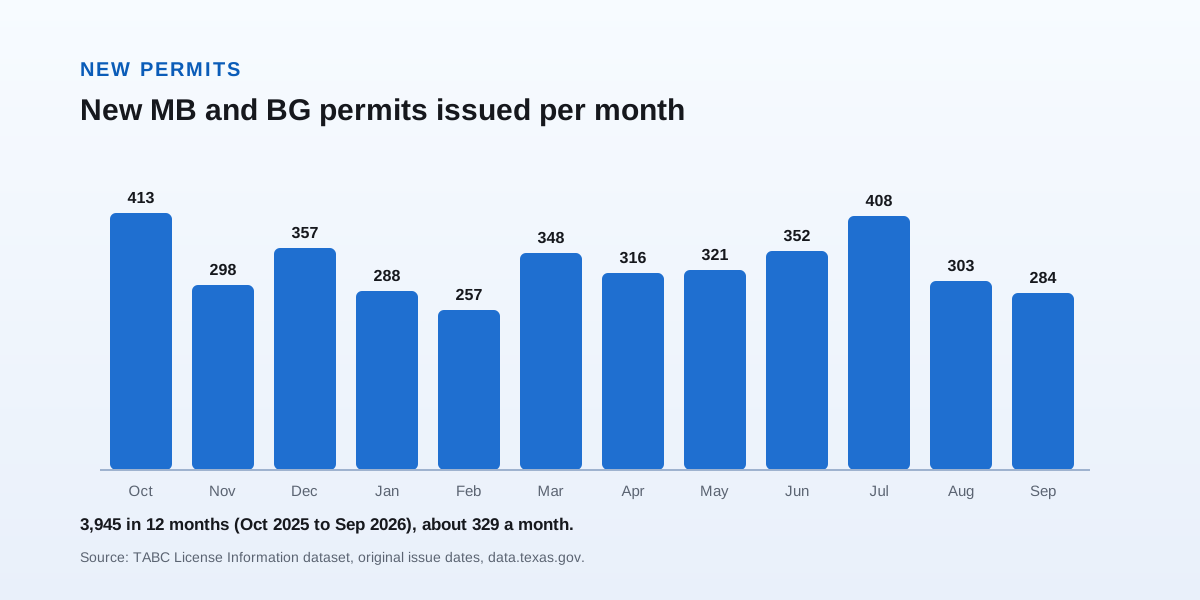
And the flow of new ones is steady. In the 12 months to September 2026, Texas issued 3,945 new MB and BG permits, about 329 a month.
Can you see how much alcohol a Texas bar sells?
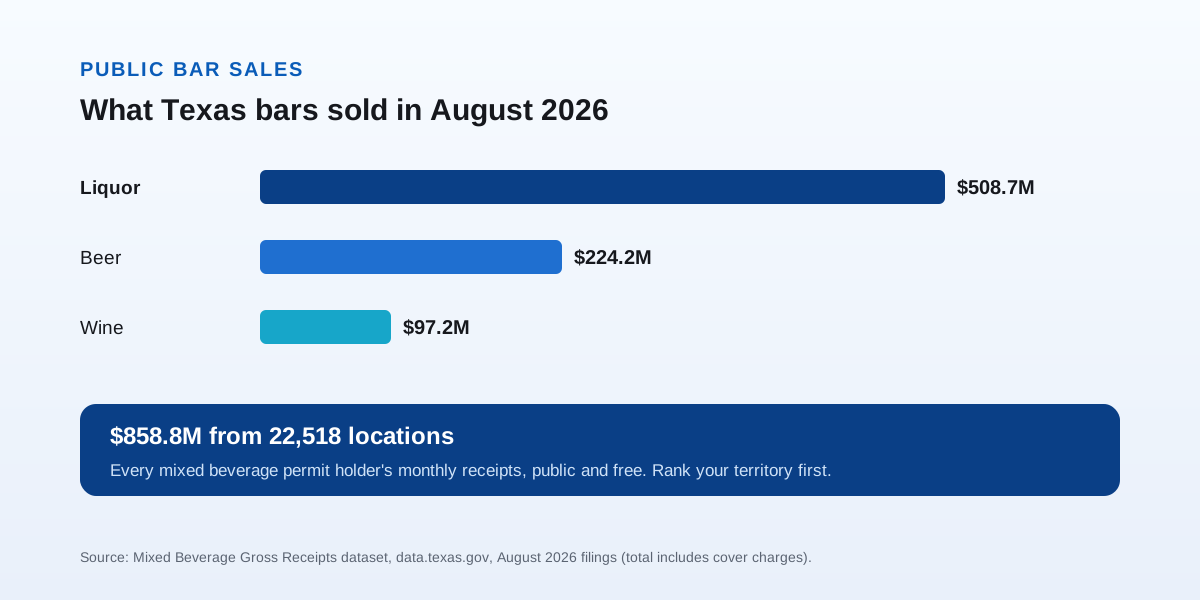
Yes. Texas publishes every mixed beverage permit holder’s monthly alcohol sales in the Mixed Beverage Gross Receipts dataset on data.texas.gov. Each row shows a location’s liquor, wine, beer and cover charge receipts for the month. In August 2026, 22,518 locations reported $858.8 million in total receipts, with liquor at $508.7 million, or 59%.
I found this one through r/BarOwners, where a Texas owner pointed someone to the Mixed Beverage Gross Receipts dataset when they asked which states publish bar sales.
I haven’t seen another state publish anything like it. Texas does because the receipts come from mixed beverage tax filings with the Comptroller.
The August 2026 split:
| Category | August 2026 receipts |
|---|---|
| Liquor | $508.7 million |
| Beer | $224.2 million |
| Wine | $97.2 million |
| Total (incl. cover charges) | $858.8 million |
For a beverage distributor, it’s the most useful public file I know of. You can rank every bar in your territory by liquor sales before you make a single call.
One caution: the latest month fills in slowly as late filers report. September 2026 showed 20,942 locations when I pulled it, against 22,518 for August, so use a month that’s at least six weeks old.
What other Texas records show a new restaurant?
The Texas Comptroller’s sales tax permits are the other big public record for new restaurants. Every business that sells taxable goods needs one, including restaurants that never serve alcohol. In the 12 months to September 2026, the Comptroller issued 22,079 sales tax permits to food and drink outlets, about 1,840 a month, in its Active Sales Tax Permit Holders dataset.
That’s more than five times the liquor permit flow, because plenty of restaurants open without a liquor permit.
The useful detail is the first sales date. In 10,782 of those permits, about half, the outlet’s first sales date came after the permit was issued. The permit showed up before the business started selling.
Put that next to a pending TABC application at the same address and you have two independent records pointing at one opening.
Why do vendors watch pending TABC applications?
Vendors watch pending TABC applications because they show a new bar or restaurant before it opens, with the owner’s name and address. A pending mixed beverage application is a business that will soon need liquor, POS, insurance and equipment. In a 2025 survey of 220 restaurant operators, 71% said they start choosing main vendors more than 90 days before opening.
That survey was reported by Restaurant Technology News in January 2026.
In Texas, the window is short. With a median wait of 15 days on the pending list, an application can turn into an active permit within weeks. Checking monthly isn’t enough.
You can do it by hand: export the pending dataset every morning, filter to your county, and look each owner up in the License Information file for a mailing address.
Or let software do it.
RestoSignals pulls TABC’s issued and pending data daily, adds Texas Comptroller sales tax permits, and matches them into one venue per address. On October 26, 2026, it held 9,722 Texas venues, about 80% with an owner mailing address and 44 scored as hot.
What it doesn’t have: Texas phone numbers. The state records don’t carry them.
Frequently asked questions
How do I look up a TABC license?
Use TABC’s free Public Inquiry System or the license search in AIMS, the agency’s licensing system. Search by trade name, location or license number. The record shows the permit type, status, owner and expiration date. For the full list, TABC publishes its License Information dataset free on data.texas.gov, with 128,294 records as of October 2026.
How can I find the liquor license database list in Texas?
TABC publishes it free on the Texas Open Data Portal at data.texas.gov. The License Information dataset lists every license and permit with the owner, trade name, address, mailing address, status and issue dates. A second dataset lists pending original applications. Both download as CSV or can be queried with an API, with no account needed.
How long does it take to get a liquor license in Texas?
TABC says processing takes about 30 to 35 days from a complete application. Many new on-premise locations must also post a 60-day sign before the permit issues, and some cities add their own approval first, so plan for two to three months. In TABC’s pending list in October 2026, the median application had been waiting 15 days.
How long is a TABC license good for?
A TABC business permit, such as a mixed beverage permit, is good for two years and must be renewed before it expires. TABC moved to two-year terms on September 1, 2021. The TABC certificate bartenders and servers carry is a different thing: a seller-server certification, which is also valid for two years.
What is the difference between an MB and a BG permit in Texas?
An MB, or mixed beverage permit, lets a business sell liquor, wine and beer for on-premise drinking, so it’s a full bar license. A BG, the wine and malt beverage retailer’s permit, covers beer and wine only. A BQ is the off-premise version for stores. In October 2026, Texas had 20,855 active MB permits and 10,528 active BG permits.
Can you see how much alcohol a Texas bar sells?
Yes. Texas publishes the Mixed Beverage Gross Receipts dataset on data.texas.gov, with monthly liquor, wine, beer and cover charge receipts for every mixed beverage permit holder. In August 2026, 22,518 locations reported $858.8 million in total receipts. Distributors use it to size accounts before they call.
Pull the pending list, not just one license
A single lookup tells you about a place that’s already open. TABC’s pending dataset tells you who opens next, and in Texas that can be weeks away. Export it for your county this week, match each owner to a mailing address in the License Information file, and reach out before the permit issues.
Or see Texas’s new venues on RestoSignals free, already matched and scored, and unlock owner contacts for $29 a month.
For other states, read the California liquor license lookup and the Illinois liquor license lookup guides.
Mukul Dutt is the founder of RestoSignals, which tracks restaurants and bars before they open by fusing public liquor, permit and business-filing records into one scored venue with owner contact. License and application counts are from TABC datasets on data.texas.gov, pulled October 28, 2026. Receipts are from the Mixed Beverage Gross Receipts dataset. This is general information, not legal advice.
FAQ
How do I look up a TABC license?
Use TABC's free Public Inquiry System or the license search in AIMS, the agency's licensing system. Search by trade name, location or license number. The record shows the permit type, status, owner and expiration date. For the full list, TABC publishes its License Information dataset free on data.texas.gov, with 128,294 records as of October 2026.
How can I find the liquor license database list in Texas?
TABC publishes it free on the Texas Open Data Portal at data.texas.gov. The License Information dataset lists every license and permit with the owner, trade name, address, mailing address, status and issue dates. A second dataset lists pending original applications. Both download as CSV or can be queried with an API, with no account needed.
How long does it take to get a liquor license in Texas?
TABC says processing takes about 30 to 35 days from a complete application. Many new on-premise locations must also post a 60-day sign before the permit issues, and some cities add their own approval first, so plan for two to three months. In TABC's pending list in October 2026, the median application had been waiting 15 days.
How long is a TABC license good for?
A TABC business permit, such as a mixed beverage permit, is good for two years and must be renewed before it expires. TABC moved to two-year terms on September 1, 2021. The TABC certificate bartenders and servers carry is a different thing: a seller-server certification, which is also valid for two years.
What is the difference between an MB and a BG permit in Texas?
An MB, or mixed beverage permit, lets a business sell liquor, wine and beer for on-premise drinking, so it's a full bar license. A BG, the wine and malt beverage retailer's permit, covers beer and wine only. A BQ is the off-premise version for stores. In October 2026, Texas had 20,855 active MB permits and 10,528 active BG permits.
Can you see how much alcohol a Texas bar sells?
Yes. Texas publishes the Mixed Beverage Gross Receipts dataset on data.texas.gov, with monthly liquor, wine, beer and cover charge receipts for every mixed beverage permit holder. In August 2026, 22,518 locations reported $858.8 million in total receipts. Distributors use it to size accounts before they call.
Find venues opening near you
100 free leads, no card. One platform for restaurants & bars about to open.