Commercial insurance leads: restaurants before they open
How to get commercial insurance leads with no incumbent policy: new restaurants found in liquor license and permit filings, months before they open their doors.
Every commercial insurance lead you buy already has an agent.
You’re asking them to switch. That’s the hard version of this job.
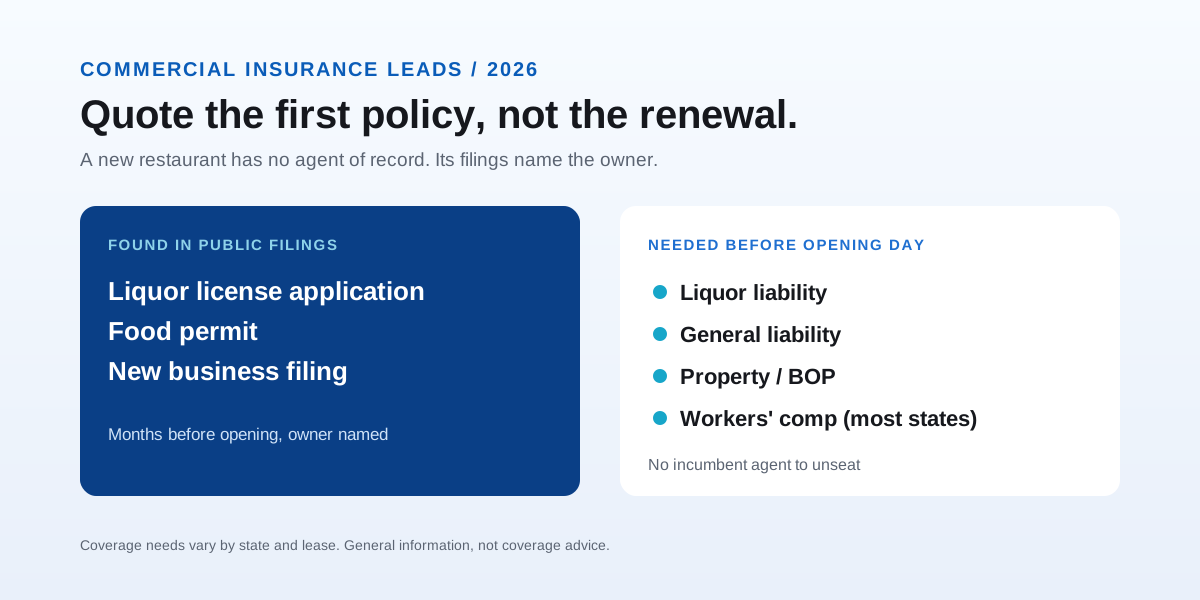
The easiest commercial insurance leads to win are businesses buying their first policy, because there’s no incumbent to unseat. New restaurants are the clearest case: they file a liquor license application, a food permit and a new business entity months before opening, and they need general liability, property, liquor liability and usually workers’ comp before the doors open. Those filings are public and name the owner.
I run RestoSignals, which tracks those filings every day. This is how an agent turns them into quotes.
How do you get commercial insurance leads nobody has quoted yet?
You get unquoted commercial insurance leads by finding businesses before they buy their first policy. Restaurants are ideal: the liquor license application, food permit and business filing all happen during the buildout, months before opening, and the owner needs coverage in place to get licensed, sign the lease and hire staff. Find the filing, and you’re often the first agent they talk to.
Most advice on this skips that step.
The top-ranking guides cover LinkedIn prospecting, Google Ads, referral partners and renewal timing. Expandi’s guide, for example, recommends starting about 120 days before a prospect’s policy expires.
That works for an existing business. A restaurant that hasn’t opened has no expiration date. It has no policy at all.
That’s the gap. None of the guides I read mention liquor licenses, permits or new restaurants.
Why are new restaurants good commercial insurance leads?
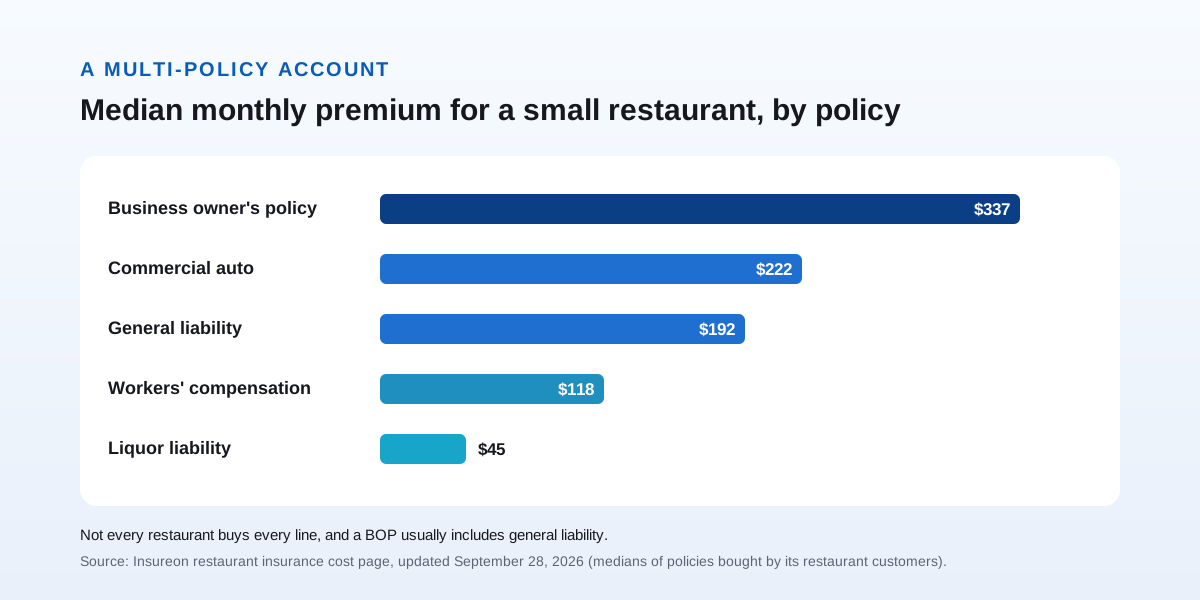
New restaurants are good commercial insurance leads because they buy several policies at once, from scratch, with no agent of record. A typical restaurant needs general liability, property or a business owner’s policy, workers’ compensation and liquor liability. Insureon’s restaurant customers paid a median of $337 a month for a BOP and $192 for general liability, per its September 2026 data.
The Insureon restaurant cost page bases its figures on policies its restaurant customers bought, most with fewer than five employees.
The medians by policy:
| Policy | Median per month | Median per year |
|---|---|---|
| Business owner’s policy (BOP) | $337 | $4,045 |
| General liability | $192 | $2,300 |
| Commercial auto | $222 | $2,669 |
| Workers’ compensation | $118 | $1,415 |
| Liquor liability | $45 | $546 |
Not every restaurant buys every line, and a BOP usually includes general liability. But even a small place is a multi-policy account.
There’s a longer payoff too. The agent who writes the first policy is the agent of record at renewal. Win a restaurant before it opens and you’re the incumbent everyone else has to unseat next year.
And there are a lot of them. Census counted 300,236 new business applications in accommodation and food services in 2025, from its Business Formation Statistics.
What insurance does a new restaurant need before it opens?
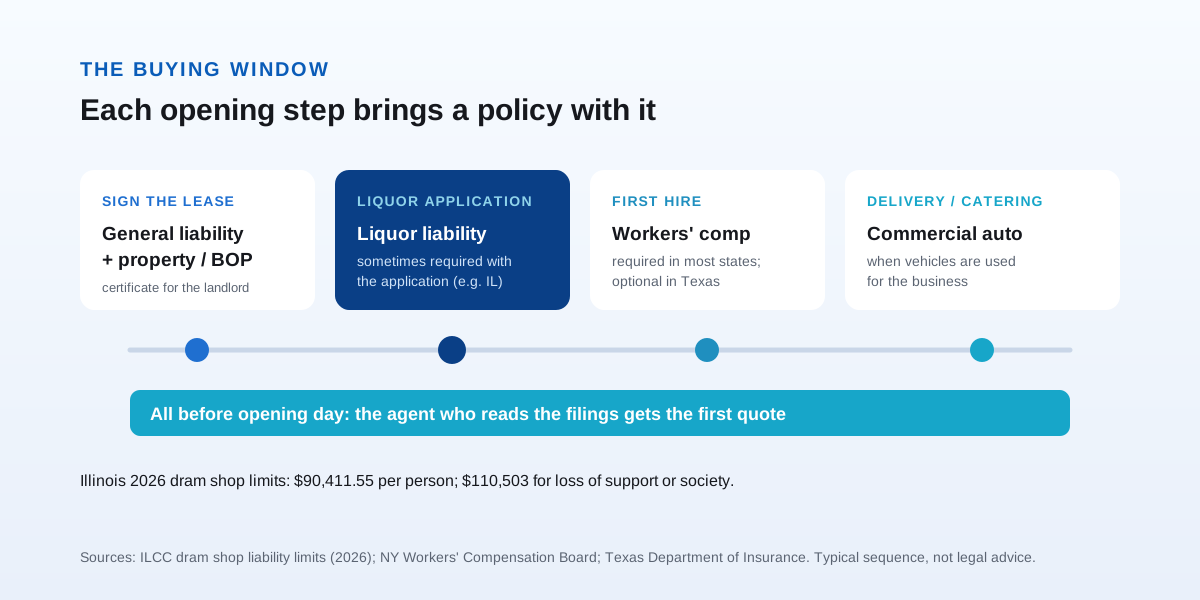
A new restaurant usually needs general liability and property coverage before it gets the keys, liquor liability before or alongside its liquor license, and workers’ compensation before its first hire in most states. Illinois, for example, sets dram shop liability limits by law each year, and New York requires workers’ comp for virtually all employers. Texas is the exception, where comp is optional.
The coverage maps onto the opening steps:
| Opening step | Coverage it usually triggers |
|---|---|
| Signing the lease | General liability and property, often as a BOP, with a certificate for the landlord |
| Applying for the liquor license | Liquor liability, sometimes required with the application |
| Hiring staff | Workers’ compensation, required in most states |
| Starting delivery or catering | Commercial auto |
Illinois shows how tight the liquor link can be. The ILCC publishes dram shop liability limits every year: for judgments on or after January 20, 2026, recovery is capped at $90,411.55 per person and $110,503 for loss of support or society. County liquor commissioners such as Ford County ask for the dram shop insurance certificate as part of the license application.
Certificates are the hidden deadline in all of this. The license file, the landlord and sometimes the general contractor each want proof of coverage on their own schedule, and owners rarely know that until someone asks. An agent who shows up with that list already sorted is solving a real problem, not selling a policy.
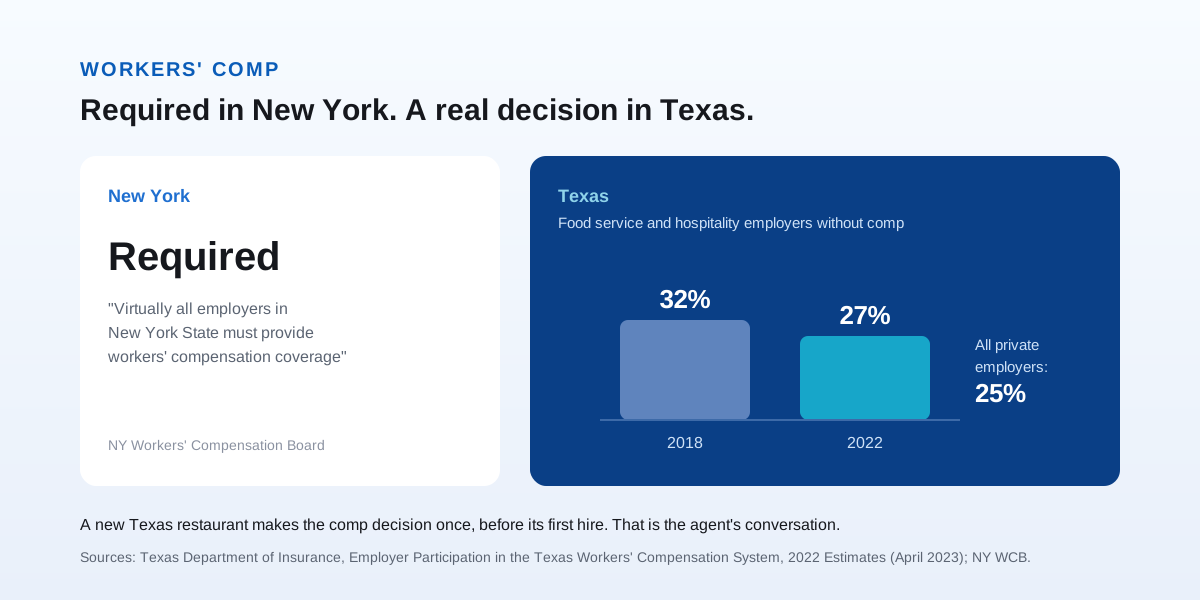
New York’s rule on comp is blunt. The Workers’ Compensation Board says “virtually all employers in New York State must provide workers’ compensation coverage” for their employees, on its coverage requirements page.
Do Texas restaurants need workers’ compensation?
Texas restaurants don’t have to carry workers’ compensation. Texas is the only state that generally lets private employers opt out, and those that do are called non-subscribers. The Texas Department of Insurance estimated that 27% of employers in arts, entertainment, accommodation and food services were non-subscribers in 2022, down from 32% in 2018.
Those numbers come from TDI’s Employer Participation in the Texas Workers’ Compensation System report, published in April 2023. Across all private employers, 25% were non-subscribers.
For an agent, that’s an opening, not a dead end.
A new Texas restaurant has to make the comp decision once, before its first hire. Non-subscribers give up some of the legal protections comp provides, and TDI requires them to post a notice of no coverage, tell new hires in writing, and file a notice with the state each year.
So the first conversation with a Texas owner can be a straight comparison: comp, a non-subscriber occupational benefit plan, or nothing. Most owners haven’t thought it through. You can help them do it before opening, not after a kitchen injury.
Where do you find restaurants before they open?
You find restaurants before they open in public filings: liquor license applications, food or health permits, new business entity filings and sales tax permits. For an insurance agent, the liquor application matters most, because it names the applicant and signals liquor liability coverage is coming. Most big states and cities publish at least one of these filings online for free.
Where to look in the states I track:
| State or city | Liquor applications | Other filings |
|---|---|---|
| New York | State Liquor Authority | NYC food permits on NYC Open Data, business filings on data.ny.gov |
| Texas | TABC public inquiry, pending included | Comptroller sales tax permits on data.texas.gov |
| California | ABC license lookup, pending included | LA and SF business registrations |
| Chicago | BACP pending applications | Chicago business licenses |
Two habits make this work. Drop renewals, since a renewing bar already has an agent. And match a second filing at the same address before you call, so you’re not chasing an LLC that never becomes a restaurant.
The filings also help you quote. Before the first call, I’d read four things off the record:
- The license class. A full on-premise liquor license and a beer and wine license carry very different liquor liability exposure.
- The address. It tells you the property, the neighborhood and whether the space is a new build or a second-generation restaurant.
- The entity. An LLC or corporation filing tells you who the named insured should be.
- The other filings. A food permit plus a sales tax permit usually means a kitchen and staff, so comp is coming.
I wrote a longer walkthrough of these sources in the merchant services leads guide. The filings are the same. Only the pitch changes.
How much do commercial insurance leads cost?
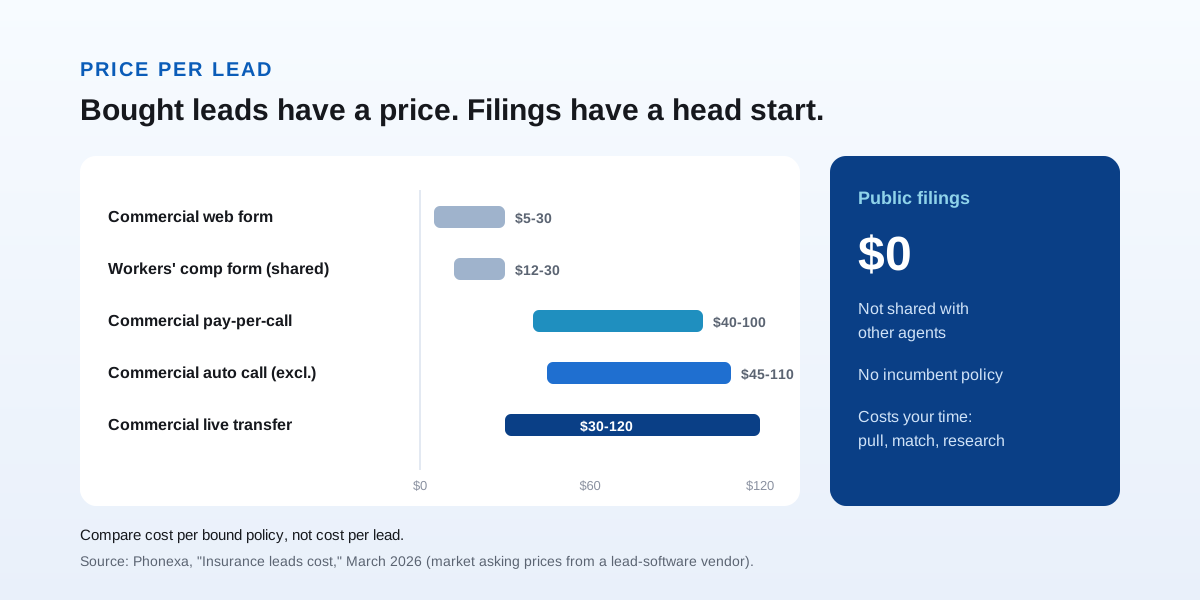
Commercial insurance leads cost from about $5 to $120 each, depending on the type. Phonexa’s 2026 benchmarks put seasonal commercial web forms at $5 to $30, shared workers’ comp web forms at $12 to $30, commercial pay-per-call at $40 to $100, exclusive commercial auto calls at $45 to $110 and live transfers at $30 to $120. Public filings are free but take time.
From Phonexa’s insurance lead cost report, published March 2026:
| Lead type | Condition | Price |
|---|---|---|
| Commercial web form | Seasonal | $5 to $30 |
| Workers’ comp web form | Shared | $12 to $30 |
| Commercial pay-per-call | $40 to $100 | |
| Commercial auto pay-per-call | Exclusive | $45 to $110 |
| Commercial live transfer | $30 to $120 |
Phonexa sells lead-management software, so read those as market asking prices.
Price per lead is the wrong number to compare, though. What matters is cost per bound policy: what you spent on leads divided by the policies you actually wrote.
Say a $10 shared lead closes once in 40 tries. That’s $400 per policy. Now say a free filing takes 15 minutes to research and closes once in 20. That’s about five hours of your time per policy. Your own numbers will differ, so track both for a quarter and the right mix becomes obvious.
The bigger difference isn’t price. A shared lead goes to several agents at once, and they race to call first. A liquor license applicant goes to nobody. The only agents who know about it are the ones reading the filings.
What do you say to a restaurant owner before they open?
Lead with the deadlines the owner already has: the liquor license, the lease and the first hire. Offer to have every certificate ready before each one, quoted as a single restaurant package, and mention the filing so the owner knows why you’re calling. Owners in buildout are buried in contractors, so keep it short and concrete.
A template you can adapt:
Hi [owner’s first name], I saw the new liquor license application for [address]. Congratulations. I insure new restaurants in [neighborhood], and I can have your liquor liability, general liability and workers’ comp quoted together, with the certificates ready for your license and your landlord before you need them. Can I send you a one-page quote?
For Texas owners, add one line about the comp decision. For Illinois, mention the dram shop certificate. Specific beats generic every time.
Then follow the paperwork, not the calendar. Call again when the food permit lands, and again before the likely opening. Buildouts slip, and the owner who ignored the first message often answers the second.
How many restaurant insurance leads are in your territory?
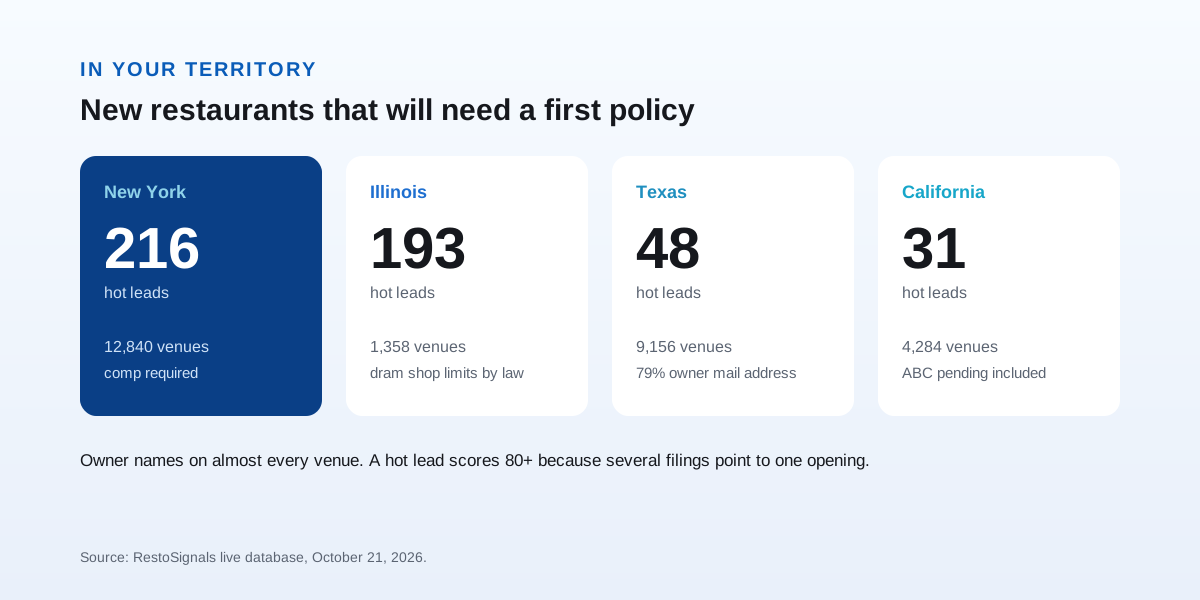
The count depends on the state, and it’s usually more than one agent can work. On October 21, 2026, RestoSignals held 12,840 New York venues with 216 hot leads, 1,358 Illinois venues with 193 hot, 9,156 Texas venues with 48 hot and 4,284 California venues with 31 hot. A hot lead scores 80 or more because several filings point to the same opening.
Illinois punches above its size: about 14% of its venues are hot, against under 2% in New York, because Chicago’s liquor and food licenses tend to land together.
Owner names are on almost every venue. About 79% of Texas venues carry an owner mailing address, and about 31% of New York venues have a phone number from city permits.
That Texas address is useful for an agent. A letter to the owner about the comp decision, sent before the first hire, is the kind of mail that gets opened.
Quote the first policy, not the renewal
Renewal season is a fight over someone else’s client. A new restaurant’s first policy is nobody’s yet. Pull last week’s liquor license applications for your territory, match a second filing, take the owner’s name from the record, and quote the license, lease and first-hire coverage before another agent binds it.
Do it yourself with the sources above, or see this week’s new venues free and unlock owner contacts for $29 a month.
If you’re comparing lead sources, I also covered what a restaurant email list really buys.
Mukul Dutt is the founder of RestoSignals, which tracks restaurants and bars before they open by fusing public liquor, permit and business-filing records into one scored venue with owner contact. This is general information about insurance requirements, not legal or coverage advice. Coverage counts are from the live RestoSignals database on October 21, 2026.
FAQ
How do I get commercial insurance leads?
The easiest commercial insurance leads to win are businesses buying their first policy, because there's no incumbent agent to unseat. For restaurants, that means new liquor license applications, food permits and business filings, which are public months before opening. Pull them for your territory, match filings at the same address, and reach the owner during the buildout.
How much do commercial insurance leads cost?
Purchased leads vary by type and exclusivity. Phonexa's 2026 benchmarks put seasonal commercial web forms at $5 to $30, shared workers' comp web forms at $12 to $30, commercial pay-per-call at $40 to $100 and live transfers at $30 to $120. Public filings cost nothing but the time to pull and match them.
What insurance does a new restaurant need?
Most restaurants need general liability, property coverage (often bundled in a business owner's policy), workers' compensation once they hire, and liquor liability if they serve alcohol. Insureon's restaurant customers paid a median of about $192 a month for general liability, $337 for a BOP, $118 for workers' comp and $45 for liquor liability.
When does a new restaurant buy insurance?
Before it opens, and often before the liquor license is approved. Illinois liquor licensing ties into dram shop liability coverage, many leases ask for proof of liability insurance, and states like New York require workers' compensation for virtually all employers once staff are hired. That puts the buying decision inside the buildout, months before opening day.
Do restaurants in Texas have to carry workers' compensation?
No. Texas is the only state that lets private employers generally choose whether to carry workers' compensation. The Texas Department of Insurance estimated that 27% of employers in arts, entertainment, accommodation and food services were non-subscribers in 2022, which makes the coverage decision a real conversation for an agent.
Are bought commercial insurance leads worth it?
They can be, if they're exclusive and the business is actually shopping. Shared leads go to several agents at once, so you're competing on price from the first call. A new restaurant found in a liquor license filing has no incumbent and no other agent working it yet, which is usually worth more than a cheaper shared lead.
Find venues opening near you
100 free leads, no card. One platform for restaurants & bars about to open.