Merchant services leads: find restaurants before they open
How to get merchant services leads nobody has pitched: new restaurants found in liquor license, food permit and business filings, before they pick a processor.
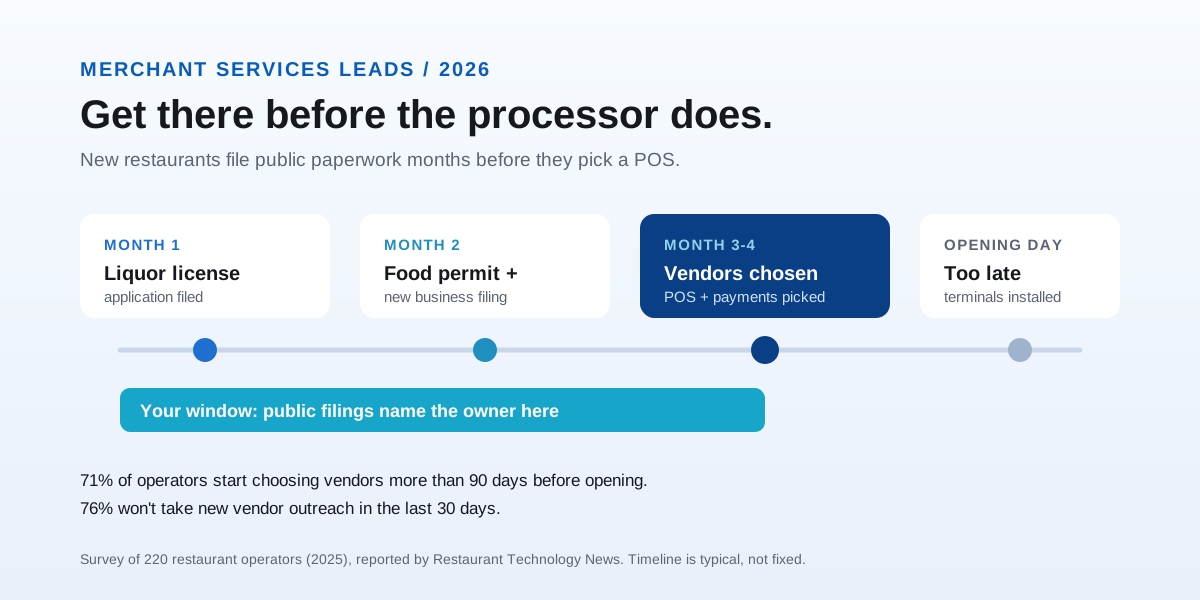
Most merchant services leads are somebody else’s customer.
You’re pitching a business that already has a processor, already has a POS, and already said no to three other agents this month.
The way to get merchant services leads nobody has pitched yet is to find businesses before they choose a processor. For restaurants, that’s easy to spot: they file a liquor license application, a food permit and a new business entity months before opening. Those filings are public, and they name the owner. Reach the owner during the buildout and you’re competing with nobody.
I run RestoSignals, which tracks those filings every day across seven states. This guide shows you where the filings are, how to turn them into leads, and what to say to an owner whose restaurant doesn’t exist yet.
How do you get merchant services leads that aren’t already taken?
You get untaken merchant services leads by targeting businesses that haven’t picked a processor, not businesses you hope will switch. New restaurants are the clearest case: they show up in liquor license, food permit and business filings months before opening. Switching an existing merchant is hard. In a January 2026 Baird survey of 37 restaurateurs, most liked their current POS provider and none talked about leaving.
That survey was covered by Payments Dive. Baird’s own line: “There wasn’t discussion of wanting to leave existing vendors.”
The usual playbook fights uphill.
Read the top-ranking guides on this topic and you’ll see the same tips. North’s 10 tips, for example, cover your network, social media, events, referrals, Google Ads and local SEO.
All fine. All aimed at merchants who already have a processor.
None of them tell you to watch liquor license applications. That’s the gap.
Why are restaurants the best merchant services leads?
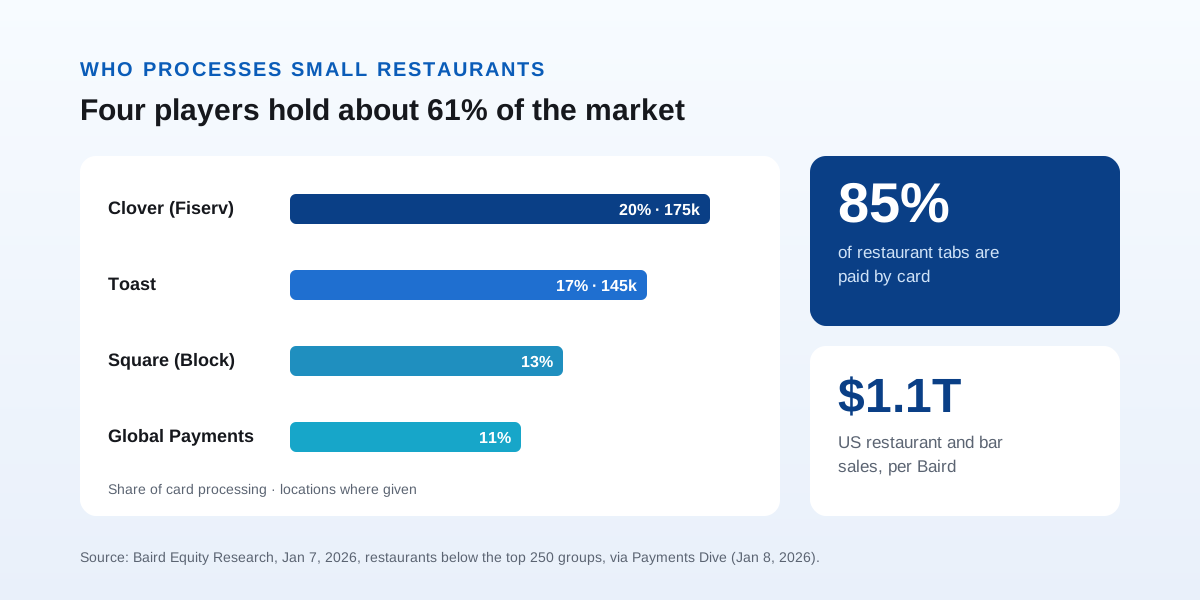
Almost every restaurant check is paid by card, and the market is huge, which makes restaurants some of the best merchant services leads there are. Baird estimated that about 85% of restaurant tabs are paid with cards, across roughly $1.1 trillion in US restaurant and bar sales. And new ones keep coming: Census counted 300,236 new business applications in accommodation and food services in 2025.
That Census number comes from the Business Formation Statistics monthly data, which I summed for 2025. It was up 7.4% from 279,607 in 2024.
Not every application becomes a restaurant. 71,065 of them planned to pay wages, which is a better proxy for real, staffed businesses.
The competition for these accounts is real, though. Among restaurants below the top 250 groups, Baird put the processing shares at:
| Provider | Share of small-restaurant card processing | Locations |
|---|---|---|
| Clover (Fiserv) | about 20% | 175,000 |
| Toast | about 17% | 145,000 |
| Square (Block) | about 13% | not given |
| Global Payments | about 11% | not given |
Baird also projects Toast to grow from 134,000 locations at the end of 2024 to 244,000 by the end of 2028.
My read: a lot of that growth has to come from new restaurants, because they have no processor to switch away from. That’s the same opening you’re after.
When does a new restaurant pick its POS and payment processor?
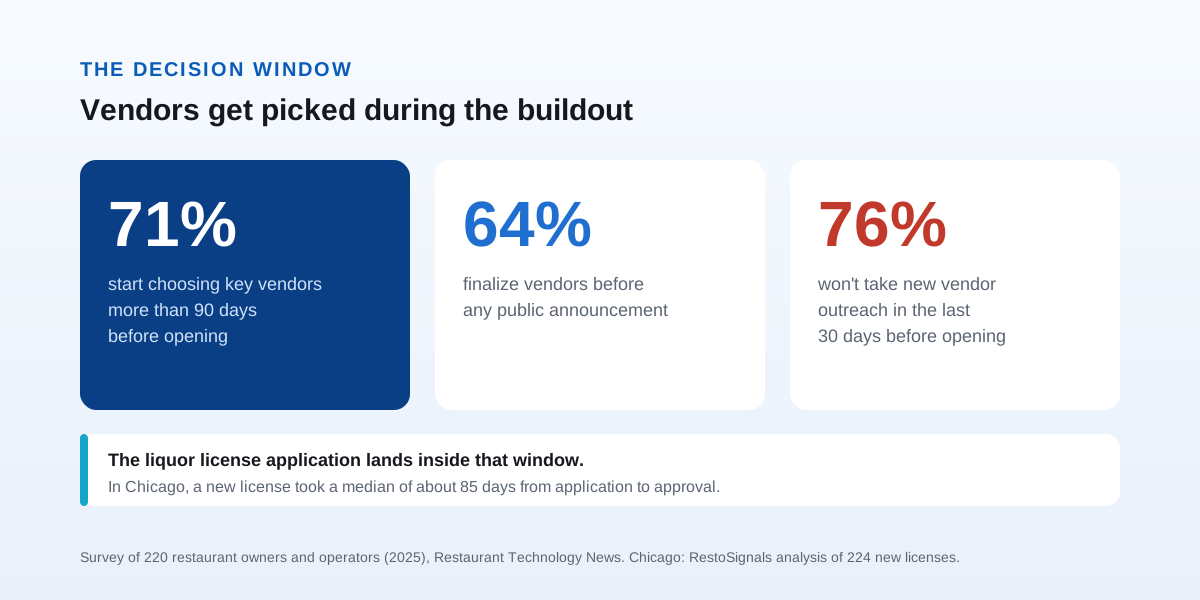
A new restaurant usually picks its POS and payment processor during the buildout, months before opening. In a 2025 survey of 220 restaurant owners and operators, 71% said they start choosing key vendors more than 90 days before opening, 64% finalize vendors before any public announcement, and 76% said they won’t take new vendor outreach within 30 days of opening.
The survey was reported by Restaurant Technology News.
Read those three numbers together and the window is obvious.
Show up the week before opening and the terminals are already mounted. Show up after a public announcement and two out of three owners have already decided.
The real window is roughly 3 to 6 months out.
That’s exactly when the paperwork happens. In Chicago, a new liquor license took a median of about 85 days from application to approval in my analysis of 224 new licenses. The application is your starting gun.
Where do you find restaurants before they open?
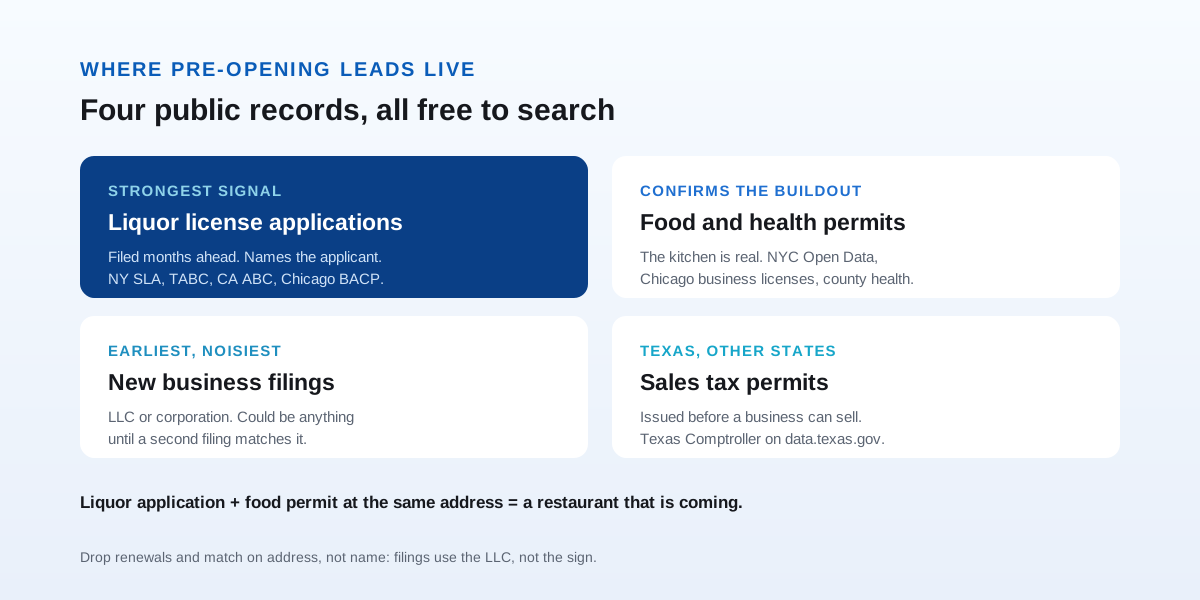
You find restaurants before they open in four kinds of public records: liquor license applications, food or health permits, new business entity filings and sales tax permits. Liquor applications are the strongest single signal for full-service restaurants and bars, because they’re filed months ahead and name the applicant. Most states and big cities publish at least one of these online for free.
Where the main ones live, in the states I track:
| State or city | Liquor applications | Food permits | Business filings |
|---|---|---|---|
| New York | State Liquor Authority | NYC permits on NYC Open Data | NY Department of State, on data.ny.gov |
| Texas | TABC public inquiry, pending included | Comptroller sales tax permits on data.texas.gov | Secretary of State (paid search) |
| California | ABC license lookup, pending included | County health departments | LA and SF business registrations |
| Chicago | BACP pending applications, last six weeks | Chicago Business Licenses | Same dataset |
A few things I learned pulling these every day:
- Renewals bury the new ones. In Chicago, only 224 of the 1,748 on-premise liquor license records issued in a year were brand-new. The other seven in eight already have a processor.
- One filing is a maybe. A business filing alone could be anything, but a liquor application plus a food permit at the same address is a restaurant that’s coming.
- The legal name isn’t the sign. Filings use the LLC, so match on address.
- Pending lists roll off. Chicago’s pending page only shows six weeks, and a missed week means missed leads.
- Liquor stores (package licenses), caterers and event venues need card processing too, and they file the same way. Don’t skip them.
How do you turn a liquor license filing into a merchant services lead?
To turn a liquor license filing into a merchant services lead, keep only new applications, match a food permit or business filing at the same address, take the owner’s name and address from the record, and contact them during the buildout with an opening-day offer. In my experience it’s about an hour a week for one metro once you know where the files are.
The steps:
- Pick one metro and one source, ideally liquor applications in the county you already cover.
- Filter to new applications only.
- Look for a food permit or a new LLC at the same address.
- Take the applicant or licensee name from the filing.
- Reach out more than 90 days before the likely opening if you can.
The owner step is where people slip. Don’t scrape directories for a phone number. The filing gives you the legal owner and often a mailing address, which is enough for a letter or a LinkedIn search by name. I compared that with buying a list in what a restaurant email list really buys.
A real example, straight from Chicago’s public data.
Bottleneck Reserve LLC applied for a restaurant liquor license at 500 W Madison St on August 25, 2026. It traded as The Reserve. The city issued the liquor license and its food license on October 16, 52 days later.
A rep watching Chicago’s pending applications page would have seen it in late August, with seven weeks to make contact before the license landed and longer before the doors opened.
A rep waiting for a grand-opening post would have seen it after the processor was installed.
Should you buy merchant services leads or build them from filings?
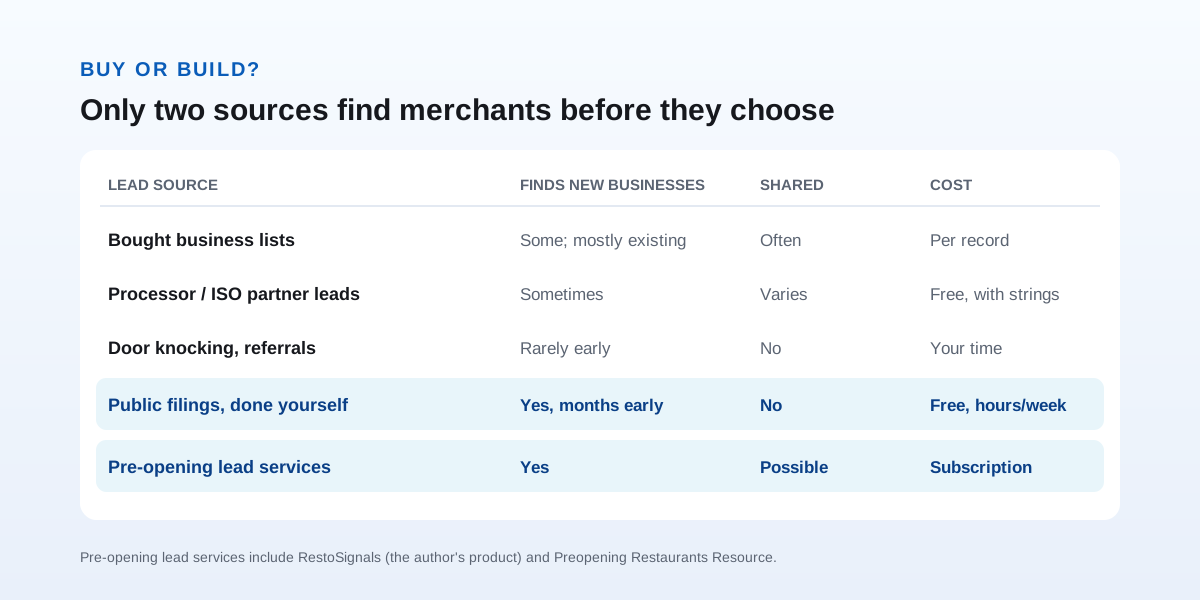
Buy merchant services leads only when you know they’re new businesses and not shared with other agents. Most paid lists are established merchants with a processor already. Building leads from public filings costs nothing but time and finds businesses nobody has pitched. The trade-off is effort: several sources, weekly pulls and matching filings by hand.
How the common sources stack up:
| Lead source | Finds new businesses? | Shared with other reps? | Owner contact | Cost |
|---|---|---|---|---|
| Bought business lists (e.g. Salesgenie) | Some; mostly existing merchants | Often | Yes | Paid, per record |
| Processor and ISO partner leads | Sometimes | Varies | Yes | Free to agents, with strings |
| Door knocking and referrals | Rarely early | No | In person | Your time |
| Public filings, done yourself | Yes, months early | No | Owner name and address | Free, hours per week |
| Pre-opening lead services (RestoSignals, Preopening Restaurants Resource) | Yes | Possible | Varies by state | Paid subscription |
That last row includes my product, so weigh it accordingly.
The hidden cost in bought leads is sharing. If the same name goes to several agents, you’re not buying a lead, you’re buying a race, and the merchant hears the same pitch from everyone who bought it.
Filings have the opposite problem. Nobody hands them to you, so almost nobody works them.
What do you say to a restaurant owner who hasn’t opened yet?
Pitch opening day, not savings, when you’re calling a restaurant that hasn’t opened. An owner in buildout has no statement to compare, so “I’ll save you money on processing” means nothing. Offer to have POS, payments, online ordering and staff training ready before the soft opening, and mention the filing so they know why you’re calling. Keep it short, and offer one concrete thing.
A template you can adapt:
Hi [owner’s first name], I saw the new liquor license application for [address]. Congrats. I set up POS and card processing for new restaurants in [neighborhood], and I’d like to have yours tested and staff-trained a week before you open. Worth a 15-minute call this week?
It works because the address proves you’re not mass-mailing, and because opening day is a deadline the owner is already worried about. The ask is small on purpose.
Then follow up, and tie each touch to the paperwork, not the calendar:
- When the liquor application is filed, introduce yourself and the opening-day offer.
- When the food or health permit lands, check in. The buildout is real and the owner is picking vendors now.
- About 60 days before the likely opening, make the last useful touch. After that you’re up against the 76% who won’t take outreach in the final 30 days.
Buildouts slip, so the owner who ignores you at the first touch often answers at the second.
How many pre-opening restaurant leads are there in your territory?
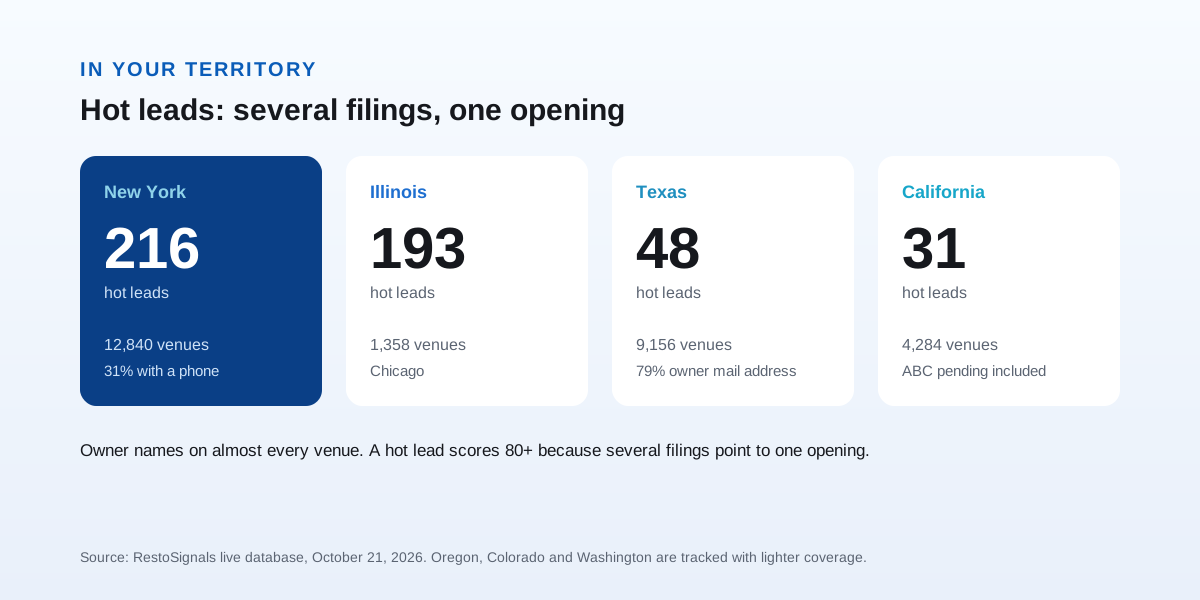
The number depends on the state, but it’s usually more than one rep can work. On October 21, 2026, RestoSignals held 12,840 New York venues with 216 hot leads, Illinois 1,358 with 193 hot, Texas 9,156 with 48 hot and California 4,284 with 31 hot. A hot lead scores 80 or more because several filings point to the same opening.
Owner names are on almost every venue. Phone numbers exist for about 31% of New York venues, from NYC permit data, and owner mailing addresses for about 79% of Texas venues.
The top of the New York list this week looked like this. Each scored 100, with a liquor filing, a food permit and a business filing, and the latest one dated October 20:
- Diner 24 Broadway NYC LLC, New York
- Straker’s NYC Inc., New York
- Osteria Brooklyn on Jackson Corp., Long Island City
- LAB 148 LLC, Brooklyn
Get there before the processor does
The best merchant services leads aren’t on anyone’s list yet. They’re in last week’s liquor license applications and food permits. Pull them for one metro, drop the renewals, match the filings, and call the owner while the space is still drywall. That’s how you win accounts without a switching fight.
Do it yourself with the sources in the table above, or see this week’s new venues in your territory free. The full feed is $29 a month.
If you sell more than payments, read how to sell to new restaurants before they open and the pre-opening restaurant leads sources compared.
Mukul Dutt is the founder of RestoSignals, which tracks restaurants and bars before they open by fusing public liquor, permit and business-filing records into one scored venue with owner contact. Coverage figures are from the live RestoSignals database on October 21, 2026.
FAQ
How do I get merchant services leads?
The best merchant services leads are businesses that haven't chosen a processor yet. For restaurants, that means new liquor license applications, food or health permits, and new business filings, which are public months before opening. Pull them for your metro, drop renewals, match filings at the same address, and reach the owner during the buildout, before a competitor or a POS company signs them.
Are purchased merchant services leads worth it?
Sometimes, but check two things first: whether the lead is shared and whether the business is new. Many paid lists are established merchants that already have a processor and get pitched constantly. A list of businesses that filed for a license in the last 60 days, with the owner's name from the filing, is usually worth more than a large list of existing merchants.
How do I find new businesses that need credit card processing?
Search the public records new businesses have to file: business entity filings with the secretary of state, sales tax permits, local business licenses and, for restaurants and bars, liquor license applications and food permits. Census data shows 300,236 new business applications in accommodation and food services alone in 2025, so the supply of new merchants is large.
When do new restaurants choose a payment processor?
Usually well before opening. In a 2025 survey of 220 restaurant operators, 71% said they start choosing key vendors more than 90 days before opening, and 64% finalize vendors before any public announcement. By opening week, the POS and processor are almost always set, and 76% said they won't take new vendor outreach within 30 days of opening.
Can I find restaurants before they open for free?
Yes. Liquor license applications, food permits and business filings are free public records. New York, Texas, California and Chicago all publish them online. The work is in pulling several sources, removing renewals, matching filings that belong to the same venue and keeping the list current every week.
What is the best type of merchant for an ISO agent to target?
Restaurants and bars are among the best, because almost every bill is paid by card. Baird estimated in January 2026 that about 85% of restaurant tabs are paid with cards, across a US restaurant and bar market of about $1.1 trillion in sales. New restaurants are better still, because they have no processor to switch away from.
Find venues opening near you
100 free leads, no card. One platform for restaurants & bars about to open.