Apollo vs ZoomInfo for restaurant sales (2026)
Apollo vs ZoomInfo for teams that sell to restaurants: price, where each gets its data, chain vs independent coverage, and what both miss before opening.
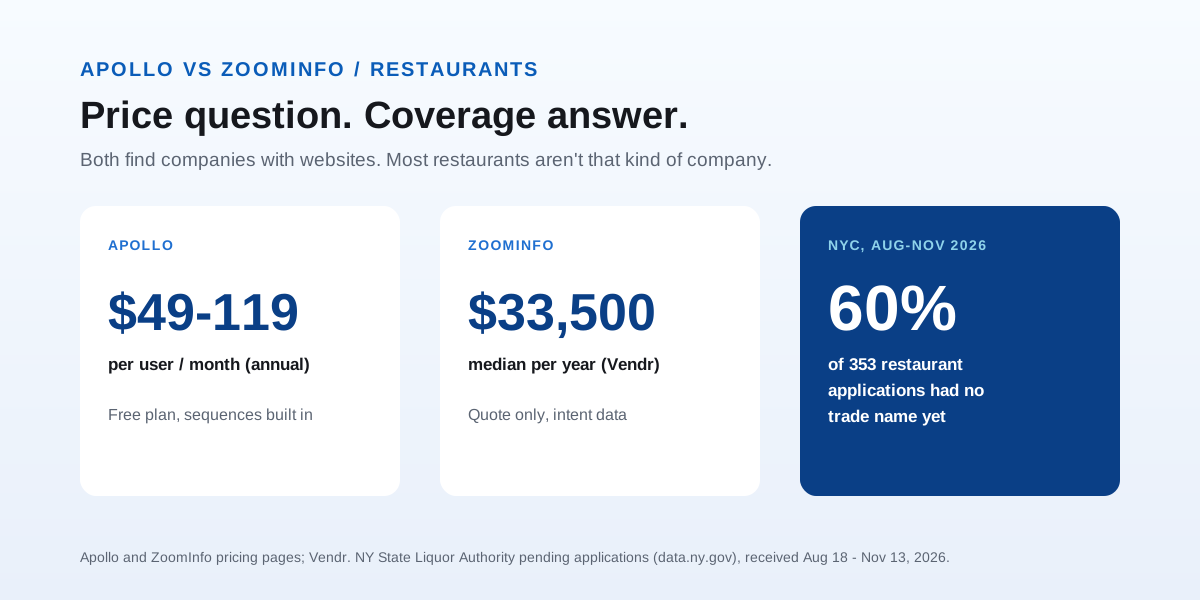
Apollo vs ZoomInfo is usually a price question. For restaurant sales, it’s a coverage question.
Both are built to find people at companies with websites, press releases and LinkedIn pages. Most restaurants aren’t that kind of company.
Here’s the short answer. ZoomInfo is the better tool for restaurant chains, franchise groups and head offices, if you can pay a median $33,500 a year. Apollo is the better value for teams selling to many industries, from $49 per user a month. For independent restaurants, and especially new ones, both are thin, because the restaurant often doesn’t exist yet in the sources they read.
I run RestoSignals, which finds restaurants before they open, so I’m not neutral. Prices and data claims below are each company’s own, plus Vendr’s contract data.
Apollo vs ZoomInfo: what’s the difference?
The difference between Apollo and ZoomInfo is depth versus price. ZoomInfo is an enterprise database with intent data, company hierarchies and location data for large brands, sold through sales reps on annual contracts. Apollo is a self-serve database with email sequences, a dialer and CRM sync built in, with a free plan and per-user pricing anyone can buy online.
That shows in how teams use them. ZoomInfo users export data into Salesforce or another sales tool. Apollo users often run their whole outbound process inside Apollo.
“apollo vs zoominfo” gets about 260 searches a month in the US, and “zoominfo vs apollo” another 170, according to DataForSEO. Clicks on those searches cost advertisers $31 to $48, so the people asking are about to buy.
How much do Apollo and ZoomInfo cost?
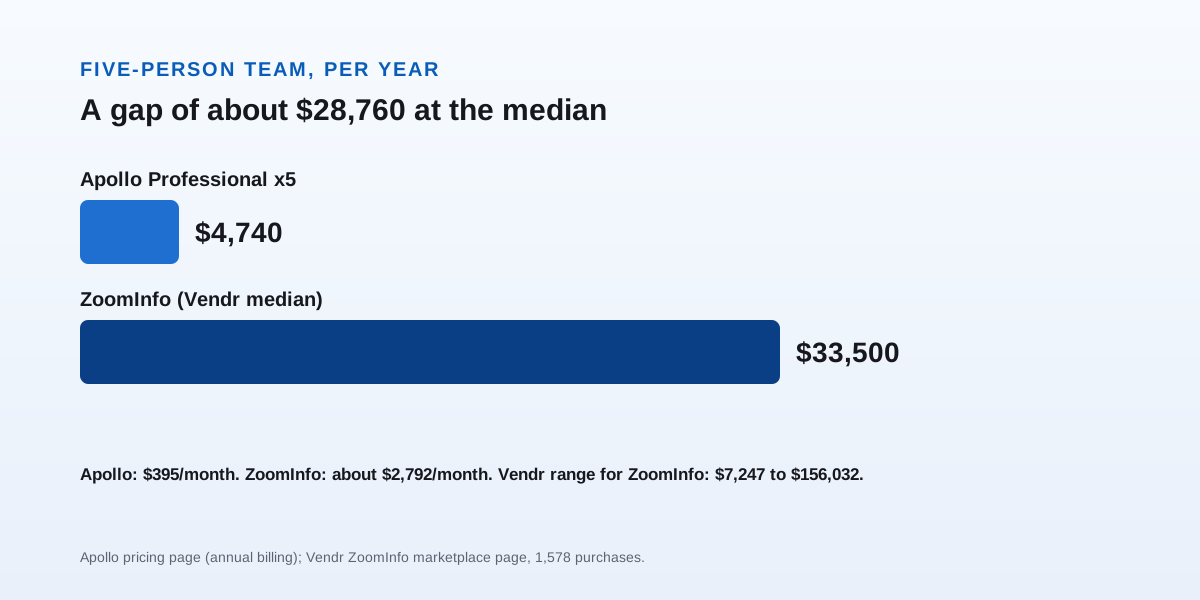
Apollo has a free plan, then Basic at $49, Professional at $79 and Organization at $119 per user a month, billed annually. ZoomInfo doesn’t publish prices. Its pricing page says cost depends on features, number of licenses and credit usage. Vendr reports a median ZoomInfo contract of $33,500 a year across 1,578 purchases.
Vendr’s range for ZoomInfo runs from about $7,247 to $156,032 a year, per its ZoomInfo pricing page.
On ZoomInfo’s pricing page, “Each export costs one credit, and credits can be added to any package as needs change.”
Apollo’s prices are on its pricing page. Credits are pooled across the team, granted each billing cycle, and don’t roll over.
For a five-person team:
| Apollo Professional | ZoomInfo | |
|---|---|---|
| Pricing model | Per user, published | Quote, annual contract |
| Five users, per year | $4,740 | Median $33,500 (Vendr) |
| Five users, per month | $395 | About $2,792 |
| Free option | Free plan | Free trial |
| Credits | Pooled, expire each cycle | One per export |
That’s a gap of about $28,760 a year at the median.
Where do Apollo and ZoomInfo get their data?
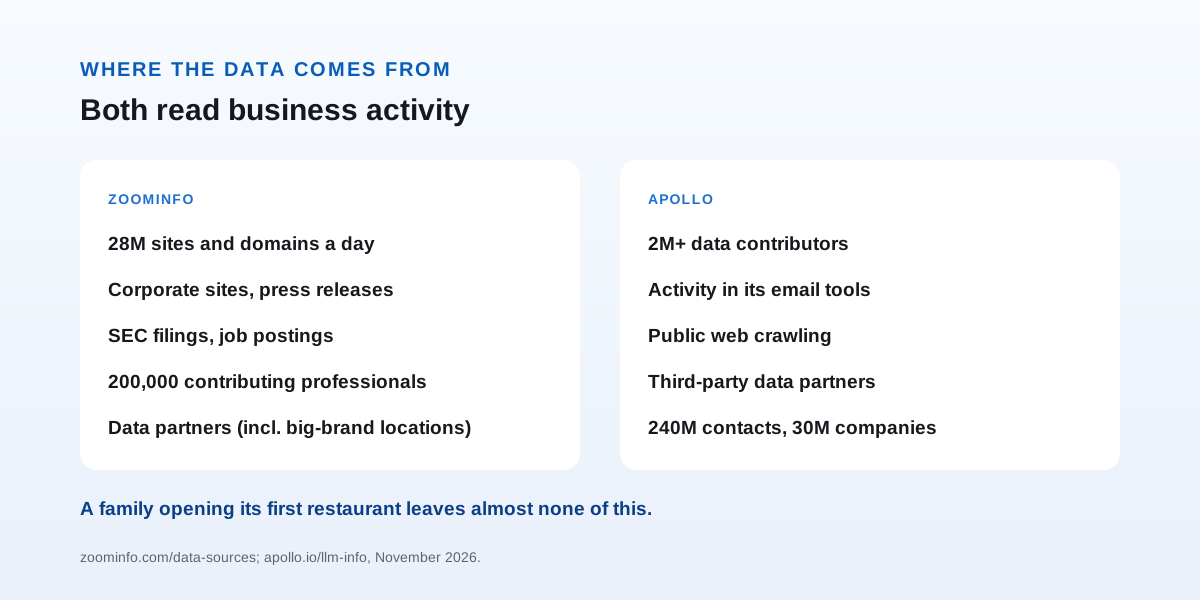
ZoomInfo reads public information on more than 28 million sites and domains every day, including corporate websites, press releases, SEC filings and job postings, plus data partners and 200,000 professionals who share contacts for free access. Apollo builds records from more than 2 million data contributors, activity in its email tools, web crawling and third-party providers.
Both descriptions come from the companies: ZoomInfo’s data sources page and Apollo’s information page for AI assistants.
Apollo says it has “more than 240 million contacts and 30 million companies” and reports “a 98% email accuracy rate.”
Notice what both lists have in common. They’re built from business activity: websites, filings with the SEC, job posts, emails sent from sales tools.
A company with a marketing team leaves lots of that.
A family opening its first restaurant leaves almost none.
Which is better for restaurant chains?
ZoomInfo is better for restaurant chains. Its data partners update the restaurant, branch and retail locations of the largest US brands, and its company hierarchies connect a franchise location to its parent. If you sell to chain head offices, franchise groups or hospitality companies with real corporate teams, that depth is hard to match with Apollo.
ZoomInfo says it standardizes address and location information for 95 million businesses. For a chain with 300 locations, that means one parent account with every unit under it.
Apollo finds the people at those head offices too. It’s cheaper and often good enough for a director of operations or a purchasing manager.
Here’s my rule of thumb:
- If one deal is worth more than $20,000 and the buyer sits at a head office, ZoomInfo pays for itself.
- If you need the contacts but not the intent data or hierarchies, Apollo does the job for a fraction.
- If you sell to single locations, neither is your main source.
Which is better for independent restaurants?
Neither is strong for independent restaurants. Both build data from business sources that independent owners rarely create: corporate websites, press releases, sales-tool activity and professional profiles. Apollo is the cheaper way to find out, with a free plan. But for owner contacts at single-location restaurants, expect generic emails and main lines from both.
Sales teams say the same thing.
On r/techsales, someone asked for “something like Zoominfo but contains data of local small businesses instead.” On r/b2b_sales, a post was titled “Why I stopped using Apollo for local business outreach.”
The independent restaurant market is large. The Bureau of Labor Statistics counted 619,919 full-service and limited-service restaurant establishments in 2024.
Most of them don’t have a head office. The owner is the buyer, and the owner is often the one person neither database knows.
Do Apollo or ZoomInfo find restaurants before they open?
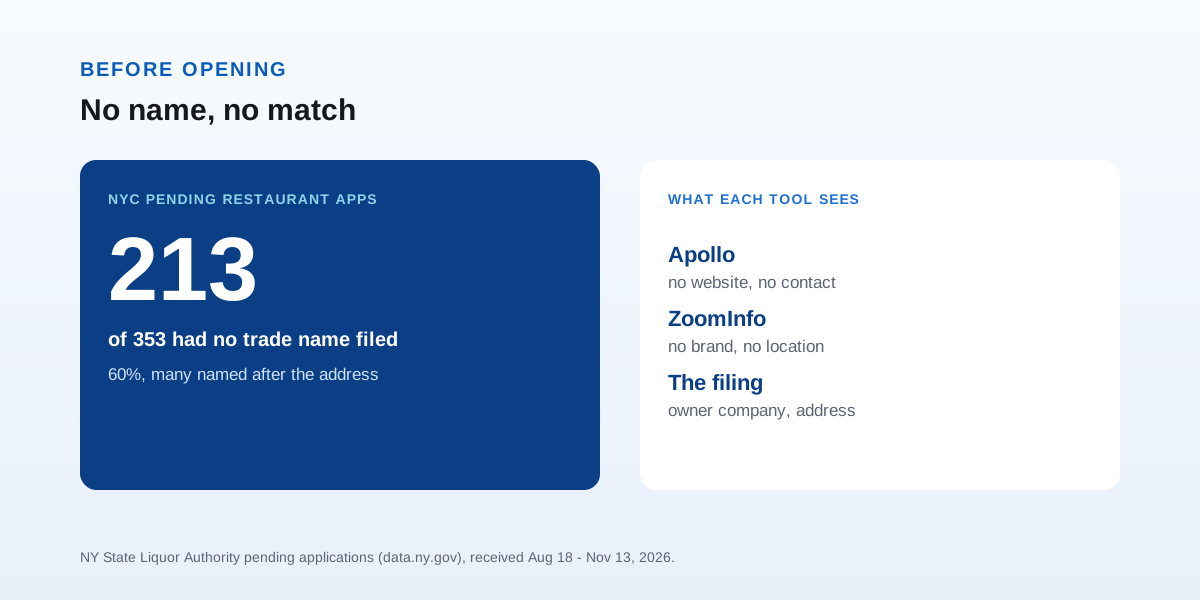
No. Both find restaurants after they exist online, and a restaurant usually doesn’t until close to opening. I checked New York’s pending restaurant liquor license applications filed between August 18 and November 13, 2026. Of 353 in New York City, 213, or 60%, had no trade name filed yet. Without a name, there’s nothing for either database to match.
The applicant companies were often named after the street address. In an earlier pull of the same applications, 62% of the applicants I could match to New York’s corporation records were formed within the past year.
That matters for timing.
In a 2025 survey of 220 restaurant operators by Preopening Restaurants Resource, reported by Restaurant Technology News, 71% said they start choosing main vendors more than 90 days before opening. That company sells pre-opening leads, so read it as a vendor’s survey.
If you sell POS, insurance, equipment or a beverage program, the restaurant picks you before Apollo or ZoomInfo can see it.
How do Apollo and ZoomInfo compare side by side?
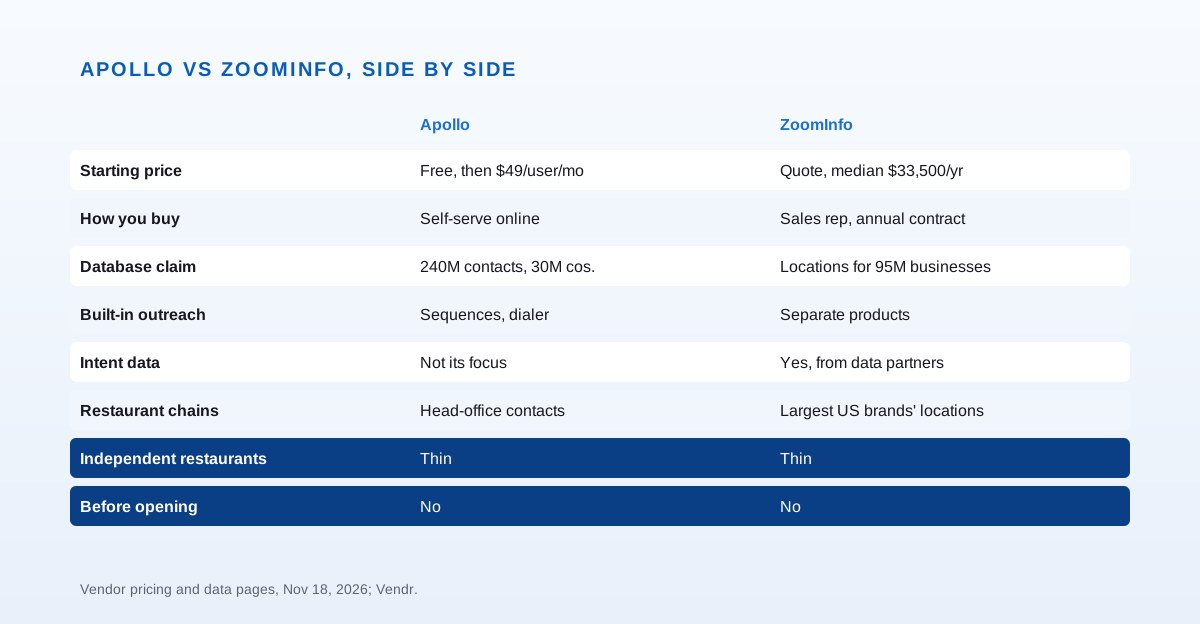
Side by side, Apollo wins on price, setup and built-in outreach, and ZoomInfo wins on depth, intent data and chain coverage. For restaurant sales, the deciding row is the last one: neither finds independent restaurants before they open.
| Apollo | ZoomInfo | |
|---|---|---|
| Starting price | Free, then $49/user/month (annual) | Quote, median $33,500/yr (Vendr) |
| How you buy | Self-serve online | Sales rep, annual contract |
| Database (its own claim) | 240M contacts, 30M companies | Location data for 95M businesses |
| Built-in outreach | Email sequences, dialer | Separate products |
| Intent data | Not its focus | Yes, from data partners |
| Restaurant chains | Head-office contacts | Locations of the largest US brands |
| Independent restaurants | Thin | Thin |
| Before opening | No | No |
How do you test Apollo and ZoomInfo before you buy?
Test Apollo and ZoomInfo on your own accounts, not on their demo. Use Apollo’s free plan and ZoomInfo’s free trial, search the same 30 restaurants in your territory, and count how many return the actual owner or buyer with a working email or direct line. Then divide each tool’s yearly cost by the usable contacts you’d get in a year.
Here’s the test I’d run:
- Pick 30 restaurants: 10 chain locations, 10 open independents, 10 that are about to open.
- Search each one in both tools on the same day.
- Mark a hit only when you get a named owner, general manager or head-office buyer.
- Send a short, honest email to every hit and track the bounces.
- Multiply your hit rate by the number of restaurants you plan to work in a year.
Most teams skip step 3. They count records, and a record with info@ looks like a win in a spreadsheet.
The 10 restaurants that haven’t opened are there on purpose. Expect zero hits from both tools. That’s your answer on timing, and it costs nothing to find out.
If chain locations are where the hits come from, you’re really choosing a chain tool. That favors ZoomInfo if your deals are large, and Apollo if they aren’t.
Ask ZoomInfo’s rep for the credit math in writing. “Each export costs one credit” sounds simple until a 2,000-row list eats a quarter’s credits.
On Apollo, watch the cycle. Unused credits don’t roll over, so buy for the volume you’ll actually work each month, not for your best month.
Which should a restaurant sales team choose?
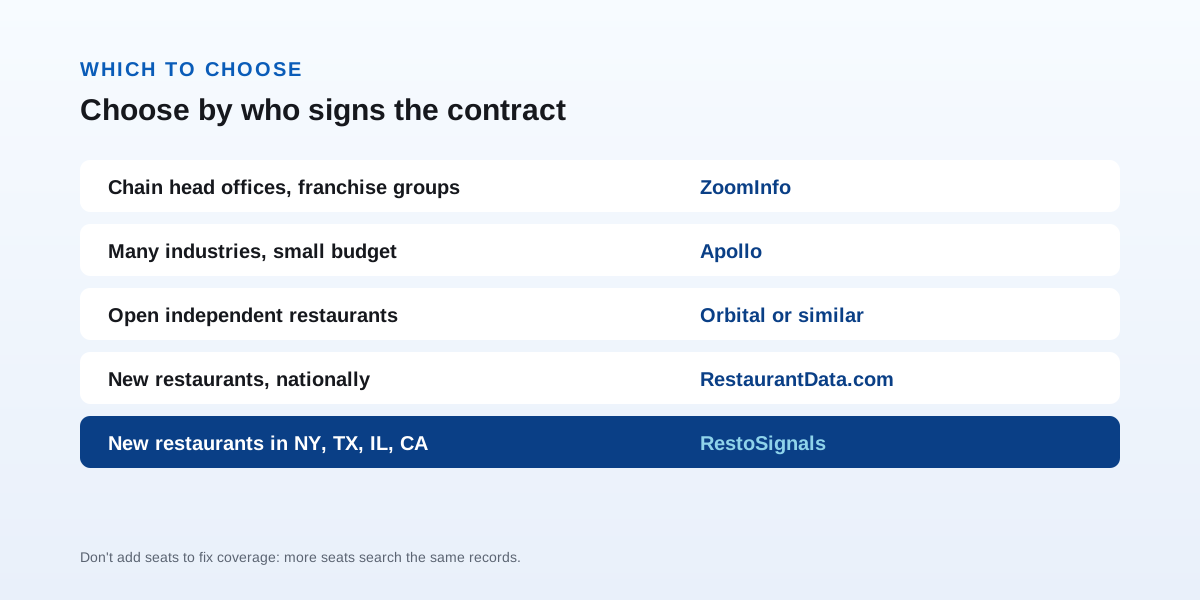
A restaurant sales team should choose by who buys. Sell to chains and franchise groups: ZoomInfo, if deals are big enough. Sell to many industries on a budget: Apollo. Sell to independent restaurants that are already open: a restaurant-specific list. Sell to restaurants before they open: liquor license and business filing data.
Here’s the full picture:
- Chain head offices and franchise groups: ZoomInfo.
- Many industries, small budget: Apollo.
- Open independent restaurants: Orbital or a similar restaurant census.
- New restaurants nationally: RestaurantData.com.
- New restaurants in New York, Texas, Illinois or California: RestoSignals.
If you’re leaning away from both, I compared the field in my Apollo alternatives and ZoomInfo alternatives guides.
And don’t add seats to fix coverage. More Apollo seats or more ZoomInfo credits still search the same records.
Frequently asked questions
Is Apollo better than ZoomInfo?
Apollo is better on price and self-serve setup: a free plan and paid plans from $49 per user a month, with email sequences built in. ZoomInfo is better on depth for large companies, with intent data and location data for the biggest US brands, at a median contract of $33,500 a year. For independent restaurants, neither is strong.
Is Apollo cheaper than ZoomInfo?
Yes, by a lot. Apollo lists Basic at $49, Professional at $79 and Organization at $119 per user a month billed annually. ZoomInfo doesn’t publish prices, and Vendr reports a median contract of $33,500 a year across 1,578 purchases. A five-person team on Apollo Professional pays $4,740 a year.
Does ZoomInfo have restaurant data?
For chains, yes. ZoomInfo’s data sources page says its data partners update the restaurant, branch and retail locations of the largest US brands. Its contact data comes from corporate websites, press releases, SEC filings, job postings and its contributor network, which independent restaurants rarely appear in.
Does Apollo have restaurant owner contacts?
For restaurant groups with a head office, often. For independent restaurants, coverage is thin. Apollo builds its data from 2 million contributors, activity in its email tools, web crawling and data partners, and many independent owners use a personal email and no sales software. Restaurants that haven’t opened usually aren’t there.
Should I use Apollo or ZoomInfo to sell to restaurants?
If you sell to restaurant chains and franchise groups, ZoomInfo’s head-office and location data earns its price. If you sell to many industries on a budget, Apollo. If you sell to independent restaurants before they open, use liquor license and business filing data, because both databases find restaurants after their vendors are chosen.
Can you use Apollo and ZoomInfo together?
Yes, but most small teams shouldn’t pay for both. A common split is ZoomInfo for enterprise and chain accounts and Apollo for sequences and smaller accounts. For restaurant teams, the more useful pairing is one contact database for chains plus a restaurant-specific source for independents and new openings.
Pick the tool that matches your buyer
Write down who signs your contracts: a head office or an owner. If it’s a head office, choose between Apollo and ZoomInfo on budget. If it’s an owner opening a new place, start with the filings. You can see this week’s new venues on RestoSignals free.
Mukul Dutt is the founder of RestoSignals, which tracks restaurants and bars before they open by fusing public liquor, permit and business-filing records into one scored venue with owner contact. Apollo and ZoomInfo prices and data claims are from their own pricing, data sources and information pages as of November 18, 2026; ZoomInfo contract figures are from Vendr. New York City figures are from the State Liquor Authority’s pending-application dataset on data.ny.gov for restaurant and food and beverage licenses received August 18 to November 13, 2026. BLS establishment count is from QCEW 2024. Search volumes are from DataForSEO, US, November 2026.
FAQ
Is Apollo better than ZoomInfo?
Apollo is better on price and self-serve setup: a free plan and paid plans from $49 per user a month, with email sequences built in. ZoomInfo is better on depth for large companies, with intent data and location data for the biggest US brands, at a median contract of $33,500 a year. For independent restaurants, neither is strong.
Is Apollo cheaper than ZoomInfo?
Yes, by a lot. Apollo lists Basic at $49, Professional at $79 and Organization at $119 per user a month billed annually. ZoomInfo doesn't publish prices, and Vendr reports a median contract of $33,500 a year across 1,578 purchases. A five-person team on Apollo Professional pays $4,740 a year.
Does ZoomInfo have restaurant data?
For chains, yes. ZoomInfo's data sources page says its data partners update the restaurant, branch and retail locations of the largest US brands. Its contact data comes from corporate websites, press releases, SEC filings, job postings and its contributor network, which independent restaurants rarely appear in.
Does Apollo have restaurant owner contacts?
For restaurant groups with a head office, often. For independent restaurants, coverage is thin. Apollo builds its data from 2 million contributors, activity in its email tools, web crawling and data partners, and many independent owners use a personal email and no sales software. Restaurants that haven't opened usually aren't there.
Should I use Apollo or ZoomInfo to sell to restaurants?
If you sell to restaurant chains and franchise groups, ZoomInfo's head-office and location data earns its price. If you sell to many industries on a budget, Apollo. If you sell to independent restaurants before they open, use liquor license and business filing data, because both databases find restaurants after their vendors are chosen.
Can you use Apollo and ZoomInfo together?
Yes, but most small teams shouldn't pay for both. A common split is ZoomInfo for enterprise and chain accounts and Apollo for sequences and smaller accounts. For restaurant teams, the more useful pairing is one contact database for chains plus a restaurant-specific source for independents and new openings.
Find venues opening near you
100 free leads, no card. One platform for restaurants & bars about to open.