ZoomInfo alternatives for selling to restaurants (2026)
ZoomInfo alternatives for teams that sell to restaurants: 7 tools compared on price, free plans, owner contacts and whether they find restaurants before they open.
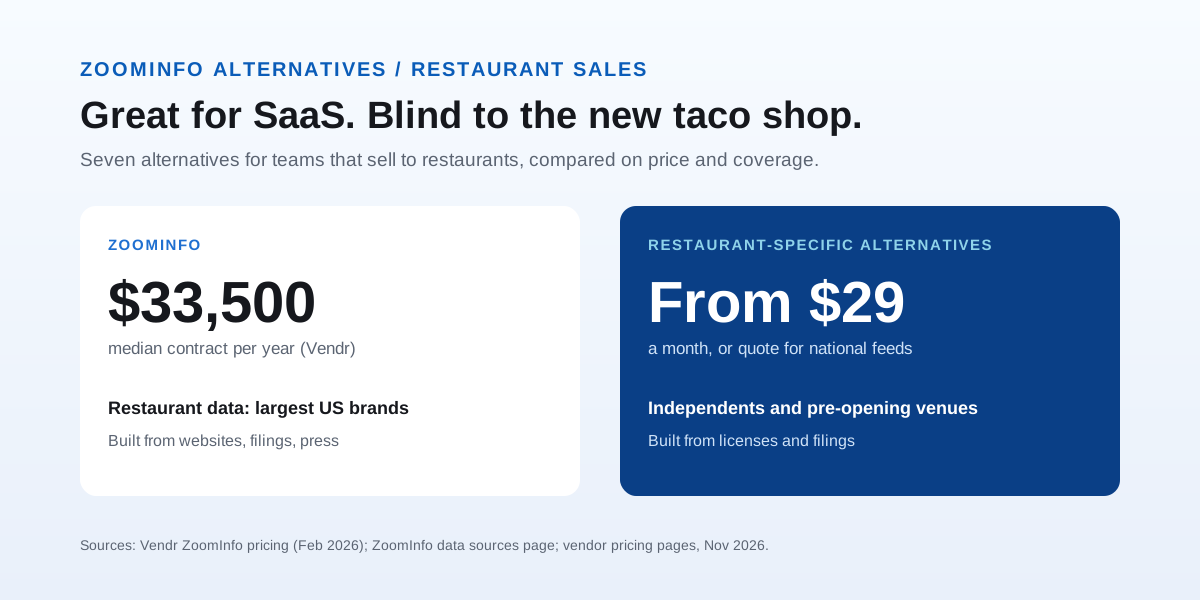
ZoomInfo is great at finding a VP of Sales at a software company.
It’s much worse at finding the person opening a taco shop on your block next month.
If you sell to restaurants, the best ZoomInfo alternatives are the ones built for local businesses. Apollo, Lusha and UpLead cost a fraction of ZoomInfo’s median $33,500 contract and work for small teams. But for independent restaurants, especially ones that haven’t opened, you need restaurant-specific data like RestaurantData.com, Orbital or RestoSignals, built from licenses and filings.
I run RestoSignals, one of the options below, so weigh that. I’ve kept the prices to what each company publishes.
Why doesn’t ZoomInfo work well for selling to restaurants?
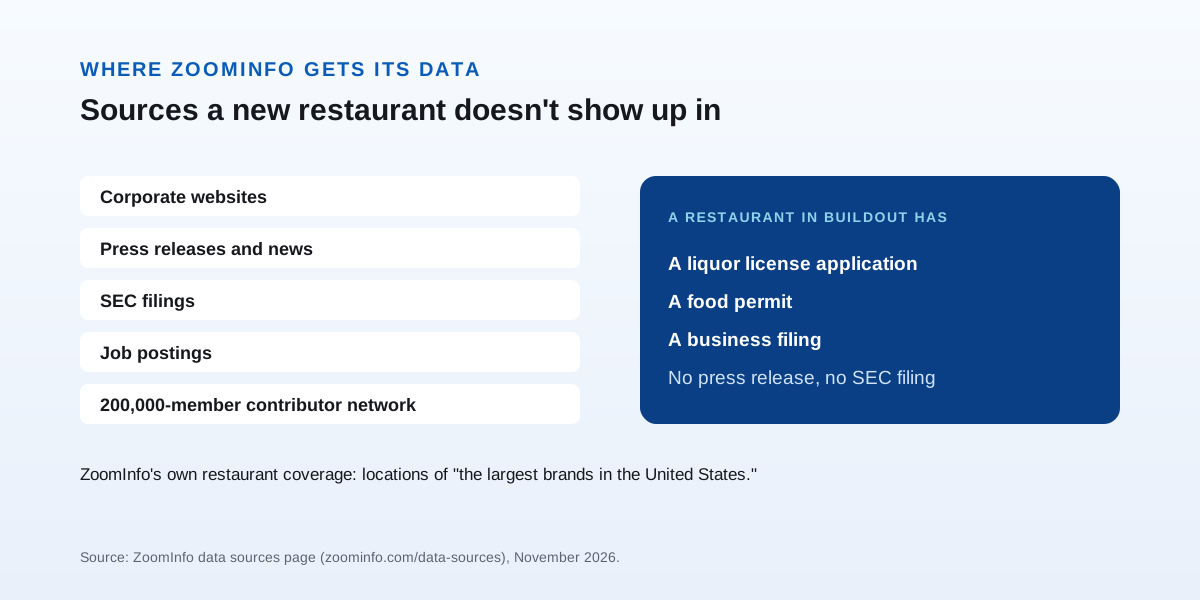
ZoomInfo doesn’t work well for restaurant sales because its data comes from places independent restaurants rarely appear. Its data sources page lists corporate websites, press releases, SEC filings, job postings and a network of 200,000 business professionals. A family-owned restaurant might have a website, but rarely a press release, a filing with the SEC or a sales team on LinkedIn. The only restaurant coverage ZoomInfo describes is location data for the largest US brands.
That’s from ZoomInfo’s own data sources page, which says its crawlers read public information “on over 28 million sites and domains every day.”
That’s a strong engine for companies with websites and LinkedIn pages.
It’s a weak one for the 619,919 restaurants the Bureau of Labor Statistics counted in 2024, many of them independents that never issue a press release.
Salespeople have noticed. On r/techsales, someone asked for “something like Zoominfo but contains data of local small businesses instead.” On r/startups, a founder put it bluntly: local businesses are “invisible to B2B data providers.”
And a restaurant that hasn’t opened yet is invisible to all of them. It has a liquor license application and a lease. It usually doesn’t have a website yet.
How much does ZoomInfo cost?
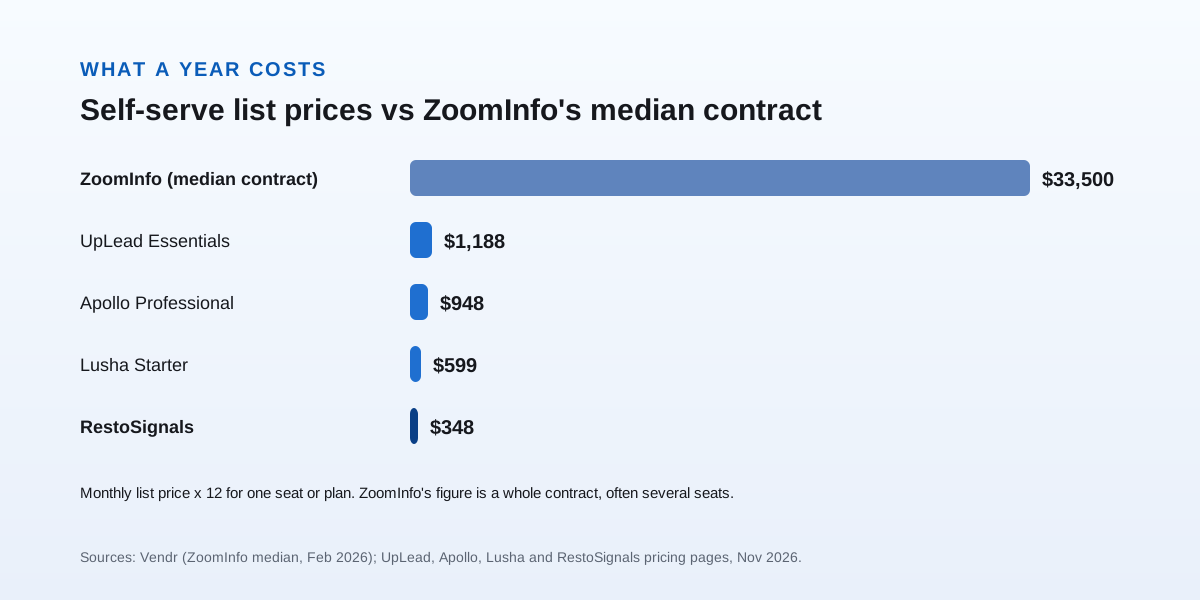
ZoomInfo doesn’t publish prices. Its pricing page says cost depends on features, number of licenses and credit usage, and each export costs one credit. Vendr, which negotiates software contracts for companies, reports a median ZoomInfo contract of $33,500 a year across 1,578 purchases, with deals from about $7,247 to $156,032.
Those numbers come from Vendr’s ZoomInfo pricing page, last updated February 2026.
ZoomInfo’s own pricing page lists plans like Professional, Copilot Advanced and Copilot Enterprise, all through sales.
Credits are part of the math. ZoomInfo’s marketing plans list included credits, such as 75,000 on Marketing Demand and 150,000 on ABM Enterprise, and every export uses one.
For a five-person team selling to restaurants, $33,500 is a lot to spend on a database that mostly knows the chains.
“zoominfo pricing” gets about 1,600 searches a month, so a lot of buyers are checking the number before they sign.
What are the best ZoomInfo alternatives for restaurant sales?
The best ZoomInfo alternatives for restaurant sales fall into two groups. General contact databases, such as Apollo, Lusha and UpLead, are cheaper and self-serve but share ZoomInfo’s blind spot for independent restaurants. Restaurant-specific sources, such as RestaurantData.com, Orbital and RestoSignals, cover independents and new openings but don’t help you sell to other industries.
Here are the seven I’d look at.
1. Apollo
Apollo’s pricing page shows a free plan “with no time limit,” then Basic at $49 and Professional at $79 per user a month.
It’s the cheapest way to get a ZoomInfo-style workflow: search, sequences and CRM sync. Vendr puts Apollo’s median contract at $17,000 for bigger teams.
Same blind spot, though. One r/b2b_sales post was titled “Why I stopped using Apollo for local business outreach.”
2. Lusha
Lusha has a free plan with 40 credits a month. Paid plans start at $49.90 a month for 400 credits, or $37.45 a month billed annually.
Revealing an email costs 1 credit and a phone number costs 5. Good for finding a direct line at a restaurant group’s head office.
3. UpLead
UpLead starts at $99 a month for 170 credits, or $74 a month billed annually. A 7-day trial gives you 5 credits.
One credit unlocks one contact with email and direct dial. Simple pricing, small-team friendly.
4. Cognism
Cognism is quote-only, with Standard and Pro plans that each include 5 seats.
It sells by seat and credit: “1 credit = 1 revealed contact.” For US independent restaurants, it draws on the same kind of company data as ZoomInfo.
5. RestaurantData.com
The restaurant-specific incumbent. It sends 350 to 600 new US restaurant leads a week, and its FAQ says about 85% are found 2 to 12 weeks before opening.
Quote-only, national coverage. I compared it in detail here.
6. Orbital
Orbital lists 632,090 active US restaurants and verifies each against at least two sources. Owner contacts unlock after signup, and pricing comes from a demo.
It’s the closest thing to “ZoomInfo for restaurants” for places that are already open.
7. RestoSignals
My product. It reads public liquor license applications, food permits and business filings daily in seven states, matches them into one venue per address and scores how close each is to opening.
It costs $29 a month after 100 free leads, and every lead carries the owner’s name from the filing.
How do the ZoomInfo alternatives compare side by side?
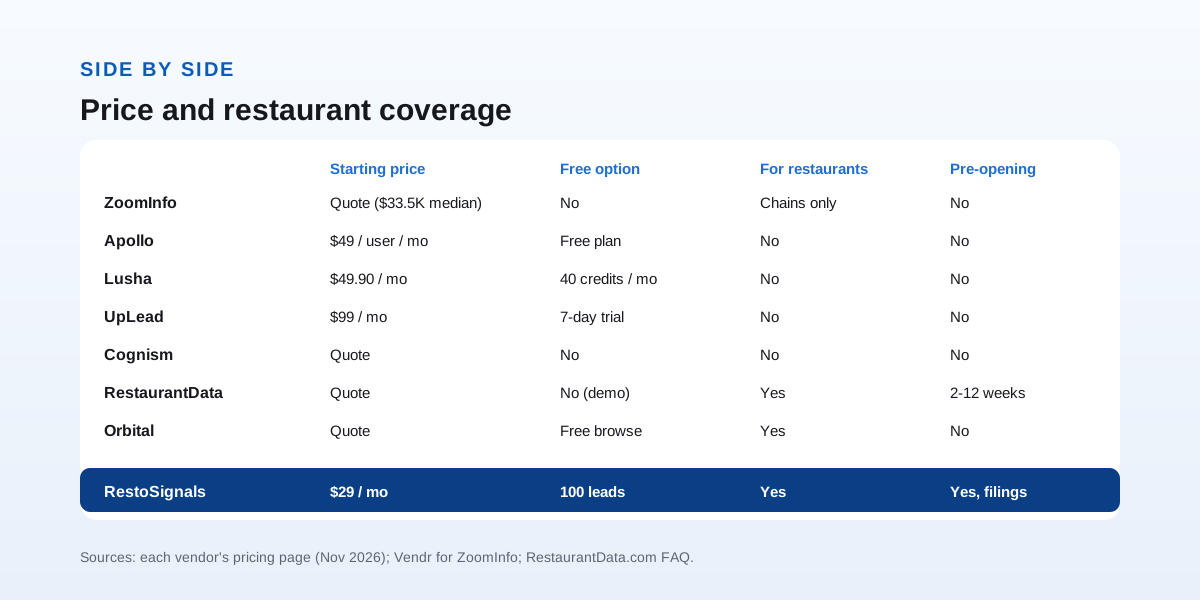
Side by side, the general databases win on price and breadth, and the restaurant-specific tools win on restaurant coverage and timing. ZoomInfo, Apollo, Lusha, UpLead and Cognism all cover every industry. Only RestaurantData.com, Orbital and RestoSignals are built around restaurants, and only RestaurantData.com and RestoSignals focus on venues before they open.
| Tool | Starting price | Free option | Built for restaurants | Finds restaurants before opening |
|---|---|---|---|---|
| ZoomInfo | Quote (median $33,500/yr, Vendr) | No | Chains only | No |
| Apollo | $49/user/month | Free plan | No | No |
| Lusha | $49.90/month | 40 credits/month | No | No |
| UpLead | $99/month | 7-day trial | No | No |
| Cognism | Quote | No | No | No |
| RestaurantData.com | Quote | No (demo) | Yes | Yes, mostly 2-12 weeks out |
| Orbital | Quote | Free browse | Yes | No |
| RestoSignals | $29/month | 100 leads | Yes | Yes, from filings |
If you sell to restaurant chains and other industries too, a general tool is the right buy.
If restaurants are your whole market, the right column matters more than the price column.
What do you give up when you leave ZoomInfo?
You give up breadth when you leave ZoomInfo. It covers every industry, maps company hierarchies, and sells intent data built from data partners that monitor web activity from company IP addresses. If you sell to restaurant chains, franchise groups or hospitality companies with real head offices, that depth is useful and hard to replace with a cheaper tool.
So be honest about who you sell to before you cancel.
If half your pipeline is chains and the other half is independents, you might keep ZoomInfo for the chains and add a restaurant-specific source for the rest.
And if price is the only problem, negotiate first. Vendr reports buyers save about 22% on average on ZoomInfo deals it handles.
But if your customers are independent restaurants, you’re paying enterprise prices for the part of the database you use least.
Is there a free alternative to ZoomInfo?
Yes. Apollo has a free plan with no time limit, Lusha gives 40 free credits a month, and UpLead has a 7-day trial with 5 credits. For restaurants, the most useful free source isn’t a database at all: liquor license applications, food permits and business filings are public, name the owner and appear months before opening. RestoSignals gives 100 free leads built from them.
“What is a free alternative to ZoomInfo?” has 12 answers on Quora. The honest answer depends on who you sell to.
For restaurants, here’s what’s free:
- State liquor license lookups, such as the California ABC, Texas TABC and Illinois systems.
- City business license and food permit data on open data portals.
- State business filings, which name the owner or registered agent.
The catch is time. You have to pull, clean and match those records yourself.
One r/sales thread named the other problem with free sources like Google Maps: it “doesn’t have owner name,” which matters on a cold call. Liquor filings do.
How do you build a restaurant prospect list without ZoomInfo?
You build a restaurant prospect list without ZoomInfo by starting from public filings instead of company websites. Pull new liquor license applications for your territory, match a second record such as a food permit or business filing at the same address, take the owner’s name from the filing, and reach out during the buildout, before the restaurant picks its vendors.
Here’s the process I’d follow:
- Pick your territory: a county or metro, not a whole state.
- Pull pending liquor applications. Texas had 948 pending original applications on October 28, 2026, and California had 3,337 pending restaurant applications on October 26.
- Drop transfers and renewals. You want new businesses, not new owners of old ones.
- Match a second filing at the same address. Two records mean the opening is real.
- Take the owner’s name and mailing address from the filing.
- Contact them during the buildout, with something useful, before the 90-day vendor window closes.
That’s free, and it works. It also takes a few hours a week per territory, which is the real cost.
Which ZoomInfo alternative fits your restaurant sales team?
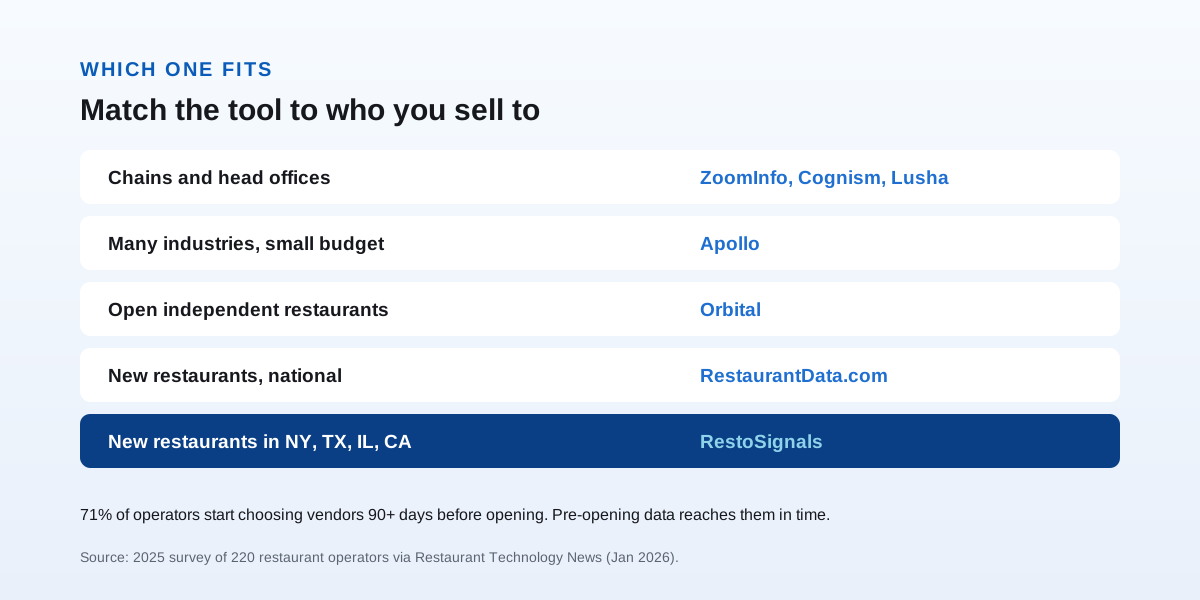
The right ZoomInfo alternative depends on when your customer buys. If you sell something restaurants replace every few years, such as software or cleaning supplies, a general database like Apollo or a census like Orbital fits. If you sell something bought once before opening, such as POS, insurance, equipment or a beverage program, you need pre-opening data.
That timing point isn’t a guess.
In a 2025 survey of 220 restaurant operators, reported by Restaurant Technology News, 71% said they start choosing their main vendors more than 90 days before opening. And 76% aren’t open to new vendor outreach in the last 30 days.
A contact database finds the restaurant after it opens. By then, the POS is installed.
Here’s how I’d match tools to teams:
- Selling to chains and franchise groups: ZoomInfo, Cognism or Lusha for head-office contacts.
- Selling to many industries on a budget: Apollo.
- Selling to open independent restaurants: Orbital, or Google Maps data plus your own research.
- Selling to new restaurants nationally: RestaurantData.com.
- Selling to new restaurants in New York, Texas, Illinois or California: RestoSignals.
Where does RestoSignals fall short?
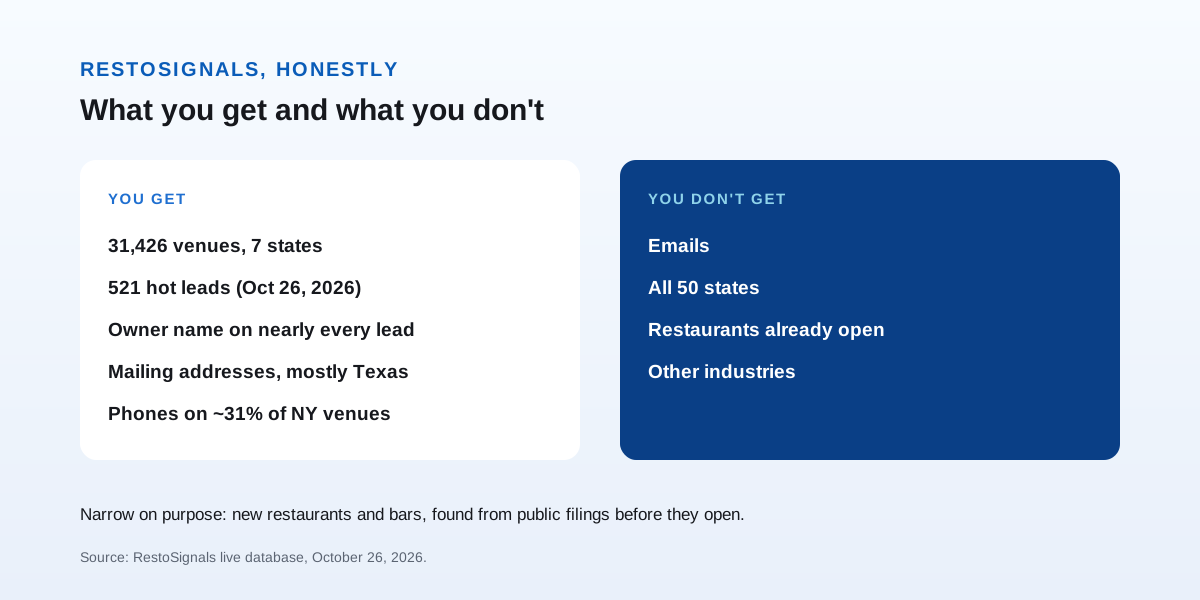
RestoSignals falls short on coverage and contact depth compared with the big databases. It covers seven US states, not all fifty, and only restaurants and bars. It gives owner names from filings on nearly every lead, mailing addresses mostly in Texas and phones on about 31% of New York venues, but no emails. And it only shows new venues, not the restaurants already open.
On October 26, 2026, it held 31,426 venues across seven states, with 521 scored as hot.
That’s a narrow product on purpose. If you need a national list of every open restaurant with emails, it’s the wrong tool.
If you sell to new restaurants in its states, it finds them earlier than any contact database can, for less than a ZoomInfo seat.
Frequently asked questions
What is a free alternative to ZoomInfo?
Apollo has a free plan with no time limit, Lusha’s free plan gives 40 credits a month, and UpLead offers a 7-day trial with 5 credits. For restaurants specifically, public liquor license applications, food permits and business filings are free and name the owner. RestoSignals gives 100 free leads from those filings with no card.
How much does ZoomInfo cost?
ZoomInfo doesn’t publish prices; plans are quoted by its sales team based on features, seats and credits. Vendr, which negotiates software contracts, reports a median ZoomInfo contract of $33,500 a year across 1,578 purchases, with deals ranging from about $7,247 to $156,032. Each export costs one credit.
Does ZoomInfo have restaurant data?
Mostly for chains. ZoomInfo’s data sources page says its data partners update the restaurant, branch and retail locations of the largest US brands. Its contact data comes from corporate websites, press releases, SEC filings, job postings and its user network, which independent restaurants rarely appear in, and restaurants that haven’t opened appear in none of them.
What are the best ZoomInfo alternatives for small businesses?
For general small-business prospecting, Apollo ($49 or $79 per user a month, plus a free plan), Lusha (from $49.90 a month) and UpLead (from $99 a month) are the common picks. For restaurants, use a restaurant-specific source: RestaurantData.com or Orbital for open restaurants, or RestoSignals for restaurants before they open.
How do I find restaurant owner contact information?
Start with the public filings a restaurant must make. Liquor license applications name the applicant, business filings name the owner or registered agent, and some permits carry a phone or mailing address. In Texas, almost every active bar and restaurant liquor permit lists a mailing address. Contact databases cover chains well but often miss independent owners.
Is there a cheaper alternative to ZoomInfo for restaurant sales?
Yes. Lusha starts at $49.90 a month, UpLead at $99 and Apollo at $49 per user, against a median ZoomInfo contract of $33,500 a year. If you sell to new restaurants, RestoSignals costs $29 a month and covers seven states, which is less coverage but includes restaurants that haven’t opened yet.
Buy for the moment your customer decides
Don’t pick a data tool by database size. Pick it by when your customer chooses a vendor. If restaurants buy from you any day of the year, a cheaper general database will do. If they choose before opening day, get pre-opening data: see this week’s new venues on RestoSignals free, then decide whether it beats the quote on your desk.
Mukul Dutt is the founder of RestoSignals, one of the tools compared here, which tracks restaurants and bars before they open by fusing public liquor, permit and business-filing records into one scored venue with owner contact. Prices come from each company’s pricing page as read in November 2026; ZoomInfo and Apollo contract figures are from Vendr. RestoSignals figures are from the live database on October 26, 2026. No vendor reviewed or paid for placement.
FAQ
What is a free alternative to ZoomInfo?
Apollo has a free plan with no time limit, Lusha's free plan gives 40 credits a month, and UpLead offers a 7-day trial with 5 credits. For restaurants specifically, public liquor license applications, food permits and business filings are free and name the owner. RestoSignals gives 100 free leads from those filings with no card.
How much does ZoomInfo cost?
ZoomInfo doesn't publish prices; plans are quoted by its sales team based on features, seats and credits. Vendr, which negotiates software contracts, reports a median ZoomInfo contract of $33,500 a year across 1,578 purchases, with deals ranging from about $7,247 to $156,032. Each export costs one credit.
Does ZoomInfo have restaurant data?
Mostly for chains. ZoomInfo's data sources page says its data partners update the restaurant, branch and retail locations of the largest US brands. Its contact data comes from corporate websites, press releases, SEC filings, job postings and its user network, which independent restaurants rarely appear in, and restaurants that haven't opened appear in none of them.
What are the best ZoomInfo alternatives for small businesses?
For general small-business prospecting, Apollo ($49 or $79 per user a month, plus a free plan), Lusha (from $49.90 a month) and UpLead (from $99 a month) are the common picks. For restaurants, use a restaurant-specific source: RestaurantData.com or Orbital for open restaurants, or RestoSignals for restaurants before they open.
How do I find restaurant owner contact information?
Start with the public filings a restaurant must make. Liquor license applications name the applicant, business filings name the owner or registered agent, and some permits carry a phone or mailing address. In Texas, almost every active bar and restaurant liquor permit lists a mailing address. Contact databases cover chains well but often miss independent owners.
Is there a cheaper alternative to ZoomInfo for restaurant sales?
Yes. Lusha starts at $49.90 a month, UpLead at $99 and Apollo at $49 per user, against a median ZoomInfo contract of $33,500 a year. If you sell to new restaurants, RestoSignals costs $29 a month and covers seven states, which is less coverage but includes restaurants that haven't opened yet.
Find venues opening near you
100 free leads, no card. One platform for restaurants & bars about to open.