Restaurant API compared: Yelp, Google, Foursquare (2026)
Restaurant API compared on price, free tier, data storage rules and new openings: Yelp, Google Places, Foursquare and RestoAPI, with what each one bans.
Every restaurant API looks the same until you read the terms.
Then you find out which ones you can actually build a product on.
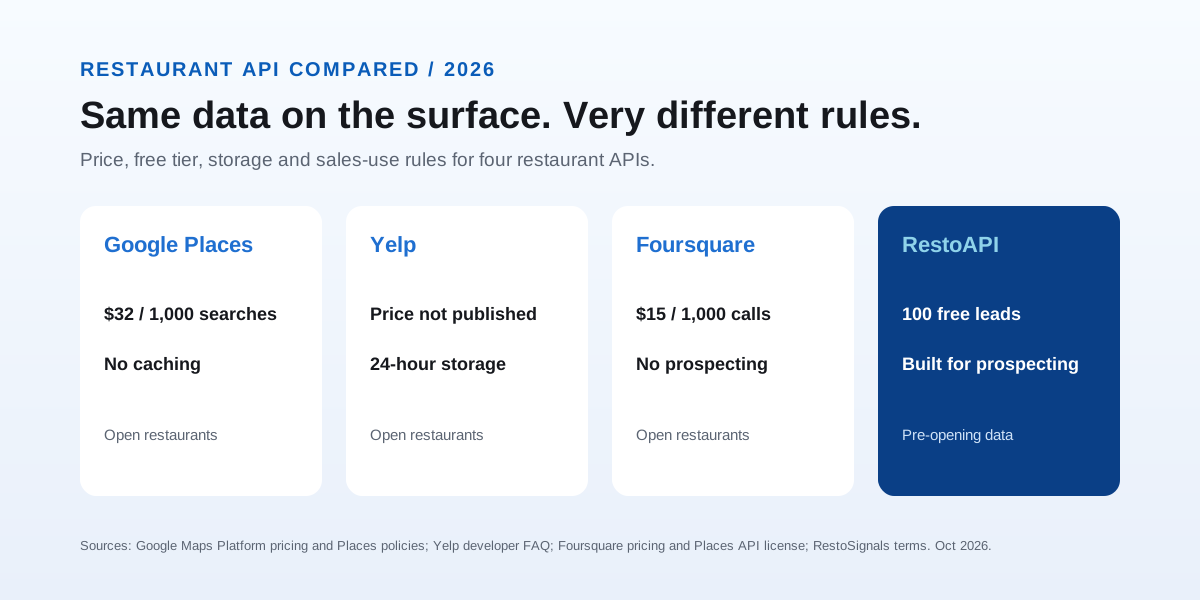
The best restaurant API depends on the job. Google Places is the default for open restaurants but costs $32 per 1,000 search calls and bans caching. Yelp adds reviews but lets you store data for only 24 hours. Foursquare is cheaper but forbids using its data to contact businesses. For restaurants that haven’t opened yet, you need an API built on public filings, like RestoAPI.
I built RestoAPI, so take my bias into account. Every price and rule below comes from each company’s own pricing page, docs or license, checked in October 2026.
What is a restaurant API, and which kind do you need?
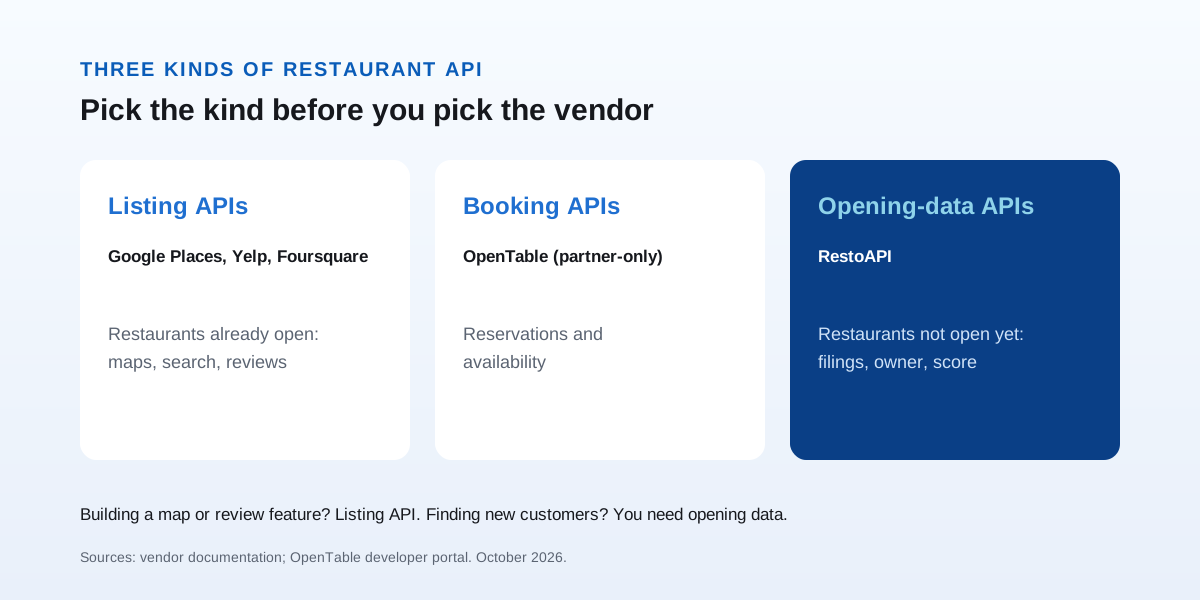
A restaurant API is a web service that returns restaurant data, such as name, address, phone, hours, ratings or menus, to your app as JSON. There are three kinds. Listing APIs like Google Places, Yelp and Foursquare describe restaurants that are already open. Booking APIs like OpenTable handle reservations. Opening-data APIs like RestoAPI track restaurants that haven’t opened yet.
A lot of people searching “restaurant API” are students looking for mock data to practice on. Of the rest, most want the first kind: they’re building a map, a review app or a “what’s near me” feature.
Some developers want something else. They’re building a sales tool, a CRM enrichment step or an AI agent that finds new customers. For that, the listing APIs either don’t have the data or don’t allow the use.
OpenTable is its own case. Its developer portal says “Partners are companies who have access to specific integrations,” so you apply and wait for approval instead of signing up.
How do the restaurant APIs compare side by side?
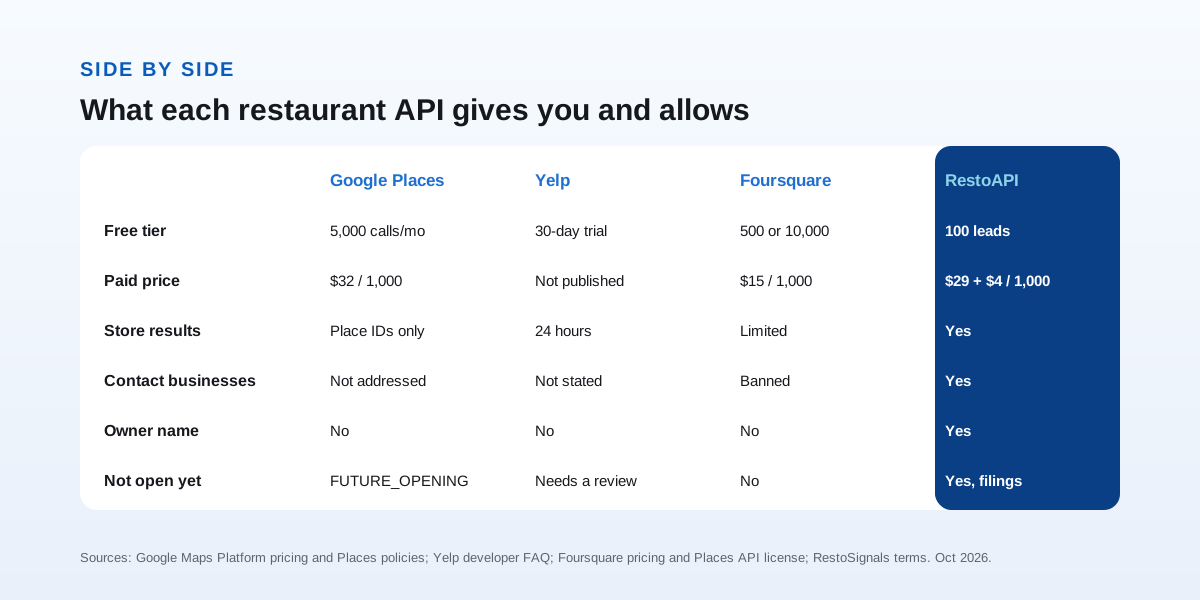
The four restaurant APIs differ most on what you’re allowed to do with the data, not on price. Google Places has the most coverage and the strictest caching rules. Yelp caps storage at 24 hours. Foursquare bans prospecting. RestoAPI is the only one of the four built for finding and contacting restaurants before they open, with an owner name on each lead.
| Google Places (New) | Yelp Places API | Foursquare Places | RestoAPI | |
|---|---|---|---|---|
| Free tier | 5,000 Text Search Pro calls/month | 5,000 calls, 30-day trial, evaluation only | Free Pro allowance (500 or 10,000, page says both) | 100 leads, no card |
| Paid price | $32 per 1,000 Text Search Pro | Not published in docs | $15 per 1,000 Pro calls | $29/month plan, then $4 per 1,000 leads |
| Can you store results? | No, except place IDs | 24 hours, IDs indefinitely | Per usage guidelines; no bulk redistribution | Yes, for your prospecting |
| Can you use it to contact businesses? | Not addressed in the pages I read | Not stated in the FAQ | No, banned by the license | Yes, that’s the purpose |
| Owner name | No | No | No | Yes |
| Restaurants not open yet | Only if listed as FUTURE_OPENING | Needs a review or photo first | No pre-opening field | Yes, from filings |
| Coverage | Global | Global | Global | 7 US states |
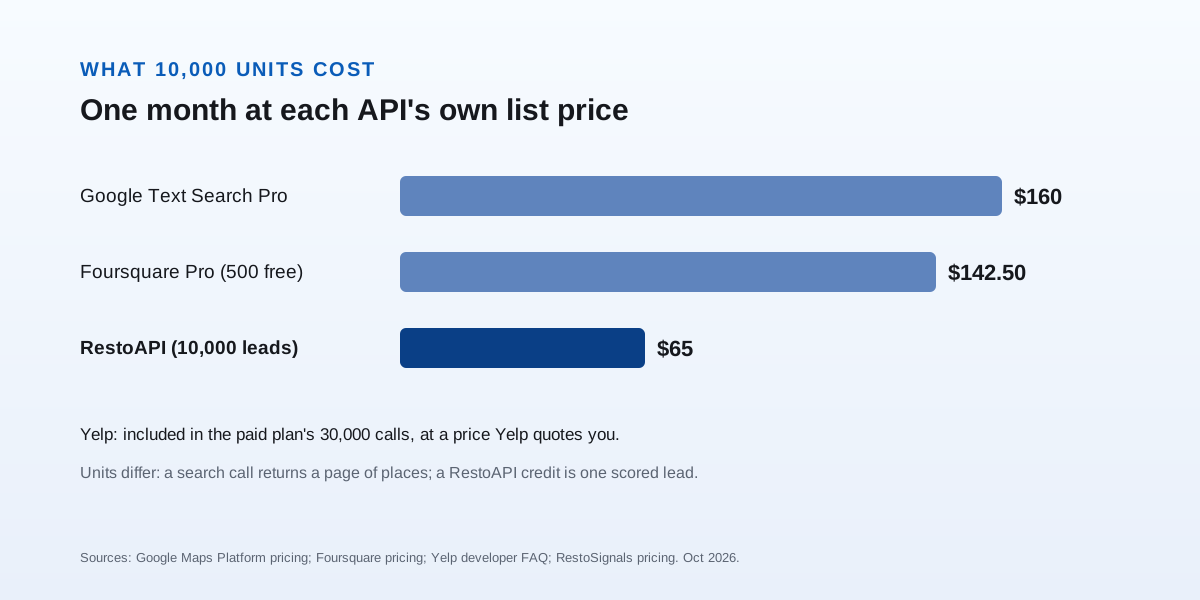
Here’s roughly what 10,000 billable units cost in a month, from each company’s own pricing:
- Google Text Search Pro: about $160 (5,000 free, then 5,000 at $32 per 1,000).
- Foursquare Pro: about $142.50 if only the first 500 calls are free, or close to nothing if the 10,000-call offer applies.
- Yelp: covered by the paid plan’s 30,000 included calls, at whatever Yelp quotes you.
- RestoAPI: about $65 for 10,000 leads ($29 plan plus two 5,000-lead packs at $18).
These units aren’t identical. One Google or Foursquare search call returns a page of places (up to 20 on Google), while one RestoAPI credit is one scored lead.
That last row matters. RestoAPI covers New York, Texas, Illinois and California most deeply, plus Oregon, Colorado and Washington. If you need Florida or Ohio, it can’t help you yet.
What does the Google Places API cost, and what can’t you do with it?
The Google Places API (New) costs $32 per 1,000 Text Search Pro or Nearby Search Pro calls after 5,000 free a month, and $5 to $20 per 1,000 Place Details calls depending on the fields you request. Its biggest limit isn’t price. Google’s Places policies say you must not cache or store Places content, except the place ID, which you can keep indefinitely.
Here are the first-tier prices from Google’s pricing page:
| Places API (New) SKU | Free calls per month | Price per 1,000 after that |
|---|---|---|
| Text Search Pro | 5,000 | $32.00 |
| Nearby Search Pro | 5,000 | $32.00 |
| Text Search Enterprise | 1,000 | $35.00 |
| Place Details Essentials | 10,000 | $5.00 |
| Place Details Pro | 5,000 | $17.00 |
| Place Details Enterprise | 1,000 | $20.00 |
So 10,000 Text Search Pro calls in a month cost about $160: 5,000 free, then 5,000 at $32 per 1,000.
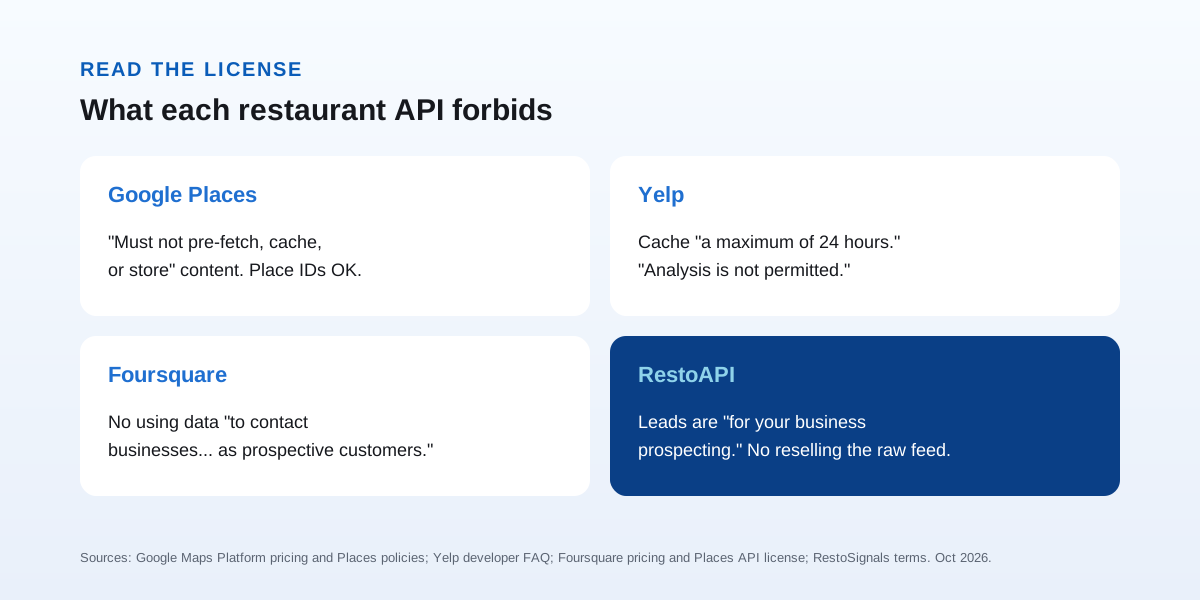
The caching rule is the bigger problem. The Places API policies say you “must not pre-fetch, cache, or store Places API content” beyond the allowed exceptions. You can keep place IDs and call again, but you can’t build your own restaurant table.
One developer on r/datasets summed it up: the big APIs are “very expensive and don’t allow for long-term caching.”
Google does have one feature people miss. A place can carry the status FUTURE_OPENING with an openingDate field, which Google’s reference describes as “the date this place will open in the future.” That only appears when someone lists the business early, though, and it never includes the owner.
What does the Yelp API cost, and can you store the data?
Yelp’s Places API, formerly Fusion, starts with a 30-day trial of up to 5,000 calls that Yelp says are “strictly for evaluation and not for commercial deployment.” Paid plans include 30,000 calls a month with a 5,000-a-day limit. You can cache Yelp content for at most 24 hours, and Yelp only returns businesses that already have a review, photo or other user contribution.
Those rules come from Yelp’s developer FAQ. Yelp doesn’t publish per-call prices in its docs. A July 2026 API report card from Supergood put the entry paid plan at $229 a month, which you should confirm with Yelp before budgeting.
Two lines from the FAQ decide most use cases:
- “You may cache Yelp Places API content for a maximum of 24 hours.”
- “Analysis is not permitted for Yelp Places integrations.”
And the coverage rule matters for new restaurants. Yelp says listings need “at least one review, photo, or other user-contributed enhancement.” A restaurant still under construction usually has none.
Yelp is great for showing ratings in an app. It’s the wrong tool for a database.
What does the Foursquare Places API cost, and what does it ban?
Foursquare’s Places API charges $15 per 1,000 Pro endpoint calls at its first paid tier and $18.75 per 1,000 Premium calls, which add hours, ratings, tips and photos. That’s well under Google’s $32 for a search call. But its license bans using Places data “to contact businesses included in Places Data as prospective customers,” so you can’t use it for sales prospecting.
The Foursquare pricing page is a little inconsistent on the free allowance. Its table shows the first 500 Pro calls at $0, and its call-to-action says “up to 10,000 free calls on Pro endpoints.”
The license is clearer. The Places API license agreement also bars making Places data “available to third parties in bulk” and systematically pulling “all or substantially all Places Data for a given locality.”
Foursquare also publishes a free dataset, FSQ Open Source Places, under the Apache 2.0 license. It has a date_created field, but Foursquare’s schema warns that this “does not necessarily mean the POI actually opened on this date.”
Is there a free API for restaurants?
Yes. OpenStreetMap’s data is free under the Open Database License and includes many restaurants, and Foursquare’s Open Source Places dataset is free under Apache 2.0. Google Places has monthly free allowances per endpoint, Yelp has a 30-day evaluation trial, and RestoAPI gives 100 free leads with no card. Free tiers are fine for testing but rarely enough for production.
This is one of Google’s “People also ask” questions for “restaurant API,” and the honest answer is that free costs you somewhere else.
OpenStreetMap is free and storable, but coverage varies by city and there are no owner names.
Foursquare’s open dataset is free, but it’s a bulk file, not a live API, and the license on the paid API doesn’t carry over.
And the big APIs’ free tiers run out fast. On r/webdev, one team said plainly that “Google Places is out of our budget” for restaurant and café data.
Which restaurant API finds restaurants before they open?
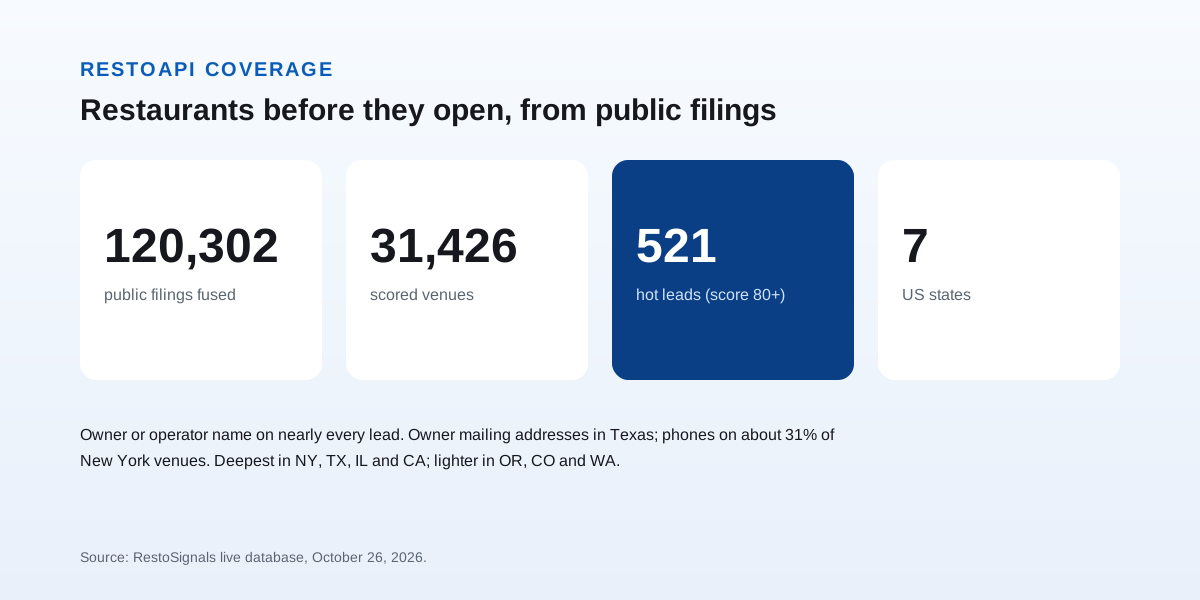
RestoAPI is built for restaurants that haven’t opened yet. It reads public liquor license applications, food permits and new business filings, matches them into one venue per address, and scores how close each is to opening. Google Places can show a FUTURE_OPENING listing, but only when one exists. Yelp needs a review or photo first, and Foursquare has no pre-opening data.
On October 26, 2026, RestoAPI held 31,426 venues across seven states, fused from 120,302 public records. Of those, 521 scored as hot, meaning several filings point to one opening.
Every lead carries the owner or operator name from the filing. Texas venues usually add an owner mailing address, and about 31% of New York venues have a phone from city permits.
The terms are the other difference. RestoSignals’ terms say leads are “provided for your business prospecting.” The only thing banned is reselling the raw feed as a competing data product.
That’s the use case the other three rule out.
How do you call RestoAPI?
You call RestoAPI with a free API key in the X-API-Key header. The main endpoint, GET /v1/openings, returns scored venues for a state, filtered by city, signal type and minimum opening score. Each returned lead costs one credit. There’s also a hosted MCP server at api.restosignals.com/mcp, so AI agents like Claude can query it directly.
Here’s a request for the five hottest pending openings in Texas:
curl -s "https://api.restosignals.com/v1/openings?state=TX&min_opening_score=80&limit=5" \
  -H "X-API-Key: YOUR_KEY"
You get a JSON list of venues with business name, city, opening score, status and the signal types behind the score.
The API docs and the OpenAPI spec list every parameter. If you’d rather work in Python, I wrote a step-by-step tutorial.
Pricing, plainly: 100 free leads with no card. After that, you subscribe for $29 a month and add credit packs at $4 per 1,000 leads or $18 per 5,000.
Which restaurant API should you use?
Use Google Places if you need global coverage of open restaurants inside a map or search feature. Use Yelp if your users care about ratings and reviews. Use Foursquare if you need cheap place search and won’t contact the businesses. Use RestoAPI if you’re finding new restaurants to sell to in New York, Texas, Illinois or California before they open.
Here’s the quick version:
- Building a map or “near me” search: Google Places.
- Showing reviews and ratings: Yelp.
- Cheap, high-volume place lookups with no outreach: Foursquare.
- A free bulk dataset you can store: OpenStreetMap or FSQ Open Source Places.
- Sales prospecting, CRM enrichment or an AI agent that finds new venues: RestoAPI.
You can also combine them. One setup that works: RestoAPI to find the venue before it opens, then a listing API later to confirm the hours once it does.
Frequently asked questions
Is there a free API for restaurants?
Yes, a few. OpenStreetMap data is free under the Open Database License, and Foursquare’s Open Source Places dataset is free under Apache 2.0. Google Places gives a monthly free allowance per endpoint, such as 5,000 Text Search Pro calls, and Yelp offers a 30-day trial of up to 5,000 calls for evaluation only. RestoAPI gives 100 free leads with no card.
What is the best API source for access to a restaurant database?
It depends on the job. Google Places is the default for open restaurants but charges $32 per 1,000 Text Search Pro calls after the free tier and bans caching. Yelp adds reviews but limits storage to 24 hours. Foursquare is cheaper per call but bans using its data to contact businesses. For restaurants that haven’t opened yet, use a filings-based API like RestoAPI.
How much does the Google Places API cost?
Google’s Places API (New) charges per request. Text Search Pro and Nearby Search Pro cost $32 per 1,000 calls after 5,000 free a month. Place Details costs $5 (Essentials), $17 (Pro) or $20 (Enterprise) per 1,000 after 10,000, 5,000 or 1,000 free calls. Prices drop at higher volumes, and a search that returns nothing still bills.
Can I store data from the Yelp API?
Only briefly. Yelp’s developer FAQ says you may cache Yelp Places API content for a maximum of 24 hours, though Yelp business IDs can be stored indefinitely. The FAQ also says analysis is not permitted for Yelp Places integrations. That rules Yelp out for building your own restaurant database or a sales list.
Is there an API for new restaurant openings?
Google Places marks some listings FUTURE_OPENING with an opening date, but only when the business or Google adds the listing early. RestoAPI finds new openings from public liquor license applications, food permits and business filings in seven states, usually months before opening, and returns a scored venue with the owner’s name.
Can I use Foursquare data for sales leads?
No. Foursquare’s Places API license agreement says you may not use Places Data to contact businesses included in it as prospective customers. It also bars bulk redistribution and systematically pulling all places in a locality. Foursquare works for maps, search and check-ins, but not for building a prospect list.
Read the license before you write the code
Price per call is the easy comparison. The terms decide whether your product is allowed to exist. If you’re building anything that stores restaurants or contacts them, check the caching and use rules first, then pick the API. For new restaurants in New York, Texas, Illinois or California, get a free RestoAPI key with 100 leads and test it against your use case today.
Mukul Dutt is the founder of RestoSignals, which runs RestoAPI, a developer API and MCP server for restaurants and bars before they open. Competitor prices and rules come from each company’s public pricing pages, documentation and license agreements as read in October 2026; Yelp’s paid plan price is from a third-party report. RestoSignals coverage figures are from the live database on October 26, 2026.
FAQ
Is there a free API for restaurants?
Yes, a few. OpenStreetMap data is free under the Open Database License, and Foursquare's Open Source Places dataset is free under Apache 2.0. Google Places gives a monthly free allowance per endpoint, such as 5,000 Text Search Pro calls, and Yelp offers a 30-day trial of up to 5,000 calls for evaluation only. RestoAPI gives 100 free leads with no card.
What is the best API source for access to a restaurant database?
It depends on the job. Google Places is the default for open restaurants but charges $32 per 1,000 Text Search Pro calls after the free tier and bans caching. Yelp adds reviews but limits storage to 24 hours. Foursquare is cheaper per call but bans using its data to contact businesses. For restaurants that haven't opened yet, use a filings-based API like RestoAPI.
How much does the Google Places API cost?
Google's Places API (New) charges per request. Text Search Pro and Nearby Search Pro cost $32 per 1,000 calls after 5,000 free a month. Place Details costs $5 (Essentials), $17 (Pro) or $20 (Enterprise) per 1,000 after 10,000, 5,000 or 1,000 free calls. Prices drop at higher volumes, and a search that returns nothing still bills.
Can I store data from the Yelp API?
Only briefly. Yelp's developer FAQ says you may cache Yelp Places API content for a maximum of 24 hours, though Yelp business IDs can be stored indefinitely. The FAQ also says analysis is not permitted for Yelp Places integrations. That rules Yelp out for building your own restaurant database or a sales list.
Is there an API for new restaurant openings?
Google Places marks some listings FUTURE_OPENING with an opening date, but only when the business or Google adds the listing early. RestoAPI finds new openings from public liquor license applications, food permits and business filings in seven states, usually months before opening, and returns a scored venue with the owner's name.
Can I use Foursquare data for sales leads?
No. Foursquare's Places API license agreement says you may not use Places Data to contact businesses included in it as prospective customers. It also bars bulk redistribution and systematically pulling all places in a locality. Foursquare works for maps, search and check-ins, but not for building a prospect list.
Find venues opening near you
100 free leads, no card. One platform for restaurants & bars about to open.