Apollo.io alternatives for selling to restaurants (2026)
Apollo.io alternatives for teams that sell to restaurants: 7 tools compared on price, free plans and owner contacts, and why Apollo misses new restaurants.
Apollo is the tool most sales teams try first, because the free plan is real and the paid plans are cheap.
Then they search for a restaurant owner and get an info@ address.
If you sell to restaurants, the best Apollo.io alternatives depend on which restaurants you sell to. For chains and restaurant groups, Lusha, Hunter or UpLead do the same job at a similar price. For independent restaurants, and especially new ones, you need data built from licenses and filings, such as Orbital, RestaurantData.com or RestoSignals, because Apollo’s sources rarely include them.
I run RestoSignals, one of the options below, so weigh that. Prices are what each company publishes.
Why do sales teams look for Apollo.io alternatives?
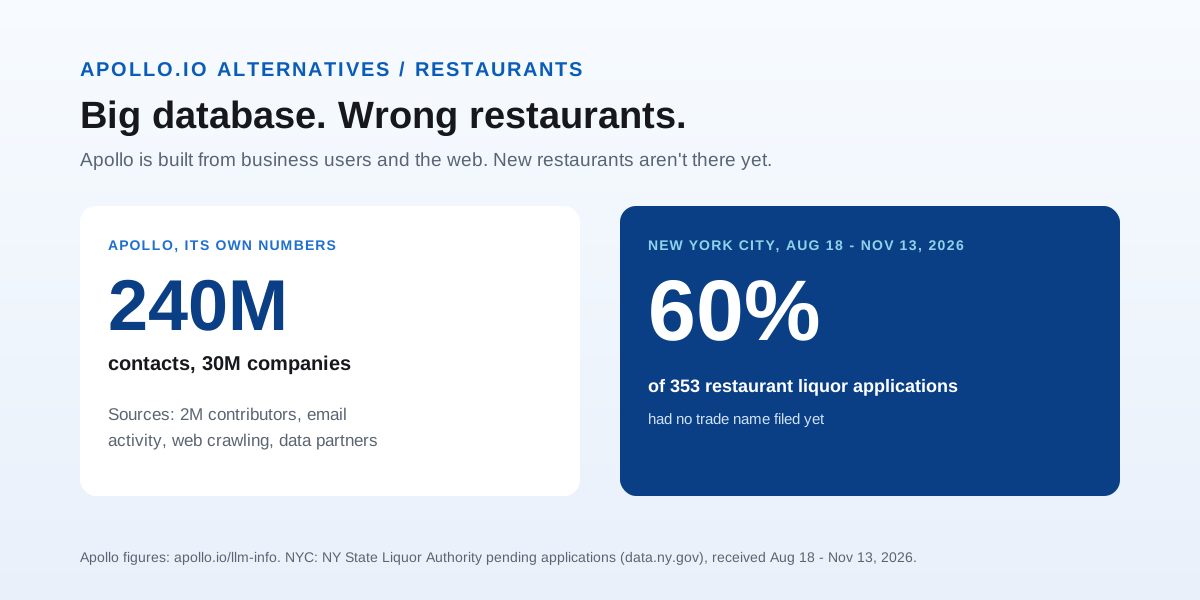
Sales teams look for Apollo.io alternatives for three reasons: bounced emails, per-seat costs as the team grows, and weak coverage of small businesses. Apollo says its database holds more than 240 million contacts and 30 million companies, but those records come from business users and the web. Teams that sell to local businesses, like restaurants, feel the gap most.
“apollo alternatives” gets about 390 searches a month in the US, and “apollo.io alternatives” another 210, according to DataForSEO. Advertisers pay $68 to $76 a click for them, so these are buyers.
The complaints are consistent.
On r/b2b_sales, one post was titled “Why I stopped using Apollo for local business outreach.” G2 reviewers flag outdated records and mobile numbers. Competitor blogs report bounce rates far above Apollo’s own claims, though those come from companies selling against it.
Apollo, for its part, reports “a 98% email accuracy rate” on its information page for AI assistants.
Both can be true. The accuracy you get depends on who you’re looking for.
Why doesn’t Apollo work well for restaurant sales?
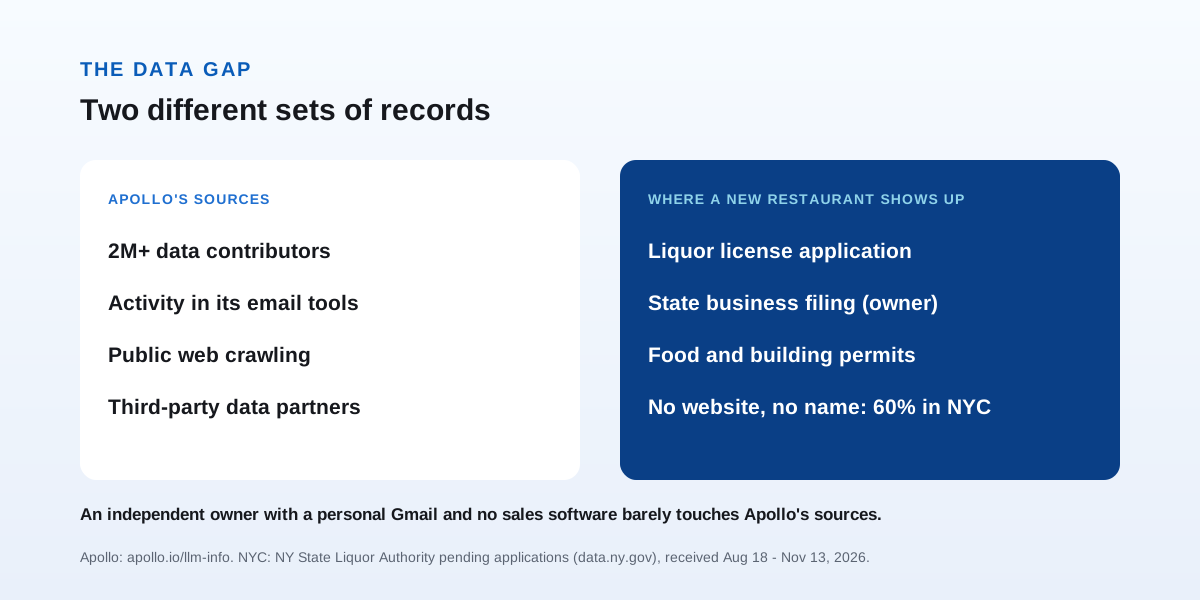
Apollo doesn’t work well for independent restaurants because of where its data comes from. Apollo says it builds records from a network of more than 2 million data contributors, activity in its email tools, public web crawling and third-party data providers. An independent restaurant owner who uses a personal Gmail and no sales software barely touches any of those sources.
That’s Apollo’s own description. Its data is “assembled through multiple information sources rather than a single database provider,” with contributor signals coming from “connected business contacts.”
A restaurant group with a head office, a website and a director of operations on LinkedIn fits that model.
A family running one restaurant mostly doesn’t.
New restaurants are worse. I checked New York’s pending restaurant liquor license applications filed between August 18 and November 13, 2026. Of 353 in New York City, 213, or 60%, had no trade name filed yet. Many applicants were companies named after the street address.
If the restaurant doesn’t have a public name, no database can find it by name. The filing is the only record.
How much does Apollo.io cost?
Apollo has a free plan, then Basic at $49, Professional at $79 and Organization at $119 per user a month, billed annually. Organization needs at least three users, and monthly billing costs more. Credits are granted each billing cycle, pooled across the team, and expire at the end of the cycle without rolling over.
Prices are from Apollo’s pricing page.
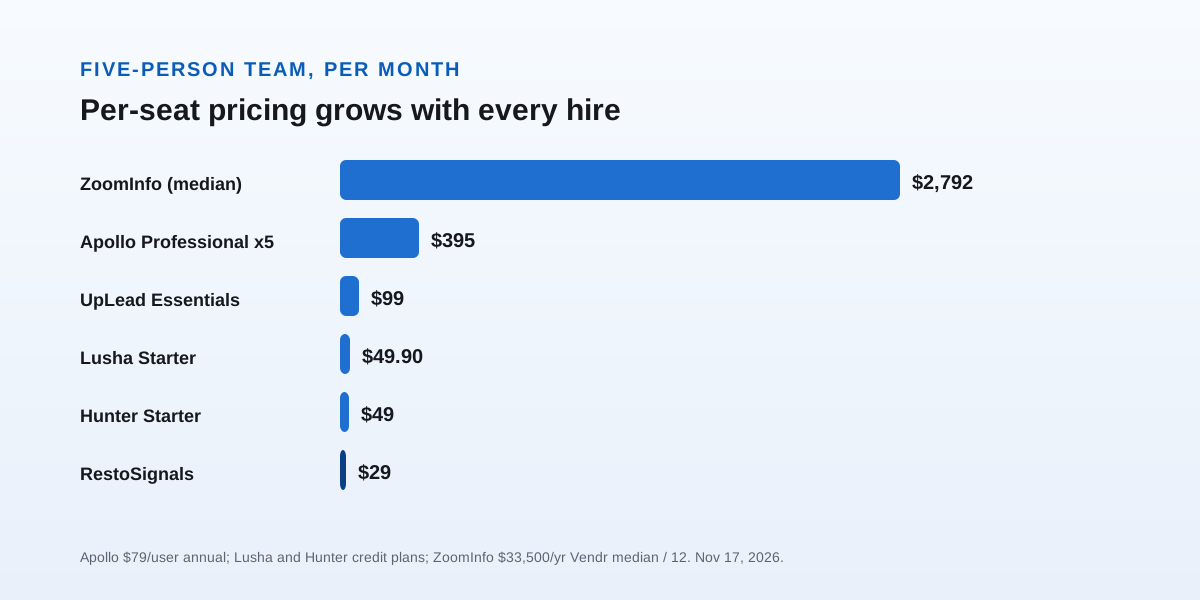
Per user is the catch for growing teams. Five reps on Professional is $395 a month, or $4,740 a year, before add-ons.
Apollo’s FAQ describes the free plan as for “Exploring Apollo or very light usage.”
That’s cheap next to ZoomInfo. It’s not cheap if most of the contacts you unlock for restaurants are generic emails.
What are the best Apollo.io alternatives for restaurant sales?
The best Apollo.io alternatives for restaurant sales split into two groups. General contact databases, such as Lusha, Hunter, UpLead and ZoomInfo, work like Apollo and share its blind spot for independent restaurants. Restaurant-specific sources, such as Orbital, RestaurantData.com and RestoSignals, are built from restaurant records, so they cover independents and new openings but nothing else.
Here are the seven I’d look at.
1. Lusha
Lusha has a free plan with 40 credits a month. Starter costs $49.90 a month for 400 credits, or $37.45 a month billed annually.
An email costs 1 credit and a phone number costs 5. It’s strongest for direct lines at restaurant groups and franchise offices.
2. Hunter
Hunter is an email finder, not a full database. The free plan gives 50 credits a month, and Starter is $49 a month for 2,000 credits, or $34 a month billed yearly.
It finds emails by domain, so it only helps once a restaurant has a website. For owners using a personal address, it can’t help.
3. UpLead
UpLead starts at $99 a month for 170 credits, or $74 a month billed annually. The 7-day trial has 5 credits.
One credit unlocks a contact with email and direct dial, and UpLead says it verifies emails with “a data accuracy rate of 95%.”
4. ZoomInfo
The enterprise option. ZoomInfo doesn’t publish prices, and Vendr reports a median contract of $33,500 a year.
It’s deeper than Apollo on large companies, including restaurant chains. I covered it in my ZoomInfo alternatives guide.
5. Orbital
Orbital lists more than 632,000 active US restaurants and verifies each against at least two sources. Owner contacts unlock after signup, and pricing comes from a demo.
It’s the best fit for selling to restaurants that are already open.
6. RestaurantData.com
The restaurant-specific incumbent. It sends 350 to 600 new US restaurant leads a week and says about 85% are found 2 to 12 weeks before opening.
National coverage, quote-only. I compared it in detail here.
7. RestoSignals
My product. It reads liquor license applications, food permits and business filings daily in seven states, matches them into one venue per address and scores how close each is to opening.
It costs $29 a month, not per user, and every lead carries the owner’s name from the filing.
How do the Apollo alternatives compare side by side?
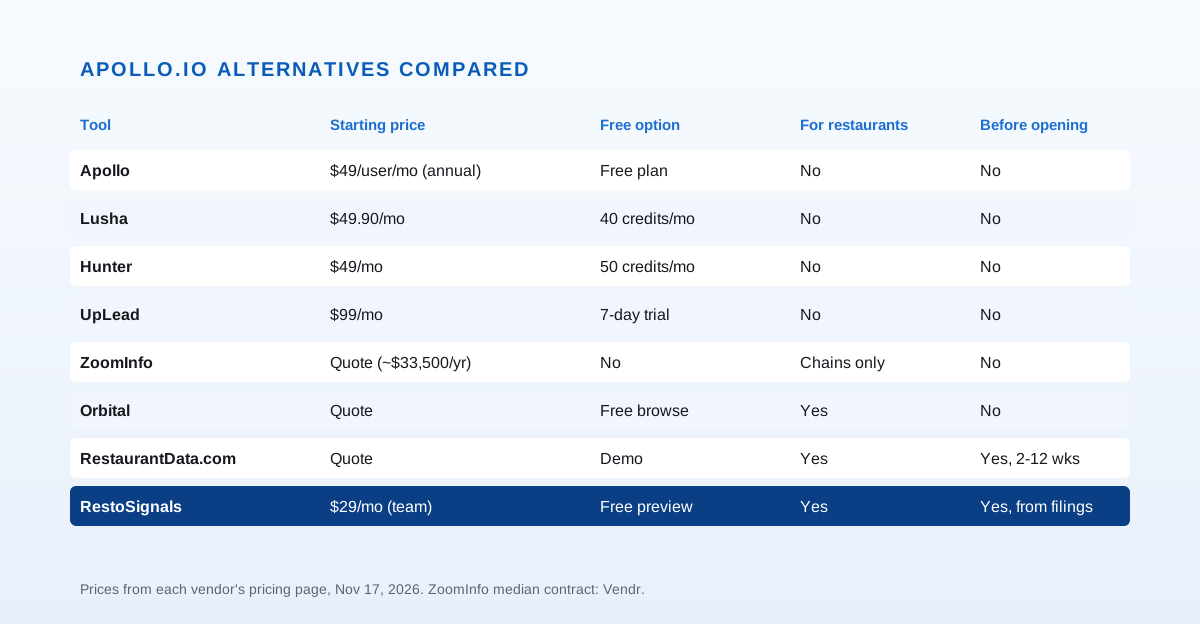
Side by side, the general databases compete with Apollo on price and features, while the restaurant tools compete on coverage. Apollo, Lusha, Hunter, UpLead and ZoomInfo all cover every industry. Orbital, RestaurantData.com and RestoSignals cover only restaurants, and only RestaurantData.com and RestoSignals focus on venues before they open.
| Tool | Starting price | Free option | Built for restaurants | Finds restaurants before opening |
|---|---|---|---|---|
| Apollo | $49/user/month (annual) | Free plan | No | No |
| Lusha | $49.90/month | 40 credits/month | No | No |
| Hunter | $49/month | 50 credits/month | No | No |
| UpLead | $99/month | 7-day trial | No | No |
| ZoomInfo | Quote (median $33,500/yr, Vendr) | No | Chains only | No |
| Orbital | Quote | Free browse | Yes | No |
| RestaurantData.com | Quote | No (demo) | Yes | Yes, mostly 2-12 weeks out |
| RestoSignals | $29/month | Free preview | Yes | Yes, from filings |
If you sell to other industries too, stay with a general tool. Apollo is hard to beat on price.
If restaurants are your whole market, look at the last two columns first.
How much would a five-person team pay?
For a five-person sales team, Apollo Professional costs $395 a month billed annually, because it’s priced per user. Lusha and Hunter price by credits instead, starting under $50 a month. RestoSignals costs $29 a month for the whole team. ZoomInfo’s median contract, according to Vendr, works out to about $2,792 a month.
Per-seat pricing grows with every hire. Credit pricing grows with every contact you unlock.
For restaurant sales, the better question is cost per usable owner contact. A cheap credit that returns info@ costs more than it looks.
Here’s how I’d test any tool before paying:
- Pick 20 restaurants in your territory, half open and half about to open.
- Search each one in the tool’s free plan or trial.
- Count how many return the owner, not a generic inbox.
- Divide the monthly price by that number, times your monthly volume.
What do you give up when you leave Apollo?
You give up an all-in-one workflow when you leave Apollo. It combines a contact database, email sequences, a dialer, CRM sync and a Chrome extension in one plan. Most alternatives do one of those. If your team sells to many industries and lives in Apollo’s sequences, replacing it means stitching two or three tools together.
So don’t rip it out if it works for most of your pipeline.
A common setup is Apollo for chains and head offices, plus a restaurant-specific source for independents. The restaurant data feeds names into Apollo’s sequences, and you keep the workflow.
The mistake is paying for more Apollo seats to fix a coverage problem. More seats search the same database.
How do you find restaurant owner contacts without Apollo?
You find restaurant owner contacts without Apollo by starting from public filings. Liquor license applications name the applicant company, state business records name the owner or registered agent, and some filings include a mailing address or phone. For new restaurants, these filings are the only records that exist, often months before opening.
Here’s the process:
- Pull pending liquor applications for your territory, such as the California ABC or Texas TABC data.
- Drop renewals and transfers. You want new businesses.
- Look up each applicant company in the state’s business records.
- Take the owner’s name, and a mailing address where the filing has one.
- Reach out during the buildout, before vendors are chosen.
It’s free. It also takes a few hours a week per territory.
In a 2025 survey of 220 restaurant operators by Preopening Restaurants Resource, reported by Restaurant Technology News, 71% said they start choosing main vendors more than 90 days before opening. That company sells pre-opening leads, so treat the number as a vendor’s survey. The direction matches what I see in the filings.
Which Apollo alternative fits your restaurant sales team?
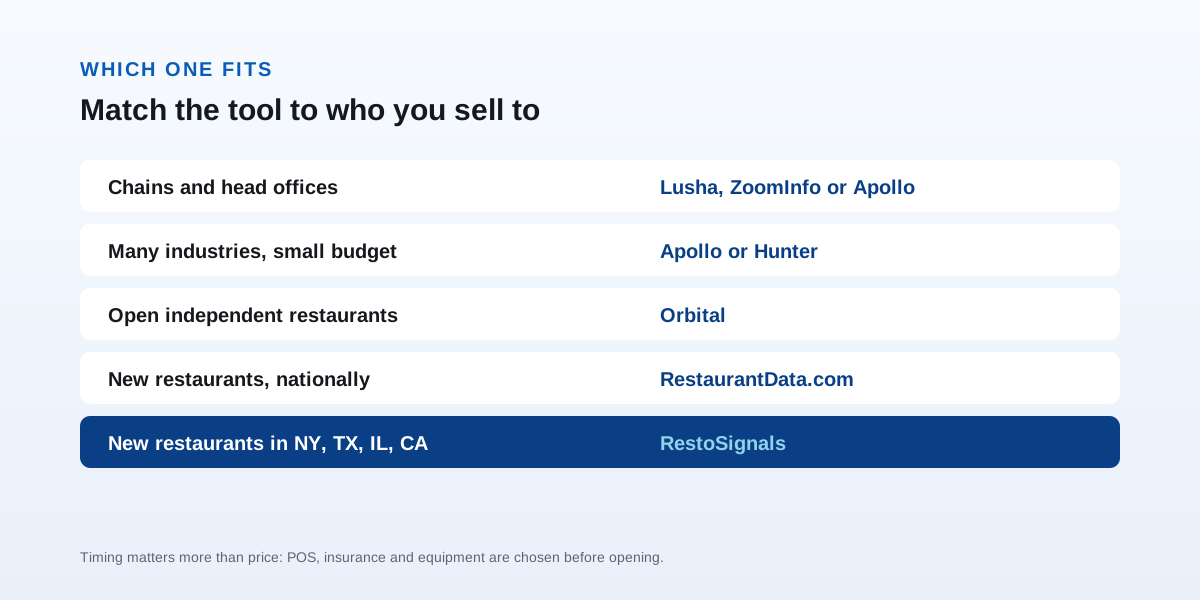
The right Apollo alternative depends on which restaurants you sell to and when they buy. For chains and franchise offices, Lusha or ZoomInfo. For open independents, Orbital. For new restaurants nationally, RestaurantData.com. For new restaurants in New York, Texas, Illinois or California, RestoSignals. If you sell to every industry, keep Apollo.
Timing decides it more than price.
If you sell something restaurants replace every few years, like linen or cleaning, an open-restaurant list works. If you sell something bought once before opening, like POS, insurance, equipment or a beverage program, you need the restaurant before it opens.
- Chains and head offices: Lusha, ZoomInfo or Apollo.
- Many industries on a budget: Apollo or Hunter.
- Open independent restaurants: Orbital.
- New restaurants nationally: RestaurantData.com.
- New restaurants in NY, TX, IL or CA: RestoSignals.
Frequently asked questions
What is the best alternative to Apollo.io?
It depends on who you sell to. For general B2B prospecting on a budget, Lusha (from $49.90 a month), Hunter (from $49) and UpLead (from $99) are the usual picks. For restaurants, use a restaurant-specific source: Orbital or RestaurantData.com for open restaurants, and RestaurantData.com or RestoSignals for restaurants before they open.
Is there a cheaper alternative to Apollo?
Apollo is already one of the cheapest contact databases, with a free plan and paid plans from $49 per user a month billed annually. Hunter starts at $34 a month billed yearly and Lusha at $37.45. If you sell to new restaurants, RestoSignals costs $29 a month and isn’t priced per user.
Does Apollo have restaurant owner contacts?
For chains and restaurant groups with a head office, often yes. For independent restaurants, coverage is thin, because Apollo builds its data from business contacts, email activity and the public web, and many independent owners use a personal email and no sales tools. A restaurant that hasn’t opened usually isn’t there at all.
How much does Apollo.io cost?
Apollo has a free plan, then Basic at $49, Professional at $79 and Organization at $119 per user a month billed annually, with Organization requiring at least three users. Monthly billing costs more. Credits are granted each billing cycle and unused credits don’t roll over.
Why is Apollo data inaccurate for small businesses?
Apollo says it has 240 million contacts built from a network of 2 million contributors, email activity, web crawling and data partners. Small businesses show up less in those sources, so records are thinner and older. Reviewers and competitors’ tests report generic info@ emails and switchboard numbers for local businesses instead of the owner.
How do I find contact information for a new restaurant owner?
Use the filings the restaurant has to make before opening. Liquor license applications name the applicant company, state business records name its owner or registered agent, and some filings carry a mailing address or phone. In New York City, 60% of pending restaurant liquor applications from August to November 2026 had no trade name yet, so no database could match them by name.
Test 20 restaurants before you pay for anything
Pick 20 restaurants in your territory, half open and half about to open, and search them in Apollo’s free plan and two alternatives. Count the owner contacts, not the records. Or see this week’s new venues on RestoSignals free and compare.
Mukul Dutt is the founder of RestoSignals, which tracks restaurants and bars before they open by fusing public liquor, permit and business-filing records into one scored venue with owner contact. Prices are from each vendor’s pricing page as of November 17, 2026; Apollo’s database and accuracy figures are from its own information page. New York City figures are from the State Liquor Authority’s pending-application dataset on data.ny.gov for restaurant and food and beverage licenses received August 18 to November 13, 2026. Search volumes and costs per click are from DataForSEO, US, November 2026.
FAQ
What is the best alternative to Apollo.io?
It depends on who you sell to. For general B2B prospecting on a budget, Lusha (from $49.90 a month), Hunter (from $49) and UpLead (from $99) are the usual picks. For restaurants, use a restaurant-specific source: Orbital or RestaurantData.com for open restaurants, and RestaurantData.com or RestoSignals for restaurants before they open.
Is there a cheaper alternative to Apollo?
Apollo is already one of the cheapest contact databases, with a free plan and paid plans from $49 per user a month billed annually. Hunter starts at $34 a month billed yearly and Lusha at $37.45. If you sell to new restaurants, RestoSignals costs $29 a month and isn't priced per user.
Does Apollo have restaurant owner contacts?
For chains and restaurant groups with a head office, often yes. For independent restaurants, coverage is thin, because Apollo builds its data from business contacts, email activity and the public web, and many independent owners use a personal email and no sales tools. A restaurant that hasn't opened usually isn't there at all.
How much does Apollo.io cost?
Apollo has a free plan, then Basic at $49, Professional at $79 and Organization at $119 per user a month billed annually, with Organization requiring at least three users. Monthly billing costs more. Credits are granted each billing cycle and unused credits don't roll over.
Why is Apollo data inaccurate for small businesses?
Apollo says it has 240 million contacts built from a network of 2 million contributors, email activity, web crawling and data partners. Small businesses show up less in those sources, so records are thinner and older. Reviewers and competitors' tests report generic info@ emails and switchboard numbers for local businesses instead of the owner.
How do I find contact information for a new restaurant owner?
Use the filings the restaurant has to make before opening. Liquor license applications name the applicant company, state business records name its owner or registered agent, and some filings carry a mailing address or phone. In New York City, 60% of pending restaurant liquor applications from August to November 2026 had no trade name yet, so no database could match them by name.
Find venues opening near you
100 free leads, no card. One platform for restaurants & bars about to open.