Restaurant email list: what $17,999 buys and what it misses
What a restaurant email list really costs, how fast it decays, why it misses new restaurants, and where to get owner contacts from public filings instead.
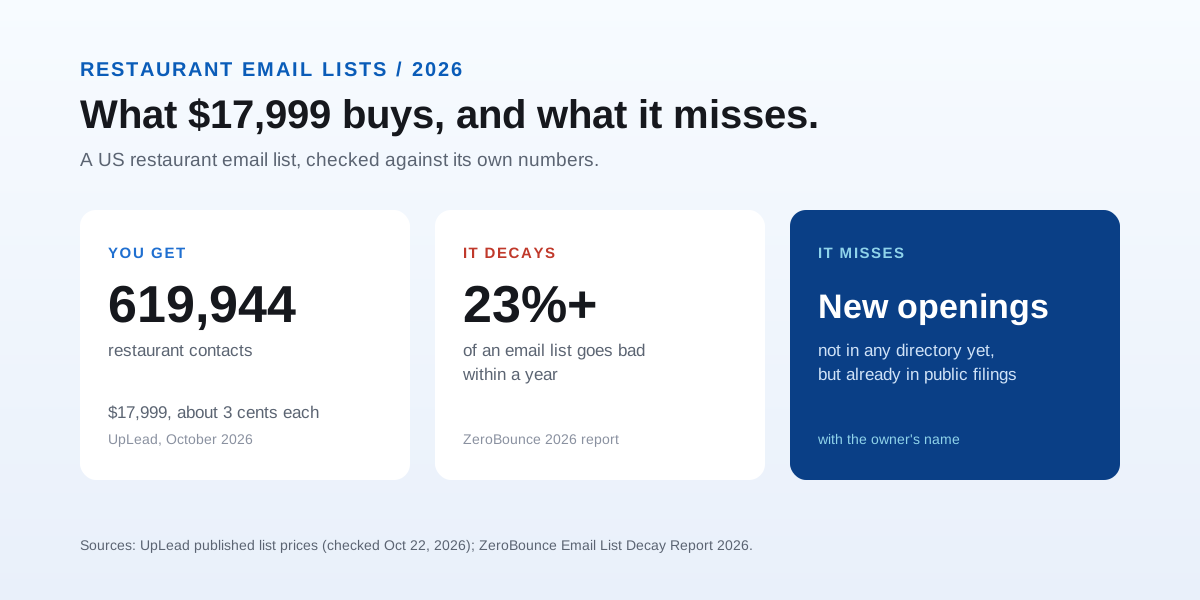
A US restaurant email list costs $17,999.
I checked. That’s UpLead’s price for 619,944 restaurant contacts, as of this week.
A restaurant email list is a database of existing restaurants with contact names and emails, sold by data vendors for a few cents to a few dollars per contact. It’s fine for reaching restaurants that are already open. It goes stale fast, at least 23% a year by ZeroBounce’s count, and it misses restaurants that haven’t opened yet, because those aren’t in any directory. For those, public filings name the owner months earlier, for free.
I run RestoSignals, which builds owner contacts from public liquor, permit and business filings. We don’t sell email addresses. So take this as a comparison from someone who chose the other route, and I’ll show you both.
Where do you get a restaurant email list?
You get a restaurant email list from one of four places: a B2B data vendor such as UpLead or Saleshandy, a scraping tool that pulls restaurants from maps and directories, your own customer and prospect records, or public filings that name restaurant owners. Vendors are fastest. Filings are slowest to work with but free, and the only one that finds restaurants before they open.
The vendors dominate the search results.
UpLead sells pre-built lists by state and country. Saleshandy sells access through a lead finder with credits. BizKonnect builds custom lists on request.
Scrapers are the do-it-yourself version. HasData, for example, walks through pulling restaurants from Google Maps, directories and restaurant websites, then extracting emails.
I don’t use that route. Our rule at RestoSignals is no scraping of Google, Yelp or LinkedIn for contacts. The filings already name the owner, so there’s no need.
How much does a restaurant email list cost?
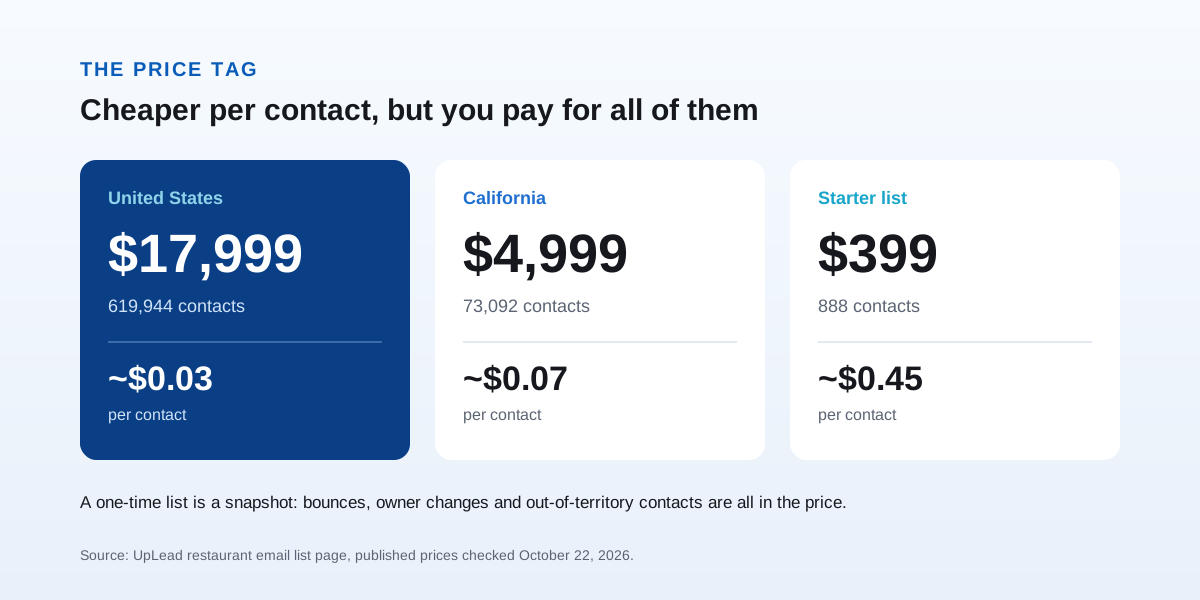
A restaurant email list costs anywhere from about 3 cents to 45 cents per contact, depending on size. In October 2026, UpLead charged $17,999 for its full US list of 619,944 restaurant contacts, $4,999 for 73,092 California contacts, and $399 for a starter list of 888. Credit-based tools like Saleshandy price by usage instead of by list.
The math on UpLead’s published prices:
| List | Contacts | Price | Per contact |
|---|---|---|---|
| United States | 619,944 | $17,999 | about $0.03 |
| California | 73,092 | $4,999 | about $0.07 |
| Starter | 888 | $399 | about $0.45 |
Three cents sounds cheap. But you pay for every contact, including the ones that bounce, the ones that changed owners, and the ones you’ll never sell to.
And a one-time list is a snapshot. It doesn’t refresh itself next month.
Territory matters too. If you only cover Los Angeles, the California list still sells you San Francisco, San Diego and every small town in between, and you pay for all 73,092.
How accurate are restaurant owner email lists?
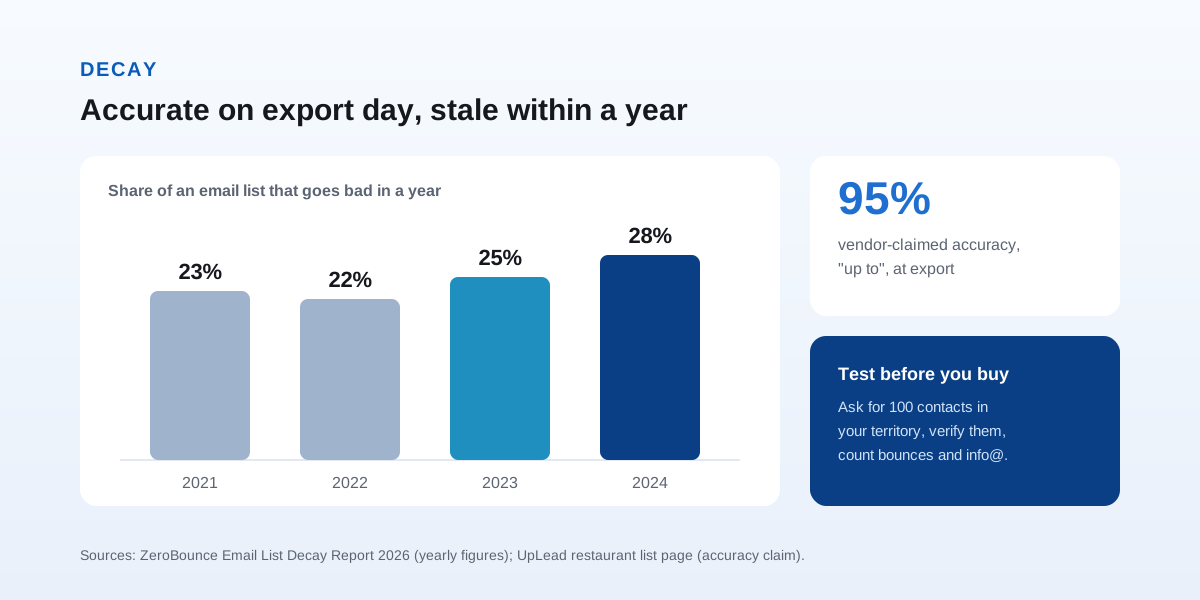
Restaurant owner email lists are accurate when exported and decay quickly after. Vendors claim high accuracy at the moment of export, UpLead says up to 95%, but ZeroBounce’s 2026 report found at least 23% of an email list goes bad within a year, up to 28% in its 2024 data. Restaurants churn owners and managers faster than most businesses, so plan on it.
The ZeroBounce Email List Decay Report is based on the email addresses it verified across 2025.
Its yearly figures: 23% in 2021, 22% in 2022, 25% in 2023 and 28% in 2024.
There’s a second accuracy problem nobody prints on the box: a lot of restaurant emails are generic.
An info@ or reservations@ address reaches a host stand, not an owner. UpLead’s own page makes the point that its list targets owner and manager roles, “not a generic info@ inbox.”
So before you buy anything, do two things:
- Ask for a sample of 100 contacts in your territory.
- Run them through an email verifier and count the bounces and generic inboxes.
That 10-minute test tells you more than any accuracy badge.
If you do buy, ask the vendor five questions first:
- Where does the data come from? Two of the vendors I read don’t name their sources at all.
- When was this record last checked, and is it re-verified at export?
- What share of the emails are named owners or managers, and what share are info@ or generic?
- What happens when a contact bounces? Some offer replacements, some don’t.
- Can you reuse the list next year, or is it licensed for one campaign?
The answers to 1 and 3 matter most. A list that can’t say where it came from, or that’s mostly info@ addresses, is a list of front desks.
Why don’t email lists include new restaurants?
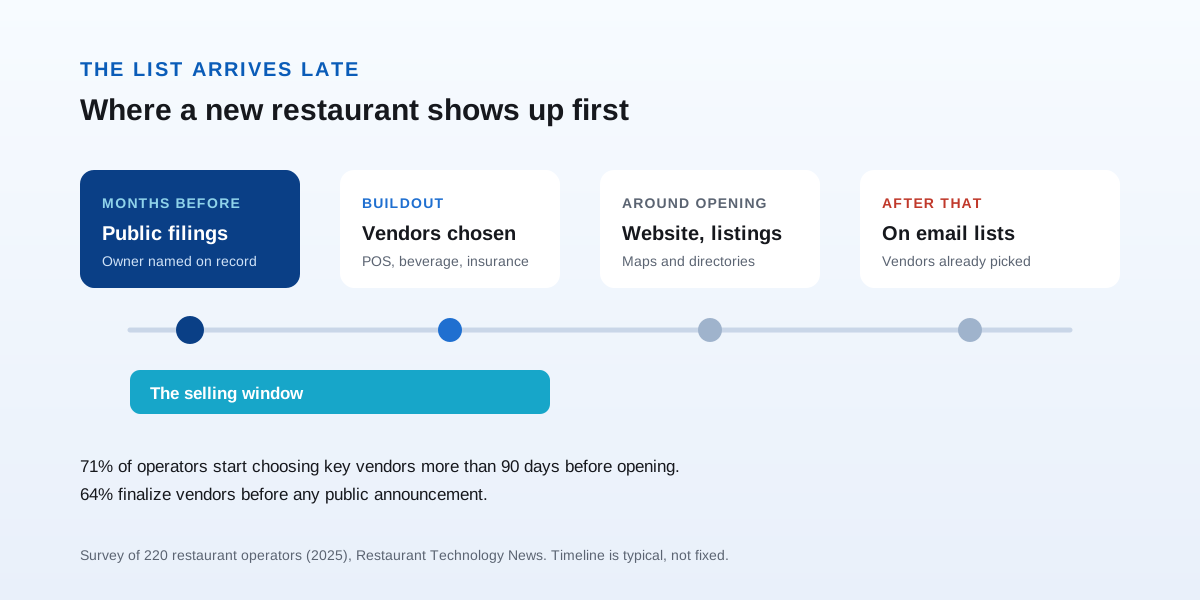
Email lists rarely include new restaurants because they’re built from websites, directories and maps listings, and a restaurant usually gets those around its opening. By then the big vendor decisions are made. In a 2025 survey of 220 operators, 71% said they start choosing key vendors more than 90 days before opening, and 64% finalize them before any public announcement.
That survey was reported by Restaurant Technology News.
The supply of new restaurants is big. Census counted 300,236 new business applications in accommodation and food services in 2025, from its Business Formation Statistics.
None of those show up in a list until they have a website or a listing. For a POS reseller, a distributor or an insurer, that’s backwards. The restaurants on the list already chose their vendors. The ones that haven’t chosen yet aren’t on it.
Where do owner contacts come from in public filings?
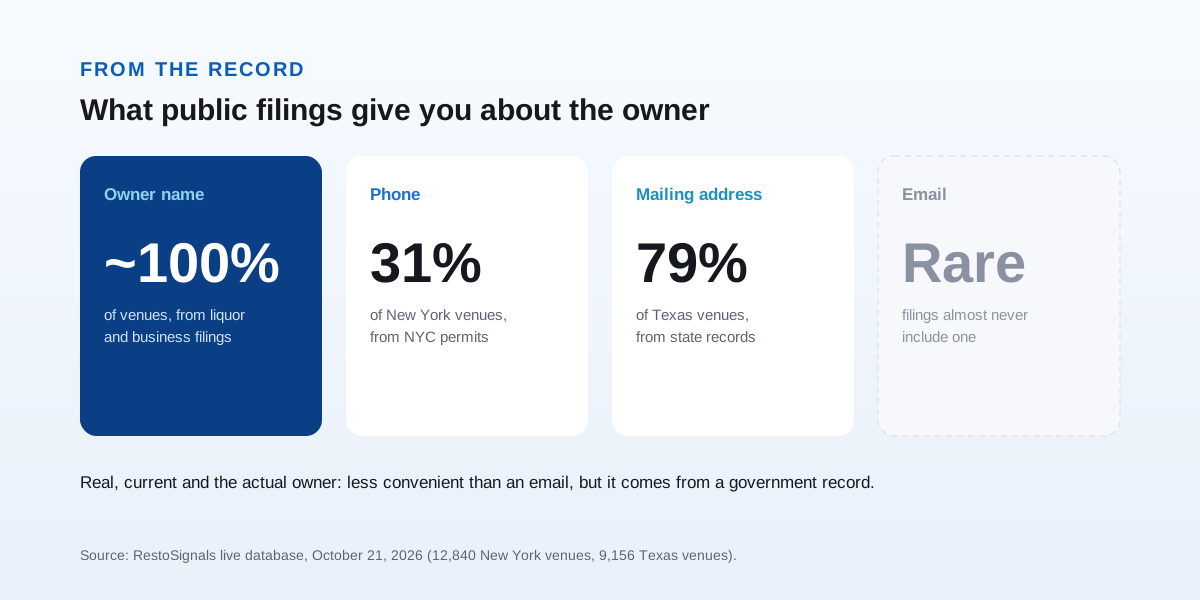
Owner contacts come from the filings a restaurant has to make before it opens. A liquor license application names the applicant, a business entity filing names the company and often a mailing address, and some city permits carry a phone number. In RestoSignals’ data, owner names are on almost every venue, about 31% of New York venues have a phone, and about 79% of Texas venues have an owner mailing address.
What each filing gives you, in the states we track:
| Filing | Owner name | Phone | Mailing address |
|---|---|---|---|
| Liquor license application (NY, TX, CA, Chicago) | Yes, the applicant | Rarely | Sometimes |
| NYC food service permit | Yes | Sometimes | No |
| Texas state records (TABC, Comptroller) | Yes | No | Often |
| New business entity filing | The company, sometimes a person | No | Often, as the registered or process address |
Those percentages come from our live database on October 21, 2026: 12,840 New York venues and 9,156 Texas venues.
You can check any one restaurant yourself. The New York State Liquor Authority, the TABC public inquiry, the California ABC license lookup and Chicago’s business license data all show the licensee, and the Texas and California searches include pending applications.
Notice what’s missing. Filings almost never include an email address.
That’s why we don’t sell emails. A name, a phone or a mailing address straight from a government record is less convenient than an email, but it’s real, it’s current, and it belongs to the actual owner.
Is it legal to cold email restaurant owners?
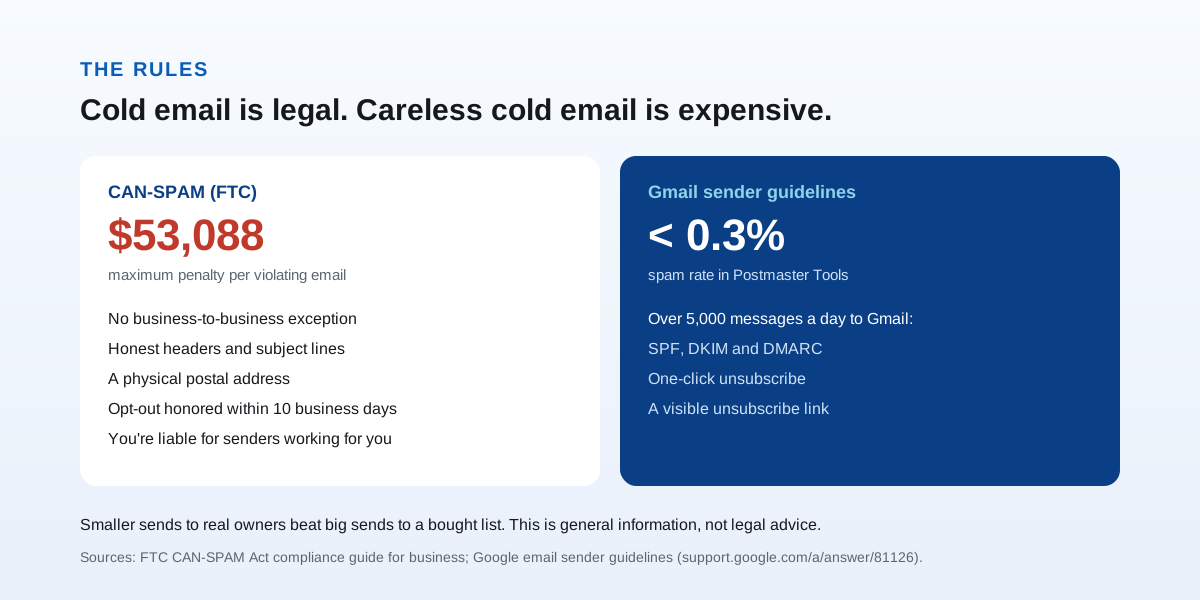
Cold emailing restaurant owners is legal in the US if you follow the CAN-SPAM Act, which makes no exception for business-to-business email. You need truthful headers and subject lines, a physical postal address, a clear way to opt out that you honor within 10 business days, and you must identify the message as an ad. Each violating email can cost up to $53,088.
Those rules are from the FTC’s CAN-SPAM compliance guide. The FTC also says you’re responsible for what anyone sends on your behalf.
Then there’s deliverability. Google’s sender guidelines say to keep your spam rate below 0.3% in Postmaster Tools, and anyone sending more than 5,000 messages a day to Gmail must set up SPF, DKIM and DMARC and support one-click unsubscribe.
Blast a bought list of 5,000 restaurants and you’ll find out fast where you stand.
I’m not a lawyer, and this isn’t legal advice. But the practical rule is simple: smaller, targeted sends to real owners beat big sends to a bought list, legally and in your inbox placement.
How do you reach a restaurant owner without an email address?
You reach a restaurant owner without an email by using what the filing gives you: a letter to the owner’s mailing address, a call to a permit phone number, a LinkedIn search by the owner’s name, or a visit to the site during buildout. For a restaurant that hasn’t opened, a short letter or a site visit often lands better than an email, because the owner’s inbox is full of contractors.
A few channels I’d use, in order:
- A letter to the filing address. Texas filings often carry one, and a real envelope with the venue’s address on it gets opened.
- A call to the permit phone, when there is one. NYC permits sometimes list it. Keep the call under a minute.
- A LinkedIn search for the applicant’s name plus the city, which usually finds them.
- The site itself. Buildouts usually have someone there during the week, so leave a card for the owner.
A message template that works for any of them:
Hi [owner’s first name], I saw the new liquor license application for [address]. Congrats on the new place. I help new restaurants in [neighborhood] get [what you sell] set up before opening day. Can I send you a one-page plan for your opening?
Mentioning the filing proves you’re not mass-mailing, which is the opposite of what a bought list signals.
Restaurant email list or public filings: which should you use?
Use a restaurant email list if you sell to restaurants that are already open and you can live with decay and generic inboxes. Use public filings if you sell what restaurants buy before opening, such as POS, payments, beverage, insurance or equipment, because filings find them months earlier and name the owner. Many teams use both: the list for the installed base, filings for new accounts. Insurance agents can use the same filings to quote a restaurant’s first policy, which I covered in commercial insurance leads.
| Source | Finds new restaurants | Owner named | Email included | Refreshes | Cost |
|---|---|---|---|---|---|
| Bought email list | Rarely | Sometimes | Yes | No, it’s a snapshot | $399 to $17,999+ |
| Credit-based lead finder | Rarely | Sometimes | Yes | On each search | Per credit |
| Scraped from maps and sites | Only once listed | Rarely | Often generic | When you re-run it | Low, plus your time |
| Public filings, done yourself | Yes, months early | Yes | Almost never | Weekly, if you pull it | Free, hours per week |
| RestoSignals | Yes | Yes | No | Daily | $29 a month |
That last row is my product, so weigh it accordingly.
When does a bought list make sense? When you sell something every open restaurant needs and replaces on a cycle, such as linen service, pest control, grease trap cleaning or a software switch. Then the installed base is your market, and a fresh list of owners and managers is a fair shortcut.
When it doesn’t: when your product gets chosen once, during the buildout, and then stays for years. POS, payments, beverage contracts and insurance all work that way. For those, the list arrives after the decision.
Build your list from the filings, not the directory
A restaurant email list tells you who already opened. Filings tell you who’s about to. If you sell anything a restaurant buys before its first service, start from last week’s liquor license applications and permits, take the owner’s name and address from the record, and reach out during the buildout.
You can pull the filings yourself with the sources in my merchant services leads guide, which covers New York, Texas, California and Chicago. Or see this week’s new venues free, and unlock owner contacts for $29 a month.
Comparing general sales databases too? See ZoomInfo alternatives for selling to restaurants.
Mukul Dutt is the founder of RestoSignals, which tracks restaurants and bars before they open by fusing public liquor, permit and business-filing records into one scored venue with owner contact. Vendor prices were checked on October 22, 2026; coverage figures are from the live RestoSignals database on October 21, 2026.
FAQ
How much does a restaurant email list cost?
It depends on the vendor and the size. In October 2026, UpLead listed its full US restaurant list at $17,999 for 619,944 contacts, about 3 cents per contact, and a California-only list at $4,999 for 73,092. Smaller starter lists cost more per contact: $399 for 888 contacts is about 45 cents each. Other vendors price by credits or by quote.
Are restaurant owner email lists accurate?
Vendors claim high accuracy, often up to 95% at the time of export, but lists decay fast. ZeroBounce's 2026 report found at least 23% of an email list goes bad within a year, and restaurants change owners and managers often. Test a sample for bounces before you buy, and expect a year-old list to be noticeably worse.
Is it legal to cold email restaurant owners?
In the US, yes, if you follow the CAN-SPAM Act, which makes no exception for business-to-business email. You need honest headers and subject lines, a physical postal address, a working opt-out that you honor within 10 business days, and you must identify the message as an ad. Each violating email can cost up to $53,088. This is general information, not legal advice.
How do I find the owner of a restaurant?
For an open restaurant, check the state liquor license lookup and the business entity filing, which name the licensee and often a registered agent or mailing address. For a restaurant that hasn't opened yet, the same filings exist months earlier: liquor license applications, food permits and new business filings all name the applicant.
Do restaurant email lists include new restaurants?
Rarely. Most lists are built from websites, directories and maps listings, and a restaurant usually gets those near its opening. By then most vendor decisions are made: in a 2025 survey of 220 operators, 71% started choosing key vendors more than 90 days before opening. Public filings show new restaurants much earlier than any list.
Is there a free restaurant owner contact list?
Not a ready-made one, but the raw material is free. Liquor license applications, food permits and business filings are public records in most states, and they name the owner or applicant. New York, Texas, California and Chicago publish them online. The work is pulling them, removing renewals and matching filings for the same venue.
Find venues opening near you
100 free leads, no card. One platform for restaurants & bars about to open.