How much is a liquor license in Oklahoma? (2026)
A full-bar liquor license in Oklahoma costs about $1,375 to $1,530 a year, and beer and wine runs far less. Here's the 2026 cost by type, plus how to get one.
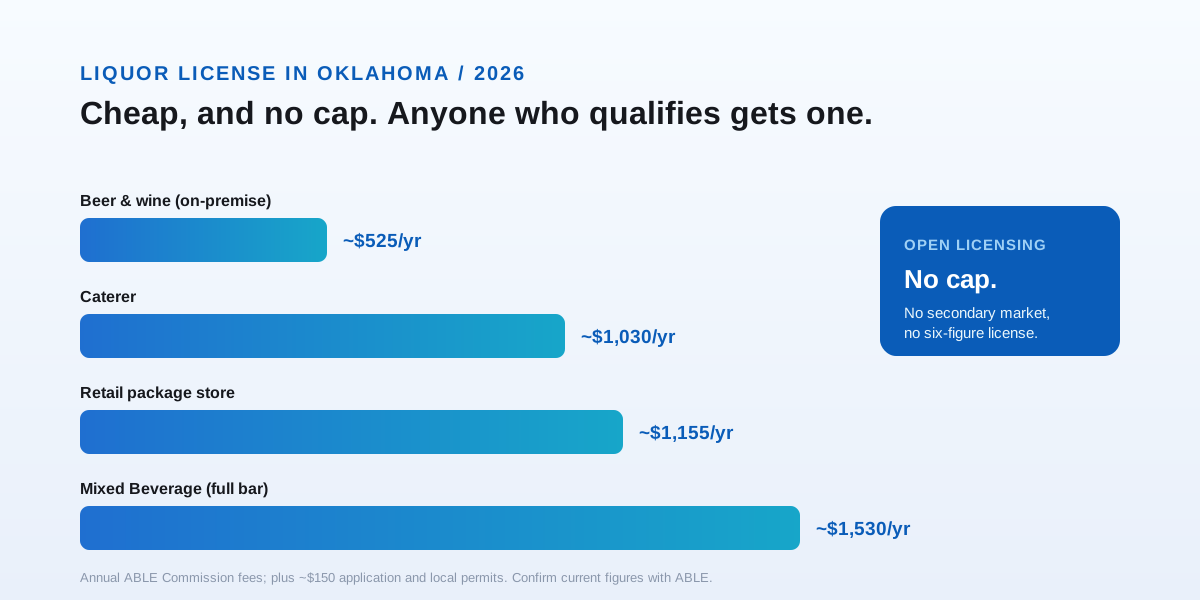
Good news if you’re opening a bar or restaurant in Oklahoma: the liquor license is cheap, and anyone who qualifies can get one.
That sounds obvious until you’ve seen New Jersey, where a license can cost over a million dollars because the state caps how many exist. Oklahoma caps nothing. You apply, you qualify, you pay a few hundred to a few thousand dollars, and you’re licensed.
A full-bar liquor license in Oklahoma costs about $1,375 to $1,530 a year, and beer and wine runs closer to $525. Here’s the real 2026 cost, by license type, plus exactly how to get one through the ABLE Commission.
How much is a liquor license in Oklahoma?
A Mixed Beverage license, the one a full-bar restaurant or bar needs, costs about $1,375 to $1,530 a year in Oklahoma, depending on how you count the $500 administrative fee and $25 surcharge on top of the base license. A beer-and-wine on-premise license is far cheaper at roughly $525 to $600. Because Oklahoma doesn’t cap licenses, that annual fee is close to your real cost, not a down payment.
So there are really two questions hiding in “how much.”
One is the annual state fee you pay the ABLE Commission to hold the license. That’s the number above.
The other is your total first-year cost once you add the application fee, local permits, and the required newspaper notice. More on that below, but it’s hundreds of dollars, not the six figures a quota state would demand.
Oklahoma ranks about 29th of 51 US jurisdictions on restaurant liquor license cost, with its $1,530 full-bar fee sitting just above the national median of $1,375, per liquorlicensecost.com. Middle of the pack, and nothing like the capped states.
Oklahoma liquor license cost by type
Oklahoma doesn’t issue one universal liquor license. The ABLE Commission issues a dozen types, and the right one depends on what you pour and whether customers drink on-site or carry it out. Here are the 2026 annual fees for the licenses a restaurant, bar, or store would actually use, drawn from current cost guides and the state fee schedule in 37A O.S. § 2-101.
| License type | Who it’s for | Annual fee (2026) |
|---|---|---|
| Mixed Beverage (MB) | Full bar: liquor, beer, wine by the drink | ~$1,375 - $1,530 |
| Beer & Wine on-premise | Restaurant serving beer and wine only | ~$525 - $600 |
| Caterer (CAT) | Serving alcohol at catered events | ~$775 - $1,030 |
| Retail Package Store (RPS) | Liquor store, spirits to go | ~$1,075 - $1,155 |
| Retail Beer & Wine | Grocery/convenience store, off-premise | ~$300 - $500 |
| Brewer / Small Brewer | On-site brewery, taproom | $1,250 / ~$160 |
| Winemaker / Distiller | Winery / distillery | $625 / $3,125 |
A couple of things worth knowing before you pick.
The cheapest real path for a restaurant is the beer-and-wine on-premise license. At roughly half the Mixed Beverage fee, it covers any concept that doesn’t need cocktails.
The published figures vary by source because of that $500 administrative fee and $25 surcharge that ride on top of the base license, per koronaPOS. The ABLE Commission’s current fee schedule is the number to budget against, so confirm it before you file.
Two details save money. Renewals run a little cheaper than the first year, since the Mixed Beverage and Caterer licenses drop by about $100 after the initial issuance. And a Retail Package Store fee scales with city population, so the same license costs less in a small town than in Oklahoma City or Tulsa.
The good news: Oklahoma doesn’t cap its licenses
The single biggest thing that makes a liquor license cheap or ruinously expensive is whether the state runs a quota, and Oklahoma doesn’t. The ABLE Commission issues a license to anyone who meets the requirements and pays the fee, so there’s no fixed pool of licenses and no secondary market bidding the price into the six figures. That’s the opposite of a capped state.
This is the part that trips up operators who’ve read horror stories.
In New Jersey or California, a town can hit its license cap and the only way in is to buy someone else’s license for hundreds of thousands of dollars. What a liquor license costs nationally swings from $25 to over $1 million almost entirely because of this.
Oklahoma sits on the cheap end. You’re paying a government fee, not buying a scarce asset. Your budget is the license fee plus some paperwork, full stop.
That’s also why the state fee is close to your real number here. In a quota state the fee is a rounding error next to the license. In Oklahoma the fee basically is the license.
What it really costs: beyond the state fee
The annual license fee isn’t your whole first-year bill. Add the ABLE application fee, local permits, a required newspaper notice, and background-check costs, and a realistic first-year total for a full-bar Oklahoma restaurant runs a few thousand dollars, more than the $1,530 license alone. Still modest, but budget for the extras so nothing stalls your opening.
Here’s what stacks on top.
The ABLE application carries a non-refundable processing fee around $150, and it’s not returned if you’re denied.
Every owner, officer, and manager needs a background check, roughly $75 per person through the OSBI, plus individual employee licenses around $33 each for staff who serve.
Your city or county charges its own business or occupancy permit, usually $100 to $500. Oklahoma City runs about $200 and Tulsa about $250.
And you have to publish a Notice of Intention in a local legal newspaper, which carries a small publication cost and a waiting period most first-timers forget to schedule.
One cost you won’t pay: there’s no statewide bond requirement for a standard on-premise license, unlike some states.
Put it together and a full-bar Oklahoma City restaurant looks at roughly $1,530 for the state license, $150 to apply, about $200 for the city permit, $75 per owner for the background check, and a small publication fee. Call it $2,000 to $2,500 in the first year before insurance, well under a thousand in a quota state’s worst case.
What changed in 2018, and why it matters
Oklahoma’s alcohol rules today come from a 2018 overhaul, so older advice you’ll find online is often wrong. State Question 792 modernized the system: it ended low-point 3.2 beer, let grocery and convenience stores sell full-strength beer and wine, allowed cold beer sales, and moved licensing to the ABLE Commission’s current structure. That’s why the license types above look nothing like Oklahoma’s pre-2018 setup.
For a new operator, three changes matter most.
Regular-strength beer and wine now sell under standard licenses, so you don’t hunt for a separate low-point permit the way you once did.
Grocery and convenience stores became real competitors for off-premise sales, which reshaped where a package store makes sense.
And the whole process moved online to the Accela portal, with walk-in filing now gone, so anything describing a paper application at an ABLE counter is out of date.
How do you get a liquor license in Oklahoma?
You get an Oklahoma liquor license by clearing local requirements first, then filing with the state through the ABLE Commission’s online Accela portal. The local steps, zoning, a public notice, and a Certificate of Compliance, have to happen before the state will issue, so sequence matters. Rush to file online before the local pieces are done and your application stalls.
Here’s the order that actually works.
-
Check zoning before you sign a lease. Confirm the site is zoned for alcohol sales, and watch the 300-foot rule: a school or church within 300 feet can block the location, per koronaPOS. This is the cheapest mistake to avoid and the most expensive to miss.
-
Publish a Notice of Intention. Run notice in a local legal newspaper twice, about eight days apart, and keep the Proof of Publication affidavit. It gives the public a window to object.
-
Get a Certificate of Compliance. Your city clerk or county commissioners issue it after checking zoning, fire, and safety codes. There’s usually no fee, but it’s a required attachment.
-
Assemble your documents. You’ll need a premises diagram, entity paperwork, a lease of at least one year, a Statement of Financing, and proof of liability insurance.
-
File through Accela. Create an account, complete the application and a personal-history questionnaire for every owner and manager, upload documents, and pay online. Paper and walk-in filings are no longer accepted, per the ABLE Commission.
-
Pass the background check and inspection. ABLE runs background checks, which can involve fingerprinting, then inspects the finished premises before emailing your license.
How long does it take to get a liquor license in Oklahoma?
Plan for 30 to 60 days of ABLE processing on a clean application, and about 8 to 10 weeks start to finish once you include the local steps. Complications stretch it to 12 to 16 weeks, and an application someone formally opposes, triggering a hearing, can run five months or more. The newspaper notice and Certificate of Compliance are the parts that quietly eat weeks, so start them early.
The practical move is to run the local track and the state track in parallel where you can.
While your Certificate of Compliance is in process, line up your documents and start your Accela account. Don’t wait for one step to fully finish before prepping the next.
And remember the sequence is non-negotiable: you can’t get the state license until the local approval is in hand, so a delay at the city clerk’s office delays everything downstream.
Can you buy an existing Oklahoma liquor license?
No. Oklahoma ABLE licenses are not transferable, so buying an existing bar or restaurant does not transfer the seller’s license to you. You apply for your own new license from scratch, even if the location has been serving alcohol for years. That surprises buyers who assume the license comes with the business.
This is actually a feature of an open-licensing state, not a bug.
Because there’s no cap, there’s no reason for a resale market. You don’t need to buy a license from anyone, because the state will issue you a fresh one for the standard fee.
So when you’re pricing an acquisition, value the business and the lease, not the liquor license. The license is yours to apply for, at the ordinary ABLE fee, the same as a brand-new venue.
Bottom line: Oklahoma is a cheap, open license
If you’re opening in Oklahoma, budget about $1,375 to $1,530 a year for a full Mixed Beverage license, or roughly half that for beer and wine, plus a few hundred dollars in application, local, and publication fees. There’s no cap, no secondary market, and no six-figure surprise. If your menu doesn’t need spirits, the beer-and-wine license is the easy money-saver, and you can always upgrade later. Start the zoning check and Certificate of Compliance early, because the local steps, not the state fee, are what decide how fast you open.
The liquor license is also the first public sign a venue is coming, which is why it’s worth filing right. For the national picture on what these licenses cost and why they swing so wildly, see how much a liquor license costs, and for the full opening budget, what it costs to open a restaurant.
Mukul Dutt is the founder of RestoSignals, which tracks restaurants and bars before they open by fusing public liquor, permit, and business-filing records into one scored venue. He works with liquor-licensing data across US states every day.
FAQ
How much is a liquor license in Oklahoma?
A Mixed Beverage license, the one a full-bar restaurant or bar needs, costs about $1,375 to $1,530 a year through the Oklahoma ABLE Commission, depending on how the $500 administrative fee and $25 surcharge are counted. A beer-and-wine on-premise license is cheaper at roughly $525 to $600. Oklahoma caps nothing, so the state fee is close to the real cost, not a down payment on a six-figure license.
What is the cheapest liquor license in Oklahoma?
An on-premise beer-and-wine license is the cheapest way to serve alcohol in an Oklahoma restaurant, at about $525 to $600 a year versus $1,375 to $1,530 for a full Mixed Beverage license. A caterer license runs about $775 to $1,030. If your concept works without spirits, beer and wine cuts your licensing cost by more than half and simplifies the application.
How do I get a liquor license in Oklahoma?
Apply through the ABLE Commission's online Accela portal after you clear local steps. First check zoning (a school or church within 300 feet can block the site), publish a Notice of Intention in a local newspaper twice, and get a Certificate of Compliance from your city or county. Then file online with your lease, premises diagram, and financing statement, pass a background check, and pass a premises inspection.
How long does it take to get a liquor license in Oklahoma?
Plan for 30 to 60 days for a clean application, and 8 to 10 weeks start to finish once you add the local steps. Complications push it to 12 to 16 weeks, and an opposed application with a hearing can take five months or more. The newspaper notice and Certificate of Compliance happen before you file with the state, so start them early.
Can you buy an existing liquor license in Oklahoma?
No. Oklahoma ABLE licenses are not transferable, so buying an existing bar or restaurant means applying for your own new license, not taking over the seller's. That's different from quota states like New Jersey or California, where a capped license trades for six figures. In Oklahoma there's no secondary market, because the state issues a license to anyone who qualifies.
Do you need a liquor license to serve beer in Oklahoma?
Yes. Serving any alcohol on-site in Oklahoma requires an ABLE license, but beer and wine fall under a separate, cheaper on-premise license than full spirits. Since Oklahoma ended low-point 3.2 beer with the 2018 reforms, regular-strength beer is sold under standard licenses. If you only plan to pour beer and wine, you don't need the more expensive Mixed Beverage license.
Find venues opening near you
100 free leads, no card. One platform for restaurants & bars about to open.