How much does it cost to open a restaurant? (2026)
The median US restaurant costs about $375,000 to open, but the real range runs from $175,000 to over $750,000. Here's the full 2026 cost breakdown, line by line.
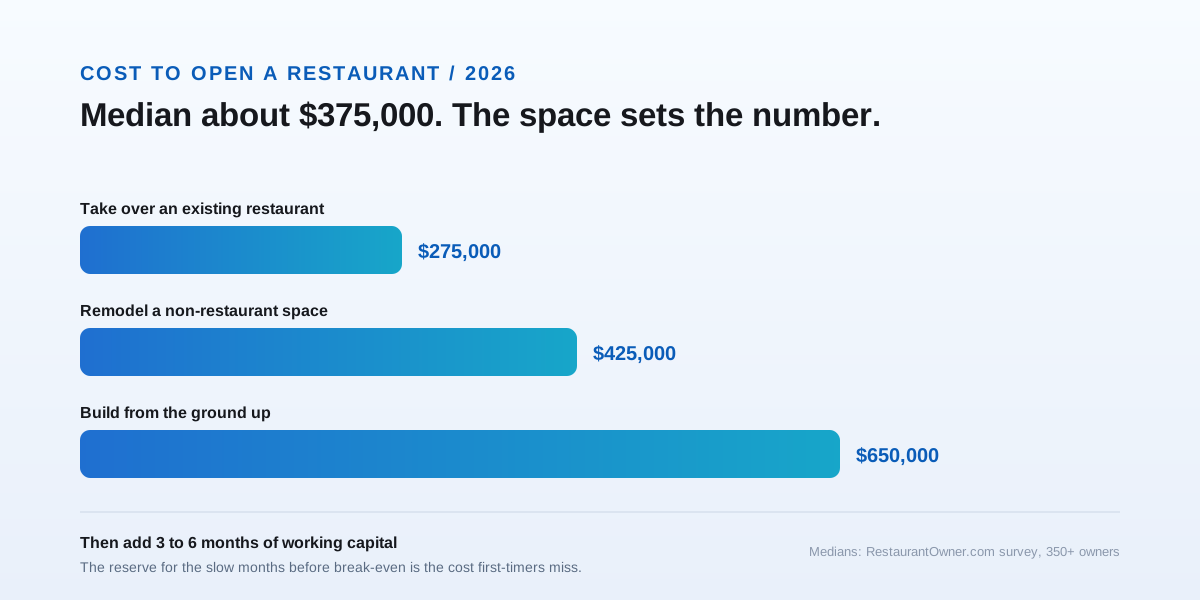
The honest answer is a number most guides bury: about $375,000.
That’s the median for a US independent restaurant, from a survey of more than 350 owners. But the median hides a huge spread, and the spread is the real story.
Some people open for $50,000. Some spend $2 million. What decides where you land isn’t luck, it’s a handful of choices you make before you sign anything. Here’s the full 2026 breakdown, line by line, and the one decision that cuts the cost the most.
How much does it cost to open a restaurant in 2026?
The median cost to open a restaurant in 2026 is about $375,000, with the middle half of restaurants landing between $175,000 and $750,000. That figure comes from a RestaurantOwner.com survey of more than 350 independent owners, cited by DoorDash and matched by Square’s 2026 guidance. The full range runs wider, from under $175,000 for a small spot to well over $1 million in a major city.
So “it depends” is the truthful answer, but it depends on specific things.
Three choices set your number before anything else: your format, your space, and your city.
A food truck and a 150-seat full-service restaurant are both “a restaurant,” and one costs ten times the other. Get those three choices right and you control most of the budget.
Why the range is so wide: what actually drives the cost
The cost swings so much because two decisions dominate everything else: what format you open and what kind of space you take over. A food truck skips the dining room, the full kitchen build, and most of the staff. A ground-up full-service build pays for all three. Everything else, equipment, licenses, tech, is real money but smaller, and it mostly follows from those first two choices.
Format is the first lever.
A delivery-only or ghost-kitchen model needs no dining room, no front-of-house staff, and no customer-facing furnishings, per CloudKitchens. A full-service dine-in concept pays for all of it.
Space is the second, and it’s bigger than most people expect.
Building a kitchen from an empty shell means installing a grease hood, a grease trap, gas lines, and heavy electrical, which are the single most expensive things in the whole project. Taking over a space that already has them skips the worst of the bill.
City is the third. Rent, permits, and liquor licensing in a dense metro can double a budget that would be modest in a smaller market.
Cost to open a restaurant by type
Your format sets the floor. A food truck opens for a fraction of a full-service restaurant because it skips the dining room, the large kitchen build, and most of the staff. Here’s what each format typically costs in 2026, per Square’s startup-cost guide, with full-service concepts topping $1 million in major cities.
| Format | Typical cost to open (2026) | Why |
|---|---|---|
| Food truck | $50,000 - $200,000 | Vehicle, kitchen install, permits, mobile POS; no dining room |
| Quick-service / fast casual | $150,000 - $300,000 | Smaller footprint, limited seating, simpler kitchen |
| Full-service restaurant | $300,000 - $750,000+ | Full kitchen, dining room build-out, bar, more staff |
| Franchise | $250,000 - $1,000,000+ | Franchise fees plus build-out, offset by proven systems |
A few things worth knowing before you pick a lane.
The food truck and quick-service ranges overlap, because a bare-bones quick-service counter can cost less than a fully built truck. Format is a guide, not a guarantee.
Full-service is where a bar and liquor license enter the picture, and both push the number up fast. In a dense city, a full-service concept routinely passes $1 million.
Where the money goes: a line-item breakdown
Inside any restaurant budget, the build-out and kitchen eat the largest share, and everything else is smaller but adds up fast. Restaurant construction runs $100 to $800 per square foot, with the kitchen driving most of it, and kitchen equipment adds tens of thousands more. Below is where a typical opening budget goes, with 2026 figures drawn from Square, Resy, and the RestaurantOwner.com survey.
| Line item | Typical 2026 cost | Notes |
|---|---|---|
| Build-out / construction | $100 - $800 per sq ft | Kitchen drives it; a cafe without a full kitchen runs $50 - $200 |
| Kitchen & bar equipment | $30,000 - $150,000 | Survey median about $95,000; used gear cuts it 30 - 60% |
| Grease hood + grease trap | $15,000 - $70,000 | Hood $10k - $50k, trap $5k - $20k+; skipped if the space has them |
| Rent + deposit | $2,000 - $12,000/mo + 1 - 3 mo deposit | Aim for rent plus utilities at 5 - 10% of forecast sales |
| Licenses & permits | $2,000 - $25,000 | Liquor license can run far higher in quota states |
| POS & technology | $1,000 - $10,000 | First-year hardware plus software |
| Initial inventory | $5,000 - $25,000 | Food, beverage, and smallwares to open |
| Pre-opening labor & training | Varies | Payroll before you take a single order |
The pattern is clear once you see it.
Build-out and kitchen equipment together are usually more than half the budget. That’s why the space you choose matters more than any other decision.
The rent line hides a cash trap too. Signing a lease rarely means one month’s rent; landlords usually want first month, a one-to-three-month security deposit, and sometimes last month and a broker’s fee, all due before you’ve sold a thing. On a $6,000 space that’s $20,000 or more out the door at signing.
The licenses line looks small, but it hides its own trap. A liquor license is a few hundred dollars in most states and six figures in a quota state like New Jersey or California. What a liquor license actually costs is worth checking before you sign a lease, not after.
The cost everyone underestimates: working capital
The number first-time owners miss isn’t on the build-out list at all: it’s the cash to survive the months before the restaurant turns a profit. Most restaurants take 6 to 18 months to reach break-even, and bars and fine dining often need 18 to 24, per Katalystos. Underestimating that gap is the most common way a restaurant with good food still runs out of money.
Resy recommends setting aside three to six months of operating expenses as working capital. That’s on top of the build-out, not inside it.
Here’s why it bites. You’ve spent your whole budget getting open. Then the first few months are slow while word spreads, and payroll, rent, and food costs don’t wait. Without a reserve, a good restaurant dies in month four.
The first month is also messy by design. You overproduce and waste food, or you underproduce and can’t keep up, per TouchBistro. Neither is a failure; both cost money you have to have on hand.
So the real budget is a formula: startup total, plus three to six months of operating costs, plus a contingency buffer on top of both. Nearly every experienced owner surveyed says the project cost more than they planned.
The single biggest way to open for less
If you want to cut the cost of opening a restaurant, take over a space that was already a restaurant. The RestaurantOwner.com survey puts the median at about $275,000 for remodeling an existing restaurant, versus $425,000 for a non-restaurant space and $650,000 for ground-up construction. A former restaurant already has the hood, the grease trap, the plumbing, and often the permits, which are the most expensive and slowest things to add.
That one choice can save you $150,000 to $375,000 against building new.
It saves time too. The hood, the gas lines, and the health and building permits are the parts that take months. Inheriting them means you open sooner, which shortens the runway you need to fund.
The trade-off is fit. You take the previous kitchen’s layout and quirks. For most first-time owners, the savings are worth the compromise, and a second-generation space is the single most common way experienced operators keep a budget down.
Leasing equipment instead of buying, and opening with a smaller menu, are the next two levers once you’ve picked the space.
Do most new restaurants fail in the first year?
No. The claim that 90% of restaurants fail in their first year is a myth with no study behind it. Real first-year closure is far lower, with research putting it around 17% to 26%, and the cumulative three-year rate near 57 to 61%, per Katalystos. Most closures trace back to running out of cash, not to bad food, which is exactly why the working-capital reserve matters.
The myth does real damage, because it scares people into either not starting or underplanning.
The truer picture: a well-funded restaurant with a clear concept has a solid chance of lasting. An underfunded one with great food often doesn’t. The difference is usually the reserve, not the recipes.
If you want the fuller picture on openings, closures, and demand, our 2026 restaurant industry statistics pulls the real numbers together.
How do most people pay for it?
Almost nobody funds a restaurant from savings alone. Most openings combine personal cash with an SBA 7(a) loan, a bank or equipment loan, and sometimes outside investors or partners. Equipment financing and leasing are common because the gear holds resale value, so lenders treat it as collateral. The mix matters: debt you have to service from day one raises the working-capital reserve you need.
Think about the order you spend it, too.
A loan funds the build-out, but the lean months after opening are what eat your own cash. Lenders look closely at whether you’ve reserved for that gap on top of the construction.
Equipment financing is the easiest piece to arrange, since the equipment secures the loan. Buying used or leasing frees up cash for the reserve, which is almost always the better trade for a first location.
And watch the soft costs that loans rarely cover: architecture and engineering fees, a lease broker’s cut, and site work like parking or signage. They’re easy to leave out of a budget and they add up to real money before you serve a plate.
How to budget your restaurant opening
Build your number in three layers. Start with the startup total for your format and space, using the ranges above, around $275,000 if you take over an existing restaurant and $650,000 or more if you build from scratch. Add three to six months of operating costs as working capital. Then add a contingency buffer of 10 to 20 percent, because nearly every owner spends more than planned.
A concrete example: take over a former restaurant for $275,000, add roughly $120,000 for six months of operating costs, then a 15 percent buffer, and you’re really funding about $455,000, not the $275,000 on the build-out quote. That’s the number that keeps you open.
Then get real quotes before you commit a dollar.
The ranges here are planning numbers. Your actual cost depends on your lease, your contractor bids, and your equipment quotes, so get all three for your specific site.
The restaurants that make it aren’t the ones that spent the least. They’re the ones that funded the whole picture, the build-out and the lean months after, and left room for the surprise that always comes. Budget for the slow months after you open, because that gap is what sinks good restaurants.
Mukul Dutt is the founder of RestoSignals, which tracks restaurants and bars before they open by fusing public liquor, permit, and business-filing records. He works with the same opening data that drives these costs every day.
FAQ
How much does it cost to open a small restaurant?
A small full-service restaurant usually costs $175,000 to $400,000 to open, and a quick-service spot runs about $150,000 to $300,000, per Square's 2026 guide. The biggest variable is your space: taking over a former restaurant can cut the total to around $275,000, while a ground-up build pushes it past $650,000. A food truck is the cheapest entry at $50,000 to $200,000.
How much money do I actually need to open a restaurant?
More than the build-out alone. Plan for the startup total plus three to six months of working capital, then add a contingency buffer on top. Most restaurants take 6 to 18 months to reach break-even, per Katalystos, so the cash to survive the slow early months is the number first-timers miss. Underfunding that reserve is the most common way a good restaurant still runs out of money.
What is the biggest cost when opening a restaurant?
The build-out, almost always. Restaurant construction runs $100 to $800 per square foot, with the kitchen driving most of it. A commercial grease hood alone can cost $10,000 to $50,000, and kitchen equipment adds $30,000 to $80,000 for a typical spot. Rent, deposits, and licenses come next. Location and build type move the total more than anything else.
Is it cheaper to buy an existing restaurant or build a new one?
Taking over an existing restaurant space is far cheaper. The RestaurantOwner.com survey puts the median at about $275,000 for remodeling an existing restaurant, versus $425,000 for a non-restaurant space and $650,000 for ground-up construction. A former restaurant already has the hood, grease trap, plumbing, and often the hardest permits, which are the most expensive pieces to add from scratch.
How much does a restaurant liquor license cost?
A liquor license costs a few hundred dollars a year in open-licensing states and over $1 million in quota states where licenses are capped and traded on a secondary market. It's one line item in your opening budget, but in a quota state it can outweigh your rent. See our full guide on what a liquor license actually costs before you sign a lease.
Do most new restaurants fail in the first year?
No. The claim that 90% of restaurants fail in year one is a myth with no supporting study. Real first-year closure is far lower, with studies putting it around 17% to 26%, and the cumulative three-year rate near 57 to 61%, per Katalystos. Most closures trace to undercapitalization, not bad food, which is why the working-capital reserve matters so much.
Find venues opening near you
100 free leads, no card. One platform for restaurants & bars about to open.