How much is an Illinois liquor license? (2026)
An Illinois liquor license costs $750 a year at the state level, but Chicago adds $4,400 every two years. Real 2026 costs, approval times, and every step.
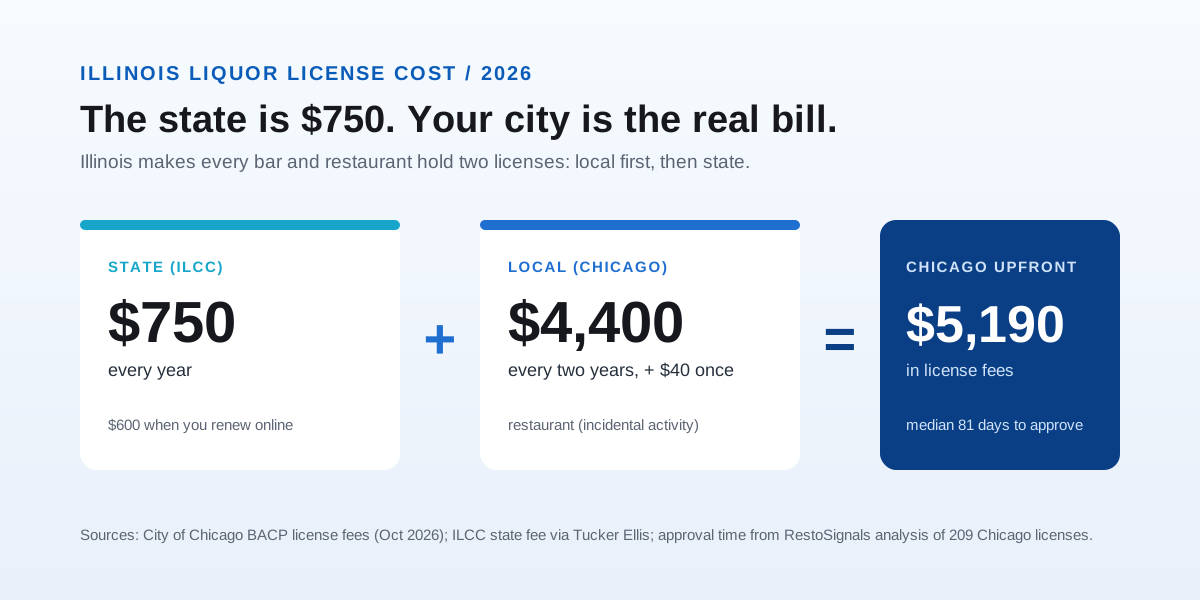
If you’re opening a restaurant in Illinois, the state liquor license is the cheap part.
It’s $750. The expensive part, and the slow part, is your city.
An Illinois liquor license costs $750 a year at the state level, or $600 when you renew online, but you also need a local license first, and that’s where the real money and the real wait sit. In Chicago, a restaurant license costs $4,400 plus a $40 fee every two years. When I analyzed 209 new Chicago restaurant licenses, approval took a median of 81 days.
I track liquor filings for a living at RestoSignals, and Illinois is one of the states where we watch every new application. So I’ll give you the official fees, plus what the filing data actually shows about timing.
How much is an Illinois liquor license?
An Illinois liquor license costs $750 a year for the state retailer’s license, the one every bar and restaurant needs, or $600 if you renew online. But Illinois makes you get a local license first, and local fees run from a few hundred dollars in small towns to $4,400 every two years in Chicago. So your real cost is the state fee plus whatever your city charges.
The state fee comes from the Illinois Liquor Control Commission (ILCC).
It’s $750 when you apply and $600 for online renewals, according to Chicago liquor attorney Ashley Brandt of Tucker Ellis. It renews every year.
The local fee is set by your city, village, or county. And it’s often bigger than the state fee.
Bloomington, for example, charges a $400 non-refundable application fee before you even get to the annual license fee, per the city’s liquor licensing page. Chicago is the big one, and I’ll break it down next.
How much is a liquor license in Chicago?
A Chicago restaurant needs a Consumption on Premises-Incidental Activity license, which costs $4,400 plus a one-time $40 publication fee and renews every two years, according to the City of Chicago’s Department of Business Affairs and Consumer Protection (BACP). Add the $750 state license and a new Chicago restaurant pays about $5,190 in license fees upfront, before insurance, permits, or legal help.
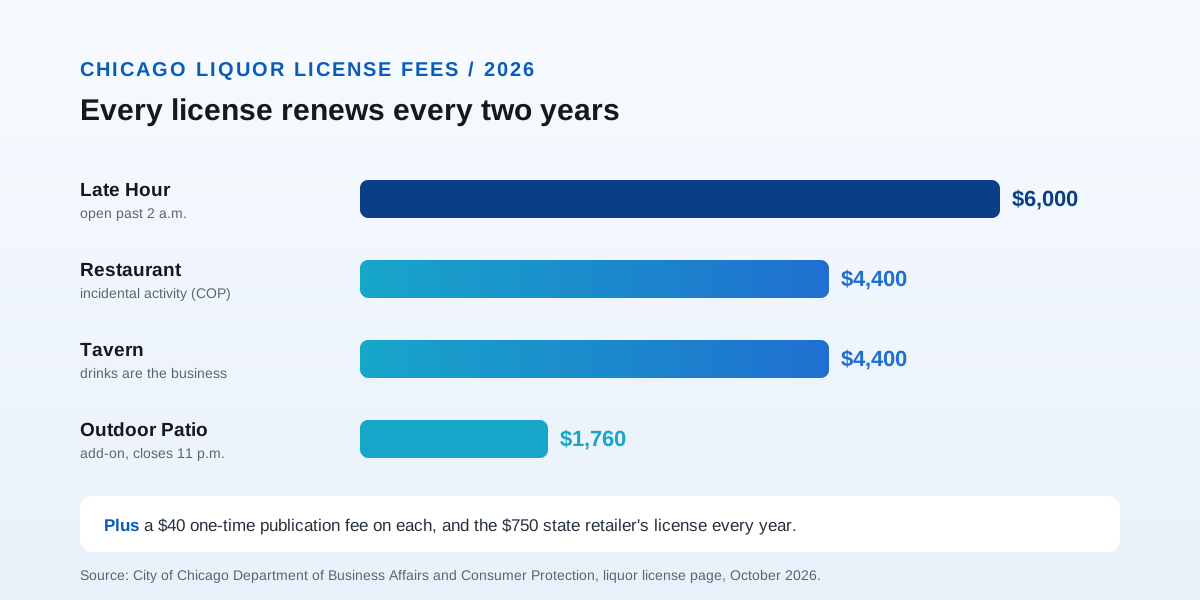
Here’s the full menu, straight from the City of Chicago’s liquor license page as of October 2026.
| Chicago license | Who needs it | Fee (2-year term) |
|---|---|---|
| Consumption on Premises-Incidental Activity | Restaurants, hotels, banquet halls, theaters, bowling alleys | $4,400 + $40 |
| Tavern | Bars, pubs, lounges, nightclubs where alcohol is the main business | $4,400 + $40 |
| Late Hour (secondary) | Staying open past the 2 a.m. closing time | $6,000 + $40 |
| Outdoor Patio (secondary) | Serving on a private patio next to a licensed premises | $1,760 + $40 |
| State retailer’s license (ILCC) | Every on-premise seller, statewide | $750/year |
Notice the Tavern and restaurant licenses cost the same.
The difference is what the city lets you do.
With a restaurant license, alcohol has to be secondary to food. A Tavern license is for places where drinks are the business, and Chicago restricts new ones much more tightly.
Spread over two years, the Chicago restaurant license works out to about $2,200 a year. Add the state renewal and you’re paying roughly $2,800 to $2,950 a year to keep serving.
The patio is the add-on people forget.
It closes at 11 p.m. Sunday through Thursday and midnight on weekends, and the Late Hour license doesn’t extend to it.
Why do you need two liquor licenses in Illinois?
You need two liquor licenses in Illinois because the state uses a dual licensing system. Your city, village, or county issues a local license first, and only then will the Illinois Liquor Control Commission issue its state retailer’s license. The local license decides whether you can operate at your address. The state license makes it legal statewide. Lose either one and you stop serving.
You can’t apply to the state first and hope the city catches up. The ILCC wants a copy of your local license in the state application, per Illinois liquor attorney Sean O’Leary.
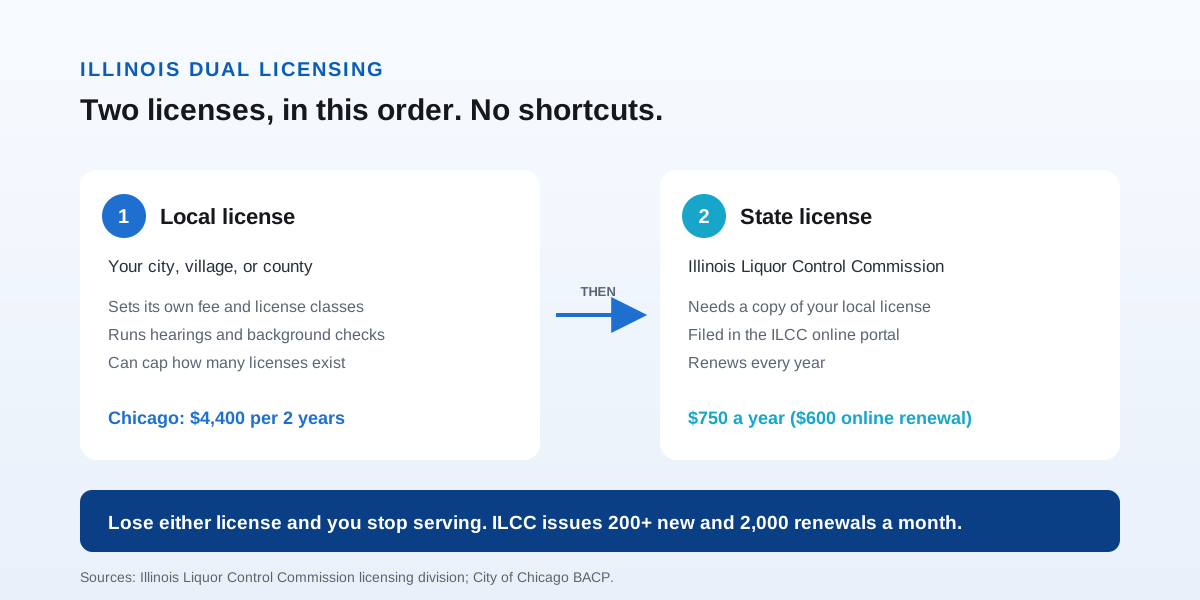
The state side has gotten easier. The ILCC moved all licensing to its new Illinois Liquor Control and Compliance Portal in 2026, and its licensing division issues more than 200 new state licenses and 2,000 renewals every month across 39 license categories, per the ILCC.
The local side is less predictable. State law lets every city and village set its own fees, hearing schedule, and even a cap on how many licenses exist. So Illinois isn’t a quota state, but your town might be.
Towns even disagree on whether a license survives a sale. Crystal Lake makes a new owner file a fresh application and go before the city council. Joliet lets the local liquor commissioner approve a transfer. If you’re buying an existing restaurant, ask the clerk which kind of town you’re in before you sign.
How long does it take to get a liquor license in Illinois?
Getting a liquor license in Illinois usually takes two to five months, and almost all of that is the local approval. In our analysis of 209 new Chicago restaurant liquor licenses issued from October 2025 to October 2026, the median was 81 days from application to approval. The middle half took 54 to 148 days, and 42 of them, about 1 in 5, took more than six months.
I pulled every new liquor license Chicago issued over the past 12 months from the City of Chicago’s business license dataset, then measured the days from application to approval.
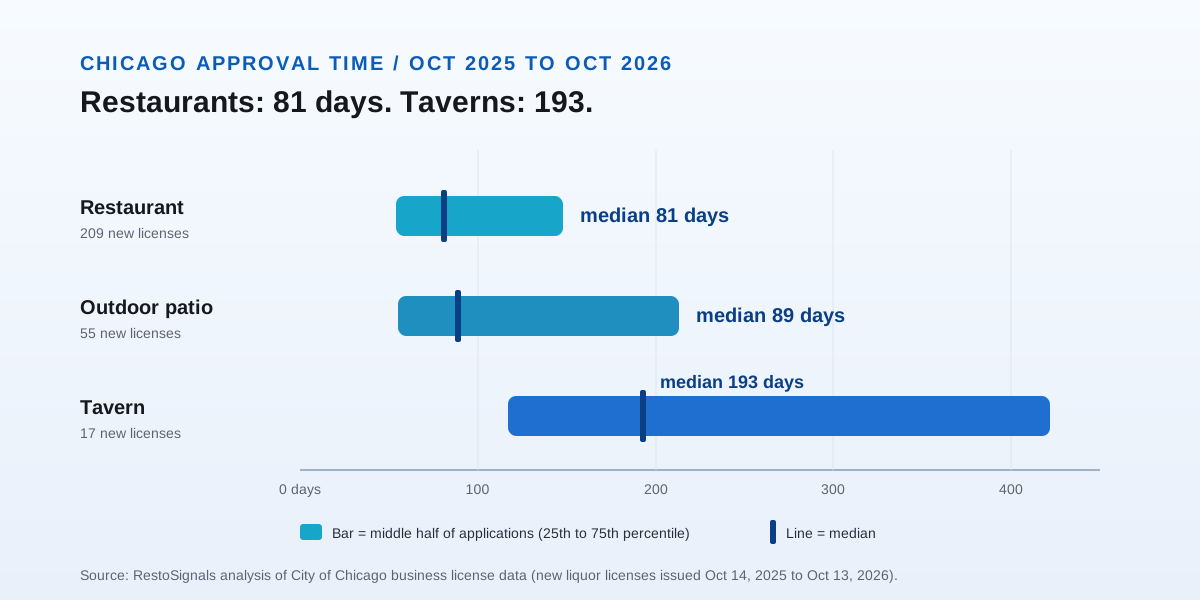
Restaurants got through fastest, at a median of 81 days, and the quickest quarter were done in under 54.
Taverns took far longer. Only 17 new tavern licenses were issued all year, and the median wait was 193 days. A quarter of them took more than 422 days.
If drinks are your main business, plan on six months or more, and ask your alderman early.
Patios landed in the middle, at a median of 89 days across 55 new licenses.
Outside Chicago, timing depends on how often your local commission meets.
Bloomington tells applicants to expect at least two months from its submission deadline to issuance. A town that hears applications once a month can add weeks on its own.
The state step is the quick one. Once you hold the local license, O’Leary puts the state wait at about 2 to 3 days in his experience.
How do you get a liquor license in Chicago, step by step?
To get a liquor license in Chicago, meet a BACP business consultant, clear zoning, then file and pay. Within 30 days you submit the required documents. The city notifies your alderman, the police commander, and every registered voter within 250 feet, who have 35 days to object in writing. Then come fingerprint checks and health, fire, and building inspections before the license is issued.
The order below comes from the City of Chicago’s steps page and its licensing requirements.
- Meet a BACP hospitality business consultant about your ownership, concept, and exact address.
- Get zoning approval for liquor at the site.
- File the application and pay the fee.
- Submit the required documents within 30 days, including your lease, floor plan, financial disclosure, liquor liability insurance, and a BASSET server-training certificate.
- The city notifies your alderman, the district police commander, and registered voters within 250 feet.
- Neighbors have 35 days from filing to object in writing.
- Controlling owners get a fingerprint-based background check, and all city debt must be paid.
- BACP, Health, Fire, and Buildings inspect the premises.
- The license is issued, and you apply for the $750 state license.
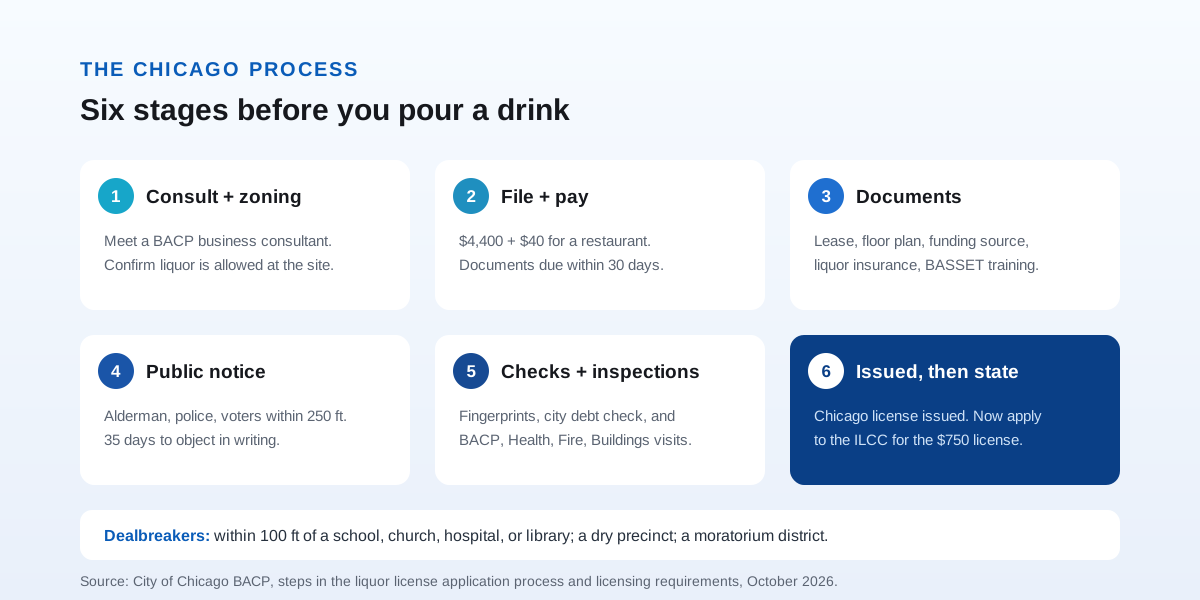
Location rules can kill a deal before you file. Chicago won’t issue a liquor license within 100 feet of a school, church, hospital, home for the aged, or library without a distance reduction. And some precincts have voted themselves dry, so no license can be issued there at all.
Then there are moratorium districts. These block new consumption-on-premises or package-goods licenses in specific stretches of a ward.
Chicago’s moratorium lookup map shows them by address, and BACP still tells you to call and confirm.
Check the map before you sign a lease, not after. Landlords don’t always know.
What other costs come with an Illinois liquor license?
The license fees are only part of the cost. Illinois requires liquor liability coverage, with 2026 dram shop limits of $90,411.55 per injured person and $110,503 for loss of support. Chicago also requires BASSET training for servers, a separate food license, and a Public Place of Amusement license if you host live music or games. Budget for insurance and training before the license arrives.
Under Illinois law, a bar or restaurant can be sued if it serves someone who then injures another person. The ILCC adjusts the caps every year for inflation, and for 2026 they’re $90,411.55 per person for injury or property damage and $110,503 for loss of support, per the ILCC’s dram shop page.
Your insurer prices your policy around those limits. Chicago won’t accept your application without proof of that insurance.
Server training comes next. Chicago lists a BASSET certificate among the required documents, so get your staff certified while the application is in review, not after.
And if you plan a DJ, live band, or a couple of arcade machines, you’ll need a Public Place of Amusement license too. It’s a separate application.
What’s the cheapest way to serve alcohol in Illinois?
The cheapest way to serve alcohol in an Illinois restaurant is usually BYOB, where it’s allowed, followed by a beer-and-wine license. Chicago doesn’t regulate BYOB at all, so a Chicago restaurant can let guests bring their own bottle without a liquor license. Many suburbs do license it, though. Bloomington charges $250 a year for a BYOB restaurant license versus $900 for beer and wine.
Chicago’s position is written right on its licensing page. The city says it doesn’t regulate BYOB, but the business is still responsible for keeping minors from drinking and for stopping guests from over-drinking.
That gives a new Chicago restaurant a cheap way to open. You can run BYOB first and apply for a full license once the numbers justify $4,400.
The suburbs are different.
Bloomington’s licensing page lists a $100 application fee and a $91 background check per owner for BYOB license types, then $250 a year.
Its beer-and-wine restaurant license runs $900 a year. St. Charles has its own BYOB license classes too.
So check your town before you assume BYOB is free. In a lot of Illinois, it’s licensed, just cheaply.
The catch with BYOB is that you aren’t selling alcohol, so drinks earn you nothing. If you want bar revenue, you need a real license.
Where are new liquor licenses being issued in Chicago?
New Chicago restaurant liquor licenses are concentrated downtown and on the near northwest side. Of the 209 issued between October 2025 and October 2026, the Near North Side led with 42, followed by West Town with 20, the Loop with 18, the Near West Side with 16, and Logan Square with 15. Those five areas took more than half of all new restaurant licenses.
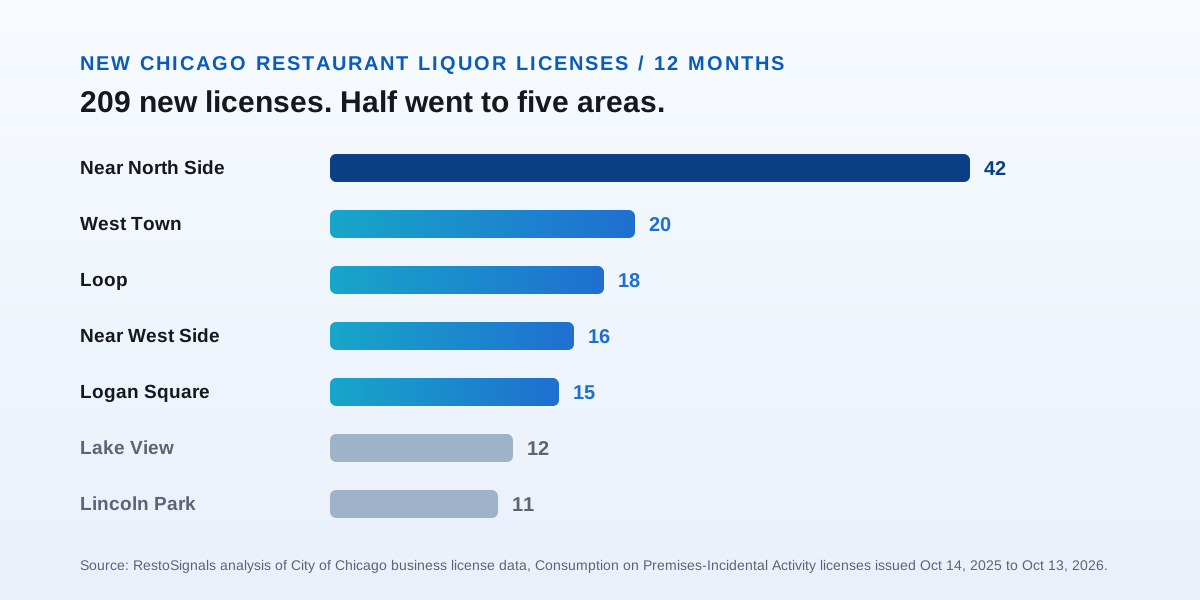
If you’re opening, it tells you where the competition is landing. The Near North Side, which includes River North, added 42 licensed restaurants in a year, and each one competes for the same diners.
If you sell to restaurants, it’s a map of where your next customers are.
That’s the other reason I watch these filings.
A liquor application is public months before the doors open, which makes it one of the earliest signs a new restaurant is coming.
To check one specific license, or to see the applications Chicago hasn’t approved yet, I walk through every official tool in the Illinois liquor license lookup guide.
On October 14, 2026, RestoSignals was tracking 1,148 Illinois venues, and 182 of them were hot leads, scoring 80 or higher because several public filings point to the same opening.
I wrote up how vendors use that window in how to sell to new restaurants before they open.
Bottom line: budget for your city, not the state
In Illinois, plan your liquor license around the local layer. The state fee is a predictable $750 a year. Your city decides the rest: $4,400 every two years and a median 81-day wait for a Chicago restaurant, six months or more for a tavern, and a flat no inside a moratorium district. Check the moratorium map, file locally four to six months out, and line up insurance and BASSET training while you wait.
If you’re comparing states, the national picture is in how much a liquor license costs. For an open-licensing state with no local quota games, see Oklahoma. And for the full opening budget, see what it costs to open a restaurant.
Opening in Chicago? Here’s what’s opening there now.
Mukul Dutt is the founder of RestoSignals, which tracks restaurants and bars before they open by fusing public liquor, permit, and business-filing records into one scored venue. The Chicago approval-time and neighborhood figures in this article come from his analysis of the City of Chicago’s public business license data, October 2025 to October 2026.
FAQ
How much is a liquor license in Illinois?
The state retailer's license costs $750 a year, or $600 when you renew online, but every Illinois bar or restaurant also needs a local license, and that's where the price swings. In Chicago, a restaurant license costs $4,400 plus a $40 publication fee and renews every two years. Smaller cities often charge a few hundred to a couple thousand dollars a year.
How much is a liquor license in Chicago?
A Chicago Consumption on Premises-Incidental Activity license, the one restaurants need, costs $4,400 plus a one-time $40 publication fee and renews every two years. A Tavern license costs the same. A Late Hour license is $6,000 and an Outdoor Patio license is $1,760, both on two-year terms. Add the $750 state license, and a restaurant pays about $5,190 upfront.
How long does it take to get a liquor license in Illinois?
The local license takes most of the time. In our analysis of 209 new Chicago restaurant liquor licenses issued between October 2025 and October 2026, the median was 81 days from application to approval, and 1 in 5 took more than six months. The state license usually follows within days once you have the local one. Smaller towns can be faster, depending on how often their commission meets.
Do I need a state and local liquor license in Illinois?
Yes. Illinois uses a dual system, so you need a local license from your city, village, or county first, then a state retailer's license from the Illinois Liquor Control Commission. The state won't issue its license until the local one is approved. Both have to stay current, and both can be suspended or revoked separately for violations.
Can you transfer a liquor license when you buy a restaurant in Illinois?
It depends on the town. Some Illinois cities, like Crystal Lake, treat licenses as non-transferable, so a new owner files a fresh application and goes before the city council. Others, like Joliet, allow a transfer with the local liquor commissioner's approval. Either way the state requires its own approval, so budget time for both before you close.
Is Illinois a quota state for liquor licenses?
Not statewide. Illinois doesn't cap liquor licenses at the state level, but state law lets each city or village limit how many it issues. Chicago restricts new licenses through moratorium districts and voter-approved dry precincts, and some suburbs cap licenses by class. So you can usually get one, but not always at the address you want.
Find venues opening near you
100 free leads, no card. One platform for restaurants & bars about to open.