Restaurant database: 8 sources compared for 2026
A restaurant database is either a census of the ~620,000 open restaurants or a feed of the ones about to open. 8 sources compared on counts, price and freshness.
Search “restaurant database” and you’ll get Flippa listings, MongoDB sample data and a Dutch list broker.
None of that helps if you sell to restaurants.
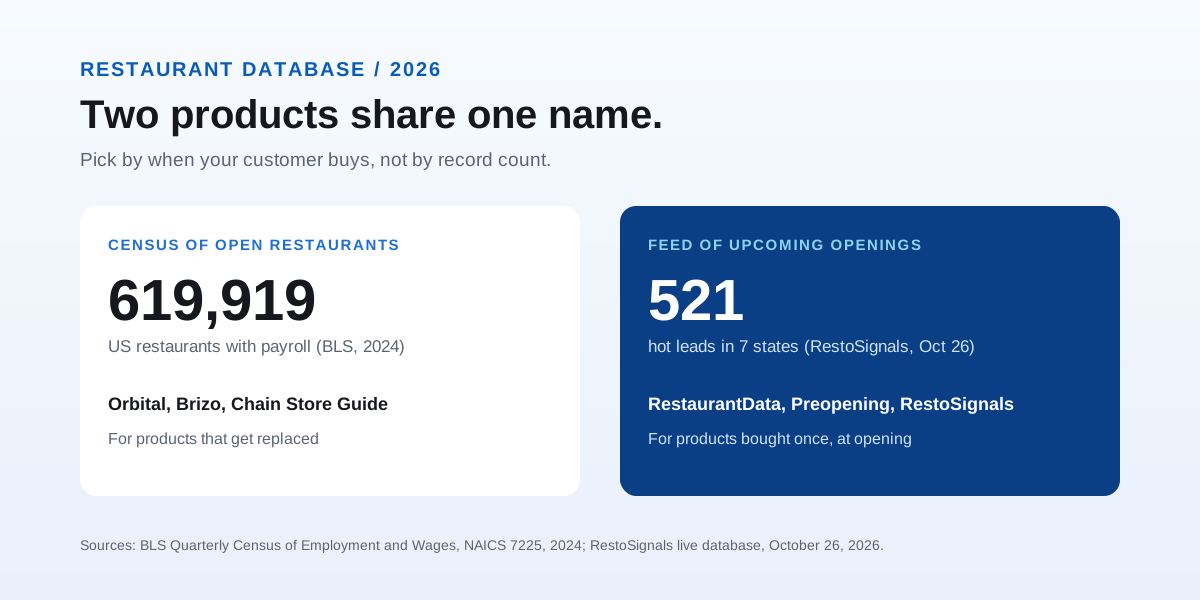
A restaurant database is one of two products. It’s either a census of the roughly 620,000 restaurants already open, sold by vendors like Orbital, Brizo and Chain Store Guide, or a feed of the few hundred about to open in your territory, from sources like RestaurantData.com and public liquor filings. Pick by what you sell. Menu software suits the census. Anything bought once at opening needs the feed.
I run RestoSignals, a pre-opening feed, so I’m biased toward one side. I’ll show you both anyway, with the numbers each vendor actually publishes.
What is a restaurant database, and which kind do you need?
A restaurant database is a list of restaurant records, usually with name, address, cuisine and some contact data, built for sales or research. The two kinds answer different questions. A census tells you who is open now. A pre-opening feed tells you who will open in the next few months. A POS reseller, insurer or beverage distributor usually needs the second, because the buying decision happens before opening day.
Here’s the test I’d use.
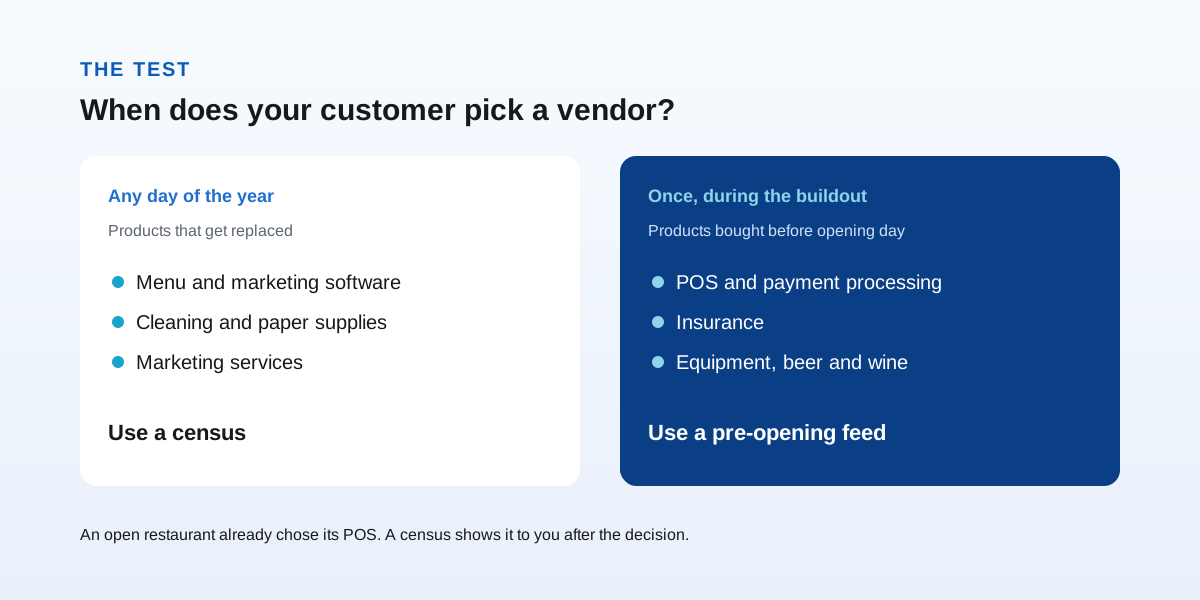
If your product gets replaced every few years (menu software, cleaning supplies, marketing services), you need the census. Every open restaurant is a prospect.
If your product gets picked once, during the buildout (POS, payment processing, insurance, walk-in coolers, a beer and wine portfolio), you need the feed. An open restaurant already chose someone.
I see vendors get this backwards all the time. They buy 600,000 records, then spend the month calling the ones that just opened.
How many restaurants are in the US?
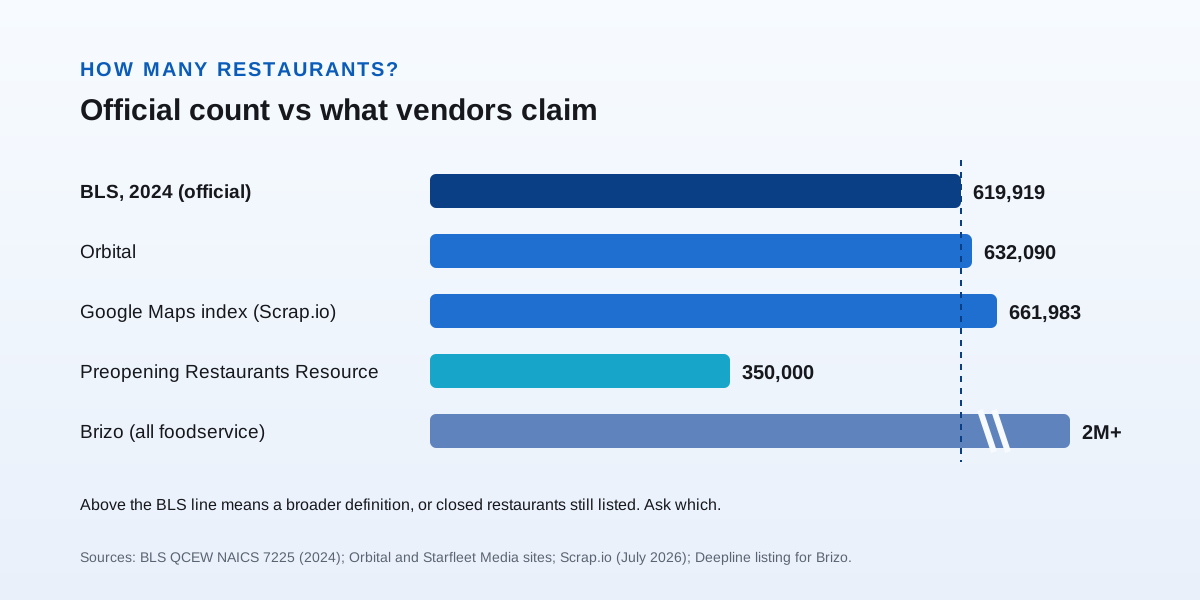
The Bureau of Labor Statistics counted 619,919 private restaurant and eating-place establishments in 2024, under NAICS code 7225, with about 11 million employees. That’s the official baseline. Vendor counts land above it because they define a restaurant differently: some include food trucks, cafeterias and bars, some include businesses with no payroll, and some never remove closed locations.
That number comes from the BLS Quarterly Census of Employment and Wages, which counts every establishment paying unemployment insurance. It’s as close to ground truth as you’ll get.
Now compare what vendors claim:
| Source | Restaurants claimed | What it counts |
|---|---|---|
| BLS QCEW, 2024 | 619,919 | Private establishments with payroll, NAICS 7225 |
| Orbital | 632,090 | “Active” US restaurants, verified against two sources |
| Scrap.io Google Maps index, July 2026 | 661,983 | Google Maps listings tagged as restaurants |
| Preopening Restaurants Resource | 350,000 | Restaurant records with researched contacts |
| Brizo by Datassential | 2 million+ | Foodservice establishments, per Deepline’s listing |
A count above the BLS number isn’t a lie. But it tells you the vendor is counting something broader, or holding on to records that may have closed.
Ask which one before you pay.
What are the best restaurant databases in 2026?
The best restaurant databases in 2026 split into three groups. Census vendors (Orbital, Brizo, Chain Store Guide) cover open restaurants with researched contacts. Pre-opening vendors (RestaurantData.com, Preopening Restaurants Resource, RestoSignals) track venues before they open. Raw sources (Google Maps scrapers and free government records) are cheapest but leave the cleaning to you. None of the curated vendors publishes a price.
Here are the eight I’d look at.
1. Orbital
Orbital lists 632,090 active US restaurants, and you can browse them free by metro and state on its restaurant data page.
Each record is checked against at least two sources, such as a state license or a corporate filing. Business records refresh weekly, owner contacts monthly. Phones and emails unlock after signup, and the price comes from a demo.
Of the census vendors, this is the one I’d test first. The free browse tells you a lot before you talk to anyone.
2. Brizo by Datassential
Brizo is built for foodservice suppliers who segment by what a restaurant already runs: menu, technology, health scores. Deepline’s provider listing puts it at 2 million+ establishments, with enterprise-only pricing.
If your pitch is “you use X, switch to us,” this is the data you want.
3. Chain Store Guide
The old-line directory publisher. Its Foodservice Elite database covers chains, franchises and independents, with decision-maker contacts and sales volume.
It’s strongest on chains and franchise groups. No public price.
4. RestaurantData.com
The pre-opening incumbent. It sends 350 to 600 new US leads a week as a CSV and PDF report, and its own FAQ says about 85% are found 2 to 12 weeks before opening.
National coverage, quote-only. I compared it in detail here.
5. Preopening Restaurants Resource
Starfleet Media’s research team works building permits, licenses, real estate deals and trade press to find openings. It also holds 350,000 existing-restaurant records with 150,000+ verified decision-maker contacts.
You can ask for a free sample. There’s no public price.
6. Google Maps scrapers
Tools like the Restaurant Lead Finder on Apify pull local listings for about $4 per 1,000 records, or $15 per 1,000 with email and POS detection.
That’s the cheapest current list of open restaurants you’ll find. But a Google listing rarely names the owner, and a restaurant that hasn’t opened has no listing at all.
7. Free government records
Cities and states publish health inspections, food permits, business licenses and liquor applications. They usually name the owner or licensee.
They cost nothing. You pay in hours spent matching them instead.
8. RestoSignals
My product. It pulls those government records daily in seven states, merges them into one venue per address and scores how close each one is to opening.
You can look for free. Owner contacts are $29 a month.
How do restaurant databases compare side by side?
Side by side, restaurant databases differ most on timing and price transparency, not on record count. Census vendors cover the whole country but list restaurants after they open. Pre-opening sources catch venues months earlier but cover fewer of them. Only scrapers, free government records and RestoSignals publish a price you can see without a sales call.
| Source | Type | Coverage | Finds restaurants | Refresh | Public price |
|---|---|---|---|---|---|
| Orbital | Census | US, 632,090 | After opening | Weekly | No, demo |
| Brizo | Census | US, 2M+ establishments | After opening | Not stated | No, enterprise |
| Chain Store Guide | Census | US chains and independents | After opening | Not stated | No |
| RestaurantData.com | Pre-opening | US, 350-600 new a week | Mostly 2-12 weeks before | Weekly | No, demo |
| Preopening Restaurants Resource | Pre-opening + census | US, 350,000 records | Before opening | Not stated | No, free sample |
| Apify Google Maps scraper | Raw | US listings | After opening | On demand | Yes, $4-15 per 1,000 |
| Government records | Raw | Per city or state | Months before opening | Daily to monthly | Free |
| RestoSignals | Pre-opening | 7 states | Months before opening | Daily | Yes, free tier |
The column I’d look at first is “finds restaurants.” That decides who you’re talking to.
How much does a restaurant database cost?
A restaurant database costs anywhere from nothing to a sales-negotiated annual contract. Scraped Google Maps data runs about $4 to $15 per 1,000 records on Apify. Free government records cost only your time. The curated vendors, including Orbital, Brizo, Chain Store Guide and RestaurantData.com, publish no prices at all. You get a number after a demo, usually tied to seats, states or export limits.
Watch for the in-between offers too.
One NYC new-openings file on Gumroad lists at $999, with 423 rows and columns for name, phone and address. One of those columns is CAMIS, the record ID from the city’s own free restaurant inspection dataset.
That’s the pattern with a lot of cheap lists. Somebody downloaded public data and put a price on it.
Paying for convenience is fine. Just know what you’re paying for.
Is there a free restaurant database?
There’s no free national restaurant database, but every state and many cities publish restaurant records at no cost. Health departments post inspection results, cities post business licenses and food permits, and liquor authorities post license applications. These records usually name the owner or licensee and the address. They rarely include phone or email, and each source has its own format.
These are the ones I use most:
| Where | Free source | What you get |
|---|---|---|
| New York City | NYC Open Data, inspections and food permits | Business name, address, phone on many permits |
| New York State | State Liquor Authority and business filings on data.ny.gov | Applicant name, premises address |
| Chicago | Business licenses portal | Licensee, address, license type and dates |
| Texas | TABC public inquiry and Comptroller sales tax permits | Owner name, mailing address, pending applications |
| California | ABC license lookup | Pending and issued liquor licenses |
The liquor application is the one to watch. A restaurant files it during the buildout, often months before opening.
The catch is matching.
One opening can show up as a liquor application under an LLC, a food permit under a trade name and a business filing under the owner’s name. Three records, one restaurant.
How fast does a restaurant database go out of date?
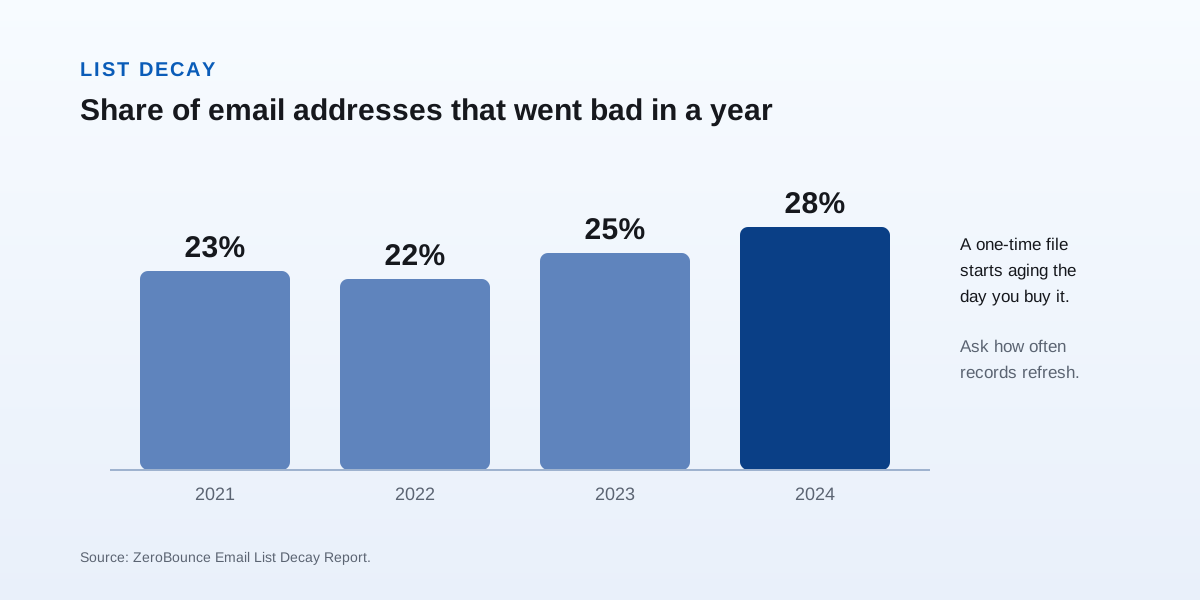
A restaurant database starts going stale the day it’s exported. ZeroBounce found 28% of email addresses went bad within a year in 2024, up from 23% in 2021. Restaurants churn faster than most businesses: Census counted 300,236 new business applications in accommodation and food services in 2025. A list that refreshes monthly misses a month of openings every time.
The ZeroBounce email list decay report tracks this every year. It has gone up every year since 2022.
And the Census Business Formation Statistics number says something about restaurants specifically. That’s about 820 new applications a day in one sector, though it includes hotels and not every application becomes a business.
So ask every vendor two questions. How often do records refresh? And how fast do you remove closed restaurants?
If the answer is “quarterly” or “we don’t,” the count on the sales deck is padded with places that no longer pick up the phone.
Which restaurant database fits vendors selling to new restaurants?
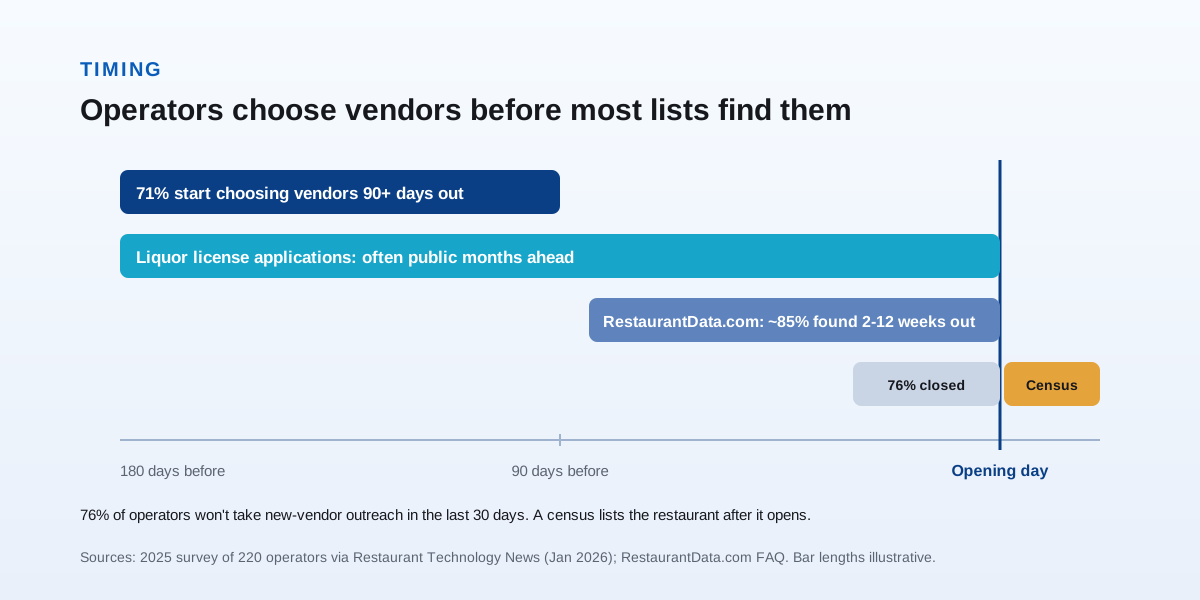
If you sell to new restaurants, the right restaurant database is a pre-opening feed, because operators choose vendors early. In a 2025 survey of 220 restaurant operators, 71% said they start choosing their main vendors more than 90 days before opening, and 76% aren’t open to new vendor outreach within 30 days of opening. A census only shows a restaurant after that window has closed.
The survey was reported by Restaurant Technology News in January 2026.
Put that next to the census number.
Out of 619,919 restaurants, the ones opening in your territory next quarter are a fraction of 1%. A census vendor sells you all 619,919 to reach them.
Here’s what that fraction looks like in our data.
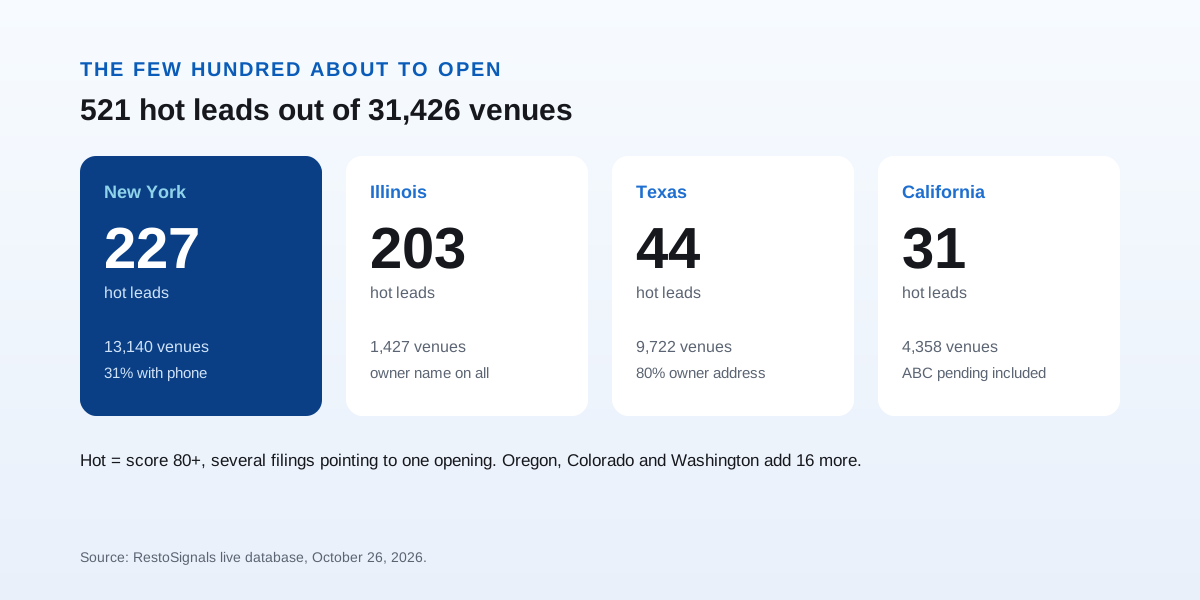
On October 26, 2026, RestoSignals held 31,426 venues fused from 120,302 public filings across seven states. Of those, 521 scored as hot, meaning several filings point to one imminent opening.
That’s 1.7% of our venues, and less than 0.1% of the BLS count.
| State | Venues | Hot leads | Contact detail |
|---|---|---|---|
| New York | 13,140 | 227 | Phone on 31% (NYC permits) |
| Illinois | 1,427 | 203 | Owner name on all |
| Texas | 9,722 | 44 | Owner mailing address on 80% |
| California | 4,358 | 31 | Pending ABC applications included |
| Oregon, Colorado, Washington | 2,779 | 16 | Lighter coverage |
Illinois stands out. Chicago’s liquor and food licenses tend to land close together, so a big share of its venues reach the hot threshold.
Where does RestoSignals fall short?
RestoSignals falls short on coverage and contact depth. It covers seven states, not fifty, so a national team still needs RestaurantData.com or a census vendor for the rest. It finds owner names from public filings but not emails, and phone numbers mostly in New York City. And it’s weakest on places that never file for a liquor license, like many coffee shops, outside the cities where it also tracks food permits.
I’d rather you know that before you sign up.
If you sell nationally and need every state on one weekly report, RestaurantData.com is the safer pick. If you need open restaurants by POS system or menu, Brizo or a scraper fits better.
If your territory is New York, Texas, Illinois or California, and you sell something bought before opening day, a daily feed of liquor and permit filings will get you in the door earlier than any of them.
Frequently asked questions
Where can I find a US restaurant database or list?
You can buy one from a vendor like Orbital, Brizo, Chain Store Guide or RestaurantData.com, scrape Google Maps listings with a tool like Apify, or build one free from government records such as health inspections, liquor licenses and business licenses. Vendors sell contact data and convenience. Government records are free, but you have to pull, clean and match them yourself.
How many restaurants are in the US?
The Bureau of Labor Statistics counted 619,919 private restaurant and eating-place establishments in 2024 (NAICS 7225), employing about 11 million people. Vendor counts run higher because they use different definitions: Orbital lists 632,090 active restaurants, a Google Maps index found 661,983, and Brizo advertises more than 2 million foodservice establishments.
Is there a free restaurant database?
Yes, but not as one national file. Cities and states publish restaurant records for free: health inspection results, food permits, business licenses and liquor license applications. NYC Open Data, Chicago’s data portal and state liquor authorities in Texas and California are good examples. They rarely include phone or email, but they usually name the business owner or licensee.
How much does a restaurant database cost?
Prices range from free to enterprise contracts. Google Maps scrapers on Apify start around $4 per 1,000 records, or about $15 fully enriched. Curated vendors like Orbital, Brizo, Chain Store Guide and RestaurantData.com don’t publish prices and sell through a demo. A one-city NYC openings file on Gumroad lists at $999. Free government records cost only your time.
What is the best restaurant database for finding new restaurants before they open?
Use a pre-opening source, not a census of open restaurants. RestaurantData.com and Preopening Restaurants Resource research new openings nationally and sell through sales calls. RestoSignals pulls liquor, permit and business filings daily in seven states and scores each venue. You can also search liquor license applications yourself, which is where most new restaurants first appear.
How often do restaurant lists go out of date?
Fast. ZeroBounce measured 28% of email addresses going bad in a single year in 2024, and restaurants churn faster than most businesses: Census counted 300,236 new business applications in accommodation and food services in 2025 alone. Ask any vendor how often records refresh. Weekly is good, monthly is common, and a one-time file starts aging the day you buy it.
Pick the database by the moment you sell into
Don’t start with record counts. Start with when your customer buys. If it’s any day of the year, buy a census and check its refresh rate. If it’s during the buildout, pull this week’s liquor license applications for your territory and call the owner before the doors open.
You can do that yourself with the free sources above, or see this week’s new venues on RestoSignals free and unlock owner contacts for $29 a month.
If you only care about pre-opening sources, I compared them in pre-opening restaurant leads. And if you’re weighing a purchased list, I broke down what a $17,999 restaurant email list buys.
Comparing general sales databases too? See ZoomInfo alternatives for selling to restaurants.
Mukul Dutt is the founder of RestoSignals, which tracks restaurants and bars before they open by fusing public liquor, permit and business-filing records into one scored venue with owner contact. Vendor details are taken from each company’s public pages in October 2026. RestoSignals figures are from the live database on October 26, 2026.
FAQ
Where can I find a US restaurant database or list?
You can buy one from a vendor like Orbital, Brizo, Chain Store Guide or RestaurantData.com, scrape Google Maps listings with a tool like Apify, or build one free from government records such as health inspections, liquor licenses and business licenses. Vendors sell contact data and convenience. Government records are free, but you have to pull, clean and match them yourself.
How many restaurants are in the US?
The Bureau of Labor Statistics counted 619,919 private restaurant and eating-place establishments in 2024 (NAICS 7225), employing about 11 million people. Vendor counts run higher because they use different definitions: Orbital lists 632,090 active restaurants, a Google Maps index found 661,983, and Brizo advertises more than 2 million foodservice establishments.
Is there a free restaurant database?
Yes, but not as one national file. Cities and states publish restaurant records for free: health inspection results, food permits, business licenses and liquor license applications. NYC Open Data, Chicago's data portal and state liquor authorities in Texas and California are good examples. They rarely include phone or email, but they usually name the business owner or licensee.
How much does a restaurant database cost?
Prices range from free to enterprise contracts. Google Maps scrapers on Apify start around $4 per 1,000 records, or about $15 fully enriched. Curated vendors like Orbital, Brizo, Chain Store Guide and RestaurantData.com don't publish prices and sell through a demo. A one-city NYC openings file on Gumroad lists at $999. Free government records cost only your time.
What is the best restaurant database for finding new restaurants before they open?
Use a pre-opening source, not a census of open restaurants. RestaurantData.com and Preopening Restaurants Resource research new openings nationally and sell through sales calls. RestoSignals pulls liquor, permit and business filings daily in seven states and scores each venue. You can also search liquor license applications yourself, which is where most new restaurants first appear.
How often do restaurant lists go out of date?
Fast. ZeroBounce measured 28% of email addresses going bad in a single year in 2024, and restaurants churn faster than most businesses: Census counted 300,236 new business applications in accommodation and food services in 2025 alone. Ask any vendor how often records refresh. Weekly is good, monthly is common, and a one-time file starts aging the day you buy it.
Find venues opening near you
100 free leads, no card. One platform for restaurants & bars about to open.