How to find ATM and arcade machine locations in new bars
Starting an ATM business or arcade route? Find locations in bars before they open: what ATMs earn, Texas license fees, and a real list of pending bar permits.
“Is it just knock and talk?”
That’s how someone on r/passive_income asked how ATM operators find locations. For most people starting an ATM business, the answer is yes.
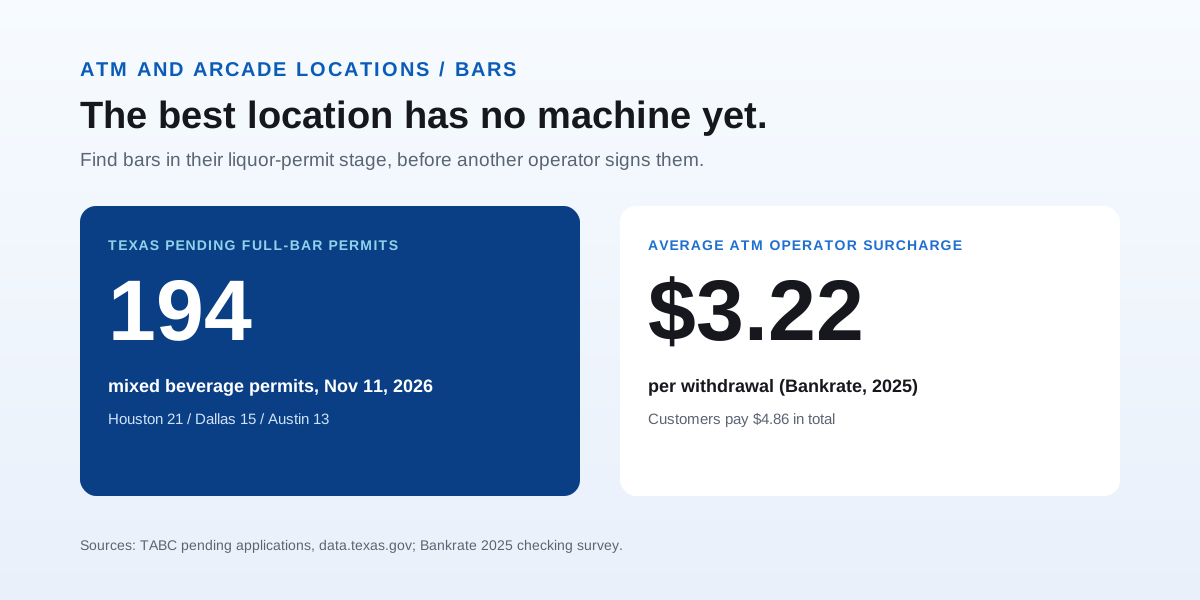
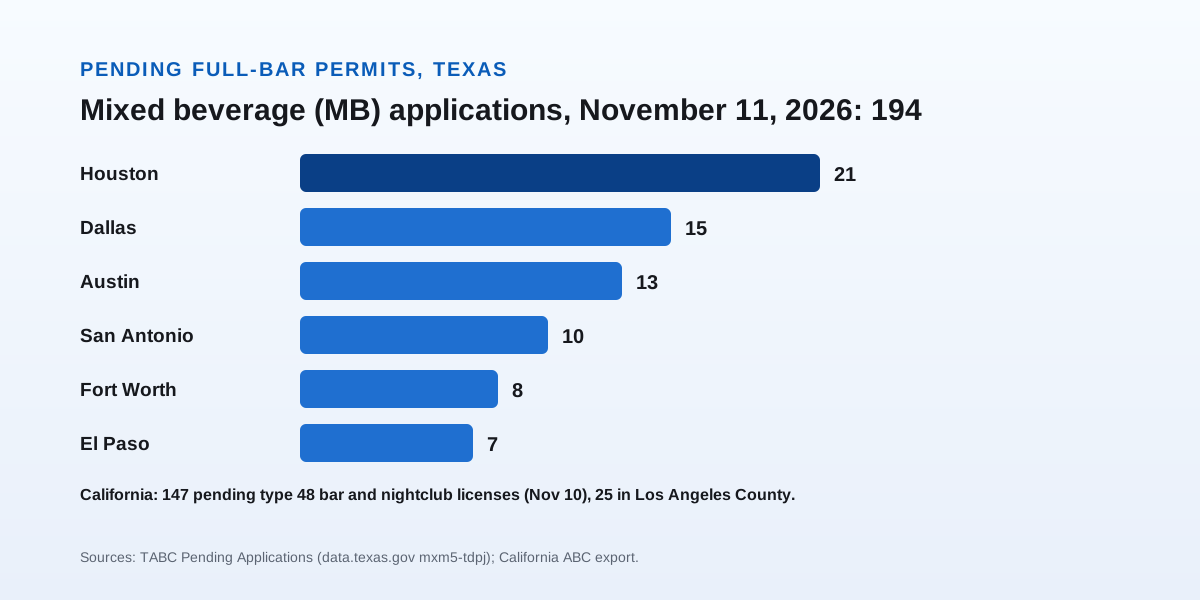
There’s a better place to knock. The best ATM and arcade machine locations are bars, and the easiest bars to sign are the ones that haven’t opened yet: no machine, no contract with another operator, and an owner still planning the floor. Public liquor license applications show you where they are. Texas alone had 194 pending full-bar permits on November 11, 2026, 21 of them in Houston.
I run RestoSignals, which finds bars and restaurants before they open, so take my enthusiasm for that with salt. Everything below is from public sources you can check.
Why are bars the best ATM and arcade locations?
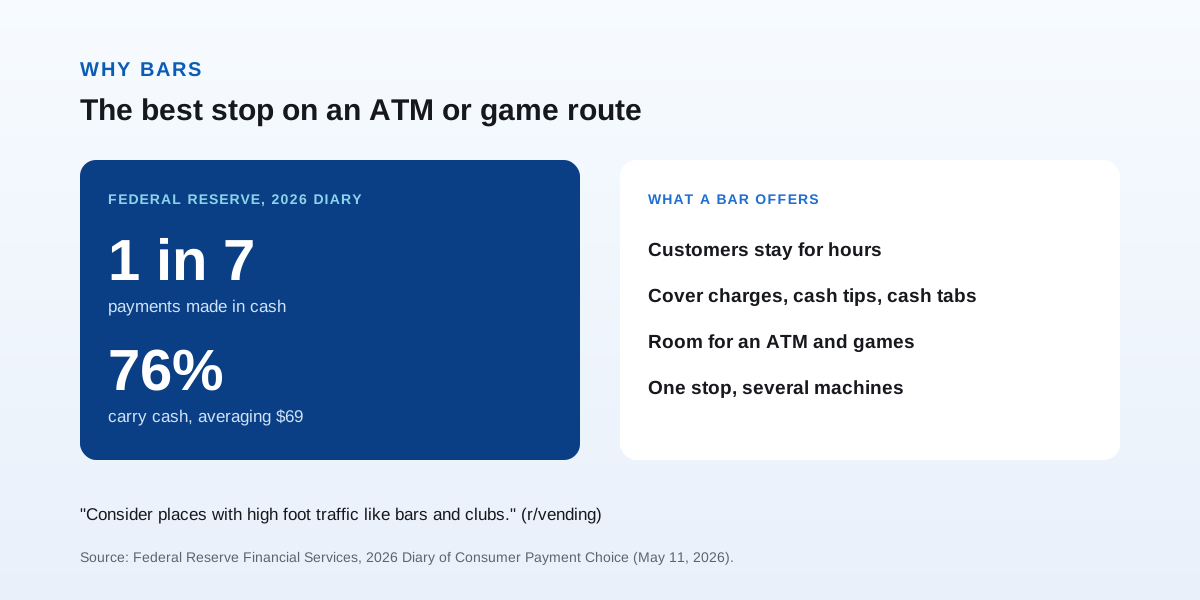
Bars are the best ATM and arcade locations because customers stay for hours, some of them still pay cash, and games fit the room. The Federal Reserve’s 2026 Diary of Consumer Payment Choice found cash was used for about 1 in 7 payments, and 76% of consumers carried cash, averaging $69. A bar with cover charges, cash tips or a cash-only pool table needs an ATM nearby.
Those numbers are from the Federal Reserve’s 2026 Diary, released May 11, 2026. It also found that four out of five consumers used cash in the last 30 days.
Operators say the same thing. In a Facebook group for independent ATM owners, the advice to a beginner was to look for “businesses that already handle cash or have customers who need quick access to it, such as bars.”
On r/vending, one reply to a newcomer was to “consider places with high foot traffic like bars and clubs.”
And unlike a convenience store, a bar has room for more than one machine. An ATM by the door, a claw machine and a jukebox can all be on one route stop.
How does an ATM business make money?
An ATM business makes money from the surcharge customers pay to withdraw cash, minus the location’s share, processing costs and the cost of keeping cash in the machine. Bankrate’s 2025 survey put the average operator surcharge at $3.22, with customers paying $4.86 in total once their own bank’s fee is added. Revenue depends almost entirely on how many withdrawals a location does.
Those fee numbers come from Bankrate’s survey, which called the $4.86 total a record high.
Here’s simple arithmetic, not a forecast:
| Withdrawals a day | Surcharge | Gross a month (30 days) |
|---|---|---|
| 3 | $3.00 | $270 |
| 10 | $3.00 | $900 |
| 20 | $3.00 | $1,800 |
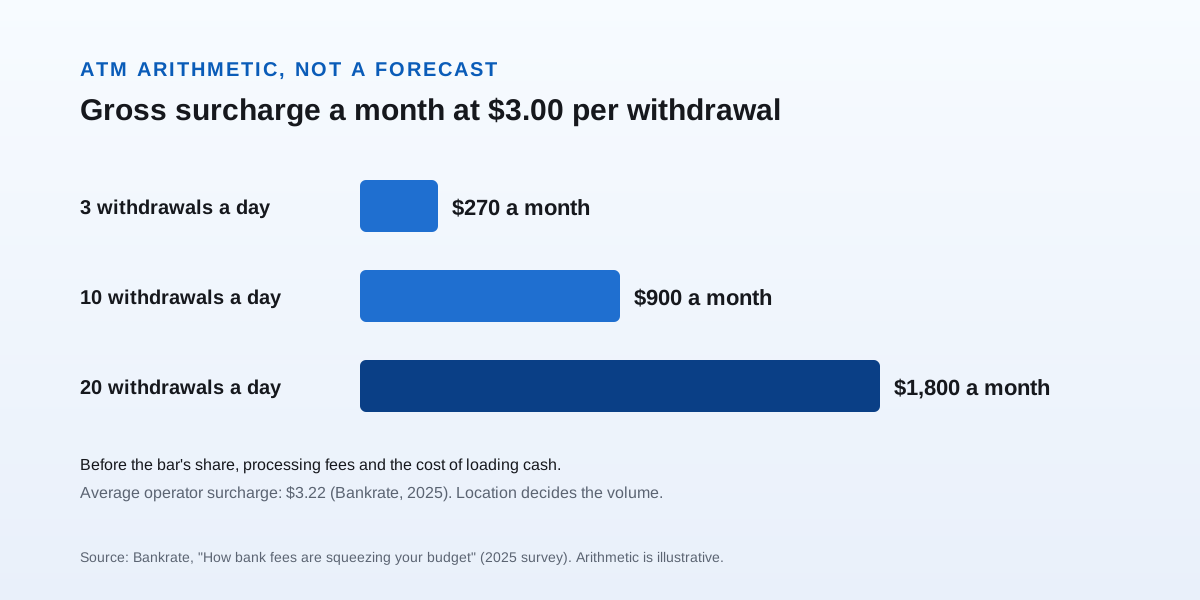
From that gross, you pay the bar its share, your processor’s fees and the cost of the cash itself, and you service the machine.
A quiet location can barely cover the machine. A busy one pays for it many times over.
That’s why location is the business. The machine is the same everywhere.
What licenses do you need for ATMs and arcade machines?
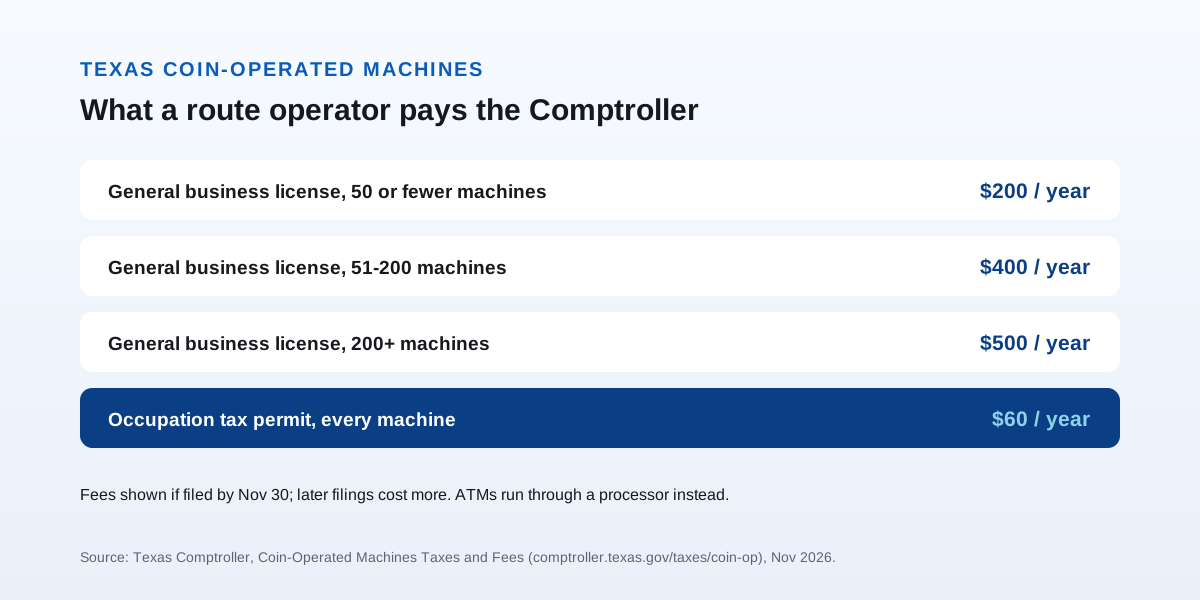
For arcade and other coin-operated machines, many states license the operator. In Texas, the Comptroller requires a general business license to keep coin-operated machines in someone else’s business, at $200 a year for up to 50 machines if filed by November 30, plus a $60 annual occupation tax permit on every machine. ATMs are different: you join a processor, which connects your machine to the card networks.
The Texas rules are on the Comptroller’s coin-operated machines page. Coin-operated machines there include any device that takes “a coin, bill, metal slug, token, electronic card or check to play a game, music or pleasure machine.”
The license tiers by number of machines, filed by November 30:
| Machines | General business license |
|---|---|
| 50 or fewer | $200 |
| 51 to 200 | $400 |
| More than 200 | $500 |
File late and the fee goes up, to as much as $400 for the smallest tier after April 1.
There’s also a cheaper $150 registration certificate, but it only covers machines in your own business. A route operator placing machines in bars needs the general business license.
Other states have their own rules, so check your state’s revenue or licensing department before you place a single machine.
Why pitch a bar before it opens?
Pitch a bar before it opens because it has no machines, no contract with another operator, and an owner still deciding the floor plan. Once a bar opens with a competitor’s ATM by the door, you’re asking the owner to break an agreement. During the buildout, you’re offering a power outlet, a spot by the entrance and a share of the surcharge before anyone else has asked.
The difference in the two pitches is simple:
- An open bar already has an ATM or a game route. You’re trying to replace someone, usually on split.
- A bar in buildout has nothing. You’re helping plan the room.
Planning matters for games. A pool table needs floor space, and a claw machine needs a wall and an outlet. If those aren’t in the plan, there’s no room after opening.
A new bar is also watching every dollar. A machine that costs nothing and pays a share from opening night is an easy yes.
How do you find bars before they open?
You find bars before they open in pending liquor license applications. On November 11, 2026, Texas had 194 pending mixed beverage permits, the license a full bar needs, with 21 in Houston, 15 in Dallas, 13 in Austin and 10 in San Antonio. California had 147 pending type 48 licenses, for bars and nightclubs, on November 10, 25 of them in Los Angeles County.
The Texas list is TABC’s Pending Applications dataset, free on data.texas.gov. Filter the license type to MB.
The applications filed in the two days before I wrote this included a sports bar in Abilene, a lounge in Round Rock, a bar and chophouse in Fort Worth and a bar and grill in Kemah. Every one of them is a potential ATM and game stop.
Here’s the process:
- Pull pending MB permits in Texas, or type 48 and 47 licenses in California.
- Keep sports bars, lounges, pubs and bar and grills.
- Sort by submission date, newest first.
- Look up the owner behind the LLC in your state’s business registry.
- Visit or call during the buildout.
My guides for Texas and California explain each license type and how to read the data.
If you’d rather not build the list by hand, RestoSignals matches the liquor filing with business records into one venue with the owner’s name, and in Texas it has an owner mailing address for about 82% of venues.
Should you buy an existing ATM route instead?
Buying an existing route gets you locations on day one, but you pay for them, and you inherit whatever the seller agreed to. Ask for at least a year of transaction reports per machine, read every placement agreement, and check that they transfer to a new owner. A route is only as good as its locations, and some sellers are selling because the best ones left.
On r/atmbusiness, one newcomer described exactly this: a seller offering three ATMs with locations.
That can be a fine start. It’s also more expensive than finding the next three bars yourself, before they open, for the cost of a few emails.
My rule of thumb: buy a route for the cash flow, build one for the locations.
Which machines work best in bars?
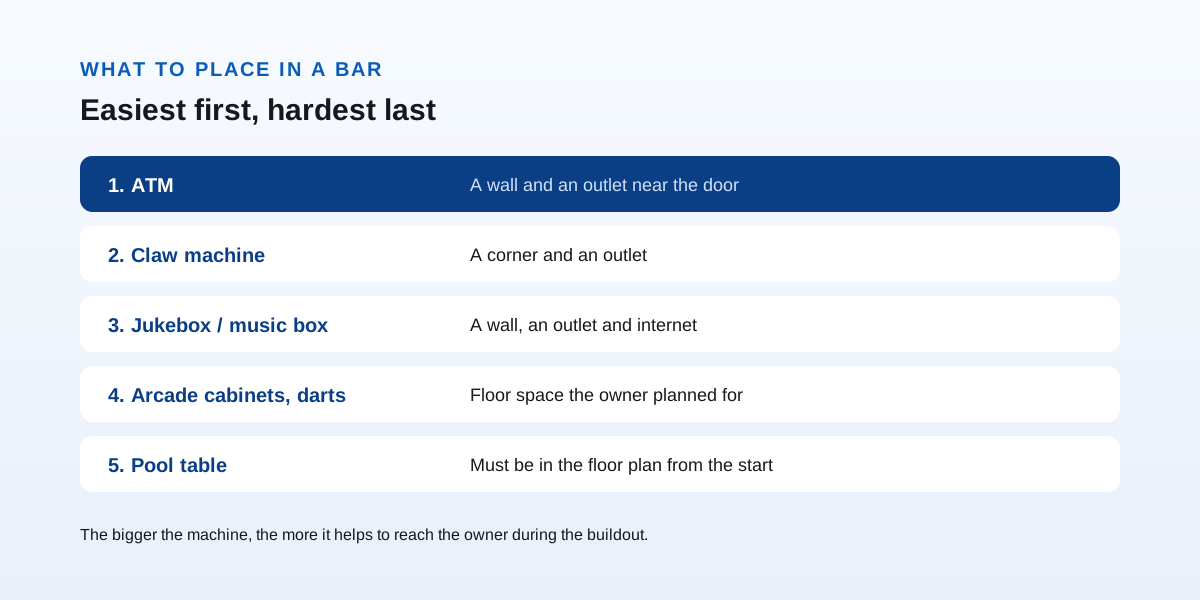
ATMs and claw machines are the easiest first placements in a bar, because they need little floor space and no staff attention. Arcade cabinets, jukeboxes, dart boards and pool tables earn more per stop but need room in the floor plan, which is another reason to reach the owner during the buildout.
In order of how easy they are to place:
- ATM: a wall and an outlet near the door.
- Claw machine: a corner and an outlet.
- Jukebox or digital music box: a wall, an outlet and the internet.
- Arcade cabinets or dart boards: floor space the owner has planned for.
- Pool table: the biggest commitment, so it has to be in the plan from the start.
What should an ATM placement agreement include?
An ATM placement agreement should spell out the surcharge amount, the location’s share of each withdrawal, who loads the cash, who pays for power and the network connection, how long the agreement runs, and what happens if either side wants the machine removed. Put it in writing before the machine goes in. A handshake works until the bar changes owners.
The points I’d cover, in plain terms:
- Surcharge amount and the location’s share per withdrawal.
- Who loads cash, and who’s liable for it inside the machine.
- Power and network: an outlet and phone or internet line near the spot.
- Term, renewal and early removal.
- Exclusivity: no second ATM on the premises.
- What happens if the bar is sold.
For arcade, claw and jukebox machines, the same list applies, with a revenue split instead of a surcharge.
Does this work for vending machines too?
Partly. Snack and drink vending does best in offices, warehouses, gyms and schools, where people are on breaks, not in bars where they’re already buying drinks. On r/vending, one operator said they landed a corporate account by door knocking, asking for HR and following up for eight months. Bars are a better fit for ATMs, arcade games, claw machines, jukeboxes and pool tables.
That’s worth knowing because “vending machine locations” gets about 2,400 searches a month, as many as “atm business.”
If you run both, bars are where your ATMs and games go. Offices are where your snack machines go.
How do you pitch a bar owner in buildout?
Pitch the ATM as money and convenience, not equipment. Tell the owner you saw their liquor application, offer to install the machine at no cost before opening, and give them a share of every withdrawal. For games, offer a revenue split and handle all the servicing. Keep it short, because owners in buildout are buried in decisions.
Something like:
Hi [name], I saw the mixed beverage application for [bar] on [street]. Congrats. I place ATMs and games in bars around [city]. No cost to you, I handle the cash and repairs, and you get a share of every withdrawal from opening night. If you’re still planning the floor, I can tell you where it fits best. [phone]
Bring the agreement with you. Owners sign faster when there’s nothing to wait for.
Frequently asked questions
How do I find locations for my ATM business?
Most operators knock on doors, which works but means competing for places that may already have a machine. A faster route is to find bars before they open, using public liquor license applications. In Texas, 194 mixed beverage permits for full bars were pending on November 11, 2026, and each one is a new venue with no ATM yet.
How much does an ATM make per month?
It depends almost entirely on withdrawals and your surcharge. Bankrate’s 2025 survey put the average ATM operator surcharge at $3.22. As simple arithmetic, 10 withdrawals a day at $3 is about $900 a month before the location’s share, processing fees and the cost of loading cash. Many machines do far less, so check a location’s traffic first.
Do bars need an ATM?
Many bars want one because some customers still carry and spend cash. The Federal Reserve’s 2026 Diary of Consumer Payment Choice found cash was used for about 1 in 7 payments, and 76% of consumers carried cash, averaging $69. A bar that takes cash for tabs, cover charges or tips benefits from having a machine on site.
What licenses do I need to put arcade machines in bars in Texas?
Texas requires a general business license from the Comptroller to keep coin-operated machines in someone else’s business. It costs $200 a year for up to 50 machines if filed by November 30. Each machine also needs a $60 annual occupation tax permit attached to it. Check the Comptroller’s coin-operated machines page for current fees and deadlines.
How do you get vending machine locations?
Vending operators mostly find locations in offices, warehouses, gyms and schools, by asking for whoever handles facilities and following up. One r/vending operator said it took eight months of follow-up to land a corporate account. Bars suit ATMs, arcade games, claw machines and pool tables better than snack vending.
What is the best location for an ATM?
The best ATM locations are busy places where customers need cash on the spot and there’s no bank machine nearby: bars, nightclubs, convenience stores and event venues. A new bar is especially good because it has no machine and no contract with another operator yet, so you’re not asking the owner to replace anyone.
Pull ten bars this week
Skip the strip mall walk for a week. Pull the pending bar permits for your city, pick the ten newest sports bars and lounges, and offer each owner an ATM or game placement before they open. Or see this week’s new venues on RestoSignals free and start with the list built.
Mukul Dutt is the founder of RestoSignals, which tracks restaurants and bars before they open by fusing public liquor, permit and business-filing records into one scored venue with owner contact. Texas counts are from TABC’s pending applications dataset on November 11, 2026; California from the state ABC export mirrored on November 10, 2026. ATM fees are from Bankrate’s 2025 survey; cash use from the Federal Reserve’s 2026 Diary of Consumer Payment Choice; Texas fees from the Comptroller’s coin-operated machines page, November 2026. The ATM revenue table is arithmetic, not a forecast.
FAQ
How do I find locations for my ATM business?
Most operators knock on doors, which works but means competing for places that may already have a machine. A faster route is to find bars before they open, using public liquor license applications. In Texas, 194 mixed beverage permits for full bars were pending on November 11, 2026, and each one is a new venue with no ATM yet.
How much does an ATM make per month?
It depends almost entirely on withdrawals and your surcharge. Bankrate's 2025 survey put the average ATM operator surcharge at $3.22. As simple arithmetic, 10 withdrawals a day at $3 is about $900 a month before the location's share, processing fees and the cost of loading cash. Many machines do far less, so check a location's traffic first.
Do bars need an ATM?
Many bars want one because some customers still carry and spend cash. The Federal Reserve's 2026 Diary of Consumer Payment Choice found cash was used for about 1 in 7 payments, and 76% of consumers carried cash, averaging $69. A bar that takes cash for tabs, cover charges or tips benefits from having a machine on site.
What licenses do I need to put arcade machines in bars in Texas?
Texas requires a general business license from the Comptroller to keep coin-operated machines in someone else's business. It costs $200 a year for up to 50 machines if filed by November 30. Each machine also needs a $60 annual occupation tax permit attached to it. Check the Comptroller's coin-operated machines page for current fees and deadlines.
How do you get vending machine locations?
Vending operators mostly find locations in offices, warehouses, gyms and schools, by asking for whoever handles facilities and following up. One r/vending operator said it took eight months of follow-up to land a corporate account. Bars suit ATMs, arcade games, claw machines and pool tables better than snack vending.
What is the best location for an ATM?
The best ATM locations are busy places where customers need cash on the spot and there's no bank machine nearby: bars, nightclubs, convenience stores and event venues. A new bar is especially good because it has no machine and no contract with another operator yet, so you're not asking the owner to replace anyone.
Find venues opening near you
100 free leads, no card. One platform for restaurants & bars about to open.