How to get bookkeeping clients: start with new restaurants
How to get bookkeeping clients by finding restaurants before they open: what a new restaurant needs set up, tip and sales tax rules, and real NYC numbers.
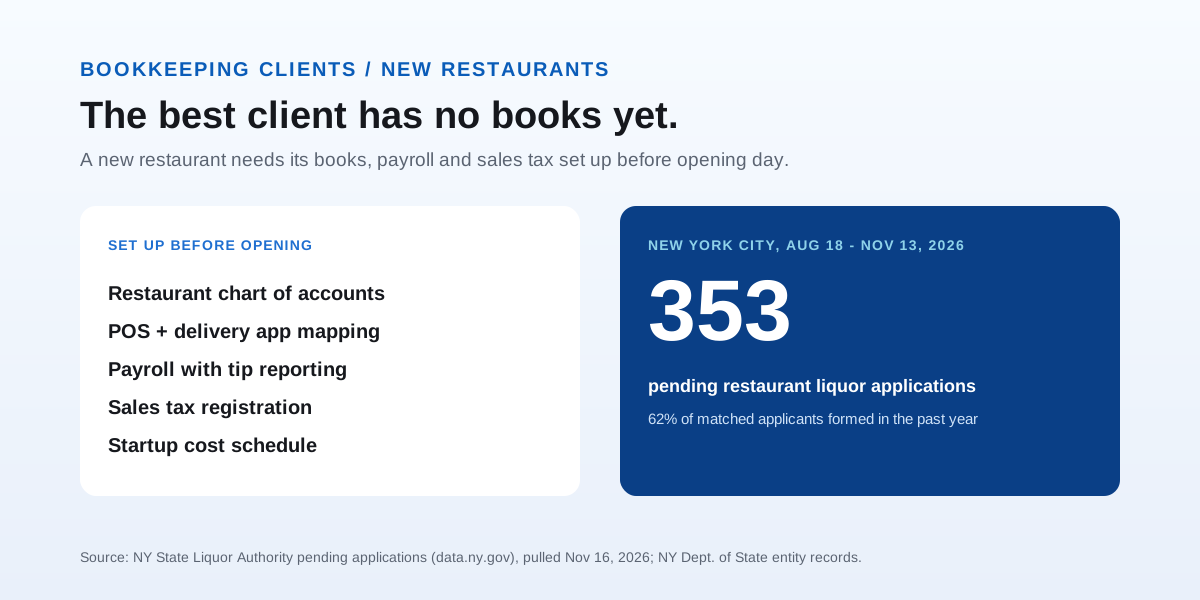
Most bookkeepers try to steal clients from someone else’s books. The easier client is the one who has no books yet.
That’s a new restaurant. If you want to know how to get bookkeeping clients without fighting over referrals, find restaurants that are about to open. Pending liquor license applications name them, with the owner’s legal entity, months before opening day. New York City had 353 filed between August 18 and November 13, 2026, and most were brand-new companies with nothing set up.
I run RestoSignals, which finds restaurants before they open, so I’m biased toward that part. The tax rules below come from the IRS and the New York Tax Department.
How do you get bookkeeping clients?
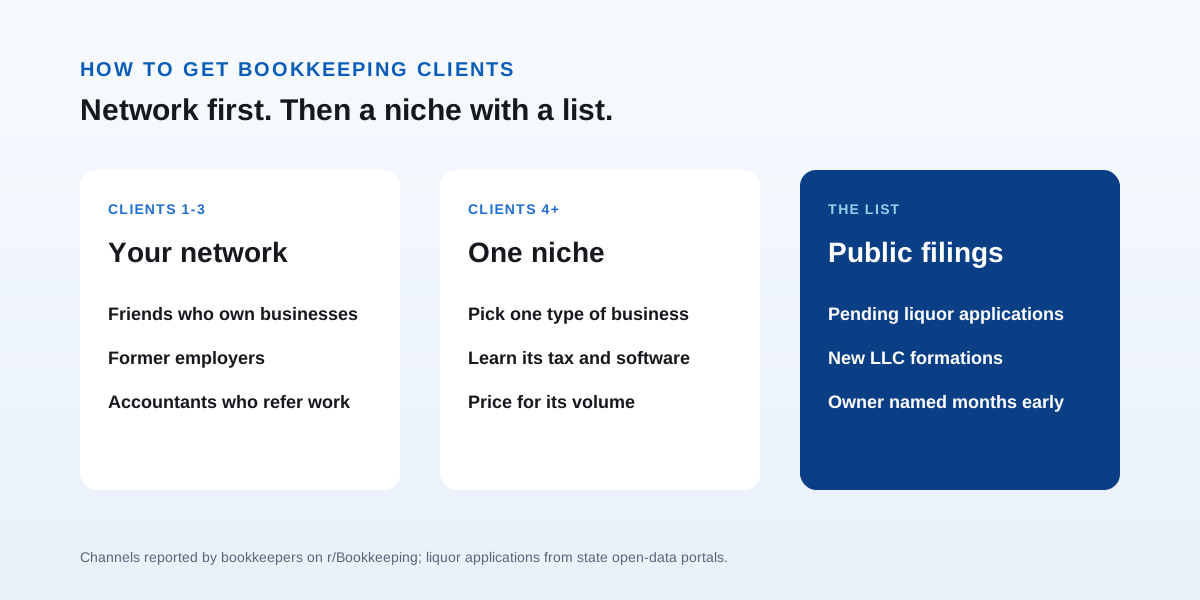
You get bookkeeping clients from two places: your network for the first few, and a niche after that. Referrals from friends, former employers and accountants usually land the first two or three. To grow past that, pick one type of business and find them at the moment they need books set up. For restaurants, that moment is before opening, and liquor applications show you when.
The network part is the same advice everyone gives, and it’s true.
On r/Bookkeeping, a thread from a bookkeeper 13 months into their business drew the usual answers: referrals from friends and clients, Indeed, Reddit itself, and paid ads. One commenter said Google Ads brought in most of their first ten clients.
But referrals don’t scale on a schedule, and ads cost money before you have revenue.
The problem with “get a niche” advice is that nobody tells you how to find the businesses in it. Restaurants are the exception. Every one that serves alcohol files a public application before it opens.
Why are new restaurants good bookkeeping clients?
New restaurants are good bookkeeping clients because they need everything at once and have no one doing it yet. The owner has to set up sales tax, payroll with tips, a POS, delivery apps and supplier accounts before the first guest walks in. A brand-new LLC has no old books to clean up and no bookkeeper to replace. Whoever sets up the books usually keeps them.
That last point is the whole game.
Switching bookkeepers is painful for an owner. Once your chart of accounts, bank feeds and payroll are running, they’d need a real problem to leave.
Restaurants are also busy books. Daily sales, many supplier invoices, tips, delivery payouts and sales tax mean real monthly work. That’s what makes them worth more than a consultant with ten transactions a month.
Here’s the catch. Restaurant owners don’t search for a bookkeeper until something breaks. If you wait for them, you’ll meet them after the first sales tax notice. Reach them before opening and you’re the one who set it up right.
What does a new restaurant need from a bookkeeper before opening?
Before opening, a new restaurant needs a chart of accounts built for food, beverage and labor costs, its POS and delivery apps mapped to the books, payroll set up with tip reporting, a sales tax registration and filing calendar, and a record of startup costs. Every one of these is easier to do right on day one than to fix in month six.
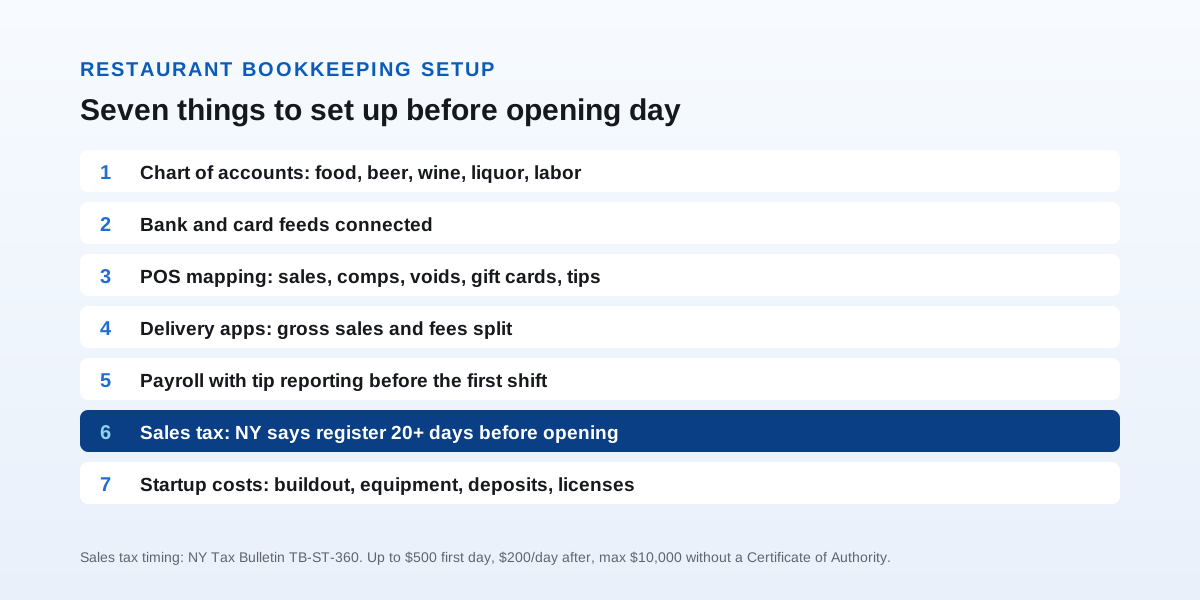
Here’s the setup I’d sell as one fixed-price package:
- Chart of accounts: separate food, beer, wine and liquor sales and costs, plus labor.
- Bank and card feeds connected, with a separate account for sales tax if the owner agrees.
- POS mapping: sales categories, discounts, comps, voids, gift cards and tips.
- Delivery apps: DoorDash, Uber Eats and Grubhub payouts net out fees, so map gross sales and fees separately.
- Payroll with tip reporting, set up before the first shift.
- Sales tax registration checked and a filing calendar set.
- Startup costs recorded: buildout, equipment, deposits, licenses.
The sales tax deadline is earlier than owners think.
New York’s Tax Department says that if you expect to make taxable sales, “you must register with the Tax Department at least 20 days before you begin business.” Operating without a valid Certificate of Authority can cost up to $500 for the first day and $200 a day after that, up to $10,000.
A bookkeeper who catches that before opening has earned the client’s trust in week one.
What makes restaurant bookkeeping different?
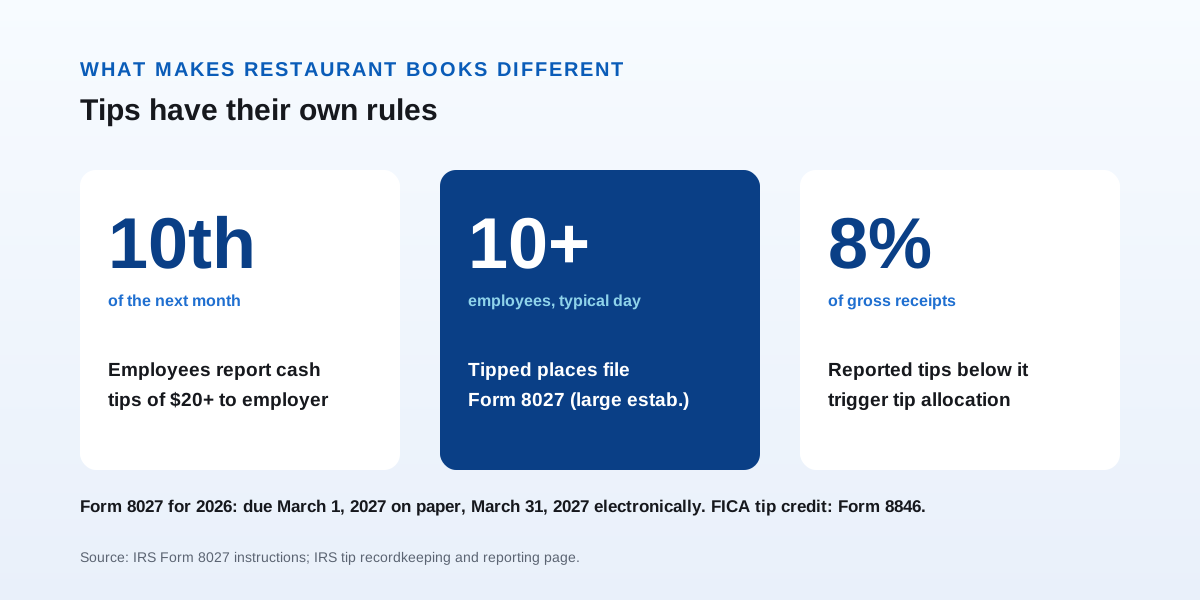
Restaurant bookkeeping is different because of tips, volume and margins. Tips have their own IRS reporting rules, including Form 8027 and the 8% tip allocation for larger establishments. Sales come in daily across cash, cards and delivery apps. And owners watch food and labor costs, called prime cost, every week, so a late close is useless to them.
Tips are where general bookkeepers get into trouble.
The IRS says “employees must report cash tips to the employer by the 10th day of the month after the month the tips are received,” unless they’re under $20 for the month. The employer then withholds taxes on those tips through payroll.
Larger places have another layer. An employer files Form 8027 for a large food or beverage establishment, where tipping is customary and the employer “normally employed more than 10 employees on a typical business day during the preceding calendar year.” If reported tips come in under 8% of gross receipts, the employer generally has to allocate the difference among tipped employees.
There’s money on the other side, too. Employers may qualify for the FICA tip credit on Form 8846 for Social Security and Medicare taxes paid on certain tips. Your CPA partner claims it, but your clean tip records make it possible.
| Task | Rule | Source |
|---|---|---|
| Sales tax registration (NY) | At least 20 days before taxable sales start | NY Tax Bulletin TB-ST-360 |
| Employee cash tip reports | By the 10th of the following month, if $20 or more | IRS tip recordkeeping page |
| Form 8027 | Large food or beverage establishments, more than 10 employees on a typical day | IRS Form 8027 instructions |
| Form 8027 due date (2026 returns) | March 1, 2027 paper, March 31, 2027 electronic | IRS Form 8027 instructions |
| 8% tip allocation | When reported tips fall below 8% of gross receipts | IRS Form 8027 instructions |
| FICA tip credit | Employer credit for taxes paid on certain tips | IRS Form 8846 |
How do you find restaurants before they open?
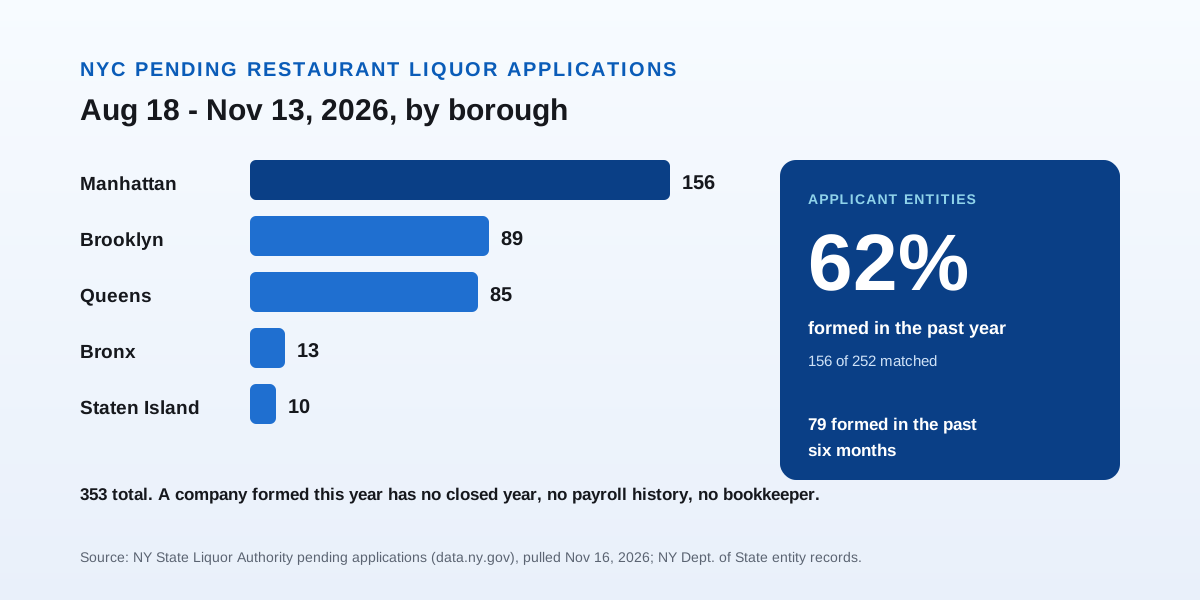
You find restaurants before they open in pending liquor license applications. New York’s State Liquor Authority publishes them on data.ny.gov. Between August 18 and November 13, 2026, New York City had 353 pending applications for restaurant and food and beverage licenses: 156 in Manhattan, 89 in Brooklyn, 85 in Queens, 13 in the Bronx and 10 on Staten Island.
Then I checked who filed them.
I matched the applicants’ legal names to New York’s corporation database. Of the 252 I could match, 156, or 62%, were entities formed within the past year. 79 were formed within the past six months.
That’s the number that matters to a bookkeeper. A company formed in the last year has no closed year, no payroll history and almost certainly no bookkeeper.
The new applicants included an omakase counter, a Queens burger bar, a Brooklyn hospitality group and a Staten Island Italian restaurant.
Here’s the process:
- Pull pending restaurant applications for your county.
- Sort by date. The newest are usually in buildout.
- Look up each applicant’s entity and its formation date.
- Keep the ones formed in the last year.
- Find the owner’s name on the filing and reach out before opening.
Not every applicant is a new restaurant. Some are a new company buying an existing place, which still needs new books. Drop the chains, because their accounting is done at headquarters.
Other states publish similar lists. My California guide and Texas guide explain theirs.
If you’d rather start from a built list, RestoSignals matches liquor filings with business records into one venue with the owner’s name.
How do you start a bookkeeping business that serves restaurants?
To start a bookkeeping business that serves restaurants, form your business, get insurance, learn one accounting platform and the common restaurant POS reports well, and partner with a CPA who handles restaurant tax returns. Then build a fixed-price setup package and a monthly plan. The niche gives you a target list and a reason owners should choose you over a generalist.
You’re entering a big field.
The Bureau of Labor Statistics counted about 1.6 million bookkeeping, accounting and auditing clerk jobs in 2024, with a median wage of $49,210. It projects employment to fall 6% from 2024 to 2034 as software automates routine work.
That decline is the case for a niche. Software can categorize transactions. It can’t walk a new owner through tips, sales tax and prime cost before opening.
What I’d have ready before the first pitch:
- One accounting platform you know cold, plus its restaurant POS integrations.
- A CPA partner for tax returns and the FICA tip credit.
- A payroll provider that handles tip reporting.
- A one-page setup checklist you can show an owner.
- A sample monthly report with sales, food cost, labor cost and prime cost.
How should you price restaurant bookkeeping?
Price restaurant bookkeeping as a one-time setup fee plus a fixed monthly fee based on volume. Volume means locations, bank and card accounts, delivery apps, supplier invoices and payroll runs. Don’t bill hourly, because restaurant books have heavy months and owners hate surprise invoices. Quote payroll and sales tax filing as separate lines so the owner sees what they’re buying.
Charge for setup. It’s real work, and it’s the part a new owner needs most.
Then set tiers by volume, not by revenue. A food truck with one bank account and a 60-seat restaurant with three delivery apps are different jobs.
On r/Bookkeeping, a thread on whether restaurant and retail clients are worth the work got both answers. One commenter warned about the transaction volume, with deliveries most days. Another said that once they proved themselves, restaurant clients brought referrals and upsells.
Both are right. Price for the volume and you get the referrals.
How do you pitch a restaurant owner before opening?
Pitch the setup, not the bookkeeping. Tell the owner you saw their liquor application, that sales tax, payroll with tips and the POS all need to be set up before opening, and that you’ll do it at a fixed price. Owners in buildout are buried in decisions, so a clear one-page checklist they can say yes to wins more than a services menu.
Something like:
Hi [name], I saw the liquor application for [restaurant] on [street]. Congrats. I set up books for new restaurants in [area]: sales tax registration, payroll with tip reporting, POS and delivery app mapping, done before you open for one fixed price. Happy to send the checklist. [phone]
Email first, then a short follow-up in a week.
If the owner already has an accountant, ask who does the monthly books. Many CPAs want someone else to do them, which makes the owner’s accountant your referral source, not your competition.
Frequently asked questions
How do I get my first bookkeeping client?
Most first clients come from people you already know: friends who own businesses, former employers and accountants who need a bookkeeper to hand work to. After that, pick one niche and find businesses at the moment they need books set up. New restaurants are a good one, because pending liquor applications name the owner months before opening.
How do I start a bookkeeping business with no clients?
Form your business, get insurance, pick one accounting platform you know well, and choose a niche before you market. A niche gives you a list of businesses to contact and a reason they should pick you. Then work your network for the first two or three clients while you build a pipeline from public records, such as new liquor license applications.
Is restaurant bookkeeping hard?
It’s more work than most small businesses. A restaurant has daily sales across cash, cards and delivery apps, many supplier invoices, tips that have their own IRS reporting rules, and food and labor costs the owner wants every week. That’s why restaurant bookkeeping clients pay more and stay longer once you’ve set up a system that handles the volume.
What does a new restaurant need from a bookkeeper?
Before opening: a chart of accounts built for restaurants, the POS and delivery apps mapped to the books, payroll set up with tip reporting, a sales tax registration and filing calendar, and a startup cost schedule. After opening: monthly closes, daily sales reconciliation, tip records, sales tax returns and a simple prime cost report.
When do restaurants have to file Form 8027?
An employer files Form 8027 for a large food or beverage establishment, meaning tipping is customary and the employer normally employed more than 10 employees on a typical business day in the previous year. For 2026 returns, the IRS lists March 1, 2027 for paper filing and March 31, 2027 for electronic filing.
Where can bookkeepers find new business owners?
Public filings. New LLC and corporation filings show who is starting a business, and liquor license applications show which of them are restaurants and bars. In New York City, 62% of restaurant liquor applicants we could match to state records were entities formed within the past year, so they had no books yet.
Set up ten restaurants before they open
Pull your county’s pending restaurant liquor applications this week, keep the ones filed by companies formed in the last year, and send each owner your setup checklist. Ten good conversations is how to get bookkeeping clients who stay. Or see this week’s new venues on RestoSignals free and start with the list built.
Mukul Dutt is the founder of RestoSignals, which tracks restaurants and bars before they open by fusing public liquor, permit and business-filing records into one scored venue with owner contact. New York City counts are from the State Liquor Authority’s pending-application dataset on data.ny.gov, pulled November 16, 2026 for restaurant and food and beverage licenses received August 18 to November 13, 2026; formation dates are from the New York Department of State corporation database. Tax rules are from IRS Form 8027 instructions, the IRS tip recordkeeping page and New York Tax Bulletin TB-ST-360. BLS figures are from the Occupational Outlook Handbook. Nothing here is tax or legal advice.
FAQ
How do I get my first bookkeeping client?
Most first clients come from people you already know: friends who own businesses, former employers and accountants who need a bookkeeper to hand work to. After that, pick one niche and find businesses at the moment they need books set up. New restaurants are a good one, because pending liquor applications name the owner months before opening.
How do I start a bookkeeping business with no clients?
Form your business, get insurance, pick one accounting platform you know well, and choose a niche before you market. A niche gives you a list of businesses to contact and a reason they should pick you. Then work your network for the first two or three clients while you build a pipeline from public records, such as new liquor license applications.
Is restaurant bookkeeping hard?
It's more work than most small businesses. A restaurant has daily sales across cash, cards and delivery apps, many supplier invoices, tips that have their own IRS reporting rules, and food and labor costs the owner wants every week. That's why restaurant bookkeeping clients pay more and stay longer once you've set up a system that handles the volume.
What does a new restaurant need from a bookkeeper?
Before opening: a chart of accounts built for restaurants, the POS and delivery apps mapped to the books, payroll set up with tip reporting, a sales tax registration and filing calendar, and a startup cost schedule. After opening: monthly closes, daily sales reconciliation, tip records, sales tax returns and a simple prime cost report.
When do restaurants have to file Form 8027?
An employer files Form 8027 for a large food or beverage establishment, meaning tipping is customary and the employer normally employed more than 10 employees on a typical business day in the previous year. For 2026 returns, the IRS lists March 1, 2027 for paper filing and March 31, 2027 for electronic filing.
Where can bookkeepers find new business owners?
Public filings. New LLC and corporation filings show who is starting a business, and liquor license applications show which of them are restaurants and bars. In New York City, 62% of restaurant liquor applicants we could match to state records were entities formed within the past year, so they had no books yet.
Find venues opening near you
100 free leads, no card. One platform for restaurants & bars about to open.