How to start a hood cleaning business and win first kitchens
How to start a hood cleaning business: what NFPA 96 requires, IKECA certification, pricing, grease traps, and where your first kitchens come from, with a real DFW list.
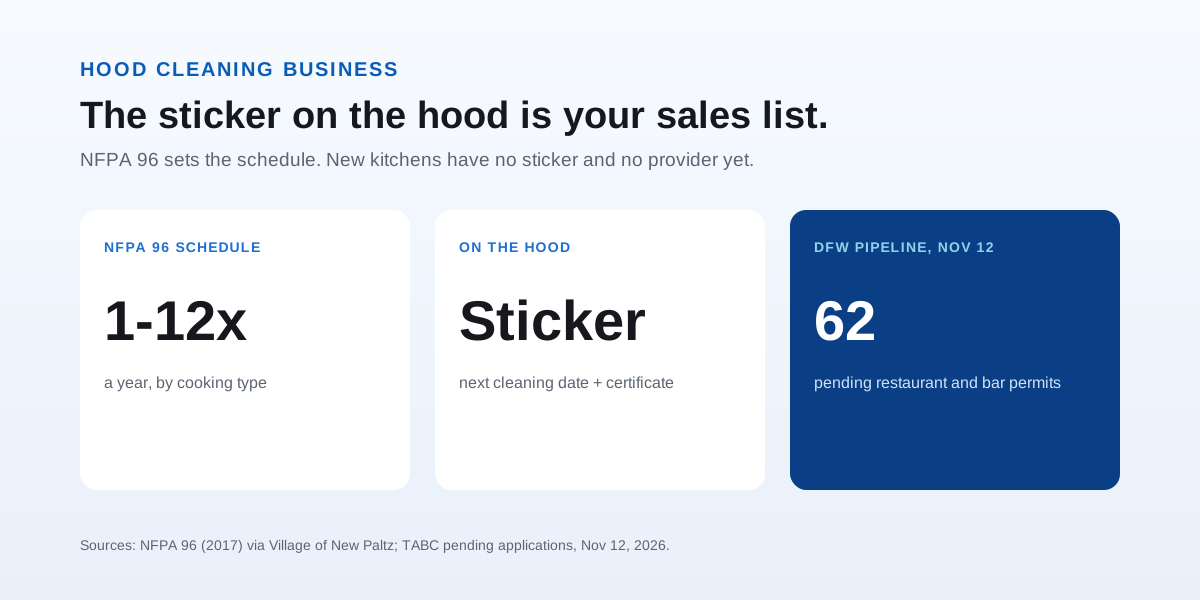
Next time you’re in a restaurant kitchen, look up. There’s usually a sticker on the hood with a date on it.
That date is someone’s next job. It could be yours.
To start a hood cleaning business, get trained and certified on NFPA 96, check what your local fire authority accepts, then build recurring accounts. The fire code sets the schedule: monthly for solid-fuel kitchens, quarterly for charbroil and wok kitchens, every six months for most others. Your first customers are new restaurants, which have no sticker and no provider yet. Dallas–Fort Worth had 62 in the pipeline on November 12, 2026.
I run RestoSignals, which finds restaurants before they open, so I’m biased toward that last step. Everything else here comes from the code, the certifying body and real operators.
Is a hood cleaning business worth starting?
A hood cleaning business is worth starting if you want recurring commercial work and don’t mind nights, grease and rooftops. The fire code makes restaurants clean their exhaust systems on a fixed schedule, so a signed account repeats two to twelve times a year. Kitchen fires are the risk the code is written for: cooking is the leading cause of fires in eating and drinking places.
NFPA’s most recent report on those properties, published in 2017 and covering 2010 to 2014, put the average at 7,410 structure fires a year in U.S. eating and drinking establishments. Failure to clean was a factor in 22% of them, as summarized by Warren Forensics. Those numbers are dated, but they’re the most recent NFPA figures I could find.
Operators who do it like it. On r/sweatystartup, one commenter put good hood work at “about $300 an hour per crew,” with the condition that you’re “reliable, insured, compliant, and documenting your work properly.”
On r/smallbusiness, the pitch was simpler. Restaurants “are required to have their exhaust hoods cleaned/degreased on a regular basis.”
It’s required, it repeats, and it’s greasy enough that most people don’t want to do it. That’s the business.
What does NFPA 96 require restaurants to do?
NFPA 96 requires restaurants to have their kitchen exhaust systems inspected for grease on a schedule set by the type of cooking, and cleaned by a trained, qualified and certified company when grease is found. After each service, a certificate naming the company, the technician and the date must stay on the premises, and a sticker with the next due date goes on the hood.
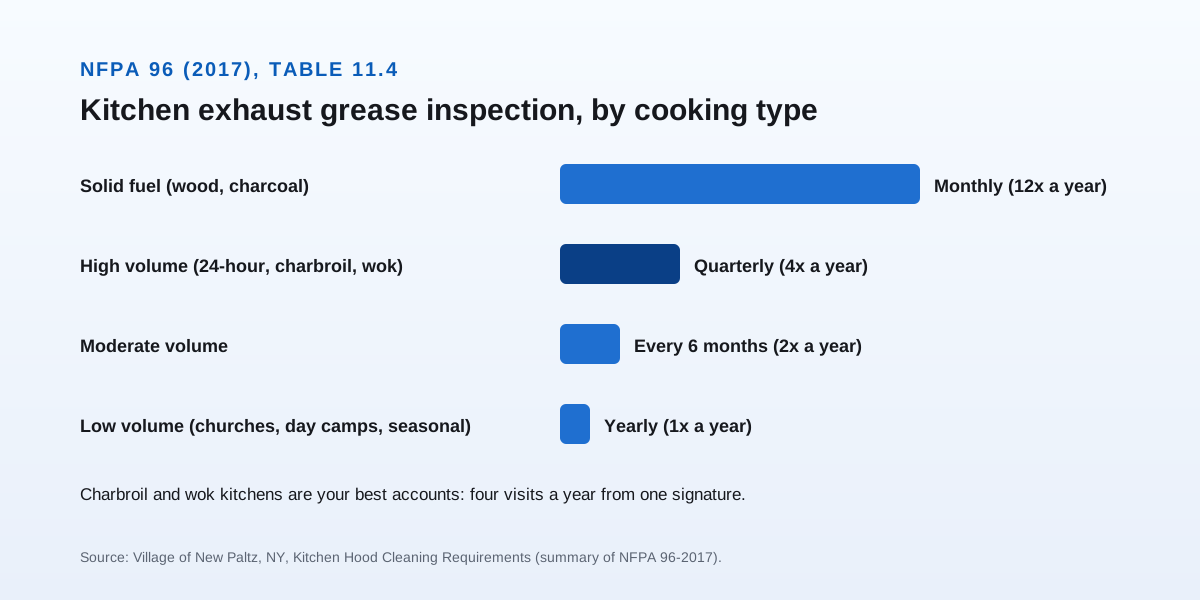
The schedule comes from Table 11.4 of NFPA 96 (2017 edition), as summarized by the Village of New Paltz, New York’s kitchen hood cleaning requirements:
| Kitchen type | Grease inspection |
|---|---|
| Solid fuel (wood, charcoal) | Monthly |
| High volume (24-hour, charbroiling, wok) | Quarterly |
| Moderate volume | Every 6 months |
| Low volume (churches, day camps, seasonal) | Yearly |
The same summary covers the paperwork, and the paperwork is where your business lives:
- A certificate showing “the name of the servicing company, the name of the person performing the work, and the date” stays on the premises.
- “A sticker shall be affixed to the exhaust hood labeling the next inspection or cleaning date.”
- Access panels must allow cleaning of 100% of the hood and ductwork.
- Panels and covers go back to normal operating condition after cleaning.
New Paltz adds one more line: “Proof of training is required to be submitted to the office.”
That’s one village. Your city may ask for more or less, so read your own fire code.
Do you need certification to clean kitchen hoods?
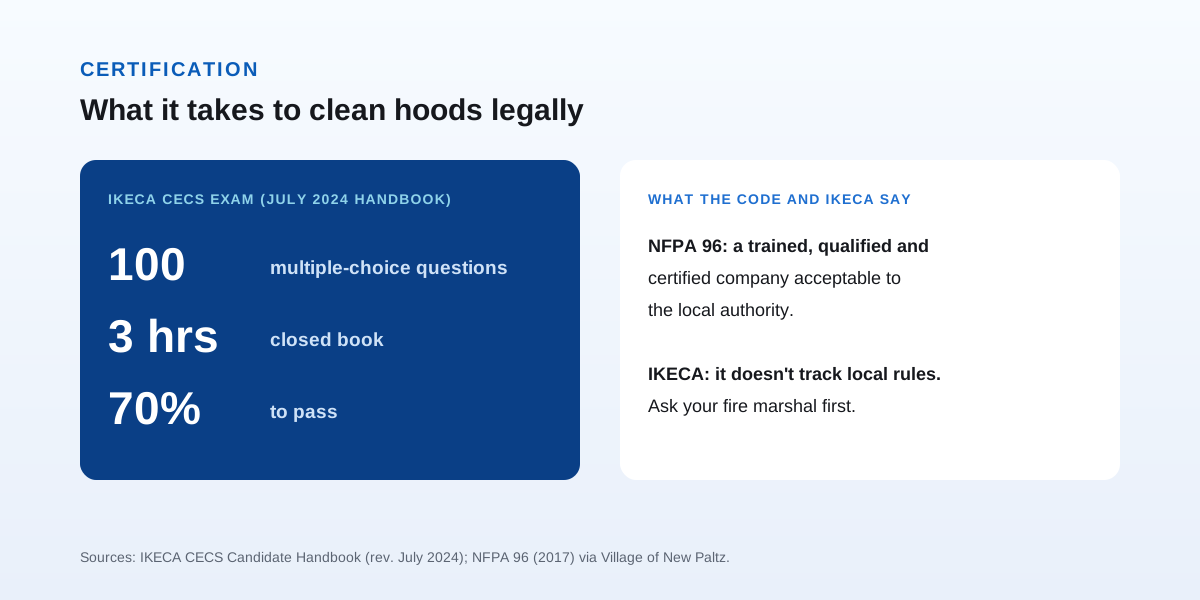
You need whatever your local fire authority accepts, and certification is the safest way to meet it. NFPA 96 says cleaning must be done by a “properly trained, qualified, and certified” company acceptable to the authority having jurisdiction. The best-known credential is IKECA’s Certified Exhaust Cleaning Specialist, a 100-question, three-hour exam with a 70% pass mark.
Those exam details are from IKECA’s CECS candidate handbook, revised July 2024. The exam is closed book.
IKECA is refreshingly honest about its limits. The handbook says it “does not track jurisdictional requirements” and recommends you speak “with your local regulatory authorities” before starting a business.
So the order is:
- Call your fire marshal and ask what they accept.
- Get trained, ideally alongside an experienced crew.
- Sit the certification your area recognizes.
- Keep up the continuing education. IKECA’s certifications require it to renew.
What do you need to start a hood cleaning business?
To start a hood cleaning business you need training and certification, general liability insurance, a vehicle that can carry a hot-water pressure washer and water tank, degreasing chemicals, scrapers, plastic sheeting to protect the kitchen, ladders and roof access gear, and a way to document every job with photos and certificates. Most work happens at night after the kitchen closes.
I won’t give you a startup cost. It swings with whether you buy a trailer rig or rent, and the numbers online mostly come from people selling equipment.
What I’d prioritize:
- Insurance. Restaurants and landlords will ask for a certificate before you touch the roof.
- Before and after photos for every job. They’re your proof if there’s ever a fire.
- The certificate and sticker routine, done the same way every time.
- A partner for what you don’t do: fire suppression system inspections are often a separate trade with its own license.
The cleaning methods IKECA lists include manual scraping, low-pressure detergent application, high-pressure hot water and saturated steam. Learn all four on someone else’s job before you charge for your first.
How do you price hood cleaning?
Price hood cleaning per system after a site visit, based on the size of the hood, the length and route of the ductwork, rooftop fan access and how often the system is serviced. More frequent service means less grease per visit. There’s no published price benchmark, and the anecdotes vary widely, from about $300 a clean to $600 to $800 for a single fryer hood.
Those two data points are real comments, not market rates:
- On r/Chefit, a chef said: “My guy charges $300 a clean. Companies charge by the size of” the system.
- On r/restaurantowners, an owner said quotes were “$700 for one fryer hood, they are all about $600-$800.”
The same owner added that “none are worth that much.” That tells you what restaurant owners think of most providers.
Win on reliability and paperwork, not on being the cheapest. A clean certificate on the wall is what the owner shows the fire inspector and the insurer.
Should you add grease trap service?
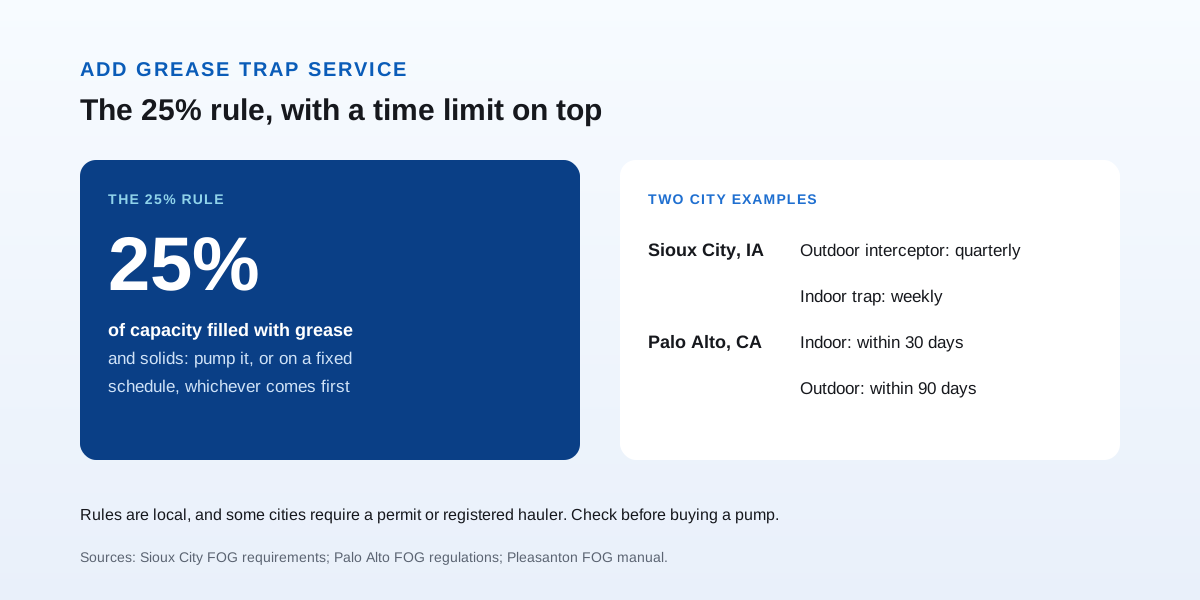
Add grease trap service if your city has a fats, oils and grease (FOG) program, because it’s another recurring visit to the same kitchen. Many FOG ordinances use a 25% rule: the trap must be pumped when grease and solids reach 25% of its capacity, or on a fixed schedule, whichever comes first. Sioux City, Iowa, for example, requires outdoor interceptors pumped at least quarterly and indoor traps maintained weekly.
Those intervals are from Sioux City’s FOG requirements. Palo Alto, California sets 30 days for indoor devices and 90 days for outdoor ones.
The rules are local, and some cities require a separate permit or registered hauler to pump and dispose of grease. Check before you buy a pump truck.
Done right, one kitchen becomes two recurring services: the hood every quarter and the trap every month.
Where do your first hood cleaning customers come from?
Your first hood cleaning customers come from two places: new restaurants that have no provider yet, and open kitchens whose sticker tells you when the next cleaning is due. New restaurants are easier. In Dallas–Fort Worth, 62 restaurant and bar liquor applications were pending on November 12, 2026, and 41 were filed in the previous four weeks. None of those kitchens has a sticker yet.
Those numbers are from TABC’s Pending Applications dataset, filtered to MB, BG and BE permits in Dallas, Tarrant, Collin and Denton counties.
| County | Pending restaurant and bar applications |
|---|---|
| Dallas | 22 |
| Tarrant | 16 |
| Denton | 16 |
| Collin | 8 |
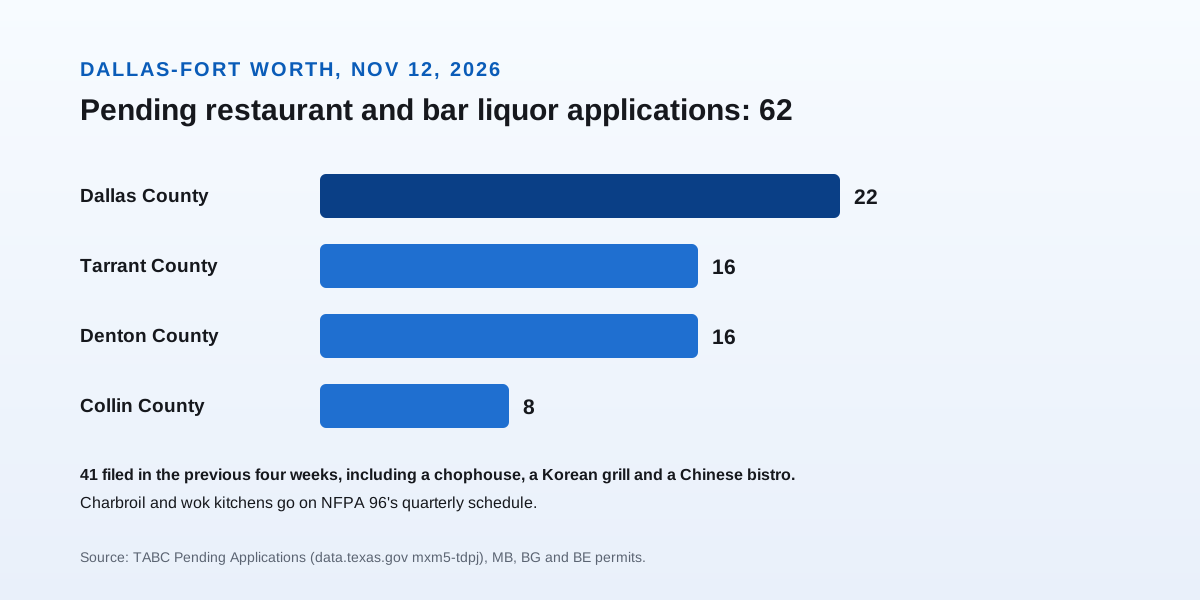
Look at the names, too. Recent filings included a bar and chophouse in Fort Worth, a Korean grill in Carrollton and a Chinese bistro in Plano.
Charbroil and wok kitchens are on NFPA 96’s quarterly schedule. Those are four visits a year from one signature.
The second source is every open kitchen in your area. One hood cleaner on r/hoodcleaner said that while “door knocking pitching cleaning services to restaurants,” owners twice asked whether they cleaned hoods.
When you walk in, look up. The sticker shows the current provider and the next due date. Call a week before.
My guides for Texas, California and New York show where each state publishes its pending applications. RestoSignals pulls them into one list with the owner’s name, if you’d rather not build it by hand.
How do you keep a hood cleaning account?
You keep a hood cleaning account by showing up before the sticker date, every time, and leaving proof. Book the next visit before you leave the roof, send a reminder a week ahead, and give the owner before and after photos with the certificate. Competitors read your sticker too, so a missed date is an open invitation for them to call.
The sticker cuts both ways.
It’s how you find your next customer, and it’s how the next company finds yours.
Three habits that keep accounts:
- Schedule the next service before you leave.
- Text the manager the day before. Kitchens forget.
- Email the photos and certificate the same night, so the owner has them for the insurer.
How do you pitch a new restaurant?
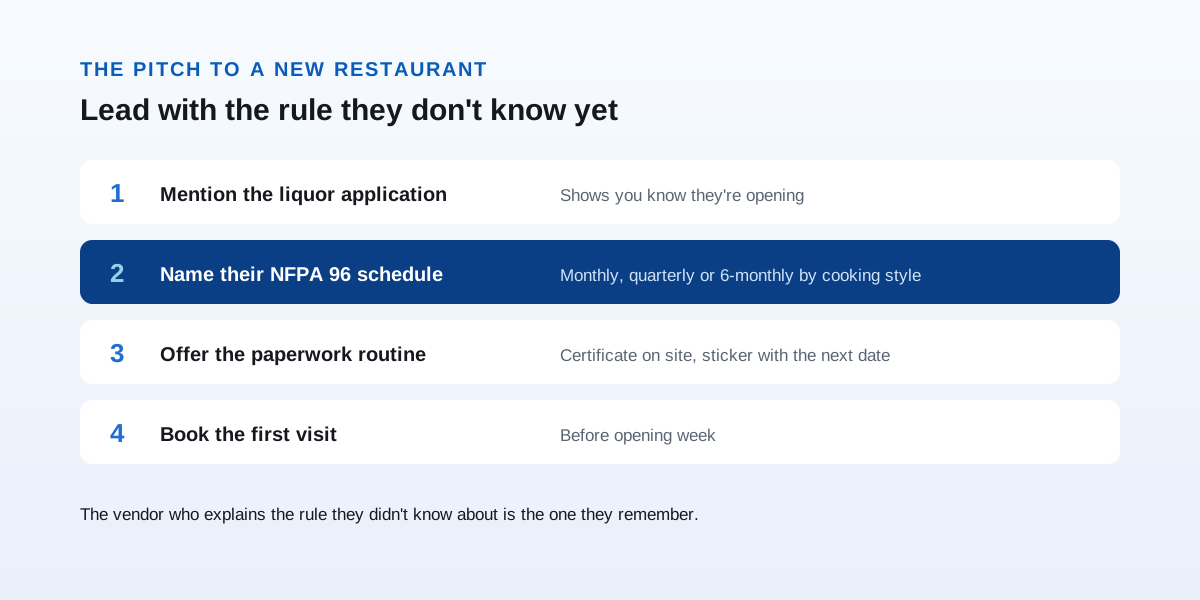
Pitch a new restaurant on its first fire inspection and its first cleaning date, not on price. Tell the owner you saw their liquor application, explain that their cooking style puts them on a monthly, quarterly or six-month schedule under NFPA 96, and offer to set up the certificate and sticker routine from day one. Then book the first service before opening week.
Something like:
Hi [name], I saw the liquor application for [restaurant] on [street]. Congrats. With a charbroiler you’ll be on a quarterly hood cleaning schedule under the fire code. I’m certified, insured and local to [area], and I’ll leave the certificate and sticker the fire inspector looks for after every visit. Happy to look at the hood before you open. [phone]
Change the cooking style and schedule to match the kitchen.
New owners have a hundred vendors to choose. The one who explains the rule they didn’t know about is the one they remember.
Frequently asked questions
Is an exhaust hood cleaning business profitable?
It can be, because the work recurs on a schedule the fire code sets. Pricing is local and there’s no published benchmark, but as data points, one r/Chefit commenter said their hood cleaner charges $300 a clean and a restaurant owner on r/restaurantowners said quotes ran $600 to $800 for one hood. Profit depends on crew cost, travel and how many recurring accounts you hold.
Do you need a license to clean kitchen hoods?
It depends on your city. NFPA 96 says cleaning must be done by a properly trained, qualified and certified company acceptable to the local authority, and some jurisdictions ask for proof of training. IKECA says it does not track local requirements and recommends asking your local regulators before you start. Check with your fire marshal.
How do you get hood cleaning certification?
The best-known route is IKECA, the International Kitchen Exhaust Cleaning Association. Its Certified Exhaust Cleaning Specialist exam has 100 multiple-choice questions, a three-hour closed-book limit and a 70% pass mark, per its July 2024 candidate handbook. Certification requires continuing education to renew.
How often do restaurant hoods need to be cleaned?
Under NFPA 96 (2017, Table 11.4), exhaust systems are inspected for grease monthly for solid-fuel cooking, quarterly for high-volume cooking such as 24-hour, charbroiling or wok kitchens, every six months for moderate volume and yearly for low volume. They’re cleaned whenever inspection finds grease buildup.
How much do restaurants pay for hood cleaning?
There’s no standard price. It depends on the hood size, the length of ductwork, rooftop access and how often the system is cleaned. In individual Reddit comments, one chef said their cleaner charges $300 a clean and a restaurant owner said quotes were $600 to $800 for a fryer hood. Quote after a site visit.
How do I get my first hood cleaning customers?
Start where there’s no incumbent. New restaurants have no hood cleaner and no sticker on the hood yet, and pending liquor license applications show them before they open. For open kitchens, read the sticker on the hood: it shows who services it and when the next cleaning is due, so you know when to call.
Book ten walk-throughs before you buy the trailer
Before you spend on equipment, find out if your area will buy. Pull the pending restaurant permits for your county, pick the ten newest kitchens with charbroilers or woks, and offer each owner a free hood walk-through before opening. If three say yes, you have a business. Or see this week’s new venues on RestoSignals free and start with the list built.
Mukul Dutt is the founder of RestoSignals, which tracks restaurants and bars before they open by fusing public liquor, permit and business-filing records into one scored venue with owner contact. Dallas–Fort Worth counts are from TABC’s pending applications dataset on November 12, 2026 (MB, BG and BE permits in Dallas, Tarrant, Collin and Denton counties). NFPA 96 requirements are from the Village of New Paltz’s summary of the 2017 edition; certification details from IKECA’s CECS candidate handbook, July 2024. Prices quoted are individual Reddit comments, not market rates.
FAQ
Is an exhaust hood cleaning business profitable?
It can be, because the work recurs on a schedule the fire code sets. Pricing is local and there's no published benchmark, but as data points, one r/Chefit commenter said their hood cleaner charges $300 a clean and a restaurant owner on r/restaurantowners said quotes ran $600 to $800 for one hood. Profit depends on crew cost, travel and how many recurring accounts you hold.
Do you need a license to clean kitchen hoods?
It depends on your city. NFPA 96 says cleaning must be done by a properly trained, qualified and certified company acceptable to the local authority, and some jurisdictions ask for proof of training. IKECA says it does not track local requirements and recommends asking your local regulators before you start. Check with your fire marshal.
How do you get hood cleaning certification?
The best-known route is IKECA, the International Kitchen Exhaust Cleaning Association. Its Certified Exhaust Cleaning Specialist exam has 100 multiple-choice questions, a three-hour closed-book limit and a 70% pass mark, per its July 2024 candidate handbook. Certification requires continuing education to renew.
How often do restaurant hoods need to be cleaned?
Under NFPA 96 (2017, Table 11.4), exhaust systems are inspected for grease monthly for solid-fuel cooking, quarterly for high-volume cooking such as 24-hour, charbroiling or wok kitchens, every six months for moderate volume and yearly for low volume. They're cleaned whenever inspection finds grease buildup.
How much do restaurants pay for hood cleaning?
There's no standard price. It depends on the hood size, the length of ductwork, rooftop access and how often the system is cleaned. In individual Reddit comments, one chef said their cleaner charges $300 a clean and a restaurant owner said quotes were $600 to $800 for a fryer hood. Quote after a site visit.
How do I get my first hood cleaning customers?
Start where there's no incumbent. New restaurants have no hood cleaner and no sticker on the hood yet, and pending liquor license applications show them before they open. For open kitchens, read the sticker on the hood: it shows who services it and when the next cleaning is due, so you know when to call.
Find venues opening near you
100 free leads, no card. One platform for restaurants & bars about to open.