Security camera installation business: win new restaurants
How a security camera installation or low voltage business wins restaurant jobs: what a buildout needs, licensing in CA and TX, camera rules for bars, and a real San Diego list.
“So the low voltage is not included in the general contractor bidding. How do I bid/become that low voltage contractor for the store?”
That’s a post on r/lowvoltage. It’s the best question in this business, and the answer is a restaurant.
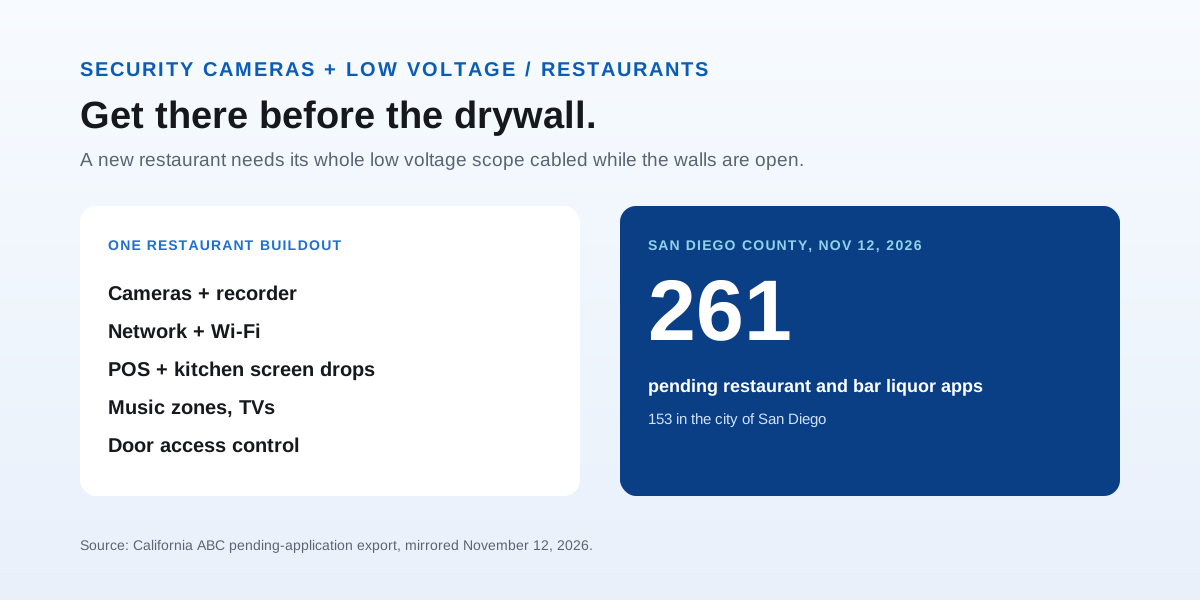
If you run a security camera installation business or any low voltage shop, new restaurants are some of the best jobs you can get: cameras, network, POS data drops, Wi-Fi, speakers and TVs, all cabled before the walls close. The owner often chooses that work separately from the general contractor. Pending liquor applications show you the restaurants months ahead. San Diego County had 261 on November 12, 2026.
I run RestoSignals, which finds restaurants before they open, so I’m biased toward that part. The licensing and code details below come from the statutes themselves.
Why are new restaurants good jobs for low voltage contractors?
New restaurants are good low voltage jobs because they need almost everything at once: security cameras, network cabling and Wi-Fi, POS and kitchen display drops, background music, TVs and sometimes access control. All of it is easiest to install while the space is open, before drywall and ceilings close. And the owner often chooses these systems separately from the general contractor’s scope.
That last part is the opening.
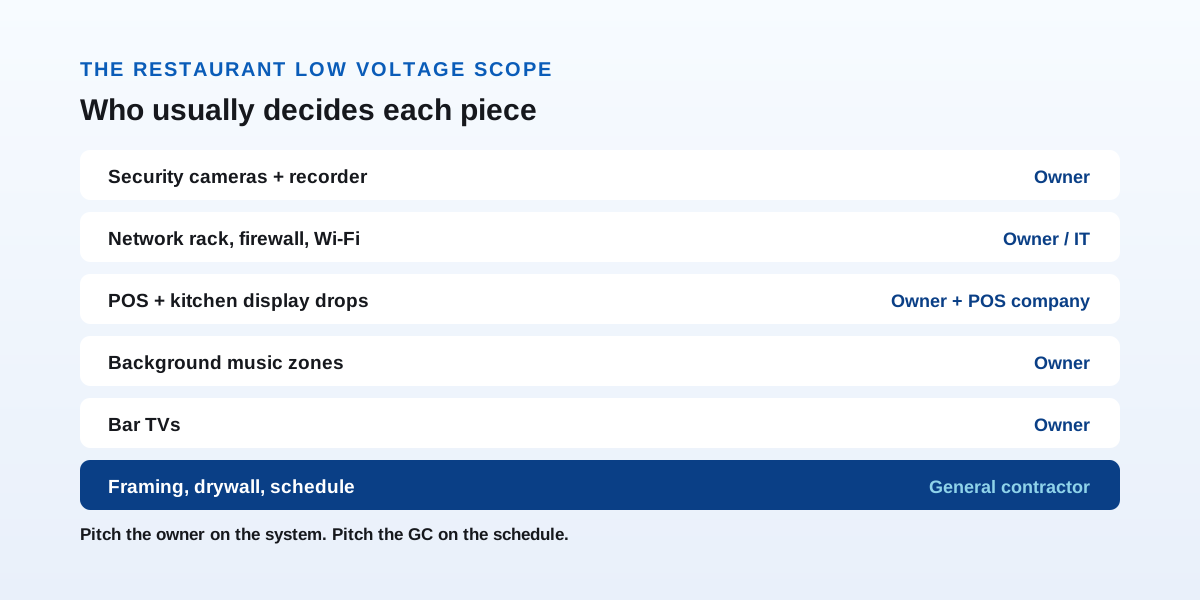
The r/lowvoltage poster above noticed it on retail jobs. Restaurants work the same way. The owner picks the POS company, the camera system and the music. The general contractor builds the room.
So the scope that matters to you is decided by someone you can call directly.
There’s real competition. BLS counted 11,162 security system service establishments in the U.S. in 2024, with about 141,000 employees, per its QCEW data for industry 561621. That doesn’t count electricians and IT shops that also pull cable.
What low voltage work does a restaurant buildout need?
A restaurant buildout typically needs security cameras with a recorder, structured cabling and Wi-Fi access points, data drops for every POS terminal and kitchen display screen, background music speakers and zones, TV mounts and cabling for the bar, and sometimes door access control for the back office and stockroom. Fire alarm systems are usually a separate licensed specialty.
Here’s how I’d scope it on a walk-through:
- Cameras: entrances, registers, the bar, the back door, the alley and the stockroom.
- Network: a rack or wall cabinet, a firewall, Wi-Fi for staff and guests.
- POS: a data drop at every terminal, printer and kitchen screen.
- Audio: speaker zones for the dining room, bar and patio.
- Video: TV locations and cabling for the bar.
- Access: a keypad or card reader on the office and liquor storage.
Ask the owner which POS they’ve chosen, because your drops, printer locations and network have to match it.
Think about the kitchen, too. Screens and printers on the line sit near heat and grease, so plan cable paths and mounts that a cook won’t knock or a degreaser won’t soak.
Do you need a license to install security cameras?
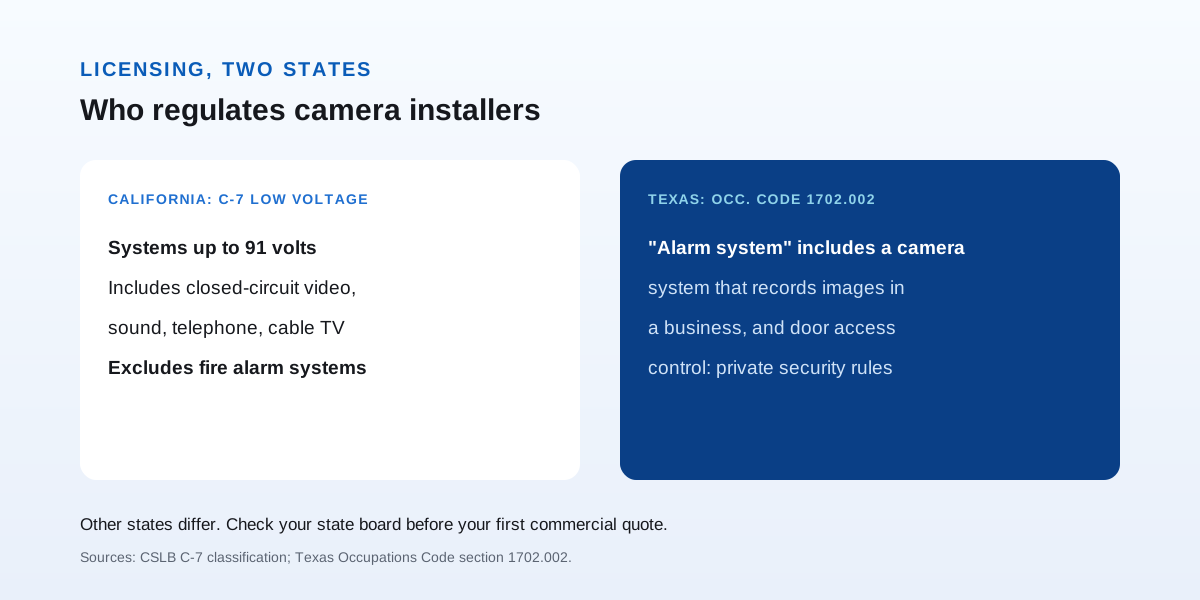
For commercial work, usually yes, and the license depends on the state. California’s C-7 Low Voltage Systems license covers systems up to 91 volts, including closed-circuit video systems. Texas defines an alarm system to include “a television camera or still camera system” that records images of a business, which brings camera installers under the state’s private security licensing.
The California definition is on the Contractors State License Board’s C-7 page. It lists “telephone systems, sound systems, cable television systems, closed-circuit video systems” and more. It also says low voltage fire alarm systems “are specifically not included.”
The Texas definition is in Occupations Code section 1702.002. An alarm system includes a camera system that “records or archives images of property or individuals” in a business, and access control systems that control entry through a door.
Other states have their own rules.
On r/SecurityCamera, the top answer to someone starting an installation business was blunt: “you will need a low voltage license because you will be installing electrical wiring in buildings.”
Fire alarms are a separate job. California leaves them out of the C-7 license, so if a restaurant needs one, bring in a licensed fire alarm contractor rather than stretching your license.
Check your state board before you quote your first commercial job.
Do bars and restaurants have to have security cameras?
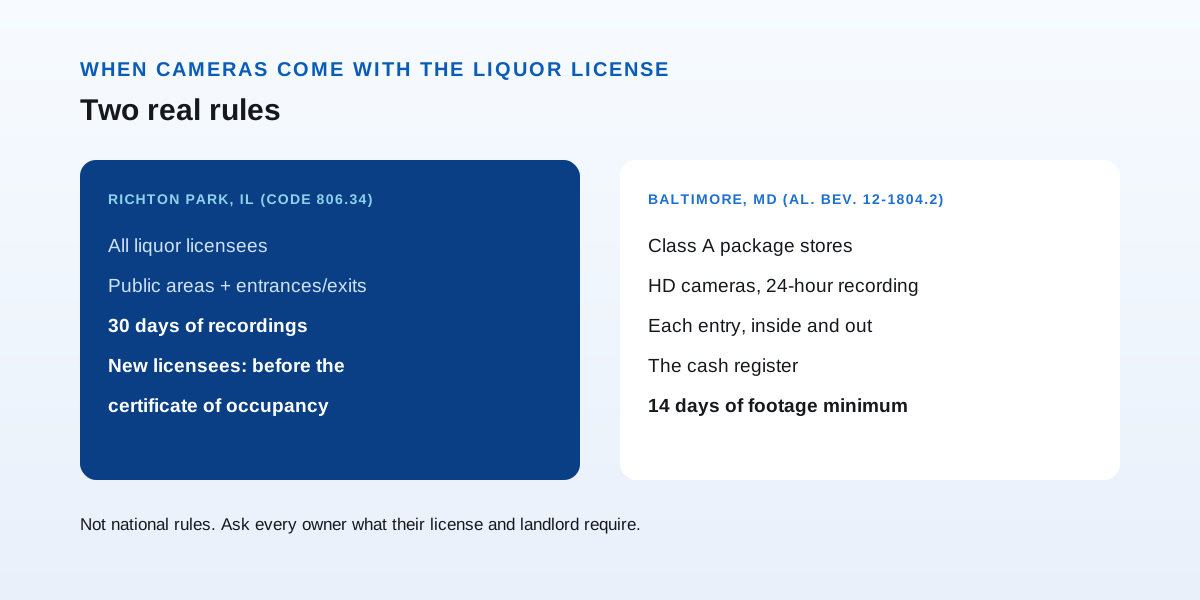
Some do, and the rule usually comes with the liquor license. Richton Park, Illinois requires every liquor licensee to have cameras covering public areas and all entrances and exits, record during business hours and keep 30 days of footage. New licensees must comply as a condition of getting their certificate of occupancy, which means the cameras go in before opening.
That’s section 806.34 of Richton Park’s code, passed November 13, 2023. Camera locations need the police chief’s approval.
Baltimore goes further for its Class A liquor licenses, which are package stores. Maryland’s Alcoholic Beverages code section 12-1804.2 requires high-definition cameras watching each entryway inside and out and the cash register, with 24-hour recording kept at least 14 days.
Those are specific places, not national rules. Most restaurants aren’t required to have cameras.
But many want them anyway, and when a license or a landlord requires them, the owner needs someone who can design to the rule. That’s you.
| Rule | Where | Cameras must cover | Keep footage |
|---|---|---|---|
| Village code 806.34 | Richton Park, IL (all liquor licensees) | Public areas, entrances and exits | 30 days |
| Al. Bev. 12-1804.2 | Baltimore, MD (Class A package stores) | Each entry inside and out, the register | 14 days minimum |
How do you find restaurants before the walls close?
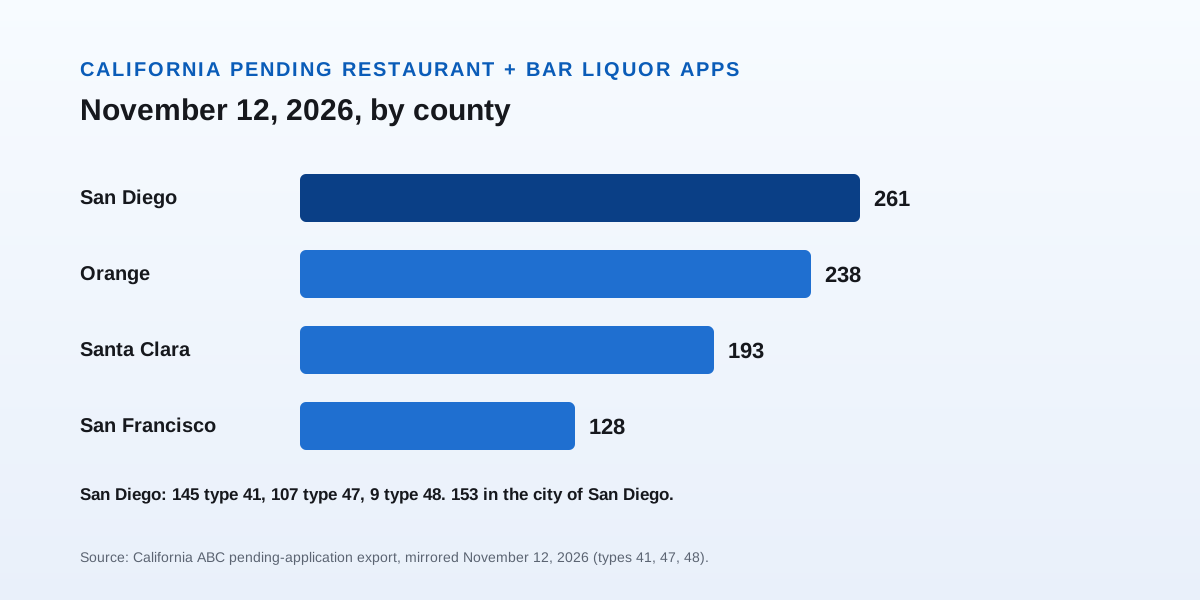
You find restaurants before the walls close in pending liquor license applications. California’s ABC export listed 261 pending restaurant and bar applications in San Diego County on November 12, 2026: 145 for beer and wine restaurants (type 41), 107 for restaurants with full bars (type 47) and 9 for bars (type 48). 153 were in the city of San Diego.
Pending applicants included a wagyu shabu house, a pizza shop, a Thai kitchen, a Mexican cocktail restaurant and a beer company.
Here’s the process:
- Pull pending applications for your county.
- Sort by date. The last one to three months are usually in buildout.
- Check the address for a building permit and a contractor’s sign.
- Find the owner through the LLC and the GC from the permit or sign.
- Offer a pre-drywall walk-through.
Orange County had 238 pending, Santa Clara 193 and San Francisco 128 on the same date.
My California liquor license guide explains the license types and the export. For Texas, use TABC’s pending applications, covered in my Texas guide.
If you’d rather start from a built list, RestoSignals matches the liquor filing with business records into one venue with the owner’s name.
Should you go through the general contractor or the owner?
Go through both. Low voltage business owners on r/lowvoltage say most of their commercial work comes from general contractors, so get on GC bid lists. But on restaurant jobs, the owner usually chooses the POS, cameras and audio, and that scope is often left out of the GC’s bid. Pitch the owner on the system and the GC on the schedule.
When one r/lowvoltage member asked how other business owners got their start in commercial security, cabling and access control, the top answer was “General contractors.”
Another owner’s advice was to “get on general contractors bid list” and contact property management companies about tenant upfits.
Both are right. Restaurants add a third door: the owner, who’s choosing systems while the GC is framing.
Here’s how the conversations differ:
- Owner: “What POS are you using? Where do you want cameras? Do you need music zones?” You’re designing.
- GC: “When is rough-in? When does drywall start? Who do I coordinate with?” You’re scheduling.
Miss the GC and you’ll find the walls closed. Miss the owner and someone else picks the system.
How do you quote a restaurant low voltage job?
Quote a restaurant low voltage job by counting drops and devices, not by guessing a lump sum. List every camera, data drop, access point, speaker zone and TV, size the recorder to the footage the owner has to keep, and price rough-in and trim-out as separate visits. Add a line for change orders, because restaurant floor plans move during buildout.
Storage is where most camera quotes go wrong.
If the license condition says 30 days of footage, the recorder has to hold 30 days at the resolution and frame rate you’re selling. Size the drives to the rule, then show the owner the math in the quote.
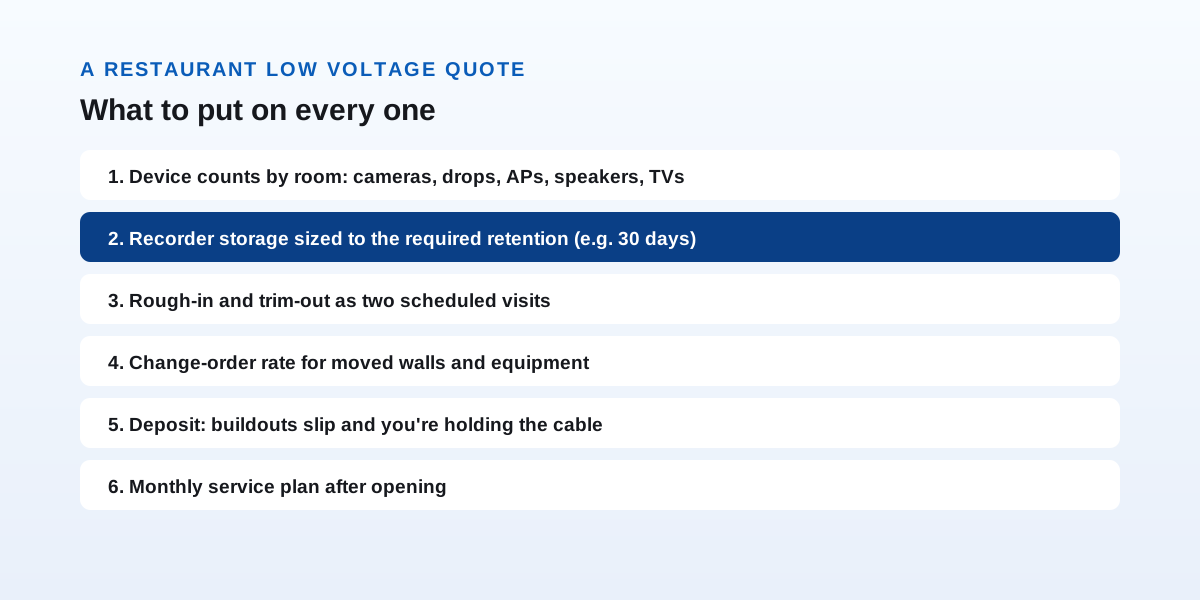
What I’d put on every restaurant quote:
- Device counts by room: cameras, drops, access points, speakers, TVs.
- Recorder storage, sized to the required retention.
- Rough-in and trim-out as two scheduled visits.
- A change-order rate for moved walls and equipment.
- A deposit, because buildouts slip and you’re holding the cable.
What recurring work can you add after opening?
After opening, a restaurant still needs someone for camera checks, recorder and network problems, Wi-Fi issues, moved POS stations and new TVs. Offer a monthly service plan that covers remote checks and a set number of visits. For alarm monitoring, partner with a monitoring company rather than building your own central station.
On r/lowvoltage, a reply about the business side of security put it simply: “With security you have to team up with a monitoring service.”
You install and service the equipment, the monitoring company runs the 24/7 center, and the restaurant keeps calling you.
Restaurants also change fast. A new patio means more cameras, a new menu board means another screen, and a new manager means new access codes. The installer who did the buildout is the one they call.
How do you pitch a restaurant owner in buildout?
Pitch a pre-drywall walk-through, not a camera package. Tell the owner you saw the liquor application, that cable for cameras, POS, Wi-Fi and music is cheapest to run before the walls close, and that you’ll design around their POS and any camera rules in their license. Then quote a full scope they can compare.
Something like:
Hi [name], I saw the liquor application for [restaurant] on [street]. Congrats. I do cameras, network, POS cabling and audio for restaurants in [area]. If your walls aren’t closed yet, now’s the time to run cable. I’m happy to walk the space with you and your GC this week and plan it around your POS. [phone]
Bring a sample layout from a past restaurant job. Owners decide faster when they can see one.
Frequently asked questions
How do I start a security camera installation business?
Start by checking your state’s licensing. California classifies closed-circuit video systems under its C-7 low voltage contractor license, and Texas counts camera systems that record a business as alarm systems under its private security law. Get licensed and insured, pick a camera platform you can support, and find commercial clients that need a full system, such as restaurants in buildout.
Do you need a license to install security cameras?
Usually, for commercial work. California’s C-7 license covers low voltage systems up to 91 volts, including closed-circuit video. Texas Occupations Code section 1702.002 defines an alarm system to include a camera system that records images of a business, which brings installers under the state’s private security licensing. Rules vary by state, so check yours.
How do low voltage contractors get work?
Mostly through general contractors and property managers, according to low voltage business owners on r/lowvoltage, who recommend getting on GCs’ bid lists and contacting property managers about tenant upfits. One poster noticed that on a new store, low voltage wasn’t included in the general contractor’s bid, which meant the business hired it directly.
Do restaurants need security cameras?
It depends on the city and the license. Richton Park, Illinois requires every liquor licensee to have cameras covering public areas and entrances, keep 30 days of recordings, and comply before a new licensee gets its certificate of occupancy. Elsewhere it’s often a license condition or an insurer’s request rather than a citywide rule.
When should cabling go in during a restaurant buildout?
Run cable during rough-in, after framing and before drywall and ceilings close. That’s when you can route camera, network, POS, Wi-Fi and audio lines cleanly. Mount devices and terminate at trim-out, close to opening. Reach the restaurant one to three months before it opens so you’re scheduled before the walls go up.
What low voltage work does a restaurant need?
A typical restaurant needs security cameras and a recorder, network cabling and Wi-Fi, data drops for POS terminals and kitchen display screens, background music speakers, TV mounts and cabling for bars, and sometimes access control on doors and offices. Fire alarm systems are a separate specialty and license in many states.
Walk ten buildouts before the drywall
Pull your county’s pending restaurant liquor applications this week, pick the ten filed most recently, and find each owner and general contractor. Offer every one a pre-drywall walk-through. Or see this week’s new venues on RestoSignals free and start with the list built.
Mukul Dutt is the founder of RestoSignals, which tracks restaurants and bars before they open by fusing public liquor, permit and business-filing records into one scored venue with owner contact. California counts are from the state ABC pending-application export mirrored on November 12, 2026. Licensing details are from the CSLB’s C-7 classification and Texas Occupations Code 1702.002; camera rules from Richton Park, IL code 806.34 and Maryland Alcoholic Beverages code 12-1804.2. BLS figures are QCEW 2024 annual averages for industry 561621. Nothing here is legal advice.
FAQ
How do I start a security camera installation business?
Start by checking your state's licensing. California classifies closed-circuit video systems under its C-7 low voltage contractor license, and Texas counts camera systems that record a business as alarm systems under its private security law. Get licensed and insured, pick a camera platform you can support, and find commercial clients that need a full system, such as restaurants in buildout.
Do you need a license to install security cameras?
Usually, for commercial work. California's C-7 license covers low voltage systems up to 91 volts, including closed-circuit video. Texas Occupations Code section 1702.002 defines an alarm system to include a camera system that records images of a business, which brings installers under the state's private security licensing. Rules vary by state, so check yours.
How do low voltage contractors get work?
Mostly through general contractors and property managers, according to low voltage business owners on r/lowvoltage, who recommend getting on GCs' bid lists and contacting property managers about tenant upfits. One poster noticed that on a new store, low voltage wasn't included in the general contractor's bid, which meant the business hired it directly.
Do restaurants need security cameras?
It depends on the city and the license. Richton Park, Illinois requires every liquor licensee to have cameras covering public areas and entrances, keep 30 days of recordings, and comply before a new licensee gets its certificate of occupancy. Elsewhere it's often a license condition or an insurer's request rather than a citywide rule.
When should cabling go in during a restaurant buildout?
Run cable during rough-in, after framing and before drywall and ceilings close. That's when you can route camera, network, POS, Wi-Fi and audio lines cleanly. Mount devices and terminate at trim-out, close to opening. Reach the restaurant one to three months before it opens so you're scheduled before the walls go up.
What low voltage work does a restaurant need?
A typical restaurant needs security cameras and a recorder, network cabling and Wi-Fi, data drops for POS terminals and kitchen display screens, background music speakers, TV mounts and cabling for bars, and sometimes access control on doors and offices. Fire alarm systems are a separate specialty and license in many states.
Find venues opening near you
100 free leads, no card. One platform for restaurants & bars about to open.