How to get commercial pest control contracts from restaurants
How to get commercial pest control contracts from restaurants: what the food code requires, NYC's pest violation rate at first inspection, and a real list of new restaurants to pitch.
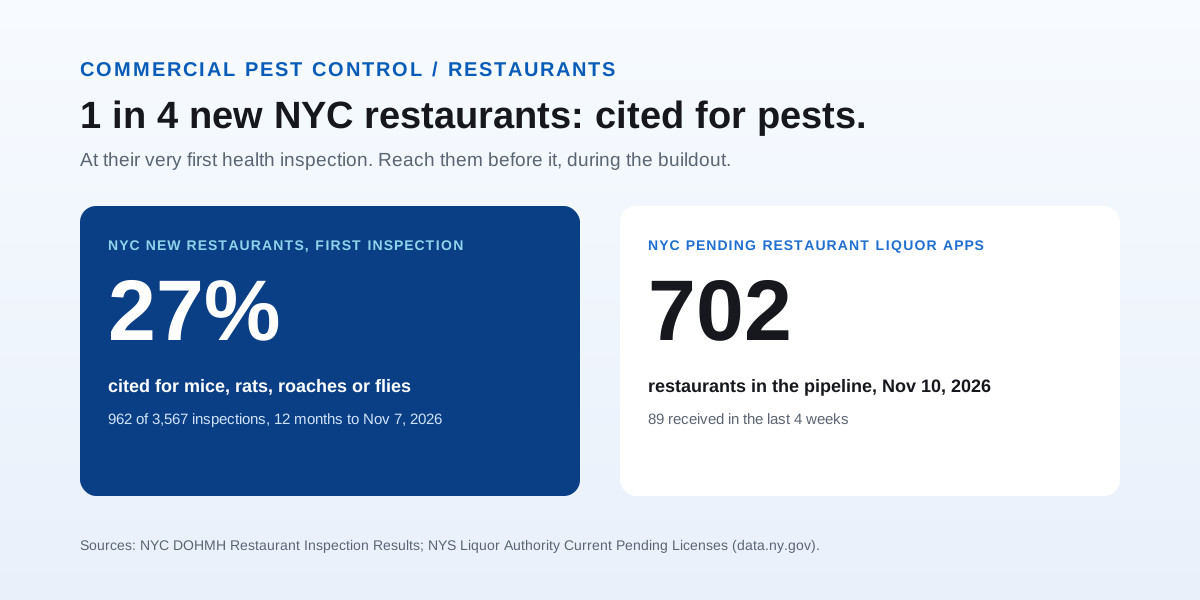
In New York City, more than one in four new restaurants gets cited for pests at its very first health inspection.
I counted. It’s 27%.
If you want to get commercial pest control contracts, restaurants are the best place to start, and new restaurants are the best restaurants. Food codes require them to keep pests out, inspectors check, and in NYC, 27% of newly permitted restaurants were cited for mice, rats, roaches or flies at their first inspection in the past year. A new restaurant has no provider yet, and public liquor applications show you where they are.
I run RestoSignals, which finds restaurants before they open, so weigh my bias. The numbers below come from NYC’s public inspection data, the state liquor authority and BLS, and you can pull them yourself.
Why are restaurants the best commercial pest control accounts?
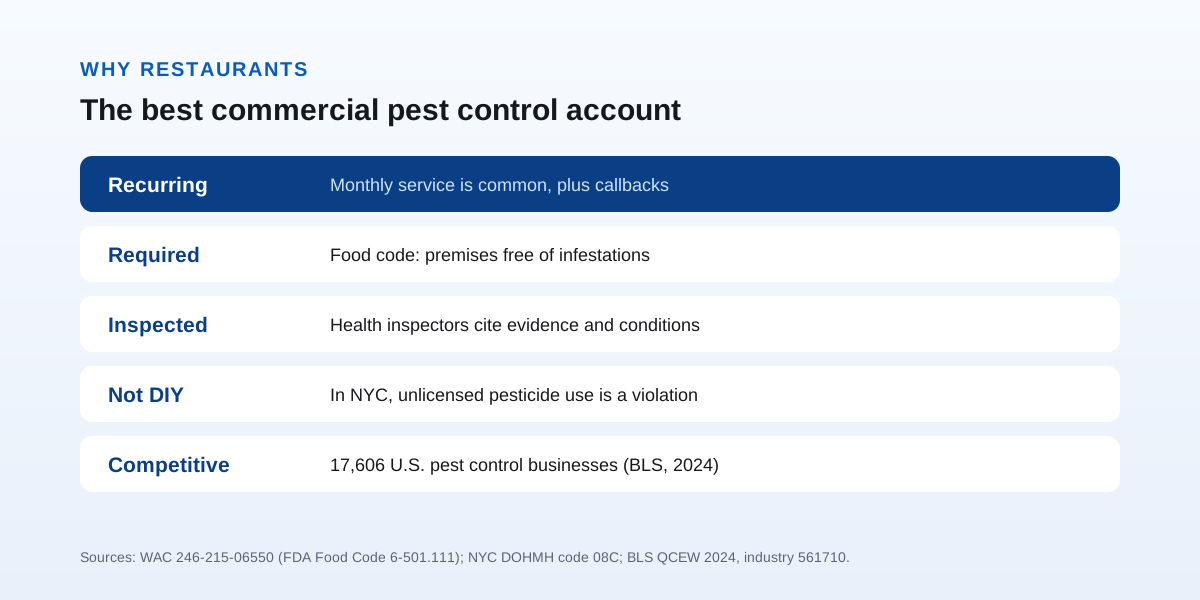
Restaurants are the best commercial pest control accounts because they need service every month, they can’t skip it, and a failed inspection costs them more than your invoice. Food, water, heat and constant deliveries attract pests, health inspectors look for evidence, and in cities like New York, applying pesticides without a license is its own violation. That makes the contract recurring and sticky.
Pest control operators say the same thing. On r/pestcontrol, one tech called commercial accounts “by far my favorite accounts,” listing “Restaurants, dealerships, factories, resorts” first.
The competition is real, though. BLS counted 17,606 exterminating and pest control establishments in the U.S. in 2024, employing about 152,000 people, per its QCEW data for industry 561710.
And restaurant owners shop around. A thread on r/houston asking restaurant owners who they use for pest control got the advice to stay away from the national companies.
That’s an opening for a local operator, if you show up at the right time.
What does the health code require from restaurants on pests?
The FDA Food Code, which most states adopt, requires restaurants to keep their premises free of pest infestations. Washington’s adoption of section 6-501.111 says pests must be controlled by routinely inspecting deliveries and the premises, using traps or other control methods when pests are found, and eliminating harborage. It doesn’t name a provider, but it describes exactly what you sell.
The exact wording is in Washington’s code, WAC 246-215-06550, which reproduces FDA Food Code 6-501.111. It says the premises “must be maintained free of infestations of insects, rodents, and other pests.”
The four required methods:
- Routinely inspecting incoming shipments of food and supplies.
- Routinely inspecting the premises for evidence of pests.
- Using traps or other pest control methods when pests are found.
- Eliminating harborage conditions.
Pre-opening checklists go further. Anne Arundel County, Maryland’s pre-opening checklist requires exterior doors to be “tight fitting and equipped with self-closing devices to prevent the entrance of insects and rodents.”
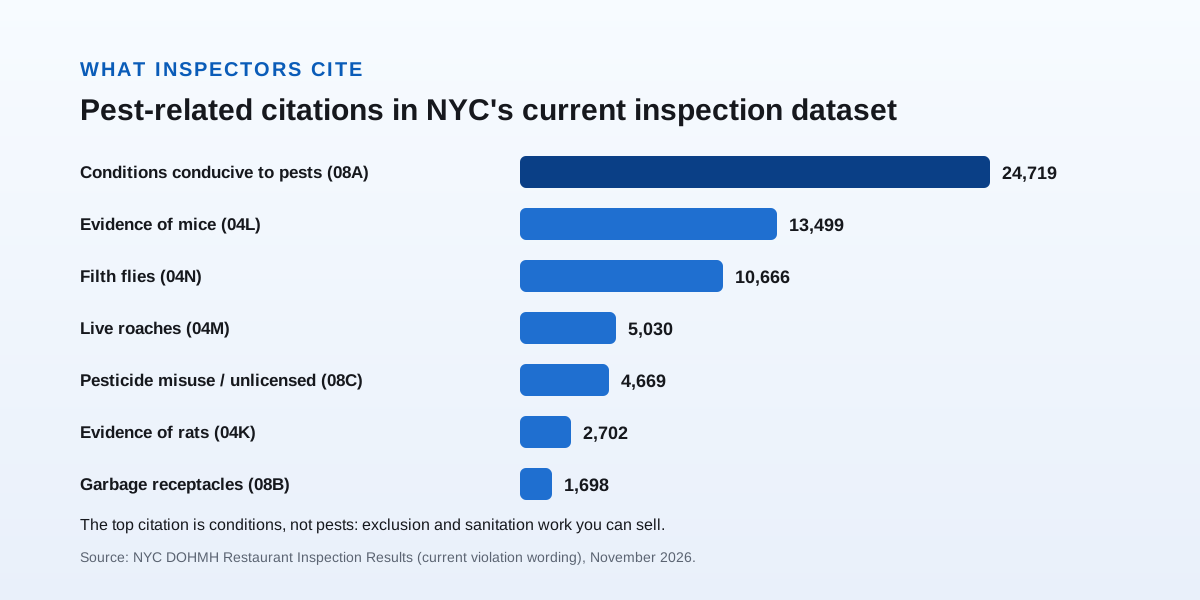
And owners can’t just buy spray. NYC’s inspection data includes a whole violation for pesticide “used by unlicensed individual.” In the city’s current inspection dataset, that code (08C) appears 4,669 times.
How often do new restaurants fail inspections for pests?
Often. In New York City, 27% of newly permitted, operating restaurants were cited for at least one pest at their first health inspection in the 12 months to November 7, 2026. That’s 962 of 3,567 initial pre-permit inspections. Mice were most common, at 14.1%, followed by filth flies at 11.1% and live roaches at 3.7%, per NYC health department data.
I pulled these numbers from NYC’s restaurant inspection results on data.cityofnewyork.us. “Pre-permit” inspections are the health department’s first visits to a restaurant applying for a new permit, which includes new restaurants and some new owners of existing ones.
| Pest violation at first inspection | Inspections cited | Share of 3,567 |
|---|---|---|
| Evidence of mice (04L) | 504 | 14.1% |
| Filth flies (04N) | 397 | 11.1% |
| Live roaches (04M) | 131 | 3.7% |
| Any pest (rats, mice, roaches or flies) | 962 | 27.0% |
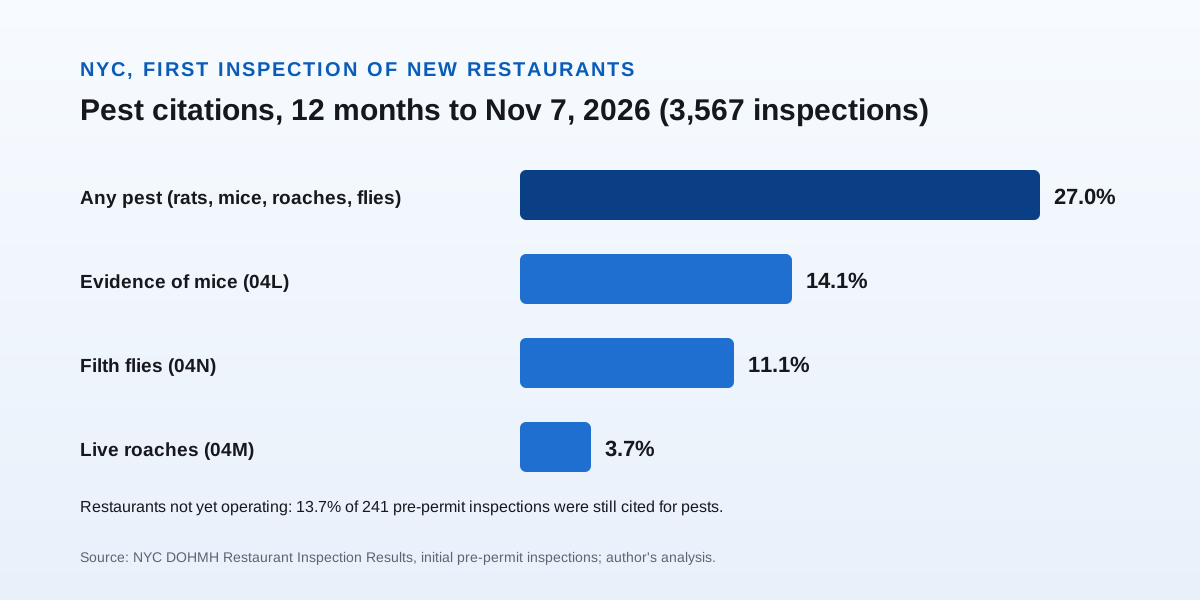
The restaurants that weren’t open yet did better, but not by much. Of 241 inspections of non-operational restaurants, 13.7% were still cited for pests.
So a brand-new kitchen isn’t a clean slate. Construction opens walls, deliveries start arriving, and the mice from the last tenant are still in the building.
What do inspectors cite besides live pests?
Inspectors cite the conditions that attract pests as well as the pests themselves. In NYC’s current inspection dataset, the most common pest-related citation isn’t mice or roaches. It’s code 08A, a restaurant not free of harborage or conditions conducive to rodents and insects, which appears 24,719 times. Uncovered or unsuitable garbage receptacles (08B) add another 1,698.
That matters for how you sell.
A restaurant can have zero mice on the day of inspection and still get written up for gaps under the door, holes around pipes or clutter behind the line.
That’s exclusion and sanitation advice, which most restaurants don’t know how to do themselves and which a good pest control provider covers in every visit report.
So your service report isn’t paperwork. It’s a list of things to fix before the inspector finds them.
Why pitch a restaurant before it opens?
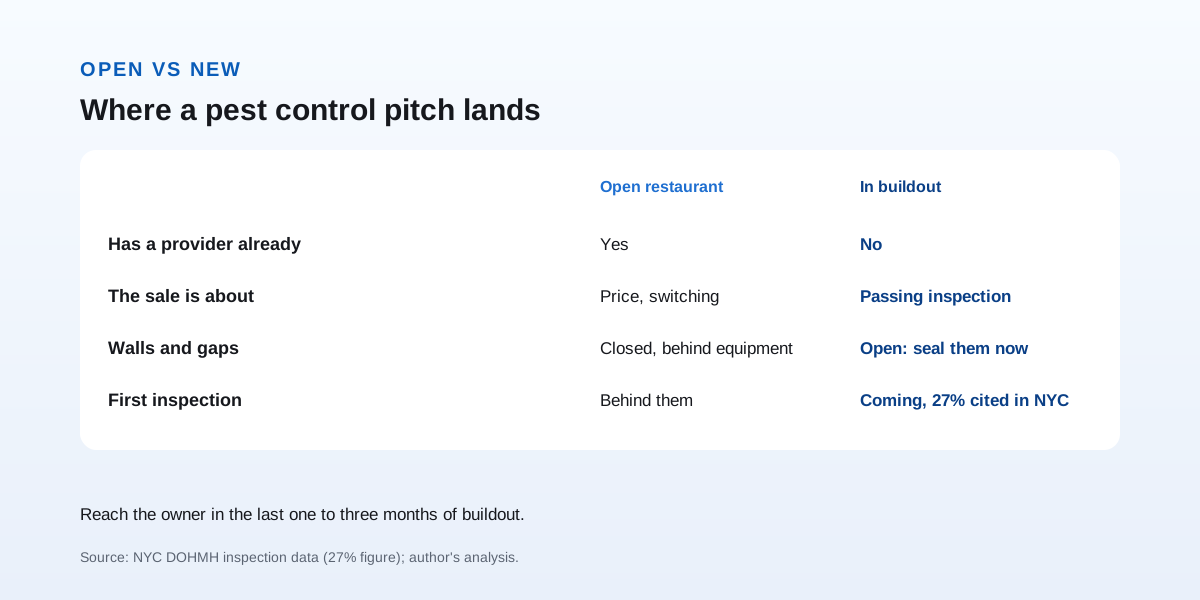
Pitch before opening because that’s when the owner has no provider, the walls are still open, and the health department’s first inspection is coming. Sealing gaps, fitting door sweeps and setting stations during buildout is cheaper and easier than fighting an infestation after opening, and an owner who just read that 27% figure has a reason to listen.
Here’s the difference in the two sales:
- An open restaurant already has a provider. You’re asking it to switch, usually on price.
- A restaurant in buildout has nobody. You’re helping it pass an inspection it’s worried about.
The second conversation is easier, and the work is better. Exclusion during construction means you’re dealing with gaps before the drywall closes and the equipment is pushed against the walls.
Timing matters. The first inspection comes around opening, so reach the owner in the last one to three months of buildout.
How do you find new restaurants that need pest control?
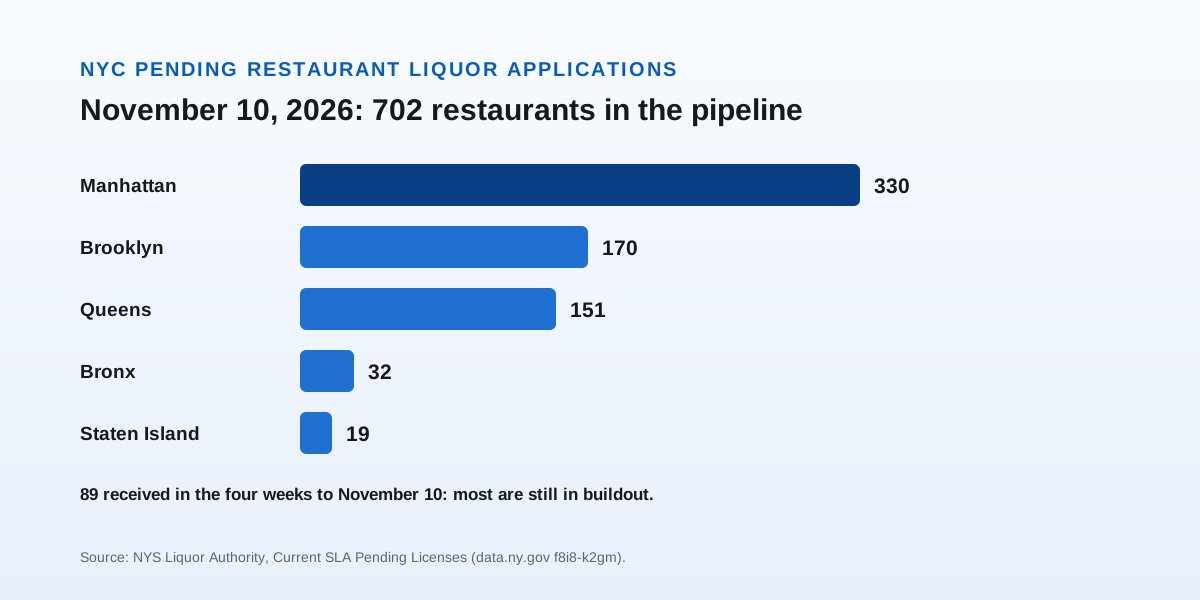
You find new restaurants in pending liquor license applications, which every state publishes. New York’s State Liquor Authority listed 702 pending restaurant applications in New York City on November 10, 2026, with 330 in Manhattan, 170 in Brooklyn and 151 in Queens. 89 were received in the previous four weeks, so most of those are still in buildout and have no pest provider.
The list is free on data.ny.gov as Current SLA Pending Licenses. Each record has the legal name, the trade name, the address and the date received.
Here’s how I’d work it:
- Filter to the “Restaurant” description and your boroughs or counties.
- Sort by received date and start with the last four to eight weeks.
- Look up the LLC behind each one, then confirm the owner through the trade name, the landlord or the contractor on site.
- Walk past. Paper on the windows and a contractor’s sign mean you’re early.
- Reach out with an offer for a pre-opening inspection.
Other states publish the same thing. Texas had 909 pending applications on November 5, 2026, and California’s ABC export listed 231 pending restaurant applications in the city of Los Angeles on November 8. My guides for Texas and California show how to read them.
There’s a second list worth watching: restaurants that just failed an inspection. NYC’s inspection data is updated daily, and a fresh mice citation is a reason to call.
If you’d rather not build this by hand, RestoSignals matches the liquor filing with permits and business records, and in New York it includes a phone number for about 29% of venues.
What should a restaurant pest control contract include?
A restaurant pest control contract should cover a monthly service visit, an integrated pest management plan for the kitchen, storage and trash areas, exclusion work, callbacks between visits, and a written service report left on site after every visit. The report matters most to the owner, because it’s what they show an inspector. Price it after a walk-through, not over the phone.
The National Pest Management Association publishes contract templates and forms for its members, which is a good starting point for the legal side.
On price, there’s no published benchmark I’d trust. Two real data points from Reddit:
- A restaurant owner on r/restaurantowners said: “We pay 75$ for monthly preventative visits.”
- A pest control operator on r/pestcontrol said they charge commercial accounts about $100 an hour, plus $5 to $10 per bait box.
Those are two people, not a market rate. Your city, the building’s age and the kitchen’s volume all change the number.
What keeps restaurant accounts is reliability more than price. The r/houston post that asked for recommendations described a client’s last pest control guy as “unclear and hard to deal with.”
How do you pitch a restaurant owner in buildout?
Pitch the inspection, not the spray. Tell the owner you saw their liquor application, that new restaurants in your city often get cited for pests at their first inspection, and that you’ll do a pre-opening walk-through to seal entry points and set up monitoring before the inspector arrives. Then propose the monthly contract once they’ve seen the work.
Something like:
Hi [name], I saw the liquor application for [restaurant] on [street]. Congrats. In NYC last year, about 1 in 4 new restaurants got a pest citation at their first inspection, mostly mice. I do pre-opening walk-throughs for restaurants in [area]: we seal entry points while the walls are open and leave a service log for the inspector. Happy to stop by this week. [phone]
Change the city and the number to yours.
What to bring to the walk-through:
- Your state pest control license number, printed on the proposal.
- A certificate of liability insurance. Landlords and contractors often ask before you set foot on site.
- A sample service report, so the owner sees what the inspector will see.
- A short exclusion list for this building: doors, pipe penetrations, drains, the back alley.
Owners in buildout are drowning in quotes. A specific list for their space stands out.
Should you buy pest control leads or market for them?
Buy or build leads that reach a restaurant before it has a provider, and spend less on ads that reach every pest company’s customers at once. Advertisers pay about $130 a click for “pest control marketing” and $36 for “pest control leads,” per DataforSEO’s November 2026 data, which shows how expensive clicks are in this industry. A public liquor application costs nothing.
Ads still have a place for residential work and emergencies.
For commercial restaurant accounts, timing beats volume. Twenty restaurants you reach before opening are worth more than two hundred that already have a provider.
Frequently asked questions
How do I get commercial pest control contracts?
Start with businesses that must have pest control and don’t have it yet. Restaurants are the clearest case: food codes require them to keep pests out, and inspectors check. New restaurants have no incumbent provider, and public liquor license applications show them months before opening. Offer a pre-opening exclusion inspection, then convert it into a monthly contract.
How much do restaurants pay for pest control?
There’s no published standard. Prices vary by city, size and pest pressure. As one data point, a restaurant owner on r/restaurantowners said they pay $75 for monthly preventive visits, and a pest control owner on r/pestcontrol said they charge commercial accounts about $100 an hour plus $5 to $10 per bait box. Quote after a walk-through, not before.
Do restaurants need a pest control contract to pass inspection?
Most codes don’t require a contract by name, but they require results. The FDA Food Code, as adopted by states such as Washington, says the premises must be free of infestations and pests must be controlled by routine inspection, trapping and eliminating harborage. In practice, a licensed provider with a service log is how most restaurants meet that.
How often should a restaurant have pest control service?
Monthly service is common for restaurants, with extra visits when there’s activity. The food code language asks for routine inspection of deliveries and premises rather than a fixed interval, so the frequency is set by the provider’s assessment and the restaurant’s history. High-volume kitchens and older buildings often need more.
What is the most common pest violation in restaurants?
In New York City, mice. Of 3,567 initial inspections of newly permitted, operating restaurants in the 12 months to November 7, 2026, 504 (14.1%) were cited for evidence of mice, 397 (11.1%) for filth flies and 131 (3.7%) for live roaches. Overall, 27% were cited for at least one pest, according to NYC health department inspection data.
Where can I find pest control leads for restaurants?
Look for restaurants before they open, when they have no provider. Pending liquor license applications are public in most states and name the business and address, such as New York’s SLA pending list on data.ny.gov or Texas TABC’s pending applications. Health department inspection data shows which open restaurants were just cited for pests.
Pull your county’s list this week
Open your state’s pending liquor applications, filter to restaurants in your service area, and pick the 20 received most recently. Offer each owner a pre-opening walk-through before their first inspection. If you’d rather start with the list built, see this week’s new venues on RestoSignals free.
Mukul Dutt is the founder of RestoSignals, which tracks restaurants and bars before they open by fusing public liquor, permit and business-filing records into one scored venue with owner contact. NYC inspection figures are my analysis of the DOHMH Restaurant Inspection Results dataset for initial pre-permit inspections from November 8, 2025 to November 7, 2026, counting each restaurant-date once. NYC pending applications are from the SLA’s Current Pending Licenses dataset on November 10, 2026. Industry counts are BLS QCEW 2024 annual averages for industry 561710. Prices quoted are individual Reddit comments, not market rates.
FAQ
How do I get commercial pest control contracts?
Start with businesses that must have pest control and don't have it yet. Restaurants are the clearest case: food codes require them to keep pests out, and inspectors check. New restaurants have no incumbent provider, and public liquor license applications show them months before opening. Offer a pre-opening exclusion inspection, then convert it into a monthly contract.
How much do restaurants pay for pest control?
There's no published standard. Prices vary by city, size and pest pressure. As one data point, a restaurant owner on r/restaurantowners said they pay $75 for monthly preventive visits, and a pest control owner on r/pestcontrol said they charge commercial accounts about $100 an hour plus $5 to $10 per bait box. Quote after a walk-through, not before.
Do restaurants need a pest control contract to pass inspection?
Most codes don't require a contract by name, but they require results. The FDA Food Code, as adopted by states such as Washington, says the premises must be free of infestations and pests must be controlled by routine inspection, trapping and eliminating harborage. In practice, a licensed provider with a service log is how most restaurants meet that.
How often should a restaurant have pest control service?
Monthly service is common for restaurants, with extra visits when there's activity. The food code language asks for routine inspection of deliveries and premises rather than a fixed interval, so the frequency is set by the provider's assessment and the restaurant's history. High-volume kitchens and older buildings often need more.
What is the most common pest violation in restaurants?
In New York City, mice. Of 3,567 initial inspections of newly permitted, operating restaurants in the 12 months to November 7, 2026, 504 (14.1%) were cited for evidence of mice, 397 (11.1%) for filth flies and 131 (3.7%) for live roaches. Overall, 27% were cited for at least one pest, according to NYC health department inspection data.
Where can I find pest control leads for restaurants?
Look for restaurants before they open, when they have no provider. Pending liquor license applications are public in most states and name the business and address, such as New York's SLA pending list on data.ny.gov or Texas TABC's pending applications. Health department inspection data shows which open restaurants were just cited for pests.
Find venues opening near you
100 free leads, no card. One platform for restaurants & bars about to open.