Pre-opening restaurant leads: the best sources compared
A straight comparison of where to get pre-opening restaurant leads in 2026: the email lists, the scrapers, the free DIY route, and the scored API, and who each one fits.
Every vendor selling to restaurants wants the same thing: the owner, before they’ve bought anything.
The problem is that the pages ranking for “pre-opening restaurant leads” are all sales pages. Each service tells you it’s the best. None tells you where it’s weak, or where a cheaper option would do.
So here’s the honest version. There are four ways to get pre-opening restaurant leads in 2026: read the government filings yourself, subscribe to a curated email list, buy a raw scraper feed, or query a scored API. This compares all four, names who each one fits, and tells you where my own product wins and where it doesn’t.
What are pre-opening restaurant leads, and why are they worth more?
Pre-opening restaurant leads are venues that have committed to opening but haven’t served a paying customer yet. They’re worth more than existing-restaurant lists because the buying decisions are still open: the POS, the distributor, the insurance, none of it is signed. Reach an existing restaurant and you’re pitching a switch. Reach a pre-open one and you’re the first vendor in the door.
The timing is the whole value.
About 71% of operators finalize key vendor decisions more than 90 days before opening, per RestaurantData, and 64% before any public announcement.
So by the time a place shows up on Eater or Google Maps, the contracts you wanted are already signed. A pre-opening lead is the only kind that reaches the owner while the money is still moving.
That’s why vendors pay for this data, and why a whole set of services exists to collect it.
The best pre-opening restaurant lead sources in 2026
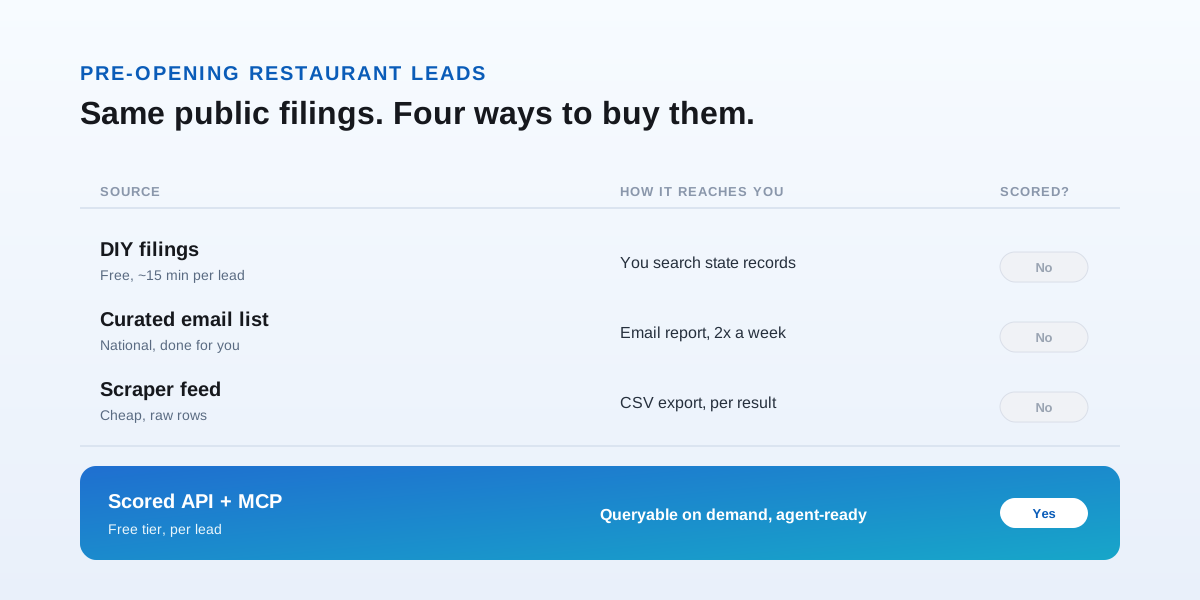
The best source depends on whether you value coverage, convenience, control, or cost. Curated email lists like RestaurantData.com and Preopening Restaurants Resource give you national reach with owner contact, done for you. Scraper feeds hand you raw rows cheaply. An API like RestoSignals gives you scored leads you can automate. Reading the filings yourself is free. Here is how they line up.
| Source | What it is | Freshness | Scored? | Contact included | Pricing model |
|---|---|---|---|---|---|
| DIY government filings | You search state liquor, tax, and business records | Daily, if you check | No | Owner on the filing | Free |
| RestaurantData.com | Curated national opening leads from legal filings | ~2,000 leads/month | No | Yes | Quote-based |
| Preopening Restaurants Resource | Human-researched email report | Twice a week | No | Yes | Subscription (not public) |
| What Now | Exclusive per-category partner leads | ~40+/month | No | Yes, direct | Subscription (exclusive) |
| Open Soon / Apify scrapers | Raw license-row feed | Weekly / on run | No | Varies | Per result (~$10/1,000) |
| RestoSignals | Scored API + MCP, fused filings | On every query | Yes | Yes (TX and more) | Per lead, free tier |
A few honest notes on each.
RestaurantData.com and its parent generate around 2,000 new opening leads a month from legal filings, with national coverage and tiered plans. Pricing isn’t public, so you request a quote.
Preopening Restaurants Resource, from Starfleet Media, is the human-curated option: research staff spend hundreds of hours a month on developer news and construction activity, and the lead includes cuisine, average check, and owner contact. It emails twice a week and now covers Canada.
What Now sells exclusive leads, one vendor per category per market. That’s great if you grab the slot and useless if a competitor already holds it.
Open Soon and the Apify scrapers give you raw license rows, cheap, with no scoring, so you sort the real openings from the renewals yourself.
How the sources actually differ: sourcing, format, and scoring
The real differences come down to three things: where the data comes from, how it reaches you, and whether anyone has ranked it. Most services pull from the same public filings, so sourcing is rarely the differentiator. Format and scoring are. An email list arrives on someone else’s schedule. A CSV needs cleaning. An API answers on demand. And only a scored feed tells you which lead to call first.
Start with sourcing.
Almost everything here traces back to the same place: government filings. Liquor license applications, sales-tax permits, business registrations. RestaurantData.com, Open Soon, and RestoSignals all say so plainly. The curated lists add human research on top, like construction news.
So the raw material is mostly the same. What you’re really buying is the packaging.
Format is where that shows. A twice-weekly email is convenient but it’s a fixed cadence you don’t control. A scraper’s CSV is cheap but raw. An API with an MCP endpoint is the only format an AI agent can query on its own, which matters more every month.
Scoring is the last gap, and the widest. Most of these hand you a flat list. A lone liquor filing could be a bar changing hands, not a new restaurant, and a flat list won’t tell you which. A scored feed ranks each venue by how many signals agree, so you work the strong ones first.
Which pre-opening lead source is right for you?
Match the source to how you sell, not to whoever markets hardest. If you cover the whole country and want leads handed to you, the curated email lists fit best. If you sell in specific states and want to automate, an API fits. If you have zero budget and some patience, do it yourself. There’s no universal winner, and any page that claims one is selling you something.
Here’s the honest routing.
-
You sell nationally and want zero setup. Go with a curated list like RestaurantData.com or Preopening Restaurants Resource. They cover all 50 states today and hand you owner contact. That’s reach I can’t match yet.
-
You want exclusivity in your market. What Now’s one-vendor-per-category model is built for that, if the slot is open.
-
You want leads in your own tools or an AI agent. Pick an API. This is where RestoSignals fits: scored leads over REST and MCP, not an inbox.
-
You have no budget. Read the filings yourself. It’s free and it works, it just costs you time.
-
You only sell to established groups. Pre-opening data is the wrong tool. An existing-restaurant database like Chain Store Guide fits multi-unit upsells better.
How much do pre-opening restaurant leads cost?
Most pre-opening lead services don’t publish prices, which is its own answer. The curated lists use quote-based or subscription pricing you request a plan for, so budget for a sales call and a per-seat or per-market fee. Scraper feeds charge per result, roughly $10 per 1,000 raw rows on Apify. Doing it yourself is free but costs about 15 minutes per lead in manual matching across two databases.
So the real cost isn’t just dollars. It’s dollars plus your time plus how much sorting you still have to do.
A cheap scraper that hands you 1,000 unscored rows can cost more in wasted calls than a smaller scored list. Half of raw liquor records are renewals or transfers, not new restaurants.
I built RestoSignals on a per-lead credit model with a free tier of 100 leads and no card, specifically so you can check lead quality in your territory before you spend anything. One credit is one returned lead. That won’t be the cheapest option at huge volume, and I’ll say so.
Can you just find pre-opening restaurants yourself for free?
Yes. Every service here is repackaging public records, and you can read those records directly for nothing. Pull pending liquor applications for your city, match them to fresh sales-tax permits or business registrations at the same name and address, and you have the same pre-opening leads the paid lists sell, minus the convenience.
The catch is time and consistency.
Matching records across two government databases runs about 15 minutes per lead, and you have to do it every week or the pipeline goes stale. Most people start and quit by week three.
If you want to try it, the method is the same in every state. Here’s how to find new restaurant openings step by step, and the state-by-state hub points you to the right records for your market. The liquor license guide explains why that filing is the earliest signal.
Do it by hand until the time cost outweighs a subscription. Then buy.
Where RestoSignals fits, and where it doesn’t
RestoSignals is the scored-API option: it fuses liquor applications, sales-tax permits, and business registrations into one ranked venue, served over REST and a hosted MCP endpoint, with a free tier of 100 leads. It fits vendors who sell in its live states and want leads inside their own tools or an AI agent, scored so they call the strong ones first. It does not fit a vendor who needs all 50 states today.
Let me be straight about the trade.
RestoSignals is live in five states, with the strongest coverage in New York City, Chicago, Dallas, Houston, Austin, Los Angeles, and San Francisco. The pipeline holds 22,132 fused venues drawn from 72,409 public records. The national curated lists cover more ground than that right now.
What they don’t do is score the leads or expose them to an AI agent. That’s the trade: narrower coverage, but ranked data you can automate, and a free tier to test it.
If your territory is one of those states, start free and see. If you need Miami and Boston this quarter, a national list is the honest answer, and I’d rather tell you that than take a bad fit.
What to check before you buy any lead list
Before you pay for any pre-opening lead source, test it against four things: sample quality, staleness, exclusivity, and whether the leads are scored. Every vendor’s coverage and accuracy claims come from its own marketing, so a free sample in your actual territory beats any headline number. The leads that matter are the ones that are real, recent, and reachable.
Run this quick check on any source.
Ask for a sample in your market, not a national average. A service can claim 350,000 restaurants and still be thin in your three counties.
Check the dates. Pre-opening lists go stale fast as projects slip or cancel, so a lead from six months ago with no update is probably dead.
Count the reachable contacts. A name with no phone or email is half a lead.
Ask whether anyone ranked the list. An unscored feed means you still sort real openings from renewals by hand, which is the cost the price tag hides.
How to choose in one afternoon
Pick the two sources that match how you sell, and get a sample from each. Most services, mine included, will show you leads in your target market before you pay. Count how many are real new openings, how many carry a reachable owner contact, and how recent they are. The one with the most usable leads in your territory wins, and you’ll know in an afternoon.
Don’t overthink the brand. Every option here is repackaging the same public filings; the difference is coverage, format, and whether the leads are scored.
If you sell in a state RestoSignals covers and want to start with a scored free tier, test it against a national list and keep whichever fills your pipeline. The data is public either way. What you’re really paying for is getting to the owner first.
Mukul Dutt is the founder of RestoSignals, an API that surfaces restaurants and bars before they open by fusing public liquor, permit, and business-filing records into one scored venue. He built the pipeline that tracks pre-opening restaurants across five US states.
FAQ
What are pre-opening restaurant leads?
Pre-opening restaurant leads are venues that have committed to opening but haven't served a customer yet, caught during buildout so you can reach the owner before they pick vendors. They come from public filings like liquor applications, sales-tax permits, and business registrations, or from services that collect those filings for you. The point is timing: 64% of operators finalize vendor decisions before any public announcement.
What's the best source for pre-opening restaurant leads?
It depends on what you value. For national, done-for-you coverage with owner contact, the curated email lists like RestaurantData.com and Preopening Restaurants Resource lead. For scored leads you can pipe into your own tools or an AI agent, an API like RestoSignals fits better. For zero budget, you can read the government filings yourself. There is no single best; match the source to your workflow.
How much do restaurant leads cost?
Most pre-opening lead services use quote-based or subscription pricing that isn't public, so you request a plan. Scraper feeds on Apify charge per result, around $10 per 1,000 raw license rows. Reading the government filings yourself is free but costs about 15 minutes per lead in manual matching. RestoSignals uses a per-lead credit model with a free tier of 100 leads, no card.
Can I get restaurant leads with the owner's contact info?
Yes. In Texas and a few other states the public filing itself names the applicant and the premises address, so the contact is already in the record. The curated services like What Now and Preopening Restaurants Resource also include owner or operator name, direct phone, and email. If you pull filings yourself, the owner name is on the liquor application in most states.
Is there an API for pre-opening restaurant leads?
Yes. RestoSignals exposes pre-opening restaurants as a REST API and a hosted MCP endpoint, so you can pull scored leads into a CRM or point an AI agent at them. Most competitors deliver by email report or CSV export instead. If you want leads inside your own systems rather than an inbox, the API model is the one to look for.
Are pre-opening restaurant leads worth it versus buying an existing-restaurant list?
For most vendors, yes. An existing-restaurant list sells you venues that already chose their POS, distributor, and insurance, so you're pitching a switch. A pre-opening lead reaches the owner while those decisions are still open, and the first vendor in usually keeps the account. Existing lists still help for upsells and multi-unit expansion, but they aren't pre-open demand.
Find venues opening near you
100 free leads, no card. One platform for restaurants & bars about to open.