How to find new restaurant openings in San Francisco
New SF restaurants file a pending liquor application and a city business registration months before they open. Here's how to read both signals, free or by API.
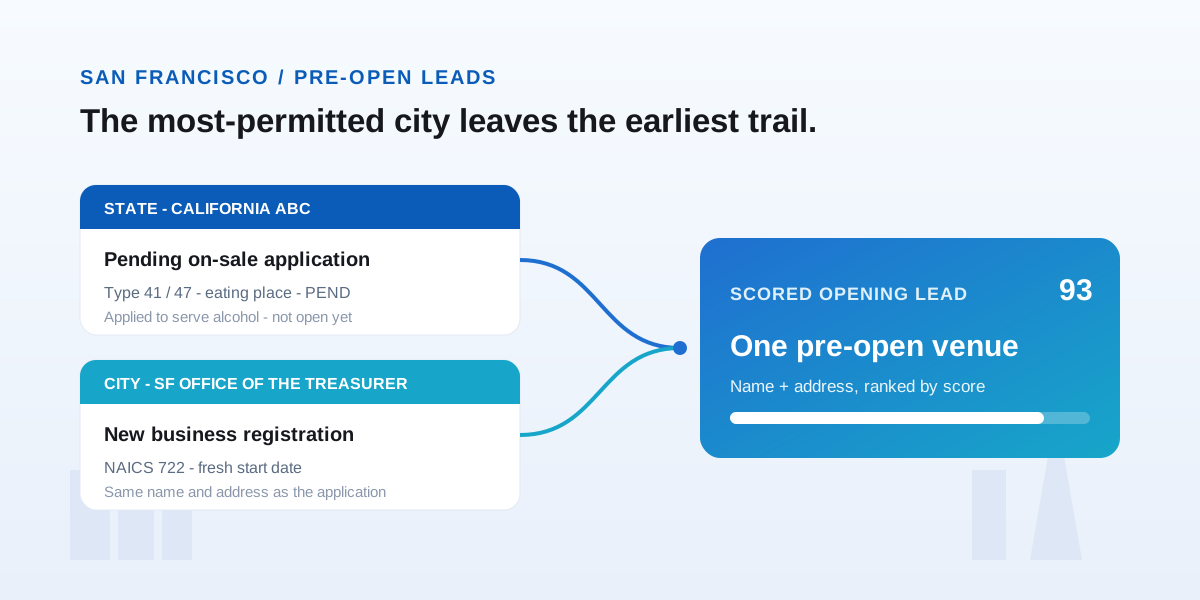
Houston lets a restaurant open on any block. San Francisco is the opposite: the densest, most heavily permitted, most independent restaurant market in the country.
That red tape is a gift, if you know how to read it.
New restaurant openings in San Francisco show up in public records one to six months before the doors open. California splits the signal: a pending liquor application sits with the state, and a new business registration sits with the city. Read both and match them, and you reach the owner while they’re still choosing vendors.
Let me show you exactly how, whether you work it by hand or pull it by API.
What does “opening soon” mean for an SF restaurant?
An SF restaurant that’s opening soon has committed to opening but hasn’t served a paying customer yet. It has applied for a liquor license and registered the business, so money is moving and vendors aren’t chosen. That’s the opposite of a place already open, where the POS, the distributor, and the insurance are already locked in.
Think about who this window is for.
If you sell point-of-sale systems, you want the owner before they sign with Toast.
If you distribute food, pour beer, or install kitchen hoods, the first vendor in usually stays.
And the timing isn’t a guess. About 71% of operators finalize their key vendor decisions before the grand opening, per RestaurantData.com. Reach an owner after opening and most of those seats are taken.
Why San Francisco’s red tape works in your favor
Here’s the SF paradox: the hardest city in America to open a restaurant is one of the easiest to see coming. San Francisco has roughly 3,900 restaurants, the highest per-capita concentration in the US at 39.3 per 10,000 households, and about 90% are independent, with tight limits on chains.
More rules mean more paper, filed earlier.
A new SF venue has to clear a liquor license, a health permit, a business registration, and in many districts a planning review. Every one of those is a public record, and most of them land during buildout.
So the city that makes operators jump through the most hoops also leaves the longest, earliest paper trail for you to follow.
And the independents are the point. When 90% of the market is one-location owners, nearly every opening is an operator no national vendor has a relationship with yet. That’s your opening.
Density compounds it. In a city this packed, a single corridor like Divisadero or Valencia can have two or three operators mid-permit at the same time, all sitting in the same public records.
Why SF dining guides can’t help you
The pages that rank for new restaurant openings in San Francisco are built for diners, not for you. The SF Chronicle, The Infatuation, Eater SF, and Time Out publish great lists of where to eat. Every one covers a restaurant at or after opening, which is the moment it stops being a lead.
Type that phrase into Google yourself. The whole first page is dining guides, and not one is a lead source.
That’s the trap. Those pages answer “where should I eat in SF this weekend,” not “who’s about to open so I can sell to them.” Same words, opposite intent.
And SF produces a steady stream of openings. Restaurant-development trackers logged about 141 San Francisco opening records in just the first half of 2026, per RestaurantData, in a city of only 47 square miles. That’s your pipeline, and the guides only name a venue once it’s too late to sell to it.
Where do new SF restaurants show up first?
New SF restaurants show up first in two public systems, not one. The state’s Alcoholic Beverage Control board logs a pending liquor application, and the City of San Francisco logs a new business registration. Chicago puts both in one dataset. California makes you join a state record to a city record yourself.
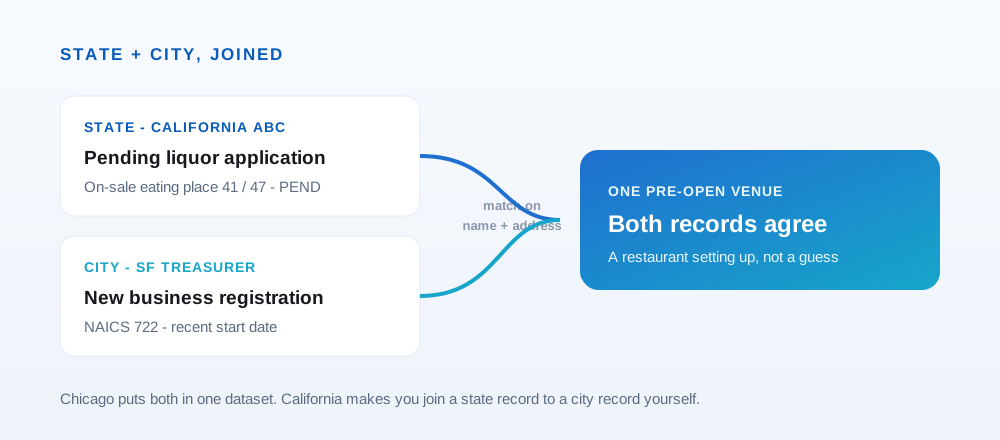
Here’s what each signal is and how early it lands.
| Signal | Where it lives | What it tells you | Typical lead time |
|---|---|---|---|
| Pending on-sale liquor application | California ABC (state) | A venue applied to serve alcohol but isn’t open | 2-12 weeks, up to 6 months |
| New business registration (NAICS 722) | SF Office of the Treasurer (city) | A food or drink business registered at a new address | Weeks to months |
| Building / tenant-improvement permit | SF DBI (city) | A kitchen or dining buildout is underway | 3-6 months |
| Health permit | SF Public Health (city) | A kitchen is being permitted to operate | Close to opening |
The two you can work fastest are the liquor application and the business registration, because both are public open data and both appear early. The building and health permits are useful confirmation, but they sit in more city systems.
How to search California ABC for pending SF restaurants
To find pending SF restaurants at the state level, search the California ABC License Query System, filter to on-sale eating-place license types, and keep only applications with a pending status. A pending on-sale application is the earliest public signal you get: the operator has applied to serve alcohol but hasn’t opened. It comes with the business name and the premises address.
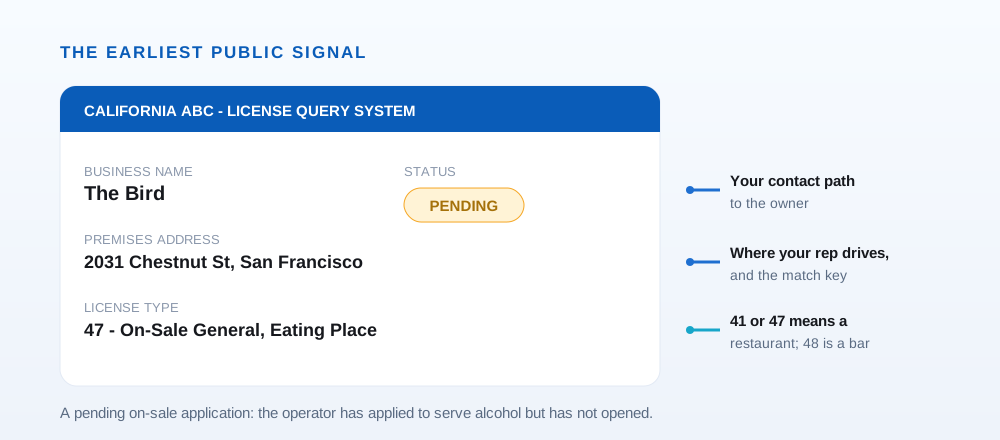
Here’s the concrete recipe.
Open the free California ABC License Query System and search by county or city. (My CA liquor license lookup guide walks through every search and status code.)
Focus on the on-sale eating-place types. Type 41 is On-Sale Beer and Wine for an eating place, and type 47 is On-Sale General for an eating place. Both mean a restaurant. Type 48 is a bar or public premises.
Then keep only the pending applications, not the licenses already issued to open businesses. A pending on-sale application is a venue that has applied but isn’t serving yet. What that license costs tells you how serious an applicant is, since a full type-47 in California is a real investment.
This list is never short. In the SF pending on-sale feed right now sit The Bird on Chestnut St in the Marina, Denya Ramen on Polk St, and Grind and Unwind on Haight St. Each one applied for a license, and none is serving a paying customer yet.
How far ahead can you find an SF opening?
You can usually find an SF restaurant one to six months before it opens. The liquor application is the clock. An operator applies during buildout because ABC approval takes weeks, so the pending record appears well before opening night. RestaurantData reports that about 85% of new-opening leads surface 2 to 12 weeks out, with some as early as six months.
The second record tightens the timing. A new business registration at the city means the owner is setting up to operate, which usually lands closer to opening. Line the two up and you can tell a project that’s months out from one that’s weeks away.
The practical move is to watch the pending feed weekly. California ABC adds new applications constantly, and an application filed this week is a venue you can reach while it’s still deciding who to buy from.
And these are real. About 99% of pre-open leads ultimately open, per RestaurantData, so a pending SF application is pipeline, not a guess.
How do you score which SF openings are worth your time?
Score an SF opening by how many records point at the same venue and how recent they are. One pending liquor application is a maybe. A pending application plus a new business registration at the same name and address, both filed this quarter, is a near-certain new restaurant. Recency matters too, because a stale application often means a project that stalled.
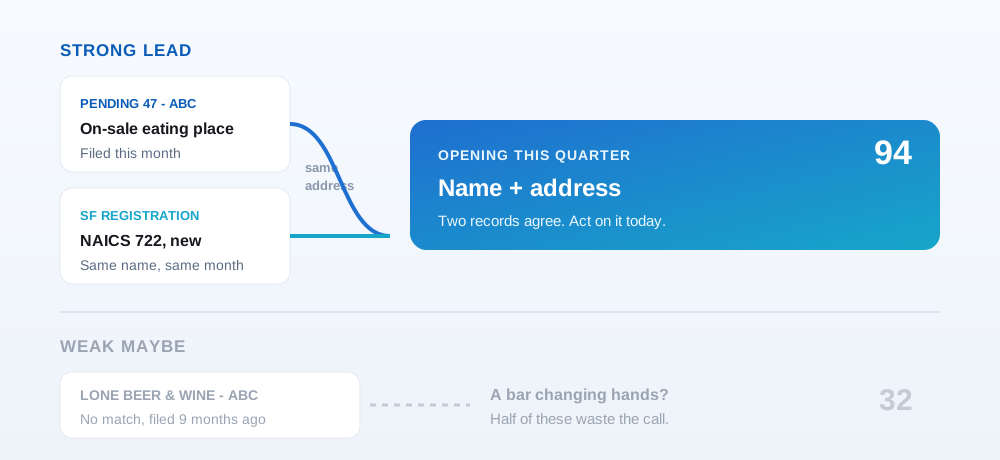
So build a simple score.
Give a venue points for each distinct record. A liquor application and a business registration beat either one alone.
Give it more points when the records share a name and an exact address. Matching on name alone will burn you, because California LLC names repeat.
Weight recent records higher. A pre-open window moves, and a stale application that never paired with a registration is probably a project that died.
Picture the strong version: a pending type-47 application for a Mission storefront and a new NAICS-722 registration at the same address, both from this month. Two records, one owner, both fresh. Now the weak version: a lone beer-and-wine application filed nine months ago with no matching registration. Could be real. Could be a bar that changed hands. You’d call and find out, and half the time you’d waste the call.
The strong lead also hands you a contact path. The ABC record carries the business name and the premises address, so you know who to ask for and where to drive. That’s the part a dining guide never gives you.
How RestoSignals covers San Francisco in one call
RestoSignals fuses California’s pending on-sale liquor applications with new San Francisco business registrations into one venue record with an opening score, so you get a ranked list of pre-open SF restaurants without joining two datasets by hand. California is live, and every lead is scored on how many records match, whether they share a name and address, and how recent they are.
The score is the part that saves your week. Instead of reading raw application rows and guessing, you get venues already ranked by how likely each is to be a soon-to-open restaurant.
To put a number on the pipeline: the RestoSignals feed currently tracks 145 pending on-sale food-and-drink applications in San Francisco, and 123 of them are restaurant eating-place types. Every lead carries the business name and the address, your path to the operator.
You can call it from code or point an AI agent at the hosted MCP endpoint and ask for new SF openings. Same data, either way, and the agent path is the one thing a weekly email list can’t match. If you want the bigger playbook, here’s how to sell to new restaurants before they open, and the Los Angeles guide runs the same California play down south.
The free tier is 100 leads, no card, and one credit equals one returned lead. That’s enough to test whether the SF venues in your territory are worth a workflow before you pay anything.
Start with one SF neighborhood this week
Pick the neighborhood where you already sell, from the Mission to the Marina to Hayes Valley. Pull the last 30 days of pending on-sale applications for that area from California ABC, then match them against fresh NAICS-722 registrations in the SF business data. That’s your first batch of pre-open SF leads, free, in about an hour.
Then decide whether you’d rather run that match every week by hand or let an API return it scored in one call. Either path beats waiting for a dining guide to name a place your competitor sold to a month ago.
San Francisco makes restaurants file more paper than almost anywhere. That paper is a map of who’s opening next. Read it first.
Mukul Dutt is the founder of RestoSignals, an API that surfaces restaurants and bars before they open by fusing public liquor, permit, and business-filing records into one scored venue.
FAQ
How do I find new restaurants opening in San Francisco before they open?
Search two public records and match them. In the California ABC License Query System, look for a pending on-sale eating-place application (license type 41 or 47) with a recent date. Then check the City of San Francisco's Registered Business Locations data for a new NAICS-722 registration at the same name or address. A pending liquor application plus a fresh food-business registration is a restaurant setting up. A lead API returns the same records already matched and scored.
Where can I search for pending San Francisco restaurant and liquor licenses?
The California Department of Alcoholic Beverage Control runs a free public License Query System at abc.ca.gov, where you search pending and active licenses by name, address, or county. For the business side, the City of San Francisco publishes its Registered Business Locations as open data at data.sf.gov. Both are free and public, and together they cover the two signals a new SF restaurant leaves behind.
How far in advance can you find an SF restaurant before it opens?
Usually 2 to 12 weeks, and sometimes up to six months. An operator files a liquor application during buildout because ABC approval takes weeks, so the pending record appears well before opening night. RestaurantData reports about 85% of new-opening leads surface 2 to 12 weeks out. In a city as permit-heavy as San Francisco, the paper trail is unusually long and early.
How many new restaurants open in San Francisco each year?
San Francisco has roughly 3,900 to 4,000 restaurants, the highest per-capita concentration in the country, and about 90% are independent. Restaurant-development trackers logged around 141 SF opening records in the first half of 2026 alone, per RestaurantData. For a 47-square-mile city, that's a dense, steady pipeline of new venues.
Is there an API for San Francisco restaurant opening leads?
Yes. RestoSignals covers California today and exposes new-opening leads as a REST API and a hosted MCP endpoint, fusing California pending liquor applications and San Francisco business registrations into one scored venue with the owner name and address. You can call it from code or point an AI agent at the MCP endpoint. The free tier is 100 leads, no card, and one credit equals one returned lead.
Do most new San Francisco restaurants fail in the first year?
No. The 90% first-year failure claim is a myth traced to a 2003 commercial, not a study. Bureau of Labor Statistics data puts real first-year closure near 17%, and Datassential measured just 0.9% for 2025 openings. The SF venue you sell to this quarter is very likely still open and still buying from its vendors next year.
Find venues opening near you
100 free leads, no card. One platform for restaurants & bars about to open.