New restaurants opening in 2026: how to find them first
Most new restaurants opening in 2026 pick their vendors before any public announcement. Here's how to find them first in public filings, state by state.
You can read about a new restaurant on Eater the week it opens. By then it has already bought its POS, signed its food distributor, and locked its insurance.
The vendors who won those contracts found it months earlier. They didn’t read a dining guide. They read the paperwork.
New restaurants opening in 2026 leave a public filing trail long before any announcement, and about 64% of operators finalize their key vendor decisions before they tell the public anything, per Preopening Restaurants Resource. This is the guide to finding those openings first, from the government records, state by state, by hand or by API.
Updated monthly. Last refreshed October 2026.
Where do new restaurants opening in 2026 actually show up first?
New restaurants show up first in government filings, not on dining sites. During buildout, an operator applies for a liquor license and registers to collect sales tax, and both records are public. They land weeks to months before opening, while the owner is still choosing vendors. Dining guides and social media only cover a place once it opens, which is the moment it stops being a lead.
Think about the order things happen in.
The lease gets signed. The buildout starts. The owner files for a liquor license and a sales-tax permit. The kitchen gets inspected. Then, finally, the doors open and Eater writes it up.
The filing comes first. The press comes last.
That gap is months wide, and it’s the only window where a vendor can still get in. The National Restaurant Association projects $1.55 trillion in sales and more than 100,000 new jobs for the industry in 2026, so the pipeline of new openings is large. The question is whether you reach them during buildout or after the contracts are signed.
Why dining guides and social media can’t give you an opening
Dining guides answer a different question than the one a vendor is asking. Eater, Yelp, Time Out, and local food blogs tell a diner where to eat this weekend. Every entry covers a restaurant at or after opening. For a vendor trying to sell before the venue buys, that is already too late, which is why “best new restaurants” lists are the wrong tool for this job.
Most “how to find new openings” advice makes this worse.
The typical guide tells you to follow food bloggers, search Google Maps, and watch Instagram hashtags. One popular guide on finding new openings lists social media, Google search, directories, and word of mouth, and names none of the government records where openings actually surface first.
That advice finds you a restaurant the week it opens. Same as Eater.
The reason this matters is timing. About 71% of operators finalize key vendor decisions more than 90 days before opening, per RestaurantData, and 64% before any public announcement. By the time a place is postable, the buying is done.
The three public filings that reveal a restaurant before it opens
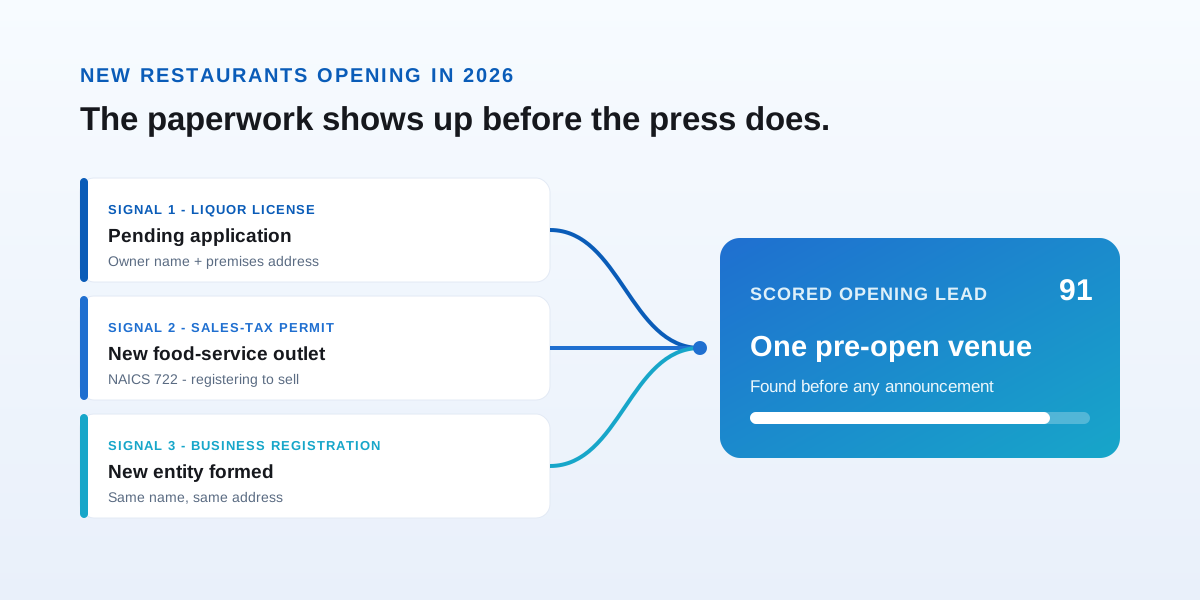
Three government records expose a restaurant during buildout, and the strongest signal is two or more of them pointing at the same venue. A liquor license application shows an owner applied to serve alcohol. A new sales-tax or seller’s permit shows a food outlet gearing up to sell. A business registration shows a new entity formed. Each is public. Together they confirm a real opening, not a rumor.
Run through them one at a time.
-
Liquor license application. The earliest and strongest signal. Filed during buildout because approval takes weeks, it carries the owner name and the premises address. A pending on-premise application is a venue setting up to serve, not one already open.
-
Sales-tax or seller’s permit. A new food-service permit (NAICS code 722) means the owner is registering to ring sales. It usually lands closer to opening and tightens your timing.
-
Business registration. A new LLC or corporation filed with the state. On its own it’s noisy, since plenty of registrations never become restaurants. Matched to a liquor record at the same name, it confirms the venue.
No single record is proof. A lone business registration could be a consultancy. A lone liquor application could be a bar changing hands. Two records at one address, both fresh, is a restaurant opening.
Picture it in practice. A new LLC registers in March. In April a pending liquor application appears at a storefront address under that same LLC. Two signals, one owner, one address, both from this quarter. That’s a kitchen getting built, and the owner is taking vendor calls right now. A lone liquor filing from nine months ago with no matching registration is the weak version, and half the time it’s a venue that already exists.
That match is also what an opening score measures: how many signals agree on one venue, and how recent they are.
How to find new restaurants opening near you, by state
The catch is that these records live at the state and city level, so where you can find pre-opening restaurants depends on which governments publish usable open data. Some states put a liquor application and a business or permit feed online and keep them current. Others publish only liquor data, which surfaces far fewer confirmed openings. A few publish almost nothing in a usable form.
These are the states where the signals are strong enough to work today, with the city guide for each.
| State | Pre-open signals | Best coverage | City guide |
|---|---|---|---|
| New York | Liquor (SLA) + business filings | New York City | NYC openings |
| Illinois | Combined license + business feed | Chicago | Chicago openings |
| Texas | TABC application + sales-tax permit | Dallas, Houston, Austin | Dallas, Houston, Austin |
| California | ABC application + city business registry | Los Angeles, San Francisco | Los Angeles, San Francisco |
| Oregon | Liquor + statewide business filings | Statewide (thinner) | n/a |
A few honest notes on coverage.
Texas is the cleanest, because both signals sit at the state level and the filing names the owner, so a Texas lead arrives with a contact path attached.
California splits the signal: the state logs the liquor application, the city logs the business registration, and you match them. That works well in Los Angeles and San Francisco, where the city publishes its registry, and poorly in cities that don’t.
Oregon is live but thinner. It publishes both a liquor feed and a business-registration feed, but the business feed only covers the most recent month, so it overlaps the liquor window briefly and fuses fewer venues than Texas or California. You’ll find confirmed openings there, just fewer of them.
States that publish only liquor data, like Colorado and Washington, surface a lot of license activity but few confirmed openings, because there’s no second signal to confirm a venue is genuinely new rather than renewing. I’d rather tell you that than sell you a thin feed.
How far ahead can you find a restaurant before it opens?
You can usually find a US restaurant one to six months before it opens. The liquor application is the clock, because approval takes weeks, so the record appears well before opening night. About 85% of new-opening leads surface 2 to 12 weeks out, per RestaurantData, with some as early as six months. A new sales-tax permit usually lands closer to opening and tells you a project is weeks, not months, away.
The practical move is to watch the filings weekly.
New applications land constantly, and one filed this week is a venue you can reach while it’s still deciding who to buy from.
And these are real. About 99% of pre-open leads ultimately open, per RestaurantData, so a pending application is pipeline, not a guess. The old line that most restaurants fail in year one is a myth from a 2003 commercial; BLS data puts real first-year closure near 17%, and Datassential measured about 0.9% for 2025 openings.
Pre-opening leads by hand versus by a lead service versus by API
You have three ways to work pre-opening restaurant leads, and they trade off time against money and flexibility. You can search the government filings yourself for free, buy a curated email list, or query a scored API. The right choice depends on whether you value your hours, your budget, or the ability to pipe leads straight into your own tools.
Here’s the honest comparison.
| Approach | Examples | What you get | Freshness | Fits a workflow? |
|---|---|---|---|---|
| Search filings yourself | State ABC + Comptroller sites | Raw records, free | Daily, if you check | No, manual every time |
| Curated email list | Preopening Restaurants Resource, What Now | Researched leads by email | 2-4 times a week | Email only |
| Raw scraper feed | OpenSoon, Apify license scrapers | Bulk license rows | Varies | CSV export |
| Scored API + MCP | RestoSignals | Fused, scored venues with contact | On every query | REST + AI agents |
Doing it by hand is free and it works. It also costs about 15 minutes per lead once you factor in matching records across two databases, which is the real reason most people never keep it up.
The email services solve the research but lock you into their inbox and their schedule. The scrapers hand you raw license rows with no scoring, so you still sort the renewals from the real openings yourself.
An API is the only option that returns leads already fused and scored, and the only one an AI agent can query on its own.
How RestoSignals tracks US restaurant openings
RestoSignals fuses the three public filings into one scored venue record, so you get a ranked list of pre-opening restaurants instead of raw government rows. It’s live in five states, exposes the data as a REST API and a hosted MCP endpoint, and scores every venue on how many signals match, whether they share an owner and address, and their recency. The pipeline holds 22,132 fused venues drawn from 72,409 public records.
The score is what saves your week. Instead of reading raw application rows and guessing, you get venues ranked by how likely each is to be a soon-to-open restaurant.
The MCP endpoint is the part a weekly email can’t match. You can point an AI agent at it and ask for new openings in your territory, and it answers from the live data.
Coverage grows as more states publish usable open data, and this page tracks where it stands. If you want the full method behind it, start with how to find new restaurant openings and how to sell to new restaurants before they open. For the wider numbers, see the 2026 restaurant industry statistics.
The free tier is 100 leads, no card, and one credit equals one returned lead. That’s enough to check whether the openings in your state are worth a workflow before you spend anything.
Start with your state this week
Find your state in the table above and open its city guide. Pull the last 30 days of pending liquor applications for your city or county, then match them against fresh sales-tax permits or business registrations at the same name and address. That’s your first batch of pre-opening leads, free, in about an hour.
Then decide whether you’d rather run that match every week by hand or let an API return it scored in one call.
New restaurants opening in 2026 will keep filing the same paperwork months before they open. The vendors who read it first get the contract. Everyone else reads about the place on Eater, after the buying is done.
Mukul Dutt is the founder of RestoSignals, an API that surfaces restaurants and bars before they open by fusing public liquor, permit, and business-filing records into one scored venue. He built the pipeline that tracks pre-opening restaurants across five US states.
FAQ
How do I find new restaurants opening near me?
Read the public filings, not the dining guides. Three government records appear while a restaurant is still under construction: a liquor license application, a new sales-tax or seller's permit, and a business registration. Pull them for your city or county, match records that share a name and address, and you have a venue that is opening but hasn't served a customer. That's months before it shows up on Eater or Google Maps.
Where do restaurant openings show up before they're announced?
In government filing databases. An operator has to apply for a liquor license and register to collect sales tax during buildout, so those records are public weeks to months before opening. About 64% of operators finalize key vendor decisions before any public announcement, per Preopening Restaurants Resource, which is why social media and dining blogs are always late. The filing is the first thing that exists.
Is there an API or list of restaurants opening soon?
Yes. RestoSignals exposes pre-opening restaurants as a REST API and a hosted MCP endpoint, fusing liquor applications, sales-tax permits, and business registrations into one scored venue. It covers five live states today. Other options are email lists like Preopening Restaurants Resource and the Restaurant Activity Report, or raw scrapers like OpenSoon on Apify. The API path is the only one an AI agent can query directly.
How far in advance can you find a restaurant before it opens?
Usually 2 to 12 weeks, sometimes up to six months. The liquor application is the clock, because approval takes weeks, so the record appears well before opening night. RestaurantData reports about 85% of new-opening leads surface 2 to 12 weeks out. A fresh sales-tax permit tightens the timing, since it means the owner is setting up to ring sales.
Which states can you find pre-opening restaurants in right now?
The states that publish two fusible signals as open data. RestoSignals is live in New York, Illinois, California, Texas, and Oregon, where a liquor record and a business or permit record can be matched to one venue. Coverage is strongest in New York City, Chicago, Dallas, Houston, Austin, Los Angeles, and San Francisco. States that publish only liquor data surface fewer confirmed openings.
Do most new restaurants fail in the first year?
No. The 90% first-year failure claim is a myth traced to a 2003 TV commercial, not a study. Bureau of Labor Statistics data puts real first-year closure near 17%, and Datassential measured about 0.9% for 2025 openings. The restaurant you sell to this quarter is very likely still open and still buying from its vendors next year, so a pre-open lead is worth real effort.
Find venues opening near you
100 free leads, no card. One platform for restaurants & bars about to open.