RestaurantData.com alternatives (2026): 5 options compared
RestaurantData.com is quote-only and most leads arrive 2 to 12 weeks before opening. Here are 5 alternatives for earlier, cheaper, or exclusive leads.
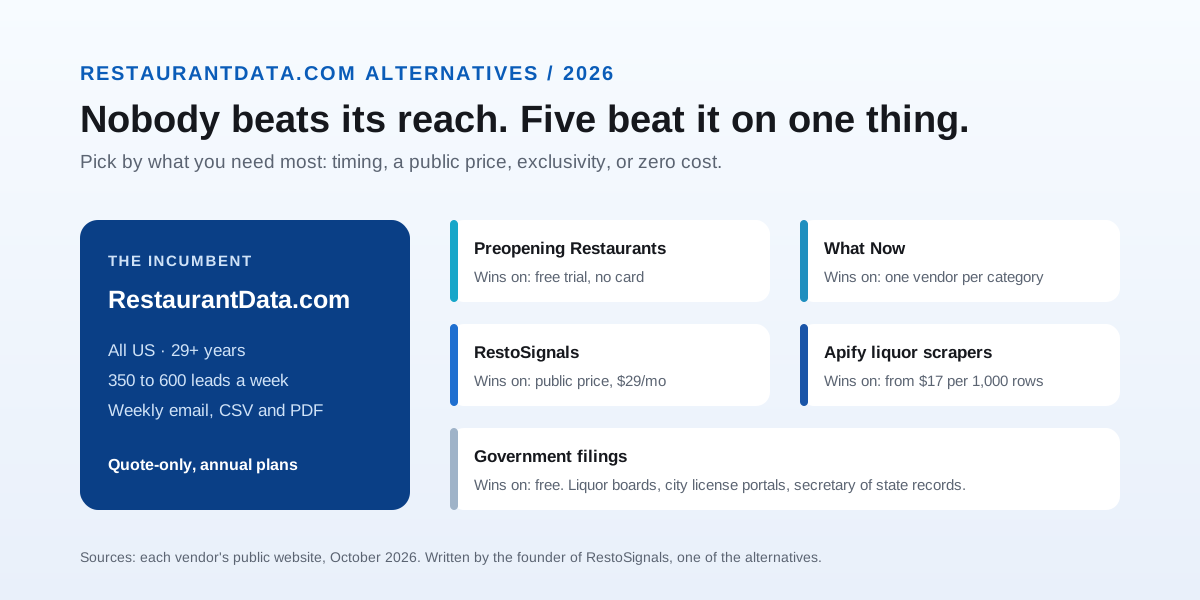
RestaurantData.com is the incumbent for a reason. It covers the whole country and has been at this for 29 years.
But it won’t tell you the price until you sit through a demo. And by its own numbers, most of its leads show up 2 to 12 weeks before opening.
The best RestaurantData.com alternatives in 2026 are Preopening Restaurants Resource, What Now, RestoSignals, Apify liquor-license scrapers, and free government filings. None matches RestaurantData’s national reach. Each one beats it on something specific: an earlier signal, a public self-serve price, exclusive local leads, or zero cost. The right pick depends on how many states you sell in and how early you need the owner.
I run RestoSignals, which is one of the alternatives here, so read this knowing that. I’ll tell you exactly where RestaurantData beats us.
What is RestaurantData.com, and what do you actually get?
RestaurantData.com sells pre-opening restaurant leads to vendors, delivered as a weekly email report in CSV and PDF, 49 weeks a year. It pulls from liquor filings, DBA registrations, building permits, LLC filings, and industry news, and produces 350 to 600 net-new US leads each week. About 90% to 95% of records name an owner or ownership entity, per the company’s own FAQ.
That’s a lot of leads. Call it roughly 17,000 to 29,000 a year across the country.
Each record carries the basics a rep needs: project name, address, opening stage, estimated timeframe, concept, and owner or ownership details, with phone and email “depending on access level,” per RestaurantData’s pre-opening leads page.
A few details from its FAQ are worth knowing before a demo:
- About 10% to 15% of leads don’t have a published phone number yet.
- Around 65% of records are single-unit independents.
- Historically, about 99% of its new-opening leads go on to open.
- The report pauses for Thanksgiving, Christmas, and July 4th weeks.
I’d pay attention to that 99% figure. When RestaurantData lists a project, it almost always opens.
How much does RestaurantData.com cost?
RestaurantData.com doesn’t publish its prices. Its plans page lists three annual plans: Team (up to 5 users, 15,000 record exports a year), Team Plus (10 or more users, 50,000 exports, priority support), and Enterprise (unlimited users and exports, custom research). Every plan’s button leads to a demo request, so you get a number only after talking to sales.
The plans page shows this as of October 2026.
| Plan | Users | Record exports | Extras |
|---|---|---|---|
| Team | Up to 5 | 15,000 a year | Core database, weekly leads |
| Team Plus | 10+ | 50,000 a year | Full database, research hours, API capabilities |
| Enterprise | Unlimited | Unlimited | Custom integrations, success manager, advanced API |
The plans sit under an “Annual Plans” heading, so expect a yearly commitment.
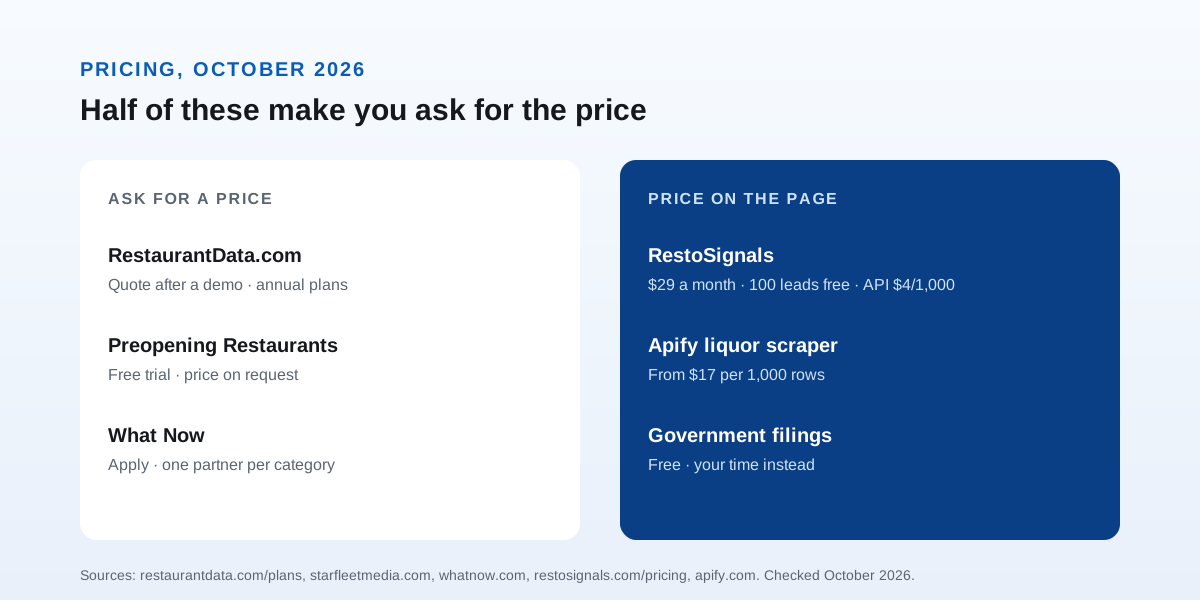
Datarade’s profile of RestaurantData.com says the same thing: no published pricing, contact the company. It also lists too few user reviews to rate it.
Quote-only pricing isn’t a red flag by itself. Plenty of good data companies sell this way.
But it matters if you’re a three-person POS reseller who wants to test one metro for a month. A demo, an annual contract, and a seat-based plan are built for a bigger sales team than that.
When do RestaurantData leads arrive, and is that early enough?
RestaurantData’s FAQ says about 85% of its new-opening leads are identified 2 to 12 weeks before opening, with some surfacing six months or more ahead. That’s early by normal standards. But in a 2025 survey of 220 restaurant operators, 71% said they begin selecting key vendors more than 90 days before opening, which means many RestaurantData leads arrive after the shopping has started.
This is the gap I’d ask about in any demo.
Twelve weeks is about 84 days. The survey, reported by Restaurant Technology News, found 71% start choosing vendors more than 90 days out, and 76% aren’t receptive to vendor outreach within 30 days of opening.
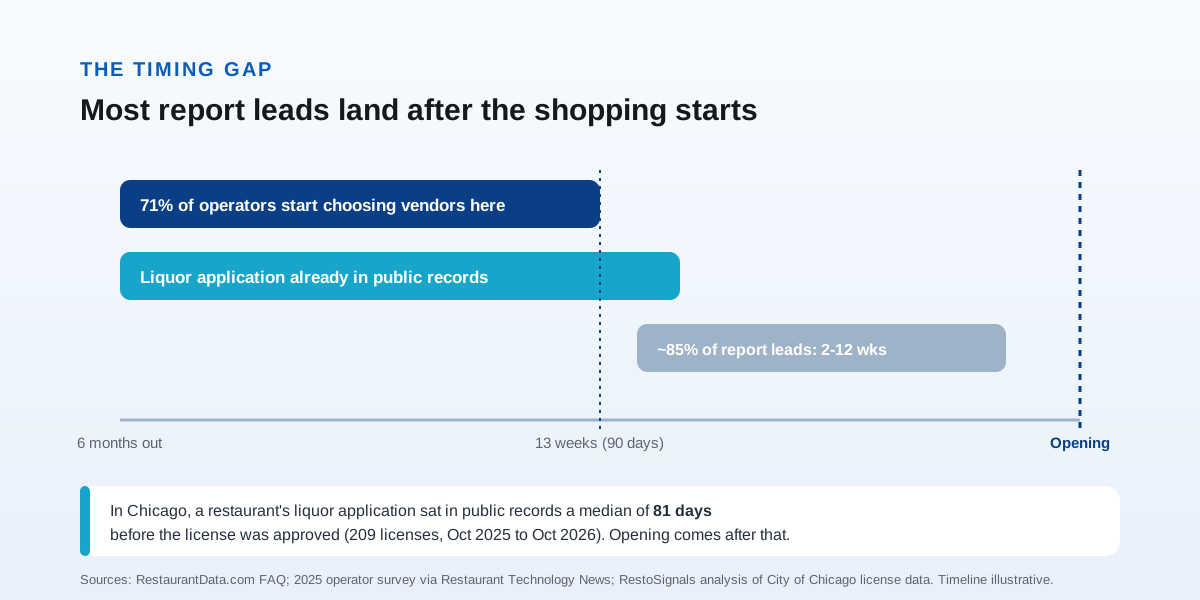
A lead at the late end of that window, 2 to 4 weeks out, is a hard sell for a POS or beverage rep. The early end can still work.
To be fair, the FAQ gives two numbers for the same window.
One section says 85%, another says 95%. Either way, the bulk lands inside three months.
The delay has a reason. A curated report waits until there’s enough evidence that a project is real, which is how it earns that 99% open rate, and waiting takes weeks.
The raw filings show up sooner. When I analyzed 209 new Chicago restaurant liquor licenses issued from October 2025 to October 2026, the application sat in public city records for a median of 81 days before the license was even approved, and the restaurant opens after that. I wrote that analysis up in the Illinois liquor license guide.
You’re choosing between a cleaner list that arrives later and a rougher signal that arrives first.
What are the best RestaurantData.com alternatives in 2026?
The best RestaurantData.com alternatives in 2026 are Preopening Restaurants Resource for human-verified reports with a free trial, What Now for exclusive leads in 33 cities, RestoSignals for a self-serve scored feed with a public price, Apify scrapers for cheap raw liquor rows, and government filings for a free do-it-yourself route. Here’s what each one does and who it fits.
1. Preopening Restaurants Resource
Of the five, it’s the closest match to RestaurantData in format. Starfleet Media’s team researches each lead by hand from permits, licenses, real estate deals, and trade press, and the product page also bundles a database of 350,000 existing restaurants with 150,000+ verified decision-maker contacts.
It added a free trial with no credit card in January 2026, per Restaurant Technology News. Current pricing isn’t published.
A 2021 Starfleet release said subscriptions started under $200 a month, which is old enough that you should ask for a current quote.
2. What Now
What Now sells pre-opening leads through a Preferred Partner program, and the hook is exclusivity: one company per category per city. Its Dallas page promises up to 40+ leads a month with the owner’s direct phone and email, across 33 cities.
Forty a month is a fraction of RestaurantData’s weekly volume. But if you’re the only POS company getting them in your city, that can be worth more.
3. RestoSignals
This is mine, so I’ll stick to verifiable facts.
RestoSignals pulls liquor applications, food permits, and business filings daily, fuses them into one venue, and scores each venue for how close it is to opening. You can start with 100 free leads, and the full plan is $29 a month with owner contacts unlocked, no demo.
It also works as an API and an MCP server for AI agents, at $4 per 1,000 leads. I showed that setup in how to build an AI agent that finds new restaurant leads.
The big limit is coverage. Seven states, not fifty.
4. Apify liquor-license scrapers
If you’re technical and want raw rows, Apify has community scrapers for state liquor-license data. The USA Liquor and Alcohol License Scraper starts at $17 per 1,000 results.
You get licensee names, license types, statuses, and addresses.
You don’t get scoring, deduping across agencies, or any sense of which rows are restaurants about to open. That work is on you.
5. Government filings, for free
Every lead on this list starts as a public record. You can search state liquor boards, city license portals, and secretary of state filings yourself at no cost.
It’s slow and the formats differ by state. But for one metro, it works, and I walk through it in how to find new restaurant openings before they open.
How do the RestaurantData.com alternatives compare side by side?
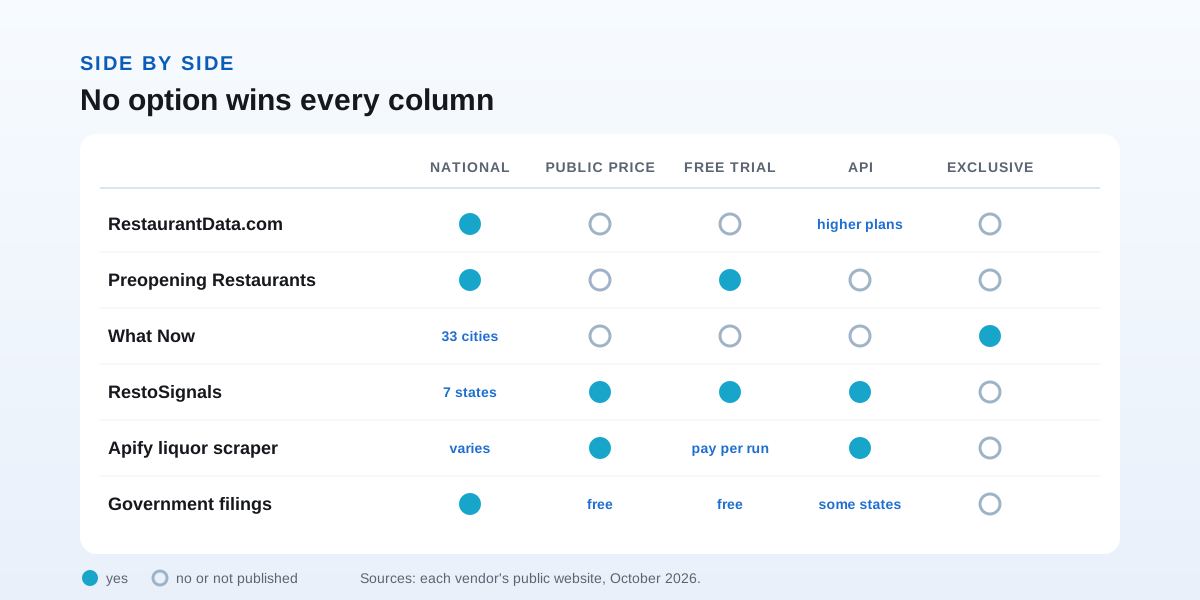
RestaurantData.com wins on national coverage and research depth. The alternatives win on narrower things: RestoSignals and Apify on public self-serve pricing, What Now on exclusivity, Preopening Restaurants Resource on a free trial of a human-verified report, and government filings on cost. No single option wins on every column, so match the column that matters to your sales motion.
| Option | Coverage | How you get leads | Public price | Contract |
|---|---|---|---|---|
| RestaurantData.com | All US | Weekly email, CSV/PDF | No (quote) | Annual plans |
| Preopening Restaurants Resource | US, plus parts of Canada | Researched report + database | No (free trial) | Subscription |
| What Now | 33 cities | Email alerts, exclusive | No (apply) | Partner program |
| RestoSignals | 7 states | Dashboard, CSV, API, MCP | Yes, $29/mo, 100 free | Monthly |
| Apify liquor scraper | Varies by state | Raw rows you run | Yes, from $17/1,000 | Pay per use |
| Government filings | Any state | You search portals | Free | None |
One thing I noticed researching this: if you look up RestaurantData alternatives on Datarade, it suggests Dotlas, SafeGraph, Grepsr, and Plugindata.
Those are data sources for restaurants that already exist. They can’t show you a restaurant that hasn’t opened, so they aren’t really alternatives for this job.
Which RestaurantData alternative fits your team?
Pick the alternative by your territory and your sales motion. If you sell in many states and have a team, RestaurantData.com is still the safest buy. If you sell in a few metros and want month-to-month pricing, use a self-serve feed. If you want to be the only vendor in your category getting the lead, use What Now. If you have engineers and no budget, scrape or search the filings yourself.
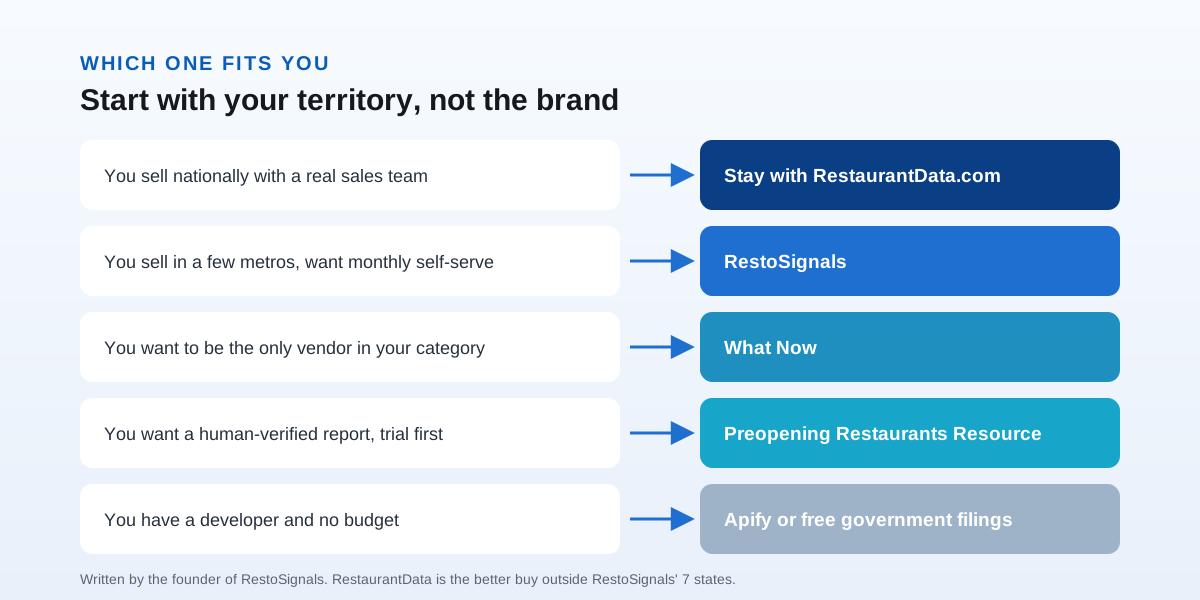
Here’s how I’d decide if I were the one buying.
A national beverage distributor or a POS company with 20 reps should stay with RestaurantData or test it against Preopening Restaurants Resource. At that size, coverage matters more than anything else.
A single-metro POS reseller or merchant-services agent should not be on an annual seat plan. A self-serve feed or What Now’s exclusive slot fits that budget better.
A rep whose product gets chosen early, like POS, insurance, or kitchen equipment, should weight timing over volume. A lead at 2 weeks out is a lost deal for them.
And a team with a developer should look at the API options before buying any report. Leads that land in your CRM automatically beat a PDF someone has to open.
What should you ask RestaurantData.com in a demo?
Ask RestaurantData.com six things in a demo: the share of leads in your territory that arrive more than 90 days before opening, the price for your exact territory and seat count, the contract length and cancellation terms, the email and phone fill rate for your region, whether API access is on your plan, and for a sample of last month’s leads in your metro. Those answers decide whether it beats a cheaper alternative.
Because the price is quote-only, the demo is where you do your homework. Go in with a list.
- What share of leads in my territory arrive more than 90 days before opening?
- What does my exact territory and seat count cost per year?
- Is it an annual contract, and can I cancel or downsize?
- What’s the email and phone fill rate for my region, not nationally?
- Is API or CRM sync included on the plan you’re quoting?
- Can you send last month’s leads for my metro as a sample?
The sample is the one that matters most. RestaurantData offers sample records, so ask for your own city.
Then check five of those sample leads against the public filings yourself. If the liquor application was filed months before the lead reached the report, you’ll see exactly how much time you’d be giving up.
Where does RestoSignals fall short against RestaurantData?
RestoSignals falls short of RestaurantData.com on coverage and research depth. It covers 7 states, not all 50. Two of those, Colorado and Washington, had zero hot leads as of October 15, 2026. And it relies on public filings alone, while RestaurantData adds news coverage and human research. If you sell outside our states, RestaurantData is the better buy today.
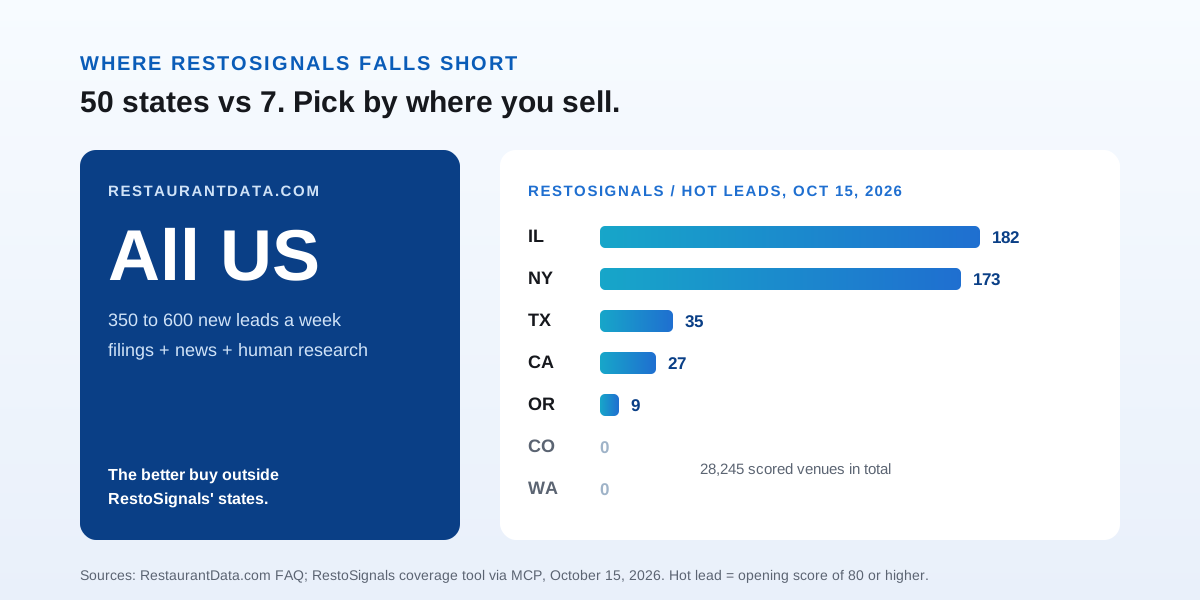
Our live coverage on October 15, 2026, from the free coverage call: 28,245 scored venues and 426 hot leads, meaning an opening score of 80 or higher.
New York had 173 hot leads, Illinois 182, Texas 35, California 27, and Oregon 9. Colorado and Washington had venues but no hot leads.
Contact depth also varies by state.
Every lead has an owner name from the filing. Phone numbers come through in New York City, and owner mailing addresses in Texas and New York.
RestaurantData researches its records by hand and says it verifies email addresses whenever possible, so expect fuller contact data from it outside those states.
I’d rather you hear that from me than find out after you sign up.
Bottom line: match the tool to your territory
If you sell nationally with a real sales team, RestaurantData.com is still the benchmark, and a demo is worth your time. Ask what share of leads arrive more than 90 days before opening, and what your territory costs. If you sell in a handful of metros, or you need the owner before they start shopping, test a self-serve option first. A week of leads will tell you whether they’re early enough.
For the wider field, including free sources, see pre-opening restaurant leads: the best sources compared. If you’re weighing census databases of open restaurants too, see restaurant database: 8 sources compared. And for the playbook once you have a lead, read how to sell to new restaurants before they open.
Comparing general sales databases too? See ZoomInfo alternatives for selling to restaurants.
Mukul Dutt is the founder of RestoSignals, one of the alternatives reviewed here, which tracks restaurants and bars before they open by fusing public liquor, permit, and business-filing records into one scored venue. RestaurantData.com details come from its public website as of October 15, 2026; no vendor reviewed or paid for placement in this article.
FAQ
What are the best alternatives to RestaurantData.com?
The main alternatives are Preopening Restaurants Resource, a human-researched lead report with a free trial; What Now, which sells exclusive pre-opening leads to one vendor per category in 33 cities; RestoSignals, a self-serve scored feed with a public price; Apify liquor-license scrapers at about $17 per 1,000 rows; and free government filings you search yourself. None of them matches RestaurantData's national coverage.
How much does RestaurantData.com cost?
RestaurantData.com doesn't publish prices. Its plans page lists three annual plans, Team, Team Plus, and Enterprise, separated by seats and export limits: Team allows up to 5 users and 15,000 record exports a year, Team Plus 10 or more users and 50,000 exports. Pricing comes from a sales demo. Datarade's profile of the company also notes it has no published pricing.
Is RestaurantData.com worth it?
It's worth it if you sell nationally and want one weekly list covering every state. RestaurantData produces 350 to 600 new leads a week and says 90% to 95% of records name an owner or ownership entity. It's a weaker fit if you sell in a few metros, need leads more than three months before opening, or want to pay month to month without a sales call.
How early does RestaurantData.com find new restaurants?
RestaurantData's FAQ says about 85% of its new-opening leads are identified 2 to 12 weeks before opening, and another section of the same page gives 95%, with some projects surfacing six months or more ahead. That's early, but it's often inside the window when operators are already choosing vendors: 71% start more than 90 days before opening.
Does RestaurantData.com have an API?
Only on higher plans. RestaurantData's plans page lists API capabilities on Team Plus and advanced API access on Enterprise, while its FAQ says API access is available on enterprise plans. The standard product is a weekly email report in CSV and PDF, plus Salesforce and HubSpot integrations. If you need an API on a small budget, a metered self-serve feed is the cheaper route.
Where do POS resellers find new restaurant leads?
Most POS resellers and merchant-services agents find new restaurants through public filings, especially liquor-license applications, new business registrations, and health permits, because those appear months before the doors open. They either search those records themselves, buy a curated report like RestaurantData's, or use a feed that pulls and scores the filings automatically. Referral programs from POS vendors are a smaller secondary source.
Find venues opening near you
100 free leads, no card. One platform for restaurants & bars about to open.