How to build an AI agent that finds new restaurant leads
Build an AI agent that finds restaurants before they open: Claude Code plus an MCP server reading liquor, permit, and business filings. Setup, prompt, cost.
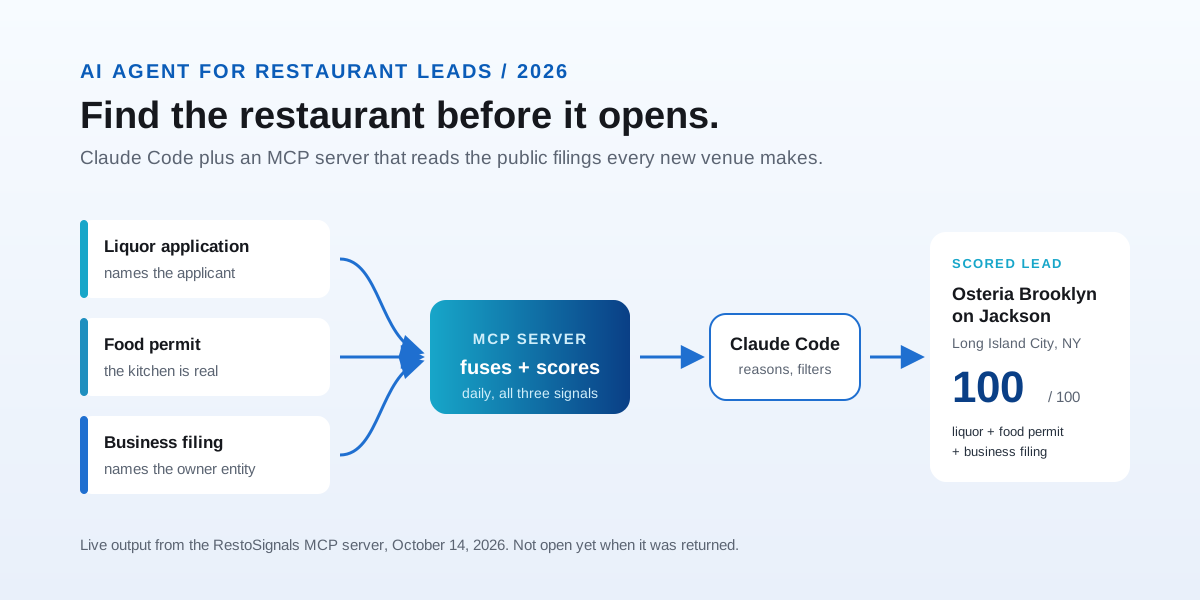
Your AI sales agent can’t find a restaurant that doesn’t exist yet.
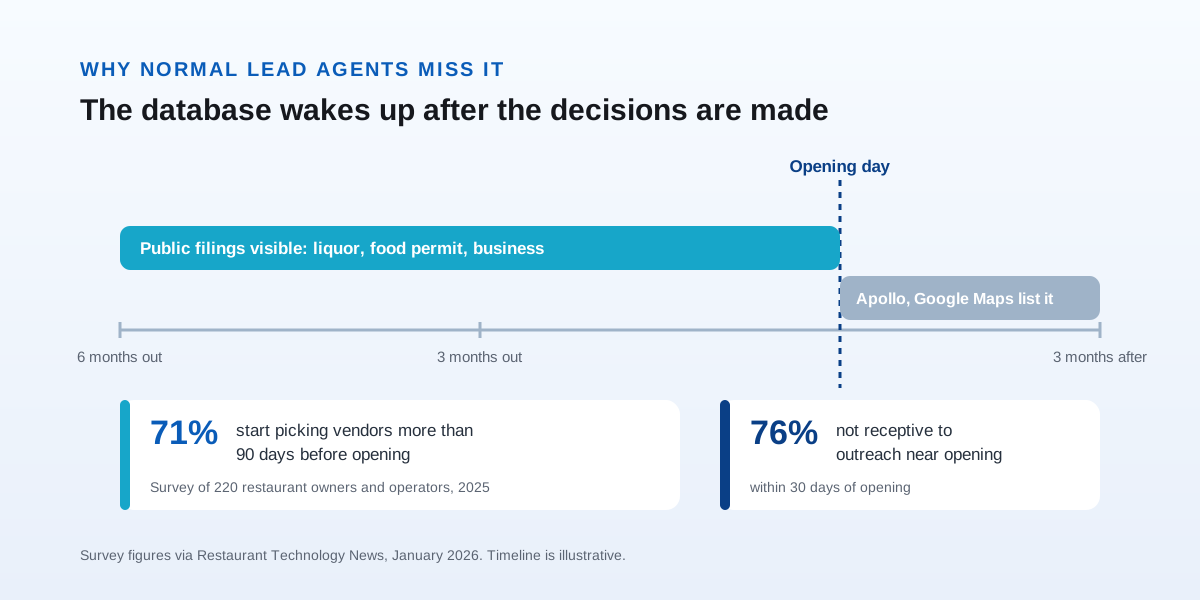
And that’s the one you want, because by the time a restaurant shows up in Apollo or Google Maps, it already picked its POS, its distributor, and its insurance broker.
To build an AI agent that finds new restaurant leads, connect a tool-using model like Claude Code to an MCP server that reads public liquor-license, food-permit, and business filings. Then give it a standing prompt with your territory, buyer, and score cutoff. The model reasons, the filings supply the leads. On October 14, 2026, I ran the same MCP calls this agent makes against live data, and scored venues in New York and Illinois came back in seconds.
I build RestoSignals, so I’ll show you the real build, the real output, and the parts where the agent gets it wrong.
What does an AI agent that finds restaurant leads actually do?
An AI agent that finds restaurant leads is a language model that can call outside tools on its own. You ask in plain English for new venues in a territory. The agent decides which tool to call, pulls the matching filings, ranks them, removes ones that don’t fit your buyer, and hands you a shortlist with the evidence behind each lead. You still decide who to contact.
The difference from a chatbot is the tools.
A chatbot answers from what it already knows. An agent goes and gets fresh data, looks at it, and decides what to do next.
The plumbing that makes this easy is the Model Context Protocol, or MCP. It’s an open standard for plugging tools into AI models, and it took off fast.
When Anthropic handed MCP to the Linux Foundation’s new Agentic AI Foundation on December 9, 2025, it counted more than 10,000 active public MCP servers and 97 million monthly SDK downloads, with support in ChatGPT, Cursor, Gemini, Microsoft Copilot, and VS Code.
Put together, the agent has four parts.
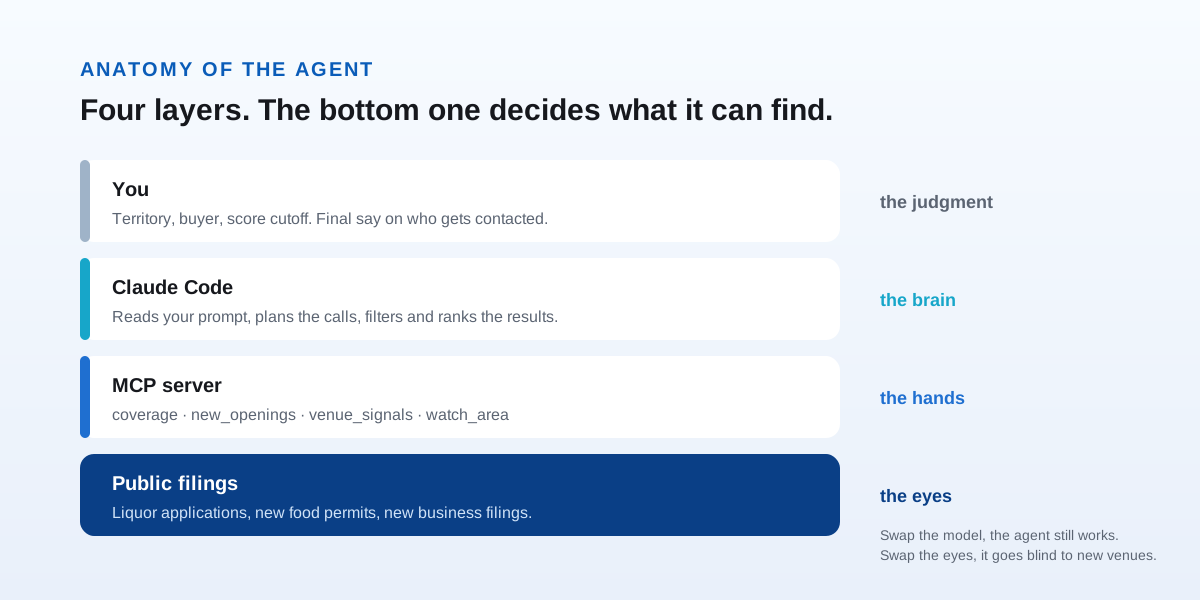
You set the goal and Claude Code does the reasoning. The MCP server gives it hands, and the data source gives it eyes.
Most people spend their time picking the model. I’d spend it on the eyes.
Why can’t a normal AI lead agent find new restaurants?
A normal AI lead agent can’t find new restaurants because it searches contact databases like Apollo, ZoomInfo, or Hunter, and those only list businesses that already exist online. A restaurant 3 months from opening has no website, no Google listing, and no LinkedIn page. The agent searches a database with a hole exactly where your best leads sit, so it returns venues after the vendor decisions are made.
I read the tutorials ranking for this right now.
Amplemarket’s guide has Claude pull contacts from Amplemarket’s people search. Hunter’s guide has it pull emails from Hunter. Both are good tutorials, and both start from a database of companies that already exist.
Even Findymail, which sells one of these tools, says in its roundup of AI lead finders that most of them just help you filter existing databases faster.
For most B2B selling, that’s fine. For restaurant vendors, it’s the wrong half of the timeline.
Why does that matter so much?
In a 2025 survey of 220 restaurant owners and operators, 71% said they begin selecting key vendors more than 90 days before opening, and 76% said they’re not receptive to vendor outreach within 30 days of opening. The same survey found 64% finalize vendor relationships before any public announcement.
Find the restaurant on opening week and your agent is about three months too late.
And it’s not one vendor seat at stake. The average restaurant runs more than 40 vendors, according to RestaurantData.com.
This is also why so many AI sales agents disappoint.
Gartner predicts that by 2028 AI agents will outnumber human sellers 10 to 1, yet fewer than 40% of sellers will say agents improved their productivity. Gartner’s own advice is to get the foundational data right before scaling the agents.
Where does an AI agent get leads for restaurants that haven’t opened yet?
An AI agent gets pre-opening restaurant leads from three public filings every new venue has to make: a liquor-license application, a new food or health permit, and a new LLC or business filing. They land in state and city records one to six months before opening. The agent needs a tool that reads all three and merges them into one venue, because a single filing alone is a weak signal.
Each filing tells you something different.
The liquor application says a bar or full-service restaurant is coming, and it names the applicant.
The food permit says the kitchen is real and close. The business filing names the owner entity, often with a mailing address.
One filing is a maybe. Three filings at the same address, from the same people, inside a few weeks of each other, is a restaurant about to open.
That merging step is the hard part, and it’s where a DIY agent usually breaks.
Names don’t match across agencies (“JOE’S PIZZA LLC” vs “Joe’s Pizza Bar & Grill”). Addresses come formatted three ways.
A model can reason through a handful of these, but not 70,000 records a night.
My advice: put the merging in the tool, not the prompt.
Our MCP server is built around that. RestoSignals pulls the filings daily, fuses them into one venue, and gives each venue an opening_score from 0 to 100.
A venue with all three signal types scores at the top, and anything at 80 or above counts as a hot lead.
The agent never sees the mess, just the fused venue and the filings behind it.
You don’t have to use mine. But whatever you plug in, ask one question: does it list venues before they open, or after?
How do you build an AI agent that finds new restaurant leads?
To build an AI agent that finds new restaurant leads, you need three things: Claude Code, a pre-opening data source exposed as an MCP server, and a standing prompt. Install Claude Code, connect the server with one command and your API key, then tell the agent your territory and buyer. The whole setup takes about 15 minutes and needs no code beyond pasting one command.
The build, in order:
- Get a data key. Sign up for a free RestoSignals key with 100 lead credits and no card. One credit is one returned lead, and calls that return nothing are free.
- Install Claude Code. It’s included in every paid Claude plan, starting with Pro at $20 a month.
- Connect the MCP server. In your terminal, run:
claude mcp add --transport http restosignals https://api.restosignals.com/mcp --header "Authorization: Bearer pk_YOUR_KEY"Then run claude mcp list to check it shows as connected. The command syntax comes straight from Anthropic’s Claude Code MCP docs, which also explain the scope flags if you want the server in every project.
- Learn the four tools. The server exposes
coverage(which states have data, free),new_openings(scored venues for a state),venue_signals(the raw filings behind one venue), andwatch_area(a webhook for new matches, free). - Give it a standing prompt. More on this below, because it’s where the quality comes from.
- Review, then schedule. Read the first few runs line by line. Once you trust the filters, run it weekly or register a
watch_areawebhook so new venues come to you.
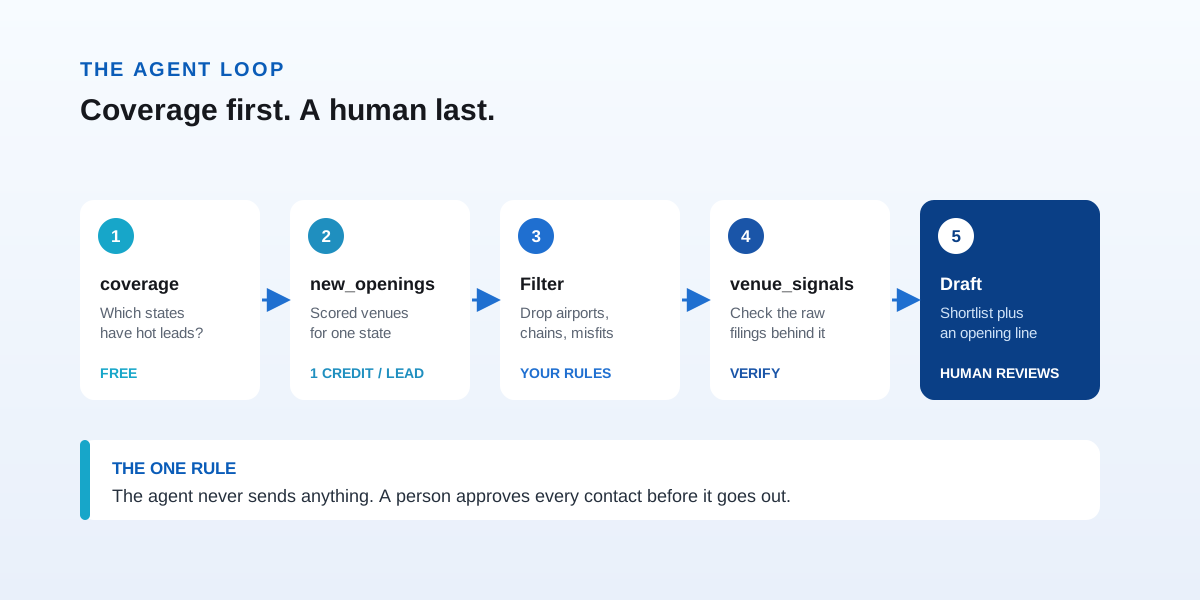
If you remember one thing from the build, make it the order. Coverage goes first, so the agent never wastes credits on a state with no data.
What did the agent find when I ran it?
When I ran this agent on October 14, 2026, the free coverage call showed 28,245 scored venues across seven states, 426 of them hot leads at a score of 80 or higher. Asking for New York venues scoring 90 or more returned three at a perfect 100, each backed by a liquor filing, a food permit, and a business filing. The whole run cost 6 credits.
Coverage returned this, by state.
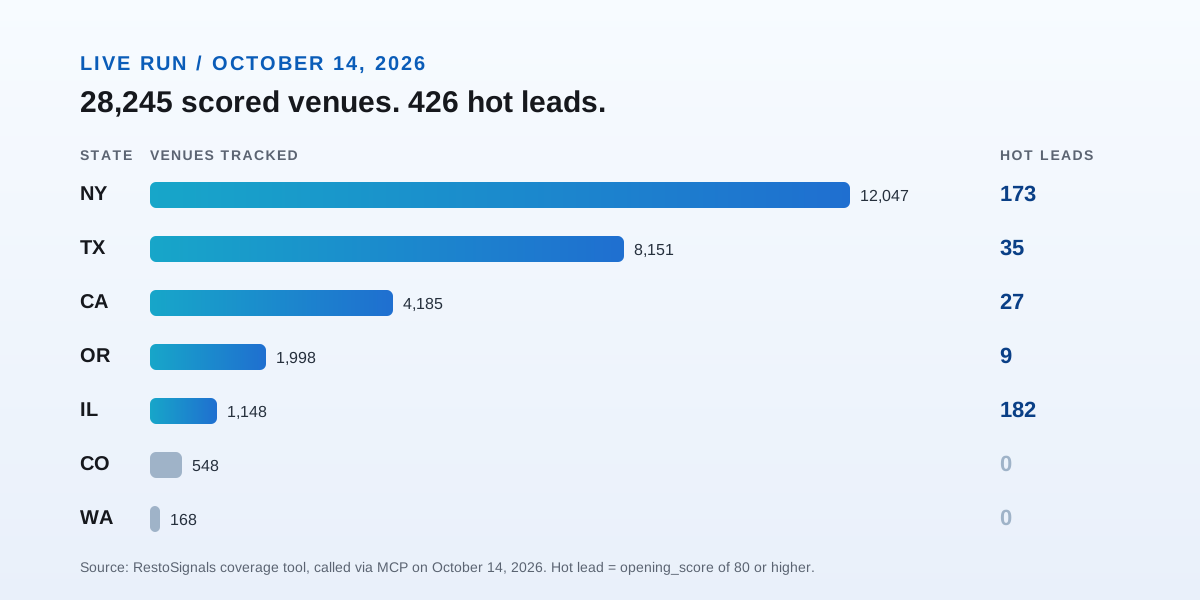
Notice Colorado and Washington: venues, but zero hot leads.
An agent that skipped the coverage call would happily spend your credits there. That’s why the prompt makes coverage step one.
The New York pull was clean. Osteria Brooklyn on Jackson in Long Island City, Diner 24 Broadway in Manhattan, and Straker’s NYC each scored 100 with all three signal types.
Illinois taught me something.
I asked for Illinois venues scoring 80 or more, and the top three were all Host International concessions at 11601 W Touhy Ave.
That’s O’Hare airport. One was a Publican Tavern, another a Chili’s, and each had real liquor and food filings.
For most vendors, neither is worth a call. An airport concessionaire buys through corporate contracts, not from a local rep.
The data was right. It just wasn’t anyone’s lead.
A rep would skip those by eye in two seconds. With an agent, you have to write that judgment into the prompt.
What prompt should you give your restaurant lead agent?
Give your restaurant lead agent a standing prompt that names your territory, your buyer, the minimum score, and what to exclude, and that forces it to check coverage before querying. Tell it to show the evidence for each lead and to draft, not send, any outreach. A good prompt turns a raw list of filings into a shortlist your rep can call the same morning.
Here’s a starting prompt. Copy it and change the brackets.
You find restaurants and bars that are about to open, for a [POS reseller / beverage distributor / insurance broker] selling in [state or cities].

1. Call coverage first. Only query states it lists with hot leads above 0.
2. Call new_openings for [state] with min_score [80].
3. Drop airport and stadium concessions, hotel chains, grocery stores, gas stations, and any operator with more than [10] locations.
4. For the top [5] leads, call venue_signals and confirm at least two filing types at the same address.
5. Return a table: venue, city, score, signal types, why it fits, and one opening line for outreach.
Never send anything. I review every lead before contact.
Three lines in that prompt do most of the work.
The exclusion line kills the O’Hare problem.
The two-filing check stops the agent from trusting a lone liquor application, which can sit for months. And “never send anything” keeps a human between the agent and your prospect.
I’d also keep the outreach line short. Treat the agent’s draft as a first pass, because you know the market and it only knows the filings.
How much does it cost to run an AI lead agent?
Running this AI lead agent costs about $20 a month for Claude Pro, which includes Claude Code, plus lead data at $4 per 1,000 returned leads after 100 free ones. Owner names and contact details unlock on the $29-a-month RestoSignals plan. A rep checking two states weekly might pull 200 leads a month, which is under a dollar of data. The model subscription is the bigger line item.
The stack, at each vendor’s public pricing in October 2026:
| Piece | What it does | Cost |
|---|---|---|
| Claude Pro | Runs Claude Code, the agent’s brain | $20/month |
| RestoSignals free key | 100 lead credits to test | $0, one time |
| RestoSignals top-up | 1,000 returned leads | $4 |
| RestoSignals top-up | 5,000 returned leads | $18 |
| RestoSignals plan | Owner names, phone and address where public, CSV | $29/month |
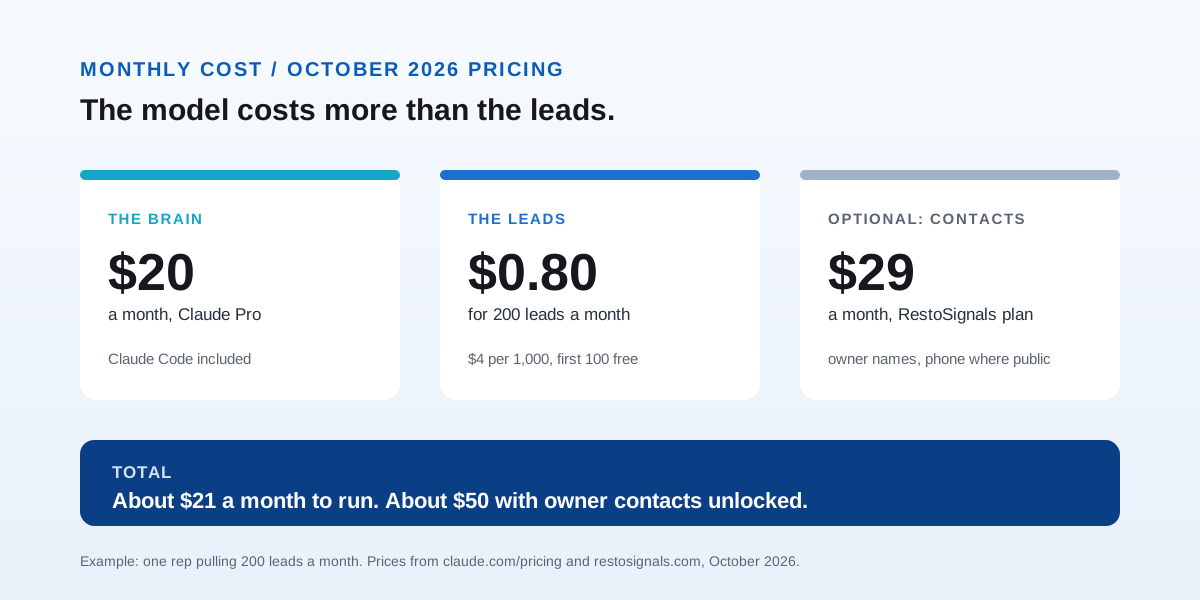
Compare that with the time it replaces.
Salesforce’s State of Sales research found reps spend just 28% of their week actually selling.
The rest goes to admin, data entry, and research. Digging through a state liquor board, a city permit portal, and a secretary of state site is exactly that kind of research.
Two hours a week back is about eight hours a month. For almost any sales salary, that’s worth more than the $20.
Can an AI agent replace an SDR for restaurant prospecting?
An AI agent can’t replace an SDR for restaurant prospecting, but it can replace most of the research an SDR does before the first call. It finds the venue, reads the filings, ranks the list, and drafts an opener in seconds. Judging fit, making the call, and earning trust with a first-time owner is still a human job. I’d bet most owners can spot a bot-written email in one line.
The O’Hare example is the whole argument.
The agent did its job perfectly and still surfaced leads no human rep would chase.
One exclusion line in the prompt handles that case. But without a person reading the output, nobody would have noticed it needed one, and the follow-ups would have gone to an airport.
Let the agent find and rank. Let the rep decide who’s worth a call.
Two rules keep you out of trouble.
First, don’t let the agent send cold email on its own. In the US, commercial email has to follow CAN-SPAM, including a real physical address and a working opt-out, and a looping agent can break both rules a hundred times before lunch.
Second, use filings for timing and owner names, not as an excuse to scrape personal data from elsewhere. An owner name on a liquor application is a public record. A cell number pulled off a social profile isn’t the same thing.
Start with the coverage call today
Your AI agent that finds new restaurant leads should start with one free question, once the MCP server is connected: “Call coverage and tell me which states have hot leads.” It’s free, it takes seconds, and it tells you whether your territory has pre-opening data worth acting on. If it does, run the prompt above for one state, read every lead yourself, and add an exclusion line for each bad one you find. After three runs, your agent will know your buyer.
Anyone can rent the same model for $20 a month, so the model won’t be your edge. The data source will, along with a prompt tuned to the buyer you actually sell to.
If you’d rather skip the agent and get the list in your inbox, the RestoSignals dashboard does the same thing without a terminal. And if you want the manual version first, start with how to sell to new restaurants before they open and the best pre-opening lead sources compared.
Weighing other data sources? See restaurant API compared: Yelp, Google Places, Foursquare and RestoAPI.
Mukul Dutt is the founder of RestoSignals, which tracks restaurants and bars before they open by fusing public liquor, permit, and business-filing records into one scored venue, available as a dashboard and as an MCP server for AI agents. He built the MCP server used in this guide and ran its calls against live data on October 14, 2026.
FAQ
How do I build an AI agent that finds leads?
Connect an AI model that can call tools, like Claude Code, to a data source through an MCP server, then give it a standing prompt with your territory, buyer, and filters. The model does the reasoning; the data source decides what leads exist. For new restaurants, that source has to read public filings, because contact databases don't list a venue until after it opens.
Do you need coding skills to build an AI sales agent?
No. The build in this guide is one terminal command to connect the MCP server and a plain-English prompt. You need to be comfortable pasting a command and editing a text prompt, not writing code. If you want the agent to run on a schedule or push leads into a CRM, that's where a little scripting or a no-code tool like n8n helps.
Can an AI agent replace an SDR?
Not the selling part. An agent can replace the research hours: finding the venue, reading the filings, ranking the list, and drafting a first note. A person still needs to judge fit, make the call, and build the relationship. Gartner expects AI agents to outnumber sellers 10 to 1 by 2028, yet fewer than 40% of sellers will say agents made them more productive.
How much does it cost to run an AI lead agent?
This build costs about $20 a month for Claude Pro, which includes Claude Code, plus RestoSignals data at $4 per 1,000 returned leads after 100 free ones. Owner contact details unlock on the $29-a-month plan. A small team checking one or two states weekly will spend far less on data than on the model subscription.
Is MCP secure for sales data?
MCP is a connection standard, so security depends on the server and the key you give it. Use a key scoped to one product, keep it out of shared repos, and prefer servers that meter per call so a runaway loop can't drain much. Read-only lead tools are low risk; tools that send email or write to your CRM deserve a human approval step.
How do I find restaurants before they open?
Watch the public filings a restaurant has to make before opening: the liquor-license application, the new food or health permit, and the new LLC or business filing. These hit state and city records one to six months before opening day. You can check each agency by hand, or let an agent pull all three, fused and scored, through one API call.
Find venues opening near you
100 free leads, no card. One platform for restaurants & bars about to open.