How to get commercial cleaning contracts from restaurants
How to get commercial cleaning contracts by starting with restaurants that haven't opened: the pre-opening clean, the hood schedule, and a real LA list from public filings.
Almost every office building in your town already has a cleaner.
A restaurant that hasn’t opened yet doesn’t.
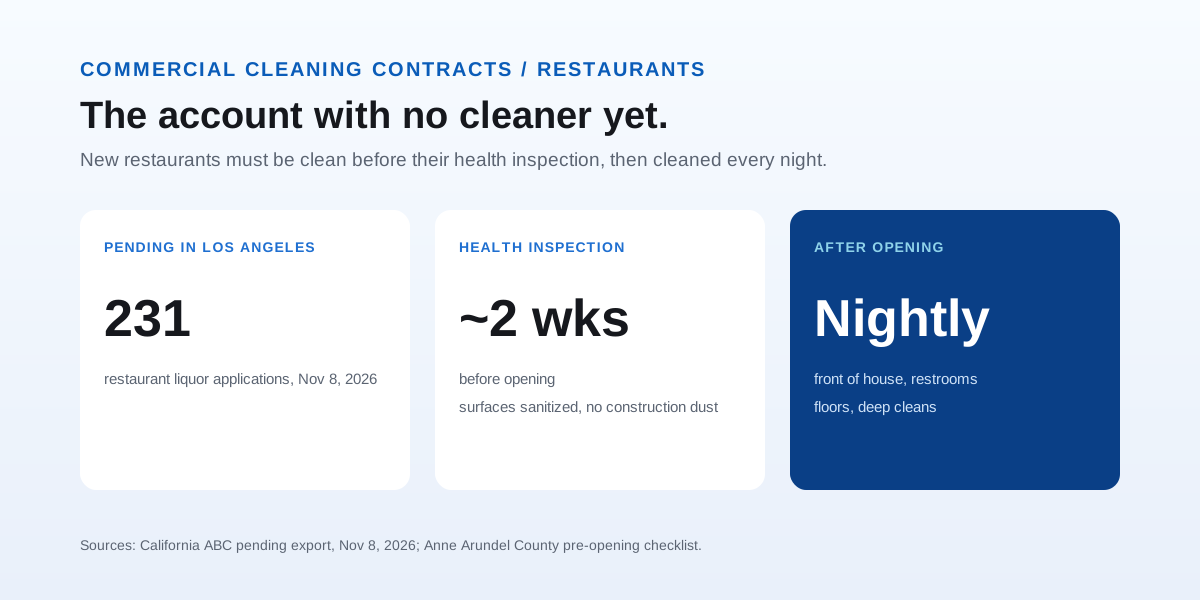
If you’re wondering how to get commercial cleaning contracts, start with new restaurants. They need a post-construction clean and a sanitized kitchen before their pre-opening health inspection, which is usually scheduled about two weeks before opening, and then cleaning every night once they open. No incumbent to beat. Public liquor license applications show you where they are, months ahead. Los Angeles alone had 231 pending on November 8, 2026.
I run RestoSignals, which finds restaurants before they open, so I’m biased. I’ve kept everything here to public sources and data you can pull yourself for free.
Why are new restaurants the easiest commercial cleaning contract to win?
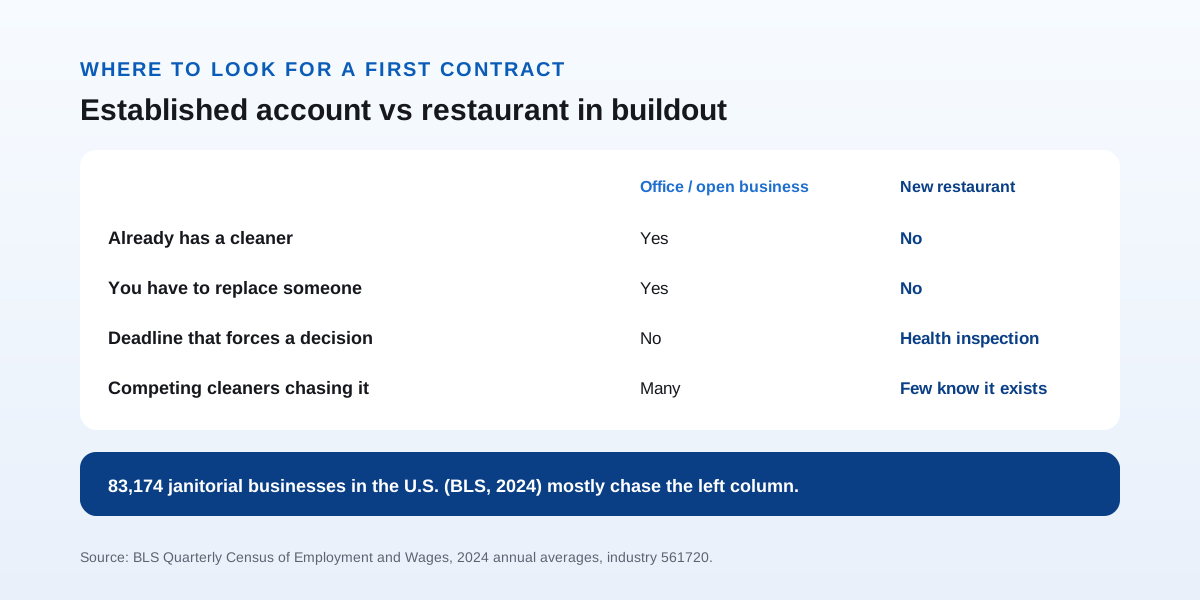
New restaurants are the easiest commercial cleaning contract to win because nobody has the account yet. An open office or store already has a cleaner, so you’re asking it to fire someone. A restaurant in buildout has to be cleaned before it can pass its health inspection and open. You’re filling a gap, not replacing a vendor.
The competition for established accounts is heavy. The Bureau of Labor Statistics counted 83,174 janitorial services establishments in the U.S. in 2024, employing about 1.07 million people, per its QCEW data for industry 561720.
A lot of them are chasing the same office parks and property managers.
The cleaners who talk about their first commercial client tell the same story. On r/cleaningbusiness, one owner said theirs came when their doctor “was relocating to a new medical office.” The top reply called that “usually the cleanest path for a first commercial account.”
A new space means a new decision about who cleans it, and new restaurants open every week.
What cleaning does a new restaurant need before it opens?
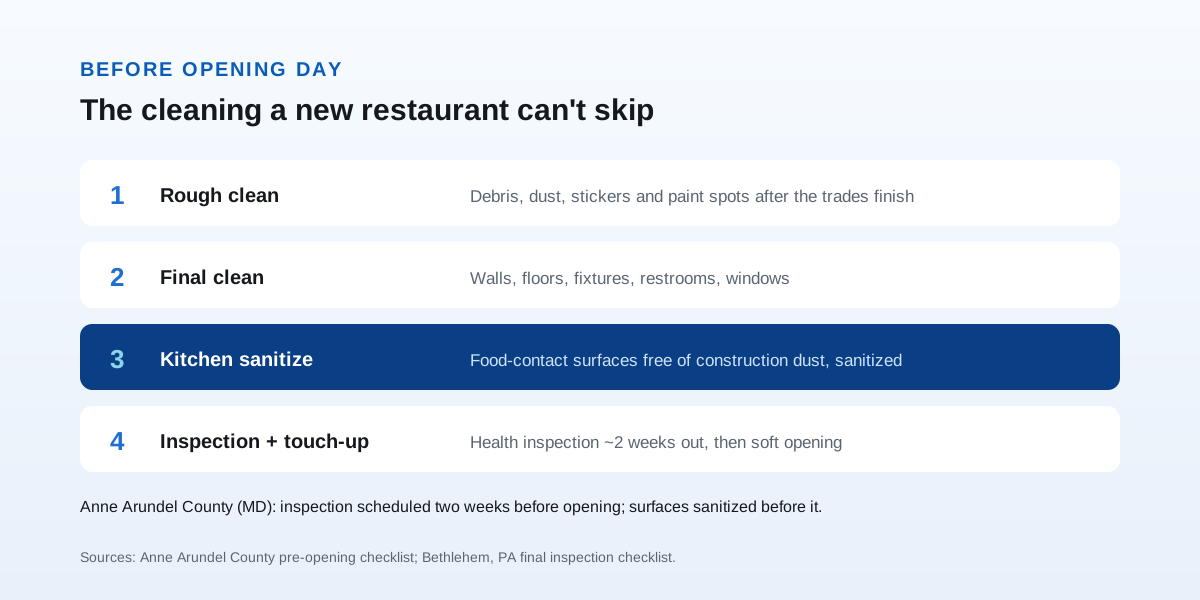
A new restaurant needs a post-construction clean to remove dust and debris after the buildout, then a kitchen clean and sanitize before its pre-opening health inspection. Health departments make this explicit. Anne Arundel County, Maryland, requires that food-contact surfaces be “free from construction dust and debris” and wiped with an approved sanitizer before the inspection, which must be scheduled two weeks before opening.
That’s from the county’s pre-opening checklist. It’s one county, but the rule is common.
Bethlehem, Pennsylvania’s final inspection checklist says all construction must be complete and the premises clean. Flathead County, Montana, charges re-inspection fees if a place isn’t ready.
That last one is your pitch. A failed inspection costs the owner a fee and, worse, days of delay on a space they’re already paying rent on.
The pre-opening work usually looks like this:
- Rough clean after the trades finish: debris, dust, stickers, paint spots.
- Final clean: walls, floors, fixtures, restrooms, windows.
- Kitchen sanitize: food-contact surfaces, sinks, walk-ins, shelving.
- Touch-up right before the inspection and soft opening.
Who hires the post-construction cleaner, the owner or the contractor?
Either can hire the post-construction cleaner. On many builds the general contractor hires and pays for the final clean as part of handing the space over, and on smaller buildouts the owner hires it directly. Ask both. The owner signs the recurring contract after opening, so even when the contractor pays for the first clean, the owner is the relationship you want.
This is where most cleaners get it wrong. They pitch only the owner, who says “talk to my GC,” or only the GC, who never introduces them to the owner.
So do both. Get the post-construction job from whoever is paying, and use it to meet the owner.
Where do you find the contractor? Usually on the building permit, or on the sign zip-tied to the fence outside.
What recurring work comes after a restaurant opens?
After opening, a restaurant needs cleaning every day it operates: front of house, restrooms and floors nightly, plus periodic deep cleans of the kitchen. The exhaust hood adds a fixed schedule. NFPA 96 requires grease inspections monthly for solid-fuel cooking, quarterly for high-volume kitchens, semiannually for moderate volume and annually for low volume, with cleaning whenever grease builds up.
That schedule comes from Table 11.4 of NFPA 96 (2017 edition), as summarized in the Village of New Paltz, New York’s kitchen hood cleaning requirements:
| Kitchen type | Hood grease inspection |
|---|---|
| Solid fuel (wood, charcoal) | Monthly |
| High volume (24-hour, charbroiling, wok) | Quarterly |
| Moderate volume | Every 6 months |
| Low volume (churches, day camps, seasonal) | Yearly |
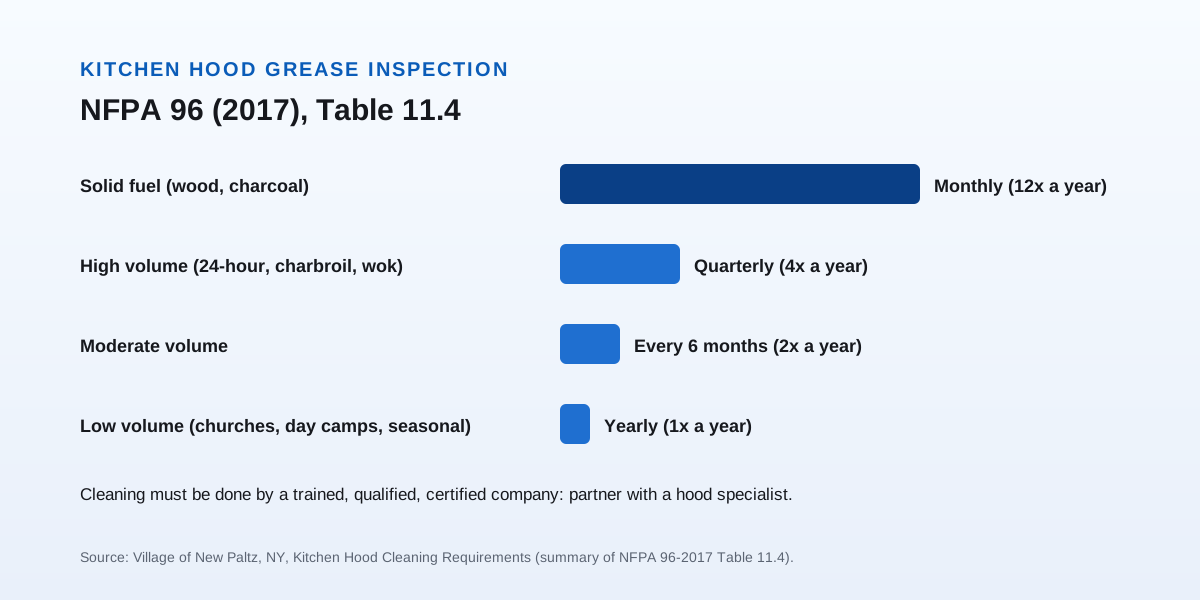
One catch. The same document says contaminated portions must be cleaned by “a properly trained, qualified, and certified company” acceptable to the local fire authority.
So unless you’re certified, don’t sell hood cleaning yourself (here’s how to start a hood cleaning business if you want to). Partner with a hood company and refer each other. They see every kitchen in town, and you see every new one. The same goes for pest control, which every kitchen also needs: see how pest control companies win restaurant contracts.
The nightly contract itself is usually simpler than people expect. Most restaurants have their own staff wipe down the line and do dishes at close, so what they hire out is the rest: front-of-house floors, restrooms, glass, trash areas, and a deeper kitchen floor and wall clean on a set schedule.
Ask what the kitchen crew already does at close. Then quote what’s left.
The market is big enough for both. BLS counted 264,208 full-service restaurant locations in the U.S. in 2024, and that’s before cafes, bars and quick-service places.
How do you find new restaurants before they open?
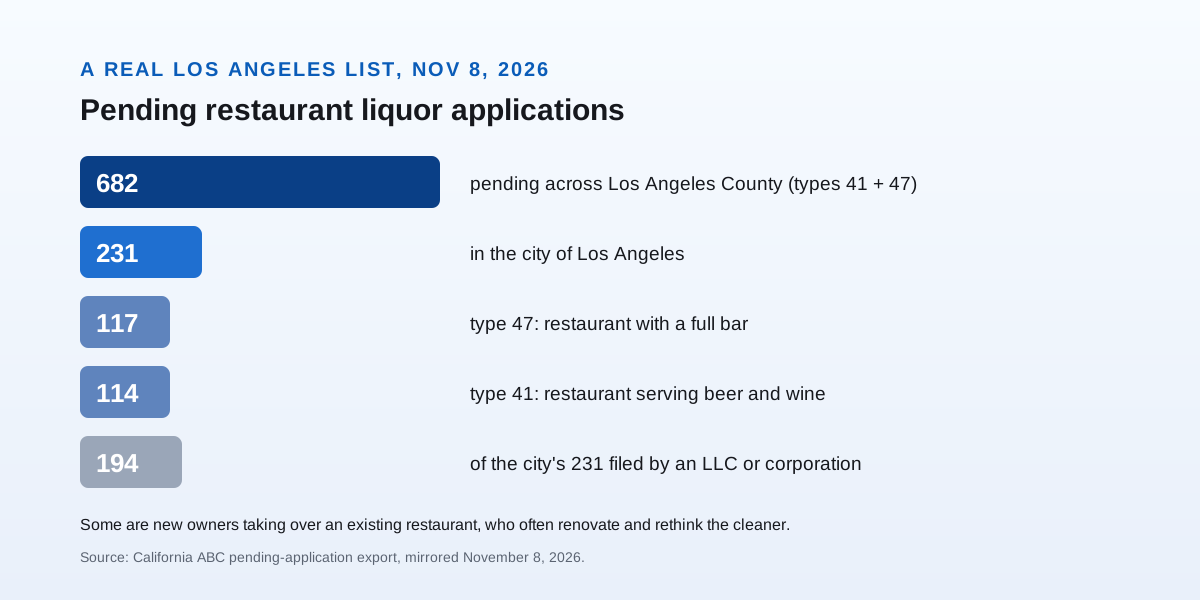
You find new restaurants before they open in public liquor license applications, which name the owner and the address months ahead. California’s ABC export listed 231 pending restaurant applications (types 41 and 47) in the city of Los Angeles on November 8, 2026, and 682 across Los Angeles County. Texas publishes the same thing: Houston had 53 pending bar and restaurant applications on November 6.
Here’s the Los Angeles list, broken down:
- 231 pending in the city: 114 type 41 (restaurants serving beer and wine) and 117 type 47 (restaurants with a full bar).
- 194 of the 231 applicants are LLCs or corporations, so you’ll look up the person behind them.
- They include a sushi restaurant, a coffee shop, a crab and grill place and a studio cafe.
Not every application is a brand-new restaurant. Some are new owners taking over an existing one. But a new owner often renovates, and a new owner is a new chance to pitch the cleaning.
For each name:
- Check the address for a building or health permit and whether there’s a website or menu yet.
- Look up the LLC’s officers in your state’s business registry.
- Find the contractor on the permit or the site sign.
- Reach out.
The step-by-step for each state’s data is in my guides for California, Texas and Illinois.
If you’d rather not pull and match these by hand, that’s what RestoSignals does: it fuses the liquor filing with permits and business records into one venue with the owner’s name.
When should you contact a new restaurant about cleaning?
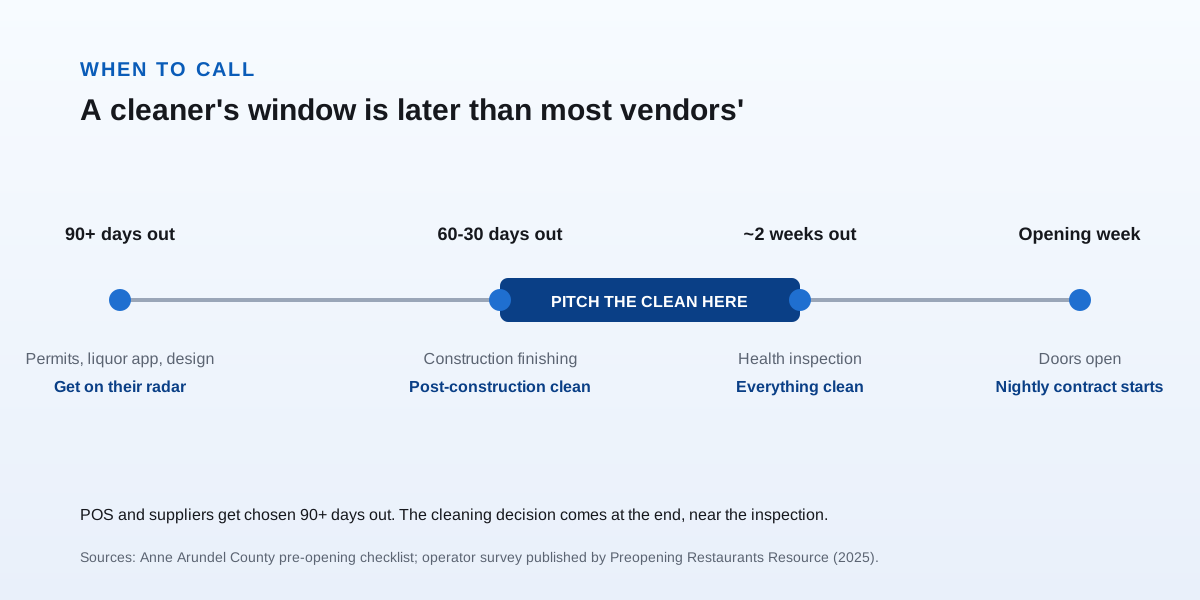
Contact a new restaurant in the last month or two of buildout. That’s later than most vendors need, which is good news for cleaners. A POS seller has to be in 90-plus days before opening, but your job happens at the end. A restaurant that’s 30 days out, with walls up and equipment arriving, is the right moment for a cleaning pitch.
Here’s the rough timeline:
- 90+ days out: permits, liquor application, design. Too early for you, but get on their radar.
- 30 to 60 days out: construction finishing. Pitch the post-construction clean now.
- About two weeks out: the pre-opening health inspection. Everything must be clean.
- Opening week: the recurring contract starts.
In a 2025 survey of 220 operators, published by pre-opening lead seller Preopening Restaurants Resource, 76% said they weren’t receptive to vendor outreach in the 30 days before opening. That’s about new systems and suppliers. A cleaner who saves them from a failed inspection is a different conversation, but call earlier rather than later anyway.
How do you price a restaurant cleaning job?
Price a restaurant cleaning job by walking the space and estimating labor hours, not by guessing a square-foot rate. The post-construction clean is a one-time quote based on the size of the space, how much construction mess is left and the deadline. The nightly contract is crew hours per night, times nights per week, plus supplies, adjusted for how greasy the kitchen runs.
I won’t give you a per-square-foot number. Every market is different, and most of the numbers online come from software companies selling quoting tools.
What I’d ask on the walk-through:
- What’s the inspection date, and is the contractor done by then?
- How many seats, and what’s the cooking style? A wok or charbroil kitchen gets greasy fast.
- What hours will they close, and when can a crew come in?
- Who handles the hood and the grease trap now?
- Do they want restrooms and front of house only, or the kitchen floors too?
Quote the one-time clean tight and fair. That job is your audition for the contract.
Should you chase government cleaning bids instead?
Government cleaning bids are worth having later, but they’re a slow first contract. Federal work requires registering your business in SAM.gov, bids are public and compared mostly on price, and award cycles take months. Most of the pages ranking for this search push bid sites. A new restaurant needs one phone call and one good job, and it decides in weeks.
Bid sites are a fine second channel once you have references.
For your first few contracts, go where no one has the account yet.
What should you say to a restaurant owner in buildout?
Offer the pre-inspection clean as a fixed job with a fixed date, not a vague “cleaning services” pitch. Owners in buildout are juggling contractors, inspectors and hiring, so a short note that solves one specific problem, passing the health inspection on time, gets read. Win that job, do it well, then propose the nightly contract before opening week.
Something like:
Hi [name], I saw the liquor application for [restaurant] on [street]. Congrats on the opening. I do post-construction and pre-inspection cleans for restaurants in [area], including the kitchen sanitize the health department checks. If you have an inspection date, I can work back from it. [phone]
That’s a starting point. Make it sound like you.
Two things that help:
- A certificate of liability insurance ready to send. Contractors and landlords usually ask for one before you set foot on site.
- Before and after photos from your last job. One restaurant kitchen photo beats a page of promises.
Frequently asked questions
How do I get my first commercial cleaning contract?
Start with a space that’s about to change hands or open, because it has no cleaner yet. New restaurants are the clearest case: they need a post-construction clean and a sanitized kitchen before their pre-opening health inspection, then nightly cleaning once open. Find them through public liquor license applications, contact the owner or general contractor during buildout, and win the one-time clean first.
How do I find commercial cleaning contracts near me?
Look where new businesses announce themselves to the government before the public. Pending liquor license applications, building permits and food facility plan checks list new restaurants weeks or months early, with an owner name and address. Public bid sites cover government work, and property managers cover offices, but new restaurants are the accounts with no incumbent cleaner.
Who hires the post-construction cleaner for a new restaurant?
It depends on the build. On many projects the general contractor hires the post-construction clean as part of handing the space over, and on smaller buildouts the owner hires it directly. Ask both. The owner is the one who signs the recurring contract after opening, so even if the contractor pays for the first clean, get in front of the owner too.
How often does a restaurant kitchen hood need to be cleaned?
Under NFPA 96 (2017 edition, Table 11.4), exhaust systems are inspected for grease monthly for solid-fuel cooking, quarterly for high-volume cooking such as 24-hour, charbroiling or wok kitchens, semiannually for moderate volume and annually for low volume, and cleaned when grease is found. That work needs a trained, qualified company acceptable to the local authority, so many general cleaners partner with a hood specialist.
When should I contact a new restaurant about cleaning?
Contact them during the last month or two of buildout. A pre-opening health inspection is usually scheduled about two weeks before opening, and Anne Arundel County, Maryland, for example, requires food-contact surfaces to be free of construction dust and sanitized before it. That’s later than most vendors need to reach a restaurant, so cleaners can still win a lead that’s close to opening.
Is restaurant cleaning a good niche for a commercial cleaning company?
Yes, if you can work nights and handle grease. Restaurants need cleaning every day they’re open, kitchens have strict health inspection standards, and the U.S. had 264,208 full-service restaurant locations in 2024, according to BLS. The tradeoff is harder work and late hours than office cleaning, and hood cleaning needs specialist certification.
Pull ten restaurants in your area this week
Skip the office parks for a week. Pull your city’s pending liquor applications, pick the ten restaurants closest to you, find the owner and the contractor for each, and offer every one a pre-inspection clean with a date. Or see this week’s new venues on RestoSignals free and start with the list already built.
Mukul Dutt is the founder of RestoSignals, which tracks restaurants and bars before they open by fusing public liquor, permit and business-filing records into one scored venue with owner contact. Los Angeles counts are from the California ABC pending-application export mirrored on November 8, 2026; Houston from TABC’s pending applications dataset on November 6, 2026. Establishment counts are from BLS QCEW 2024 annual averages (industries 561720 and 722511). Hood schedule from NFPA 96 (2017) as summarized by the Village of New Paltz.
FAQ
How do I get my first commercial cleaning contract?
Start with a space that's about to change hands or open, because it has no cleaner yet. New restaurants are the clearest case: they need a post-construction clean and a sanitized kitchen before their pre-opening health inspection, then nightly cleaning once open. Find them through public liquor license applications, contact the owner or general contractor during buildout, and win the one-time clean first.
How do I find commercial cleaning contracts near me?
Look where new businesses announce themselves to the government before the public. Pending liquor license applications, building permits and food facility plan checks list new restaurants weeks or months early, with an owner name and address. Public bid sites cover government work, and property managers cover offices, but new restaurants are the accounts with no incumbent cleaner.
Who hires the post-construction cleaner for a new restaurant?
It depends on the build. On many projects the general contractor hires the post-construction clean as part of handing the space over, and on smaller buildouts the owner hires it directly. Ask both. The owner is the one who signs the recurring contract after opening, so even if the contractor pays for the first clean, get in front of the owner too.
How often does a restaurant kitchen hood need to be cleaned?
Under NFPA 96 (2017 edition, Table 11.4), exhaust systems are inspected for grease monthly for solid-fuel cooking, quarterly for high-volume cooking such as 24-hour, charbroiling or wok kitchens, semiannually for moderate volume and annually for low volume, and cleaned when grease is found. That work needs a trained, qualified company acceptable to the local authority, so many general cleaners partner with a hood specialist.
When should I contact a new restaurant about cleaning?
Contact them during the last month or two of buildout. A pre-opening health inspection is usually scheduled about two weeks before opening, and Anne Arundel County, Maryland, for example, requires food-contact surfaces to be free of construction dust and sanitized before it. That's later than most vendors need to reach a restaurant, so cleaners can still win a lead that's close to opening.
Is restaurant cleaning a good niche for a commercial cleaning company?
Yes, if you can work nights and handle grease. Restaurants need cleaning every day they're open, kitchens have strict health inspection standards, and the U.S. had 264,208 full-service restaurant locations in 2024, according to BLS. The tradeoff is harder work and late hours than office cleaning, and hood cleaning needs specialist certification.
Find venues opening near you
100 free leads, no card. One platform for restaurants & bars about to open.