How to become a POS reseller or merchant services agent
How to become a POS reseller or merchant services agent: what Square, Clover, Toast and ISO programs pay, the 80/20 split, and where first merchants come from.
Search “square reseller program” and you’ll find plenty of companies offering one.
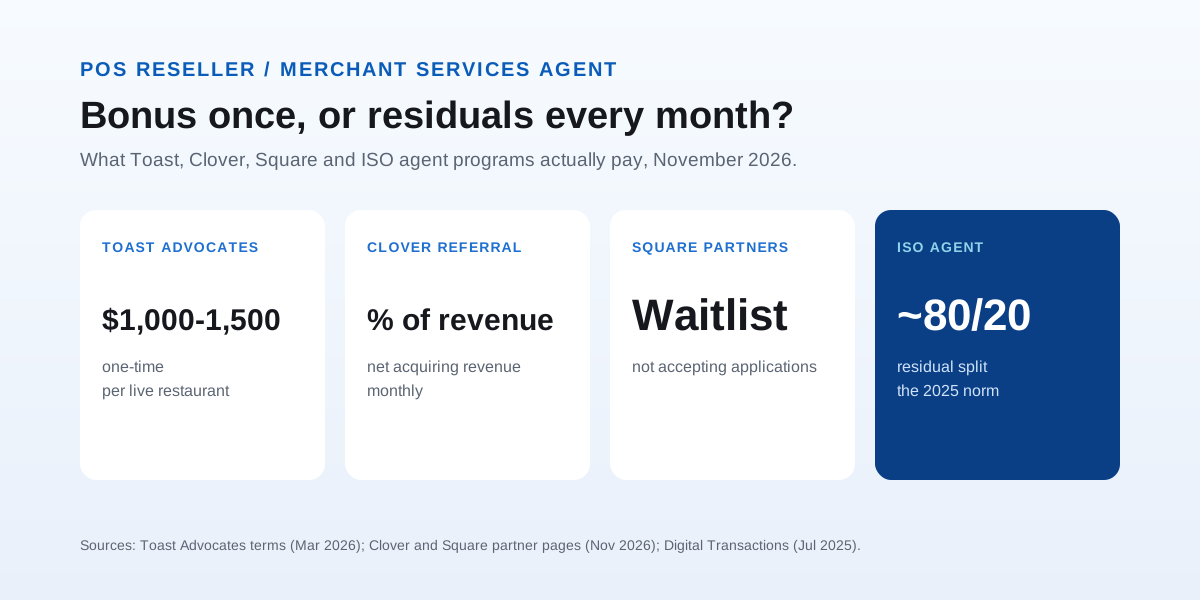
Square itself isn’t taking applications. Toast doesn’t really have a reseller program either.
If you want to become a POS reseller or merchant services agent in 2026, your real choices are a one-time referral bonus from a POS brand, a revenue share from a processor program like Clover’s, or a 1099 agent deal with an ISO that pays monthly residuals, where keeping about 80% of the profit is now the norm. The program matters less than one question: where your first 20 restaurants will come from.
I run RestoSignals, which finds restaurants before they open, so I’m biased toward that last part. Everything else here comes from each program’s own terms, read in November 2026.
What does a POS reseller or merchant services agent actually do?
A merchant services agent signs businesses up for card processing on behalf of an independent sales organization (ISO) and earns a share of the profit on every card those businesses take, paid monthly as a residual. A POS reseller does the same with the point-of-sale system attached, often adding hardware margin and install fees. The ISO underwrites the merchant, holds the risk and handles support.
So there are really four job titles hiding in one search:
- Referral partner. You pass a name, the brand closes it, you get a bonus or a small revenue share.
- Agent. You close the deal yourself under an ISO’s paper and earn a residual.
- Dealer or VAR. You sell, install and support a POS system and earn on hardware, software and payments.
- ISO. You’re the company registered with the card networks through a sponsor bank. That’s a much bigger step.
The ISO part sounds abstract until you read the fine print on a brand you know. Clover’s own site says First Data Merchant Services, doing business as Clover Business Solutions, “is a registered ISO of Pathward N.A.” and Wells Fargo.
Most people searching “pos reseller” want to be number 2 or 3.
Which POS reseller programs can you join in 2026?
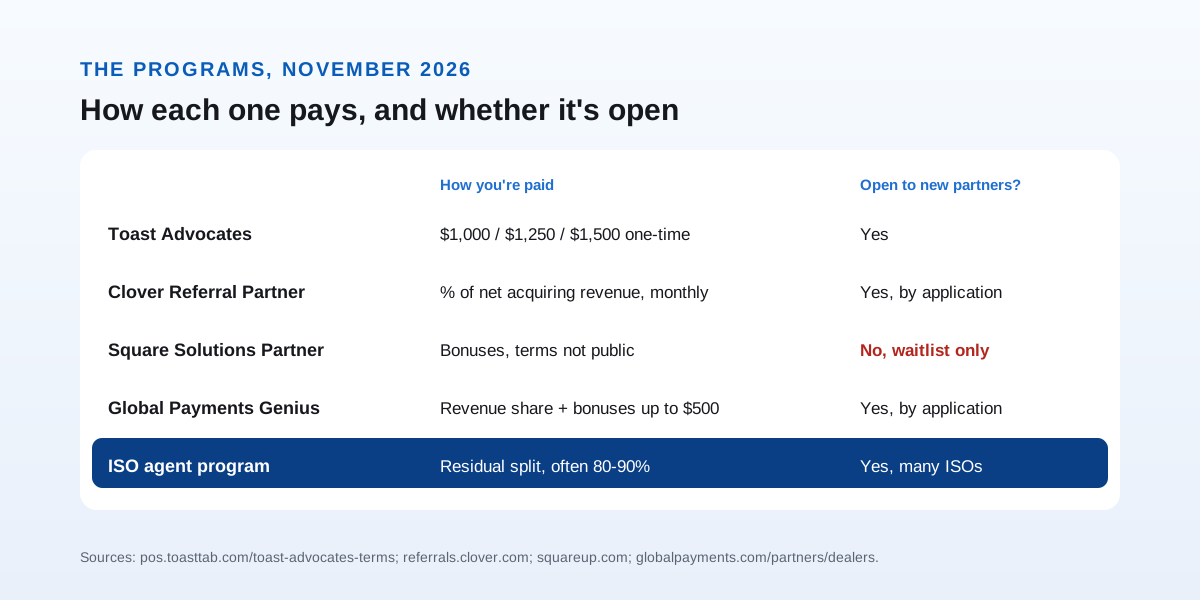
In November 2026, Clover runs an open referral partner program that pays a share of net acquiring revenue monthly, Toast pays one-time bonuses of $1,000 to $1,500 through Toast Advocates, and Square’s Solutions Partner Program isn’t accepting applications. Global Payments (formerly Heartland’s dealer channel) recruits Genius POS dealers on revenue share. Most other options run through an ISO agent agreement.
Here’s what each program’s own page says.
| Program | How you’re paid | Open to new partners? | Source |
|---|---|---|---|
| Toast Advocates | $1,000 first live restaurant, $1,250 2nd-3rd, $1,500 4th on | Yes | Toast terms, Mar 2026 |
| Clover Referral Partner | % of net acquiring revenue, monthly | Yes, by application | Clover |
| Square Solutions Partner | Bonuses and incentives, terms not public | No, waitlist only | Square |
| Global Payments Genius dealer | Revenue share, residuals, daily bonuses up to $500 | Yes, by application | Global Payments |
| ISO agent program | Residual split, often 80-90%, plus upfront bonuses | Yes, many ISOs | Agent agreement |
Toast partner program
Toast sells direct. When someone on r/ToastPOS asked how much “the average toast reseller” makes per restaurant, the top answer was blunt: “Toast doesn’t have resellers. They sell direct.”
What Toast does have is Toast Advocates. Its terms, effective March 1, 2026, pay $1,000 for your first restaurant that signs and stays live for seven days, $1,250 for the second and third, and $1,500 from the fourth on.
Extra locations in the same group pay $500 each, up to 14. Verbal referrals don’t count.
There’s also a short promo: referrals submitted between November 1 and 15, 2026 earn an extra $500.
Companies with a formal Toast partner agreement get paid under that agreement instead. Those terms aren’t public.
Square reseller program
Square’s Solutions Partner Program covers agencies, systems integrators and resellers. Right now its page says: “We’re not currently accepting applications.”
You can join the waitlist. Meanwhile, the companies advertising “Square reseller” deals are third parties that hold their own Square relationship. Read their contract, not the headline.
Clover reseller and referral program
Clover is the most open of the big three.
Its referral partner program says you “earn a percentage of the net acquiring revenue” from your referrals, paid monthly once they start processing. You get a lead portal after approval.
Clover is also sold through partner banks and ISOs. If you sign with an ISO that boards Clover, your pay is that ISO’s residual split, not the referral share.
Global Payments Genius dealer program
If you want to be a full POS dealer, installing and supporting systems, this is the classic route. Heartland’s old dealer page now redirects to Global Payments.
Its dealer page promises revenue share, residuals that grow with performance, and “daily bonuses of up to $500” on processing referrals. It works with the RSPA, the trade group for POS dealers.
Dealers carry more work: installs, menu builds, support calls. In return, they own the merchant relationship.
How much does a merchant services agent make?
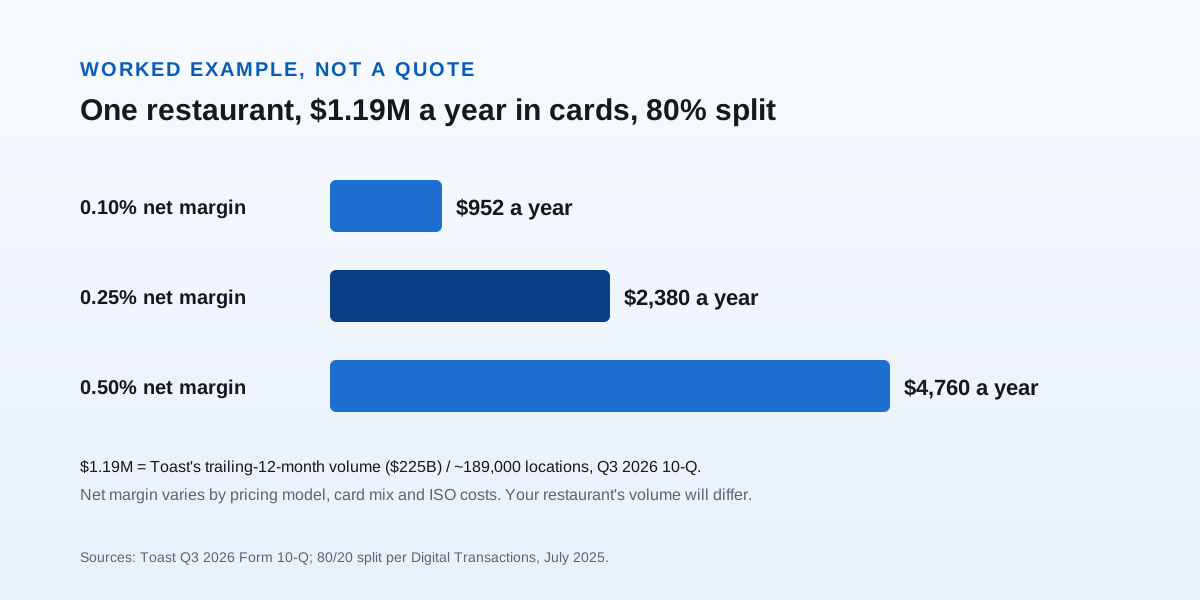
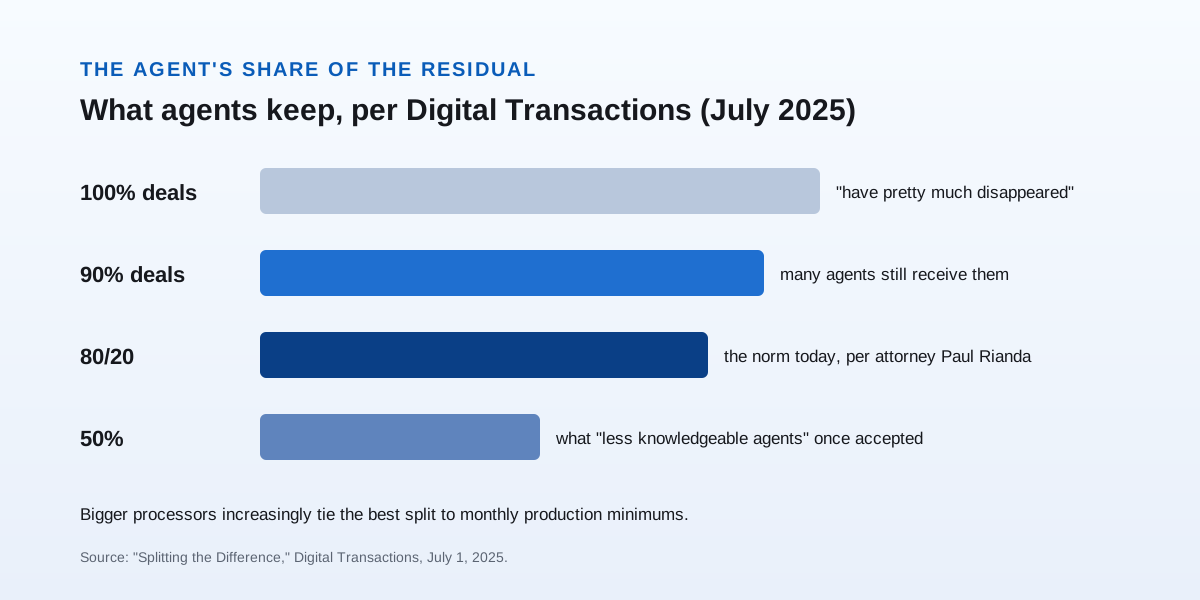
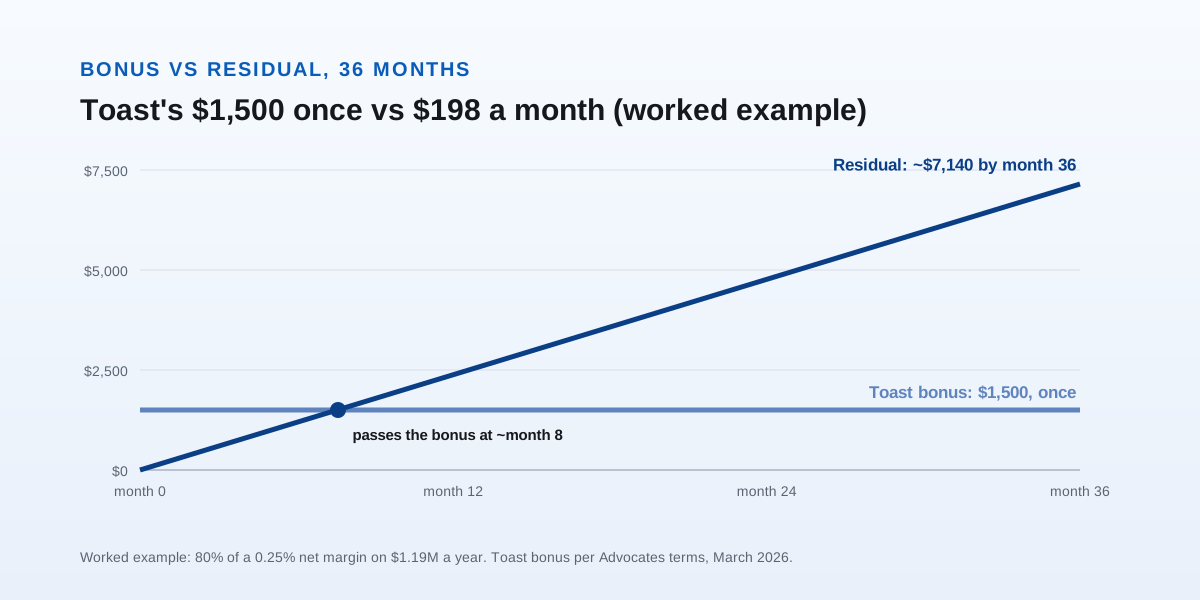
A merchant services agent typically keeps about 80% of the net profit on each merchant’s processing; Digital Transactions reported in July 2025 that the norm is now “closer to an 80/20 split,” with many agents still on 90%. On an average Toast-sized restaurant processing about $1.19 million a year, an 80% split of a 0.25% net margin pays roughly $2,380 a year, every year the merchant stays.
That 80/20 line comes from payments attorney Paul Rianda, quoted in Digital Transactions. The same piece notes many agents still get 90% deals, while “the 100% deals have pretty much disappeared.”
Larger processors now often require production minimums to get the best split.
Now the volume. Toast’s Q3 2026 10-Q says it served about 189,000 locations and processed about $225 billion in the trailing 12 months. That’s about $1.19 million per location.
The net margin is the number nobody publishes. It depends on the merchant’s pricing, card mix and your ISO’s costs.
So here’s the math at three margins. Treat it as a worked example, not a quote:
| Net margin after costs | Profit per year at $1.19M volume | Your 80% |
|---|---|---|
| 0.10% | $1,190 | $952 |
| 0.25% | $2,975 | $2,380 |
| 0.50% | $5,950 | $4,760 |
Your independent taco shop won’t do $1.19 million. A busy bar might do more.
Pricing models move the margin, too. PayBright’s CEO told Digital Transactions that dual pricing has produced “upwards of 10X increases in profitability” in some agent portfolios. That’s an ISO talking about its own model, so I’d verify it on your own residual report.
Should you take a referral bonus or residuals?
Take residuals if you plan to stay in the business for more than a year, and take a referral bonus if you only meet restaurant owners occasionally. In the worked example above, a $2,380-a-year residual passes Toast’s $1,500 one-time bonus in about eight months and earns about $7,140 over three years. The bonus is cash now, with no exposure if the restaurant closes.
That’s the honest trade.
Restaurants close. A residual from a place that shuts in month six pays you six months.
But a book of residuals is an asset. Agents sell portfolios, and ISOs pay upfront bonuses to win them.
Upfront bonuses usually come out of your split. If an ISO offers $500 per account and 60%, while another offers nothing upfront and 85%, run the numbers on your expected merchant volume before you pick.
How do you become a merchant services agent, step by step?
To become a merchant services agent, pick a payment model, shortlist two or three ISOs or programs, get each agent agreement and Schedule A in writing, and check vesting, minimums and chargeback liability before you sign. Then learn one POS system properly and build a pipeline of merchants who need a processor now. Agents usually don’t need an exam or their own card-network registration; you sell under the ISO’s.
The steps:
- Pick how you want to be paid: one-time bonuses or monthly residuals.
- Shortlist two or three ISOs or programs. Ask which POS systems each one boards.
- Get the agent agreement and Schedule A, the cost sheet your split is calculated from.
- Read the agreement (next section).
- Learn one POS system well. Restaurants buy a working setup, not a rate.
- Build a pipeline of restaurants that haven’t opened yet.
- Check your residual report every month.
Two top answers I read on r/PaymentProcessing gave new agents the same advice: start under a reputable ISO, get trained, and don’t try to become an ISO in year one.
What should you check in an ISO agent agreement?
Before you sign an ISO agent agreement, check what your split is calculated on, whether your residuals are vested and keep paying if you leave, whether there are monthly production minimums, who absorbs chargebacks and merchant losses, and whether a non-solicit clause stops you moving merchants later. An 80% split of an inflated cost base can pay less than 60% of the true cost.
If you want the full chain, from interchange to the ISO’s cut, I broke down ISO vs agent in merchant services on a single $40 restaurant ticket.
Here’s my checklist, in the order I’d ask:
- What exactly is my split calculated on? Get Schedule A.
- Are my residuals vested? Do they keep paying if I leave or the ISO is sold?
- Is there a monthly minimum, and what happens to my split if I miss it?
- Who pays when a merchant charges back or closes owing money?
- Can I move my merchants to another ISO later, or does a non-solicit block it?
- How fast are approvals, and who answers the merchant’s support calls at 9 p.m. on a Friday?
The first point catches people. “80%” means nothing until you see the buy rate it’s based on.
Ask for a sample residual report. If they won’t show one, that’s your answer.
Sara Egan of CWA Merchant Services put the other half well in the same Digital Transactions piece: the relationship “should never solely be based on the revenue share alone.” Approval speed, support quality and same-day funding win you deals, too.
Where do POS resellers find their first merchants?
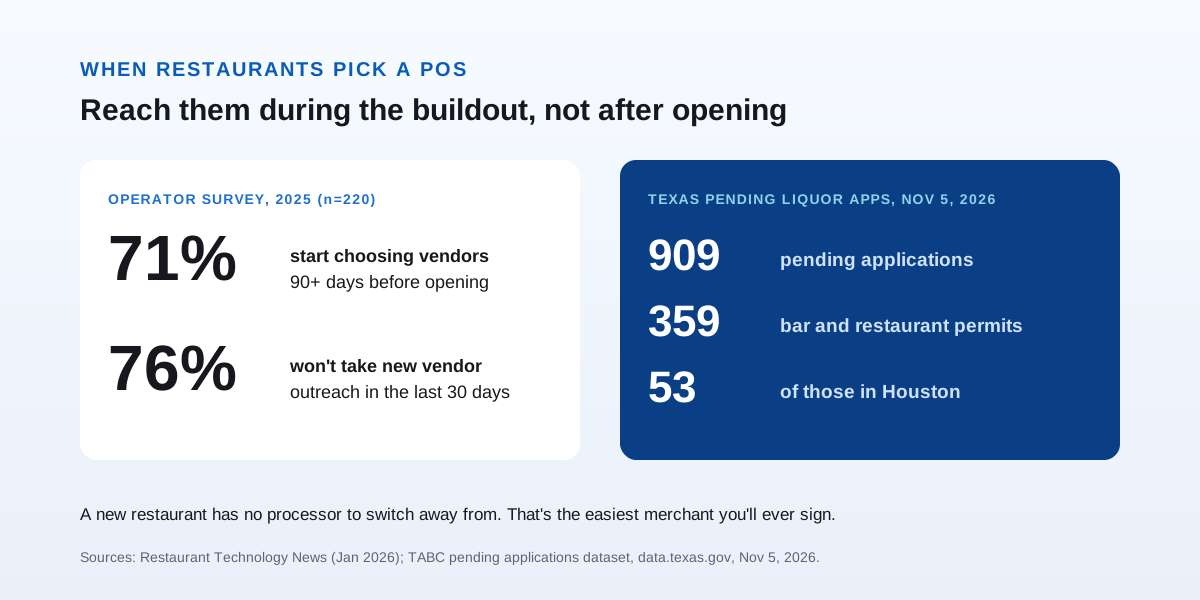
POS resellers find their best first merchants among restaurants that haven’t opened yet, because a new restaurant has no processor to switch away from and picks one during the buildout. Public liquor license applications reveal these restaurants months early. Texas alone had 909 pending applications on November 5, 2026, 359 of them for bar and restaurant permits.
The timing matters more than the pitch.
In a 2025 survey of 220 restaurant operators, reported by Restaurant Technology News, 71% said they start choosing their main vendors more than 90 days before opening. And 76% aren’t open to new vendor outreach in the last 30 days.
Walk into an open restaurant and you’re asking the owner to switch. That’s a hard sale, often against a contract with an early termination fee.
Reach the owner during the buildout and you’re helping them choose. Much easier.
Here’s where to look, for free:
- Texas: TABC’s pending applications dataset. On November 5, 2026, Houston alone had 53 pending bar and restaurant applications. My Texas lookup guide shows how to read it.
- California: ABC’s daily export. In my tracking this fall, about 27 new restaurant and bar applications (types 41 and 47) appeared a day. See the California lookup guide.
- Any state: new business filings and city food permits at the same address. Two records mean the opening is real.
Toast added about 33,000 locations, net, in the year to September 2026 (189,000, up 21%, per its 10-Q). Every one of those owners chose a POS from somebody.
If you’d rather not build the list by hand, RestoSignals does it in seven states, with the owner’s name from the filing on nearly every lead. I also wrote about merchant services leads from new restaurant filings in more detail.
Frequently asked questions
How do I become an agent for merchant services?
Sign a 1099 agent agreement with an independent sales organization (ISO) or a processor’s partner program. The ISO handles underwriting, risk and support; you find merchants and earn a share of the profit on their card processing, usually paid monthly as a residual. There’s no exam. The work is picking a fair agreement and finding merchants who need a processor.
Does Square hire merchant services agents to sell their products?
Not as commissioned resellers. Square sells direct, and its Solutions Partner Program, which covers agencies, integrators and resellers, said in November 2026 that it is not accepting applications and only takes waitlist sign-ups. Square’s partner pages offer bonuses and incentives to approved partners, but there’s no open agent program paying residuals on Square processing.
How much in residuals does a Toast reseller make per restaurant?
Usually nothing, because Toast doesn’t run an open reseller program; it sells through its own sales team. Outsiders earn through Toast Advocates, a one-time bonus of $1,000 for the first restaurant that goes live, $1,250 for the second and third and $1,500 from the fourth, per Toast’s March 2026 terms. Formal partners are paid under private partner agreements.
How much do you make per merchant account?
It depends on the merchant’s card volume and your split. An agent on an 80% split of a 0.25% net margin earns about $2,380 a year from a restaurant processing $1.19 million in cards, Toast’s average volume per location. Upfront bonuses of a few hundred dollars per account are common, often traded for a lower split.
What’s the difference between an ISO and a merchant services agent?
An ISO is a company registered with the card networks through a sponsor bank; it underwrites merchants and carries the risk. An agent is an independent salesperson who signs merchants for an ISO and gets a share of the residual. Clover’s own site shows the chain: First Data Merchant Services is a registered ISO of Pathward and Wells Fargo.
Is selling merchant services to restaurants worth it?
Yes, if you reach them before they open. A restaurant processes a lot of card volume, and a new one has no processor to switch away from. The catch is timing: in a 2025 survey of 220 operators, 71% started choosing vendors more than 90 days before opening, and 76% weren’t open to new vendor outreach in the final 30 days.
Sign the agreement last, find the merchants first
Pick the program after you know where your merchants will come from. Pull this month’s pending liquor applications for your city, count the restaurants opening in the next 90 days, and take that number to two ISOs when you negotiate your split. Or see this week’s new venues on RestoSignals free and start with a list instead of a cold walk-in.
Mukul Dutt is the founder of RestoSignals, which tracks restaurants and bars before they open by fusing public liquor, permit and business-filing records into one scored venue with owner contact. Program terms come from Toast, Clover, Square and Global Payments pages as read in November 2026. Toast volume figures are from its Q3 2026 10-Q. Texas counts are from TABC’s pending applications dataset on November 5, 2026. The residual table is a worked example, not a quote from any ISO. No program reviewed or paid for this article.
FAQ
How do I become an agent for merchant services?
Sign a 1099 agent agreement with an independent sales organization (ISO) or a processor's partner program. The ISO handles underwriting, risk and support; you find merchants and earn a share of the profit on their card processing, usually paid monthly as a residual. There's no exam. The work is picking a fair agreement and finding merchants who need a processor.
Does Square hire merchant services agents to sell their products?
Not as commissioned resellers. Square sells direct, and its Solutions Partner Program, which covers agencies, integrators and resellers, said in November 2026 that it is not accepting applications and only takes waitlist sign-ups. Square's partner pages offer bonuses and incentives to approved partners, but there's no open agent program paying residuals on Square processing.
How much in residuals does a Toast reseller make per restaurant?
Usually nothing, because Toast doesn't run an open reseller program; it sells through its own sales team. Outsiders earn through Toast Advocates, a one-time bonus of $1,000 for the first restaurant that goes live, $1,250 for the second and third and $1,500 from the fourth, per Toast's March 2026 terms. Formal partners are paid under private partner agreements.
How much do you make per merchant account?
It depends on the merchant's card volume and your split. An agent on an 80% split of a 0.25% net margin earns about $2,380 a year from a restaurant processing $1.19 million in cards, Toast's average volume per location. Upfront bonuses of a few hundred dollars per account are common, often traded for a lower split.
What's the difference between an ISO and a merchant services agent?
An ISO is a company registered with the card networks through a sponsor bank; it underwrites merchants and carries the risk. An agent is an independent salesperson who signs merchants for an ISO and gets a share of the residual. Clover's own site shows the chain: First Data Merchant Services is a registered ISO of Pathward and Wells Fargo.
Is selling merchant services to restaurants worth it?
Yes, if you reach them before they open. A restaurant processes a lot of card volume, and a new one has no processor to switch away from. The catch is timing: in a 2025 survey of 220 operators, 71% started choosing vendors more than 90 days before opening, and 76% weren't open to new vendor outreach in the final 30 days.
Find venues opening near you
100 free leads, no card. One platform for restaurants & bars about to open.