ISO vs agent in merchant services: how the money works
ISO vs agent in merchant services: who carries the risk, what registration costs, and where every cent of a $40 restaurant card payment goes.
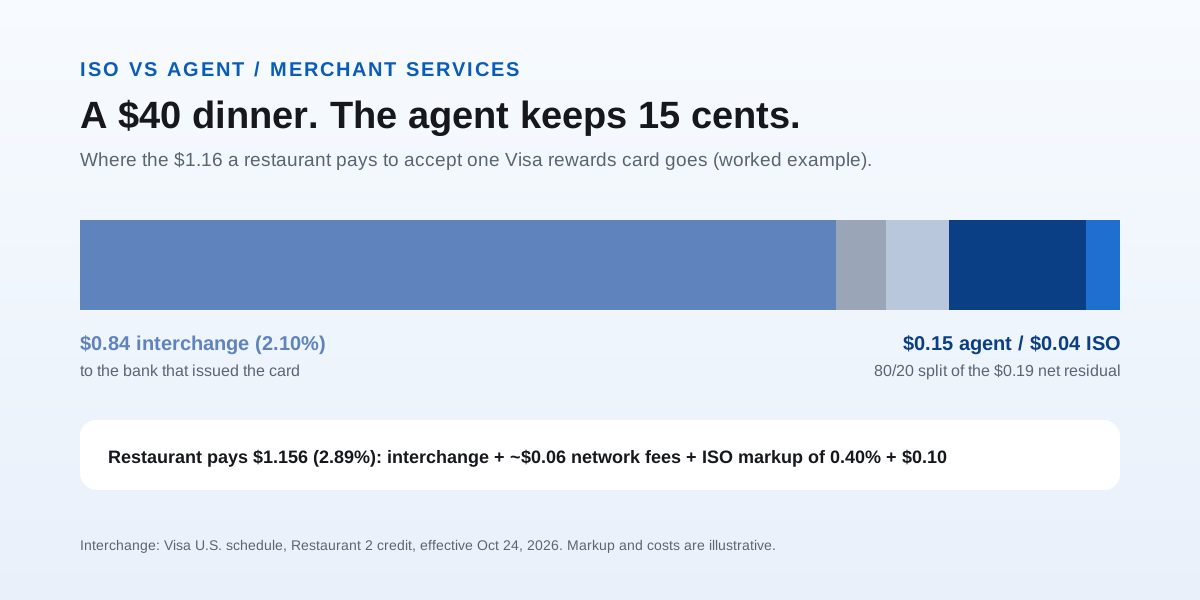
On a $40 restaurant dinner paid by credit card, the agent who signed that restaurant might keep 15 cents.
The bank that issued the card keeps 84.
ISO vs agent in merchant services comes down to who carries the risk. An ISO is registered with Visa and Mastercard through a sponsor bank, sets merchant pricing and absorbs merchant losses, which costs about $10,000 in network fees in year one. An agent sells under the ISO’s name, pays nothing to register and keeps a share of the residual, usually around 80%. Most people should start as an agent.
I run RestoSignals, which finds restaurants before they open, mostly for people in this business. The rest of this page comes from Visa’s own fee schedule, the networks’ registration rules and industry sources, linked as I go.
What is an ISO in merchant services?
An ISO, or independent sales organization, is a company that sells card processing to businesses under a sponsor bank’s Visa and Mastercard membership. It sets the merchant’s pricing, boards and supports the account, recruits sales agents and usually carries the risk if the merchant defrauds customers or goes under. ISOs exist because card networks only admit member banks, and banks don’t want to sell to taco shops.
Here’s the chain, top to bottom:
- Visa and Mastercard set the rules and the interchange rates.
- Member banks (acquirers) sponsor processors and ISOs into the networks.
- The processor or ISO boards merchants and runs the accounts.
- Agents find the merchants.
You can see this in the fine print of brands you know. Clover’s own site says First Data Merchant Services, doing business as Clover Business Solutions, “is a registered ISO of Pathward N.A.” and Wells Fargo.
Global Payments’ ISO guide describes ISOs as “middlemen between small businesses and large member banks.” That’s honest.
“iso merchant services” and “merchant services iso” each get about 110 searches a month. Most of those searchers are trying to work out which of these jobs they want.
What’s the difference between an ISO and a merchant services agent?
The difference between an ISO and a merchant services agent is risk, registration and branding. The ISO registers with Visa and Mastercard, signs indemnity agreements and absorbs merchant losses. An unregistered agent signs merchants under the ISO’s name, can’t hire sub-agents, pays no registration fees, and keeps a share of the residual, often about 80%.
The branding rule surprises people.
Payments attorney Paul Rianda explains it: network rules require an unregistered agent to market “under the name of the Credit Card Processor.” That covers the business card, the website and how you answer the phone.
The other rule: an unregistered agent can’t have independent contractors selling for it. Sub-agents need a registered sales organization above them.
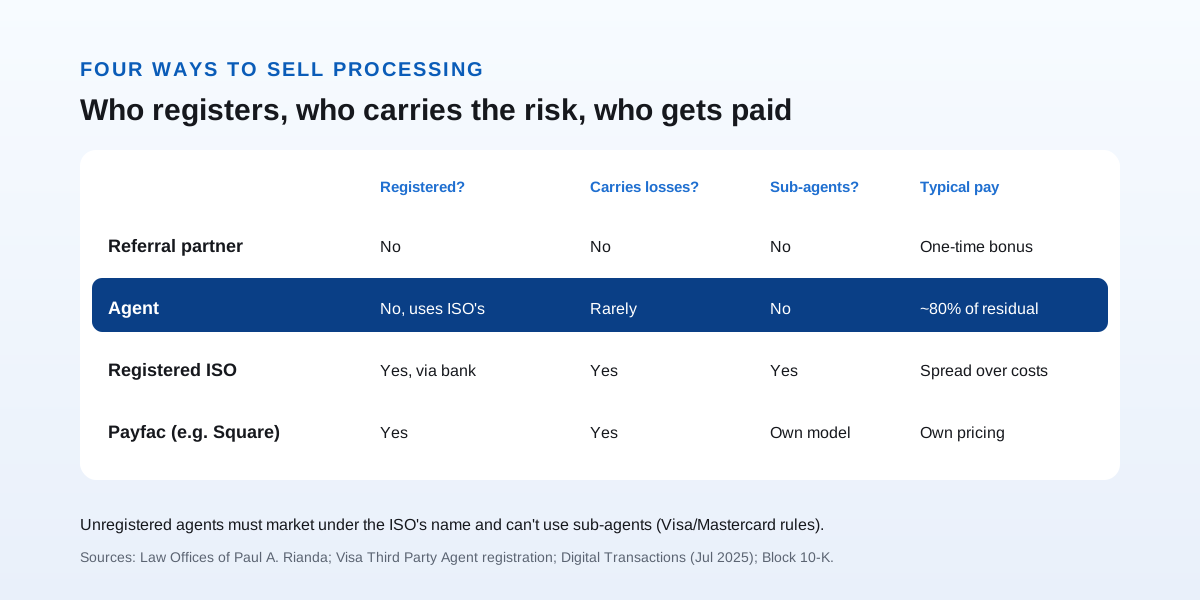
Here’s how the four models compare:
| Model | Registered with networks? | Carries merchant losses? | Can use sub-agents? | Typical pay |
|---|---|---|---|---|
| Referral partner | No | No | No | One-time bonus or small share |
| Agent | No (sells under ISO) | Rarely, check the contract | No | ~80% of residual |
| Registered ISO | Yes, via sponsor bank | Yes | Yes | The spread above its costs |
| Payment facilitator | Yes, as merchant of record | Yes | Its own model | Its own pricing |
“Sub-ISO” is the middle ground you’ll hear about. It usually means a registered sales office with its own agents that boards merchants through a bigger ISO’s processor relationship. The name varies by company, so ask what they mean.
How does the money flow on one card swipe?
On a $40 restaurant payment with a standard Visa rewards credit card, Visa’s October 2026 schedule sends $0.84 (2.10%) to the card-issuing bank as interchange, and the networks take roughly $0.06 more in assessments. Everything above that is the ISO’s markup. In a typical interchange-plus deal, the agent might keep about 15 cents of the roughly $1.16 the restaurant pays.
The interchange part isn’t a guess. Visa’s interchange reimbursement fee schedule, effective October 24, 2026, lists in-person “Restaurant 2” credit at 2.10% for traditional and rewards cards and 2.60% for Signature, Signature Preferred and Infinite cards, each with a 4-cent minimum.
Premium cards cost the restaurant more. Nobody in the chain below the issuer earns more from them.
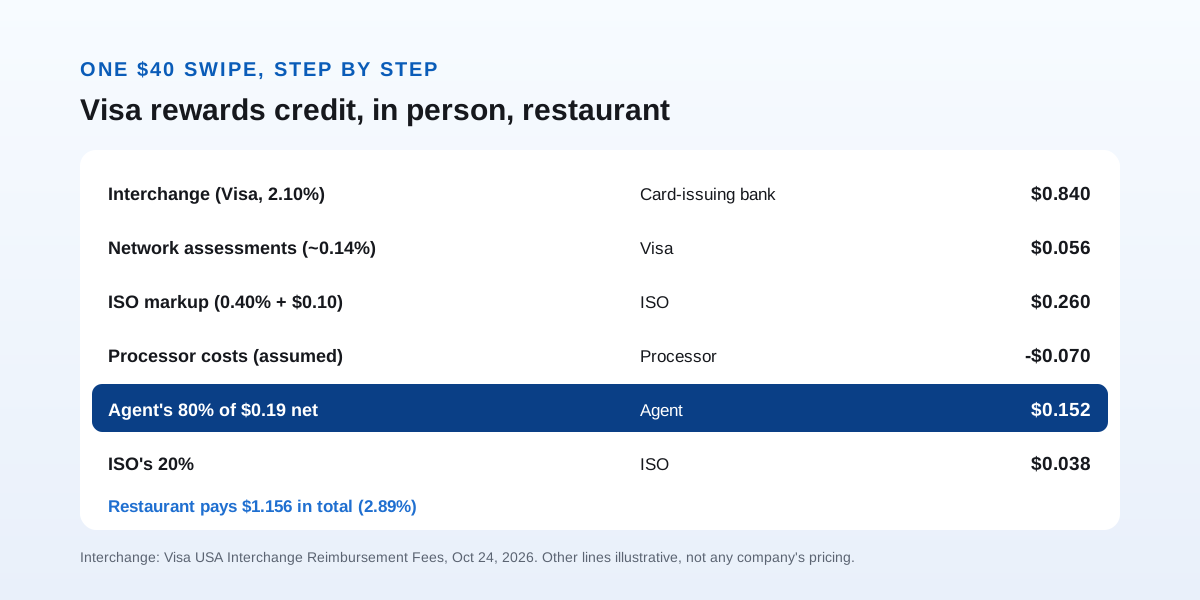
The rest of this example is a worked illustration, not anyone’s real rate card:
| Step | Who gets it | Amount on $40 |
|---|---|---|
| Interchange (Visa, 2.10%) | Card-issuing bank | $0.840 |
| Network assessments (~0.14%) | Visa | $0.056 |
| ISO markup (0.40% + $0.10) | ISO | $0.260 |
| Restaurant pays in total | $1.156 (2.89%) | |
| Processor costs (assumed 0.05% + $0.05) | Processor | -$0.070 |
| Net residual | ISO and agent | $0.190 |
| Agent’s 80% | Agent | $0.152 |
| ISO’s 20% | ISO | $0.038 |
So why would anyone run the ISO for 4 cents?
Because the ISO isn’t living on one merchant. It’s earning 20% on thousands of merchants signed by hundreds of agents, plus fees, equipment and its own direct sales.
The agent’s job is to make that 15 cents happen a few hundred thousand times a year.
Why does the card in the customer’s hand matter?
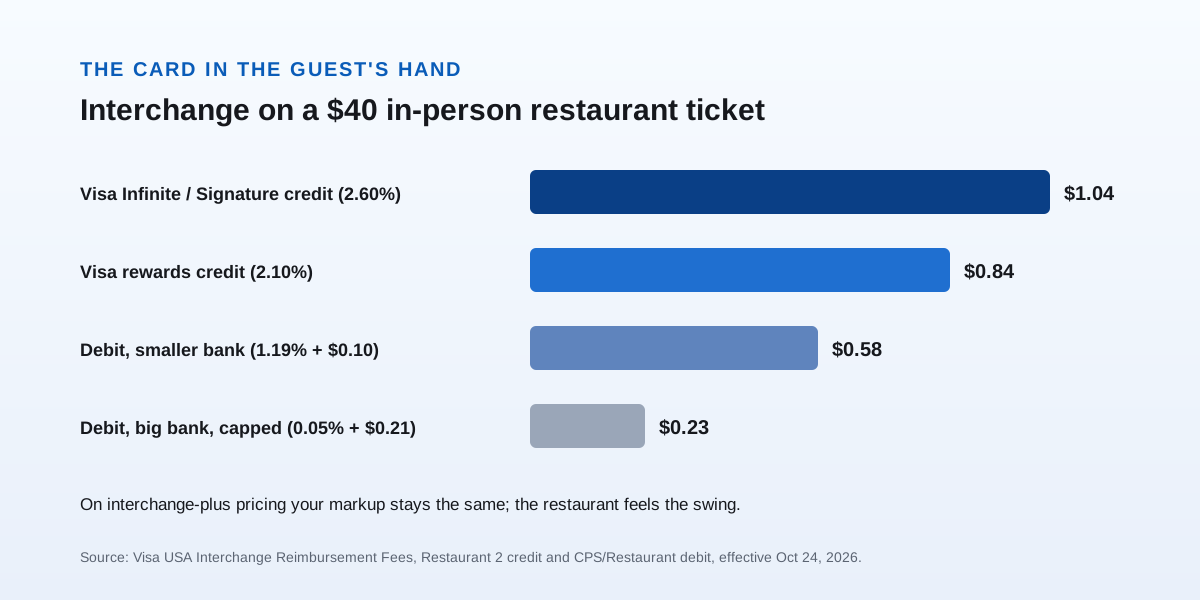
The card type changes what the restaurant pays far more than it changes what you earn. The same Visa schedule lists in-person restaurant debit at 1.19% + $0.10 for debit cards from smaller banks, and 0.05% + $0.21 for cards from big banks covered by the federal debit cap.
On our $40 ticket, that’s about $0.58 or $0.23 in interchange, against $0.84 on a rewards credit card and $1.04 on a Visa Infinite.
On interchange-plus pricing, your markup stays the same whichever card the guest uses. The restaurant sees the swing.
On flat-rate pricing, it’s the opposite. The ISO’s margin shrinks on premium credit cards and grows on regulated debit. That’s one reason residual reports bounce around month to month even when the restaurant is just as busy.
How much does it cost to become a registered ISO?
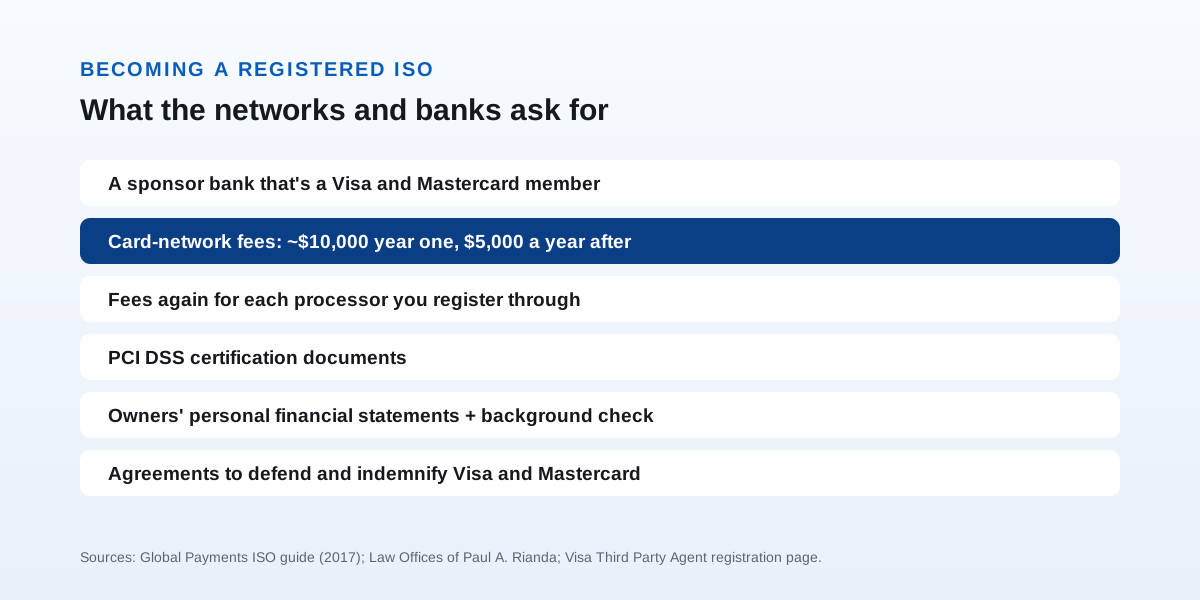
Becoming a registered ISO has been quoted at $10,000 in card-network fees for the first year and $5,000 a year after that, according to both Global Payments’ ISO guide and payments attorney Paul Rianda. Rianda adds that the fee applies again for every processor you register through. That’s before the sponsor bank’s own requirements, PCI DSS compliance and the legal work on indemnity agreements.
Two caveats. Global Payments’ guide is dated 2017, and Rianda’s article isn’t dated. Ask your sponsor bank for current numbers.
The paperwork is the bigger hurdle. Rianda lists what registration asks for:
- A detailed application covering the company and every significant owner.
- Income, profits, assets and liabilities.
- Personal financial statements from all principals.
- A background check.
- Separate Visa and Mastercard agreements to “defend and indemnify” them.
Visa’s Third Party Agent registration page adds a practical one: most agents “need a Visa Client sponsor” (a member bank), plus current PCI DSS certification documents.
Who carries the risk when a merchant goes bad?
The processor and its sponsor bank stand behind every transaction, and the ISO usually absorbs merchant losses it can’t recover, such as chargebacks from a restaurant that closed owing customers money. That risk is why the ISO keeps part of the residual. Agents usually carry little direct risk, but some agreements push losses back onto the agent through reserves or clawbacks.
Sara Egan of CWA Merchant Services put it plainly in Digital Transactions: the processor is “holding (usually all of) the risk and liability.”
That’s the real trade in ISO vs agent.
Restaurants are a good example of why it matters. They take deposits for events, sell gift cards and sometimes close fast. Picture a restaurant that shuts with $8,000 in prepaid catering on customers’ cards. Those chargebacks land somewhere.
As an agent, read the clause that answers “where?” before you sign.
Where do payment facilitators like Square fit?
Payment facilitators like Square sit outside the ISO-and-agent model. Square’s 10-K says it acts as the merchant of record and payment service provider for its sellers’ card payments, so sellers sign up directly under Square’s own processing relationship. There’s no ISO in the middle and no residual for an outside agent, which is why Square doesn’t run an agent program.
Block’s 2024 10-K describes the merchant of record as the party “responsible for settling funds with the seller.”
Toast sells mostly through its own sales team, too.
That’s why “square reseller program” searches end in disappointment. I covered what Square, Toast and Clover actually offer outsiders in how to become a POS reseller or merchant services agent.
For an agent, payfacs are competition. A restaurant can sign up for Square online in an afternoon without meeting you.
Your edge is getting there first and setting up a system that fits a full-service restaurant.
Should you start as an agent or an ISO?
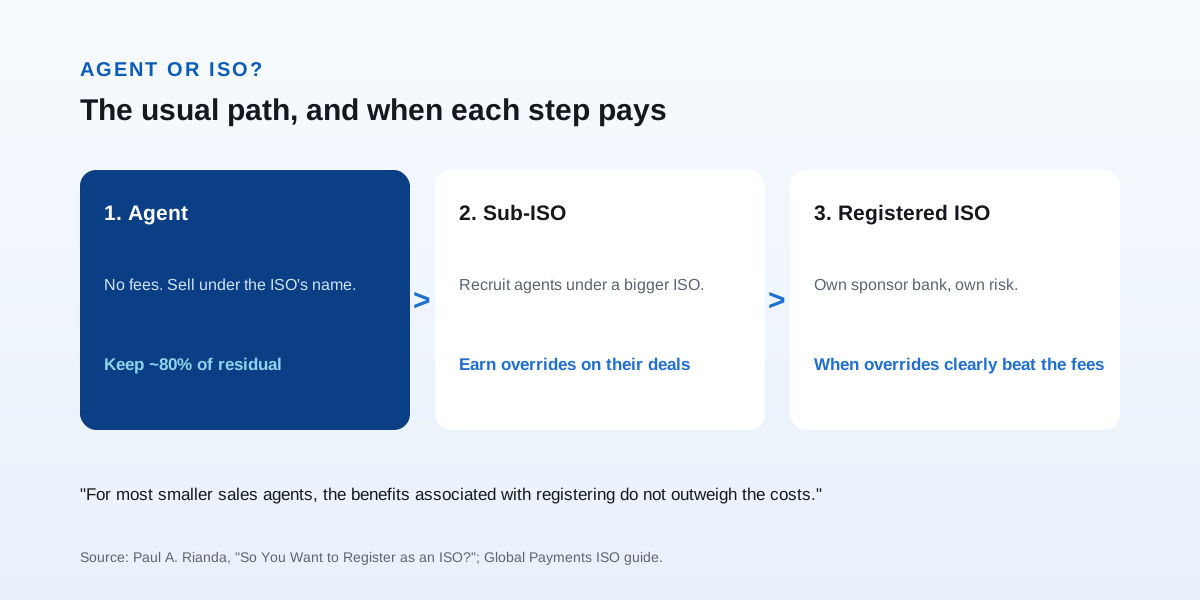
Start as an agent. Registration costs at least $5,000 a year after the first year, adds personal financial disclosure and indemnity, and pays off mainly when you have sub-agents or need your own brand, per payments attorney Paul Rianda, who says that for most smaller agents the benefits “do not outweigh the costs.” Register once your sub-agent overrides clearly exceed those fees.
Run the numbers on your own book.
In the worked example above, the gap between the agent’s 80% and 100% of the net residual is about 4 cents per $40 ticket. You’d need a big book before that covers $5,000 a year.
Sub-agents change the math. If ten agents under you each sign a few restaurants a month, your override on their residuals can pass the fees fast.
r/PaymentProcessing says the same. One top answer told a would-be ISO founder to “start as an agent or sub-ISO with a reputable upstream.”
Where do agents and ISOs find their first merchants?
Agents and ISOs find their easiest merchants among businesses that haven’t picked a processor yet, and new restaurants are the clearest case. They process heavy card volume, and public liquor license applications reveal them months before opening. California had 3,268 pending restaurant and bar liquor applications (types 41 and 47) in the state’s export on November 4, 2026, 679 of them in Los Angeles County.
Texas had 909 pending applications on November 5, 2026, per TABC’s pending applications dataset.
Not every application is a brand-new restaurant. Some are ownership transfers. But a new owner also picks a processor.
And timing matters. In a 2025 survey of 220 restaurant operators, reported by Restaurant Technology News, 71% started choosing vendors more than 90 days before opening.
You can pull these lists yourself from the California and Texas lookups. Or use RestoSignals, which matches them with permits and business filings and adds the owner’s name.
For the outreach itself, see how to sell merchant services to restaurants, with a real Houston pipeline built from free data.
Frequently asked questions
What is an ISO in merchant services?
An ISO, or independent sales organization, is a company that sells card processing to merchants under a sponsor bank’s Visa and Mastercard membership. It sets merchant pricing, handles onboarding and support, recruits agents, and usually carries the risk of merchant losses. Clover’s own site shows one: First Data Merchant Services is a registered ISO of Pathward N.A. and Wells Fargo.
How much does it cost to become an ISO?
The card-network fees alone have been published at $10,000 in the first year and $5,000 a year after that, per Global Payments’ ISO guide and payments attorney Paul Rianda, and Rianda says the fee applies again for each processor you register through. On top of that come a sponsor bank, PCI DSS compliance, background checks, personal financial statements and indemnity agreements.
ISO vs agent: what’s the real difference in payment processing?
The ISO carries the risk and the registration; the agent carries the sales bag. An unregistered agent must market under the ISO’s name and can’t use sub-agents, per Visa and Mastercard rules as described by attorney Paul Rianda. In return, the agent pays no registration fees and typically keeps about 80% of the residual, the 2025 norm reported by Digital Transactions.
Is it difficult to begin your own ISO in payment processing?
Yes. You need a sponsor bank that is a Visa and Mastercard member, a business plan, credit reports and financial statements for every owner, PCI DSS documents, indemnity agreements and the registration fees. Global Payments calls the process long and arduous. Most people start as an agent, build a book of merchants, and register only when sub-agents would pay for it.
Do merchant services agents need to register with Visa and Mastercard?
Usually not. A sales agent can sell under an ISO’s registration as long as it markets under the ISO’s name. Registration becomes necessary when the agent wants to market under its own brand or use sub-agents, according to payments attorney Paul Rianda, who says most smaller agents don’t benefit enough to justify the cost.
Who is liable for chargebacks, the ISO or the agent?
The processor and its sponsor bank stand behind the transaction, and the ISO usually absorbs merchant losses it can’t recover, which is why it keeps part of the residual. As CWA Merchant Services’ Sara Egan told Digital Transactions, the processor holds ‘usually all of’ the risk. Some agent agreements push losses back onto the agent, so read that clause before signing.
Sign as an agent, and spend the $10,000 on finding merchants
Don’t register as an ISO until sub-agents pay for it. Sign an agent agreement, get Schedule A and the liability clause in writing, and put your money and time into the one thing the ISO can’t do for you: reaching restaurants before they choose a processor. See this week’s new venues on RestoSignals free, or pull the pending liquor applications in your county tonight.
Mukul Dutt is the founder of RestoSignals, which tracks restaurants and bars before they open by fusing public liquor, permit and business-filing records into one scored venue with owner contact. Interchange rates are from Visa’s U.S. interchange reimbursement fee schedule effective October 24, 2026. Network assessment, markup and processor-cost figures in the worked example are illustrative, not any company’s pricing. California counts are from the state ABC export mirrored on November 4, 2026; Texas counts from TABC’s pending applications dataset on November 5, 2026. Nothing here is legal advice.
FAQ
What is an ISO in merchant services?
An ISO, or independent sales organization, is a company that sells card processing to merchants under a sponsor bank's Visa and Mastercard membership. It sets merchant pricing, handles onboarding and support, recruits agents, and usually carries the risk of merchant losses. Clover's own site shows one: First Data Merchant Services is a registered ISO of Pathward N.A. and Wells Fargo.
How much does it cost to become an ISO?
The card-network fees alone have been published at $10,000 in the first year and $5,000 a year after that, per Global Payments' ISO guide and payments attorney Paul Rianda, and Rianda says the fee applies again for each processor you register through. On top of that come a sponsor bank, PCI DSS compliance, background checks, personal financial statements and indemnity agreements.
ISO vs agent: what's the real difference in payment processing?
The ISO carries the risk and the registration; the agent carries the sales bag. An unregistered agent must market under the ISO's name and can't use sub-agents, per Visa and Mastercard rules as described by attorney Paul Rianda. In return, the agent pays no registration fees and typically keeps about 80% of the residual, the 2025 norm reported by Digital Transactions.
Is it difficult to begin your own ISO in payment processing?
Yes. You need a sponsor bank that is a Visa and Mastercard member, a business plan, credit reports and financial statements for every owner, PCI DSS documents, indemnity agreements and the registration fees. Global Payments calls the process long and arduous. Most people start as an agent, build a book of merchants, and register only when sub-agents would pay for it.
Do merchant services agents need to register with Visa and Mastercard?
Usually not. A sales agent can sell under an ISO's registration as long as it markets under the ISO's name. Registration becomes necessary when the agent wants to market under its own brand or use sub-agents, according to payments attorney Paul Rianda, who says most smaller agents don't benefit enough to justify the cost.
Who is liable for chargebacks, the ISO or the agent?
The processor and its sponsor bank stand behind the transaction, and the ISO usually absorbs merchant losses it can't recover, which is why it keeps part of the residual. As CWA Merchant Services' Sara Egan told Digital Transactions, the processor holds 'usually all of' the risk. Some agent agreements push losses back onto the agent, so read that clause before signing.
Find venues opening near you
100 free leads, no card. One platform for restaurants & bars about to open.