How to sell merchant services to restaurants
How to sell merchant services to restaurants: why new restaurants beat open ones, what owners care about, the dual pricing rules, and a real Houston pipeline for your first 20 merchants.
Restaurant owners get pitched on card processing constantly.
One person on r/sales put it better than I can: “Everyone and their mother I feel like is selling merchant services. My parents own a restaurant.”
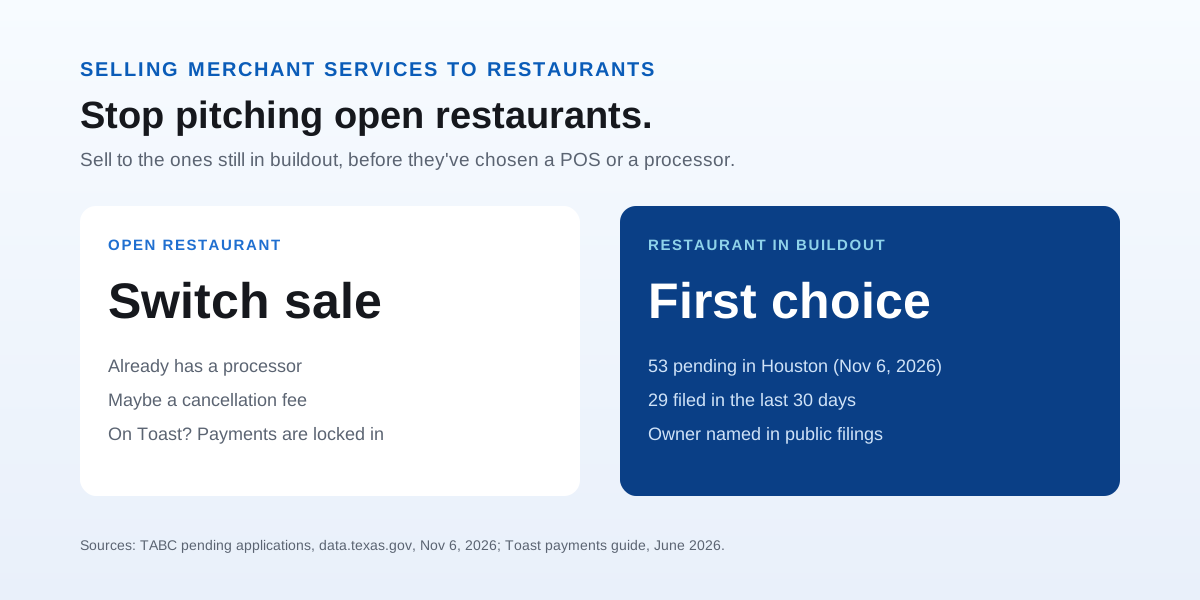
The way to sell merchant services to restaurants is to stop selling to open ones. An open restaurant already has a processor, often a contract, and sometimes a POS like Toast that requires its own payments, so every pitch is a switch sale. A restaurant in buildout is choosing for the first time. Find those through public liquor applications, reach the owner months before opening, and lead with how they’ll run service, not your rate.
I run RestoSignals, which finds restaurants before they open, so I’m biased toward that answer. Here’s the evidence anyway, plus a real Houston list built from free public data on November 6, 2026.
Why are restaurants worth selling merchant services to?
Restaurants are worth it because they process a lot of card volume and they need processing on day one. Toast’s average location processed about $1.19 million in the year to September 2026, by its 10-Q. Visa’s in-person restaurant credit interchange runs 2.10% to 2.60%, so restaurants feel every point. The catch is that every agent knows this, and owners are tired of being pitched.
That $1.19 million comes from Toast’s Q3 2026 10-Q: about $225 billion processed in 12 months across roughly 189,000 locations.
A small independent does less. A busy bar does more.
And owners push back. On r/restaurantowners, a thread asking operators about their POS and processor opened with: “POS sales people, do not DM me.”
So there’s real money here, and a lot of agents already chasing it.
Should you sell to open restaurants or new ones?
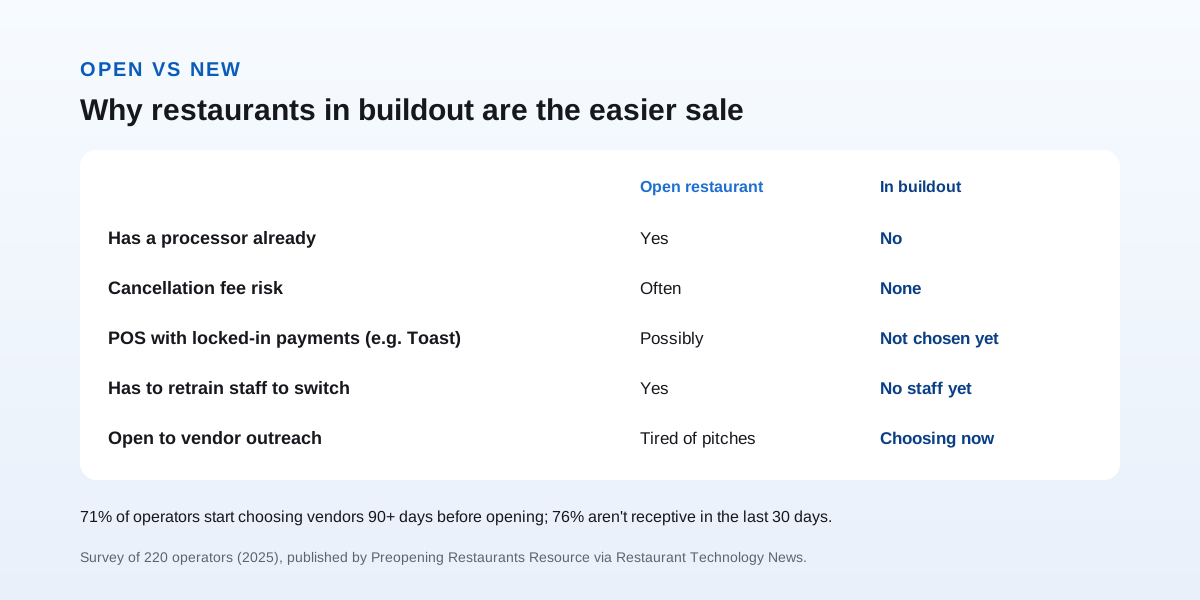
Sell to new ones. An open restaurant already has a processor, maybe an early termination fee, and often a POS with payments built in, so you’re asking it to switch hardware, retrain staff and take a risk mid-service. A restaurant in buildout has none of that. In a 2025 operator survey, 71% started choosing vendors more than 90 days before opening.
That survey of 220 operators was published by Restaurant Technology News in a sponsored post from Preopening Restaurants Resource, which sells pre-opening leads. So it has a horse in this race, same as me. Here’s what it found:
- 71% start selecting key vendors more than 90 days before opening.
- 64% finalize vendor relationships before any public announcement.
- 76% aren’t receptive to vendor outreach within 30 days of opening.
Then there’s the Toast problem.
Toast’s own payments guide, updated June 2026, says it plainly: “Toast POS requires Toast Payments.” A restaurant on Toast “can’t shop for outside processing rates.”
Toast served about 189,000 locations at the end of September 2026. Every one of them is closed to a processing-only pitch unless you also replace the POS.
What do restaurant owners care about in a processor?
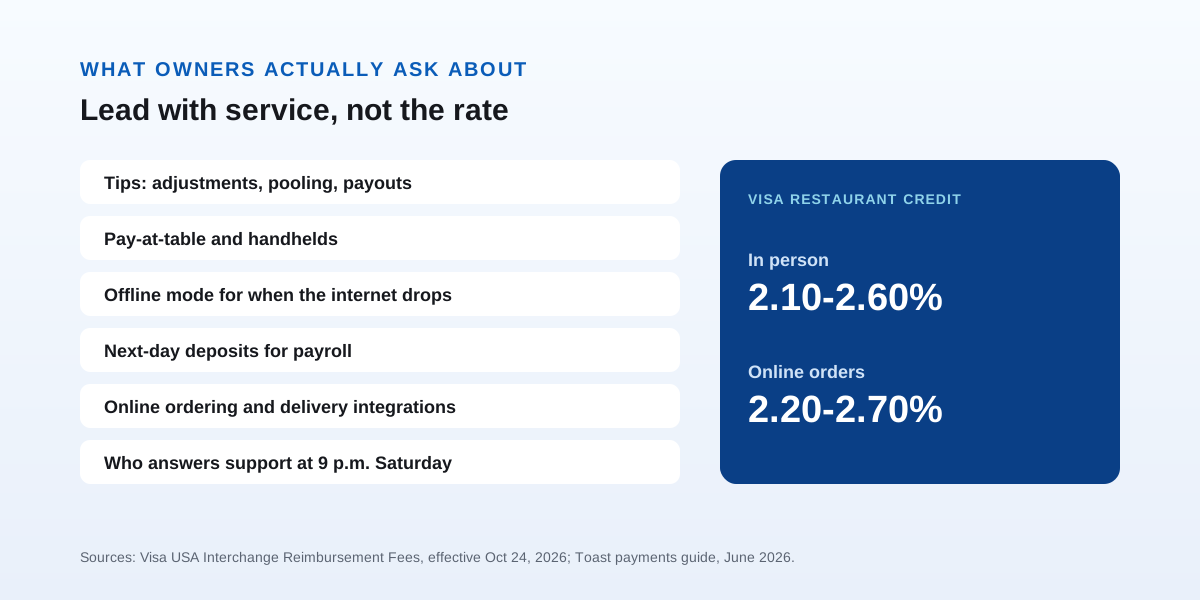
Restaurant owners care about how payments fit service, not the rate on paper. They want tips and tip adjustments that work, pay-at-table or handhelds, payments that keep running when the internet drops, next-day deposits for payroll, and a POS that talks to their online ordering. Online orders also cost more: Visa charges restaurants 2.20% to 2.70% on card-not-present credit versus 2.10% to 2.60% in person.
Those interchange numbers are from Visa’s fee schedule effective October 24, 2026. Restaurants with lots of takeout and delivery orders pay more per dollar.
Look at what Toast’s own payments guide highlights: tip management, offline mode, chargeback records and next-day deposits. The rate barely comes up.
That’s your pitch list, too:
- Tips. How tip adjustments, pooling and payouts work on your system.
- Pay-at-table. Handhelds turn tables faster on a Friday.
- Offline mode. The internet always fails during the rush.
- Deposits. Next-day or same-day funding for payroll and vendors.
- Online ordering. Which ordering and delivery systems your POS connects to.
- Support. Who picks up at 9 p.m. on a Saturday.
Should you pitch dual pricing or surcharging to restaurants?
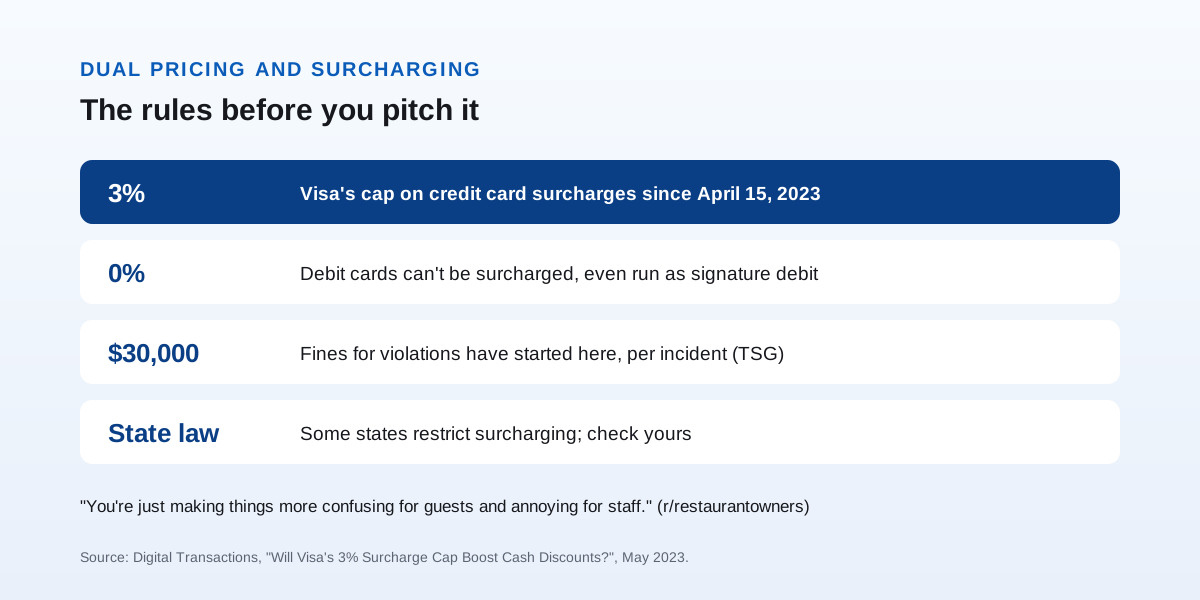
Pitch it carefully, if at all. Visa capped credit card surcharges at 3% in April 2023 and doesn’t allow surcharging debit cards, and fines for violations have started at $30,000 per incident, according to TSG. Some states restrict surcharging. Dual pricing can make an agent’s portfolio far more profitable, but many restaurant owners worry it annoys guests and staff.
The rule details come from Digital Transactions, which reported that Visa lowered its cap “from a maximum of 4% to 3%” on April 15, 2023. The same piece said surcharging debit, “even if processed as signature debit, is not permitted.”
At the time, Massachusetts and Connecticut didn’t allow surcharging. Check your state’s current rules.
The money side is real. PayBright’s CEO told Digital Transactions that dual pricing has produced “upwards of 10X increases in profitability” in some agent portfolios. That’s an ISO describing its own product, so treat it as a claim.
The pushback is real too. When an owner asked r/restaurantowners about dual pricing, the top answer was: “You’re just making things more confusing for guests and annoying for staff.”
My view: offer it, explain the rules, and let the owner decide. Don’t lead with it.
How do you find your first 20 restaurant merchants?
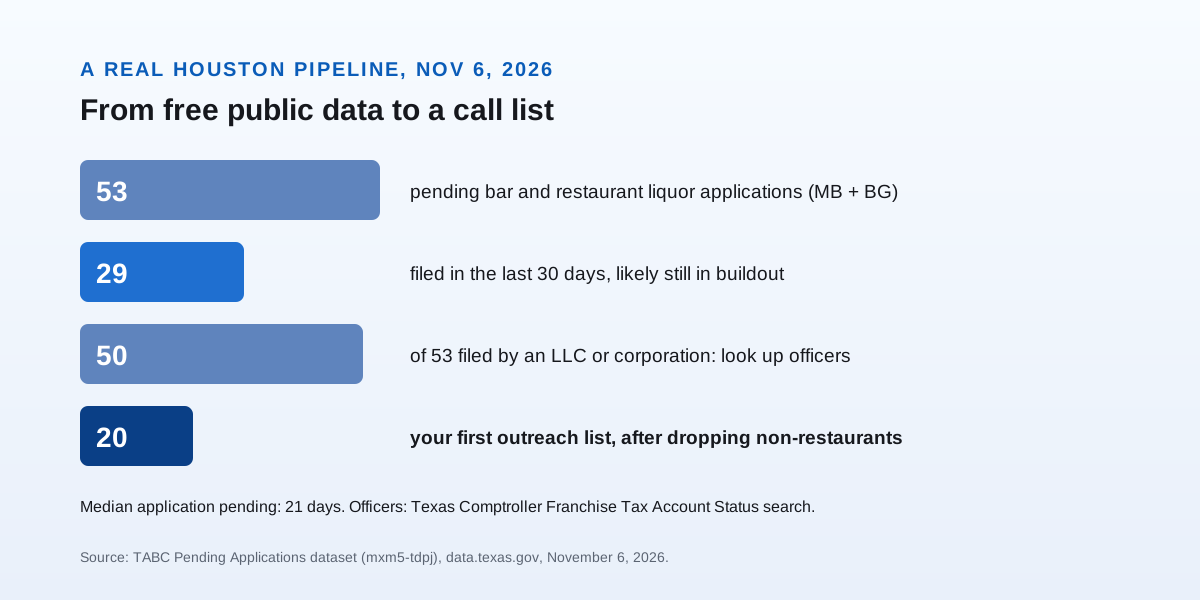
You find your first 20 restaurant merchants in public liquor license applications. Houston alone had 53 pending bar and restaurant applications (permit types MB and BG) in TABC’s dataset on November 6, 2026, and 29 were filed in the previous 30 days. Most applicants are LLCs, so you look up the officers in the Texas Comptroller’s entity search, then contact the owner during buildout.
Here’s the Houston pipeline, step by step, using only free sources.
Step 1: Pull pending applications
TABC’s Pending Applications dataset is public and free. Filter by city and by MB (mixed beverage, the full bar permit) and BG (wine and beer).
On November 6, Houston had 53: 22 MB and 31 BG. The median application had been pending 21 days.
Step 2: Keep the restaurants
Read the trade names. Among Houston’s newest that week were a sushi restaurant, a golf club with a bar, a showroom restaurant and a daiquiri spot. There was also a fuel station.
Drop the fuel station.
Step 3: Find the person behind the LLC
50 of the 53 Houston applicants were companies, not people. That’s normal.
Search the company name in the Texas Comptroller’s Franchise Tax Account Status search. It shows the registered agent and the officers or managers from the latest Public Information Report.
One honest caveat. The Comptroller says that officer information isn’t updated between annual reports, and a brand-new LLC may not have filed one yet. Then the registered agent and the trade name are your way in.
Step 4: Confirm it’s not open
Search the trade name and address. No reviews and no online menu usually means you’re early. If it’s already taking orders online, the POS is probably chosen.
Step 5: Reach out with something useful
Mail a short letter, call, or stop by the buildout. More on what to say below.
Other states have their own versions. California’s ABC export had 3,268 pending restaurant and bar applications on November 4, 2026. See my guides for Texas and California.
Doing this by hand takes a few hours a week per city. That’s the job RestoSignals does, matching the liquor filing to permits and business records and adding the owner’s name.
The same list works for other vendors. Cleaners, for example, can use it later in the buildout: see how to get commercial cleaning contracts from restaurants.
What do you say to a restaurant owner who hasn’t opened yet?
Open with their opening, not your rate. Mention the permit you saw, ask when they expect to open and what POS they’re considering, and offer something useful for the buildout, such as a hardware checklist or a tip-payout setup. Owners in buildout are buried in contractors and inspections, so a short, specific note beats a long pitch or a demo request.
Something like this, as a letter or a voicemail:
Hi [name], I saw the mixed beverage application for [trade name] on [street]. Congrats. I set up card processing and POS for restaurants in [city], including tip payouts and handhelds. If you haven’t locked in a POS yet, I’m happy to walk you through what similar places nearby use, no pitch deck. [phone]
That’s an example. Change it to sound like you.
Two things to avoid:
- Leading with a rate. They don’t have volume yet, and every other agent quotes a rate.
- Showing up 30 days before opening. By then most have chosen, and 76% in that survey said they weren’t receptive.
Should you sell the POS too, or just processing?
Sell the POS too if you can. Restaurants choose a POS first and processing comes with it: Toast requires Toast Payments, and Square runs its own processing, so a processing-only agent loses every restaurant that picks one of them. Agents who bring a POS that works with their ISO’s processing, such as Clover through an ISO or a dealer system, get to compete at the moment the choice is made.
That changes what you’re selling.
The owner isn’t comparing 2.6% to 2.4%. They’re comparing how the system handles a split check for eight, a kitchen ticket that has to reach the bar, and a server’s tips at close.
If you can demo that on a tablet at the buildout, you’re in the running. If you can only quote a rate, you’re competing with every other agent and with Toast’s own sales team.
I covered which POS programs are open to outside agents, and what each pays, in the POS reseller guide.
One honest downside: a POS sale means install days, menu builds and support calls. Some agents partner with a local installer and keep the payments side for themselves. That installer is often a low voltage contractor, and here’s how they win restaurant buildouts.
How many restaurants do you need for this to pay?
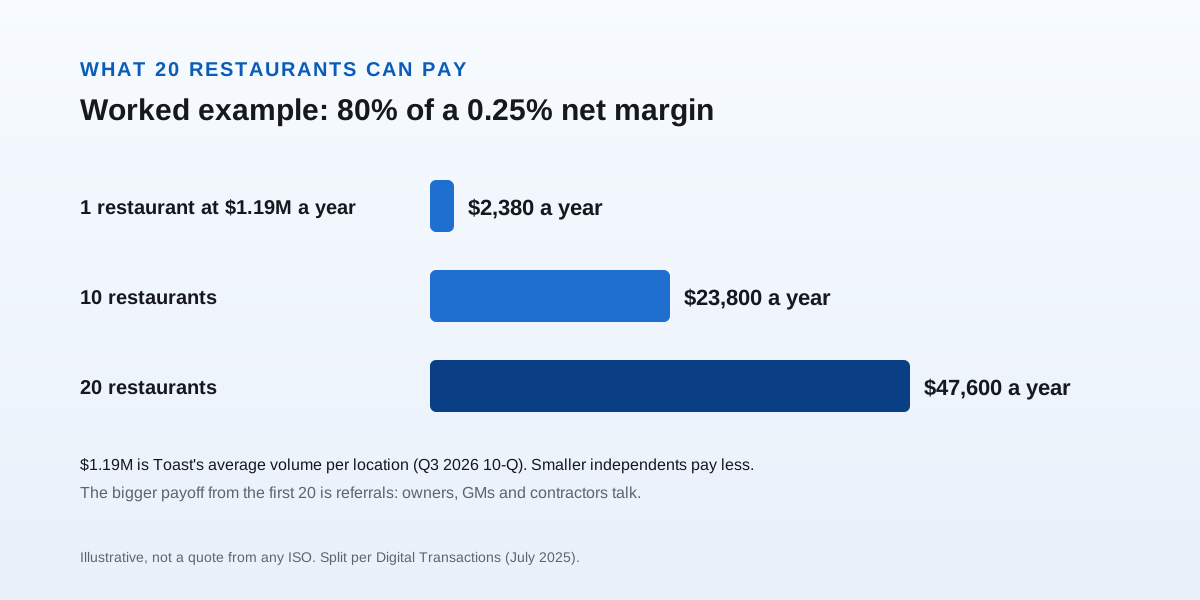
Twenty restaurants can add up to a real income if they’re busy. In my worked example, an agent on an 80% split of a 0.25% net margin earns about $2,380 a year from a restaurant processing $1.19 million in cards. Twenty of those would be roughly $47,600 a year in residuals. Smaller independents earn you less, so count on a range, not that number.
I showed the math in how to become a POS reseller or merchant services agent, and the full chain on one $40 ticket in ISO vs agent in merchant services.
The point of the first 20 isn’t the money. It’s the referrals. Restaurant owners talk to each other, and so do their contractors, GMs and suppliers.
Frequently asked questions
How do I sell merchant services to restaurants?
Sell to restaurants before they open, not after. An open restaurant has a processor, often a contract and sometimes a POS that requires its own payments, so you’re asking it to switch. A new one is choosing for the first time. Find them through public liquor license applications and business filings, contact the owner during the buildout, and lead with tips, deposits and POS fit instead of rates.
What are the main reasons restaurants change their payment processor?
Usually because they’re changing POS, the processor’s fees crept up, deposits were slow, or support failed during a busy service. Rate alone rarely moves a restaurant, because switching means new hardware, retraining staff and sometimes a cancellation fee. That’s why switch sales are hard and why first-time choices during a restaurant’s buildout are easier to win.
What is the best lead generation tool for a merchant services agent?
For restaurants, the best leads are restaurants that haven’t chosen a processor yet, and public filings find them first. Free sources are state liquor license applications, such as Texas TABC’s pending applications dataset, city permits and business filings. Paid tools like RestoSignals, RestaurantData.com and Preopening Restaurants Resource collect them for you. General contact databases mostly list restaurants that are already open.
Can a Toast restaurant use a different payment processor?
No. Toast’s own June 2026 guide says Toast POS requires Toast Payments, so a restaurant can’t shop for outside processing rates while staying on Toast. To win that restaurant’s processing, you’d have to replace its POS as well. That’s a much bigger sale, which is one more reason to reach restaurants before they pick a POS.
Is dual pricing legal for restaurants?
Generally yes, with rules. Visa caps credit card surcharges at 3% and bans surcharging debit cards, per a 2023 rule change reported by Digital Transactions, and fines for violations have started at $30,000 per incident. Some states restrict surcharging. Check your processor’s compliant program before pitching it.
When should you contact a new restaurant about card processing?
Contact them during the buildout, roughly 60 to 120 days before opening. In a 2025 survey of 220 operators, published by pre-opening lead provider Preopening Restaurants Resource, 71% started choosing key vendors more than 90 days before opening and 76% weren’t receptive to vendor outreach in the final 30 days. By the time the ordering system is live, the processor is usually chosen.
Pull your city’s list tonight
Don’t spend another week walking into open restaurants. Open your state’s pending liquor applications, filter to your city and to bar and restaurant permits, look up the owners of the 20 newest, and send each one a short note this week. If you’d rather start with the list done, see this week’s new venues on RestoSignals free.
Mukul Dutt is the founder of RestoSignals, which tracks restaurants and bars before they open by fusing public liquor, permit and business-filing records into one scored venue with owner contact, and sells to the agents this article is written for. Houston figures are from TABC’s pending applications dataset on November 6, 2026; California from the state ABC export on November 4, 2026. Interchange rates are from Visa’s schedule effective October 24, 2026. The earnings example is illustrative, not a quote from any ISO.
FAQ
How do I sell merchant services to restaurants?
Sell to restaurants before they open, not after. An open restaurant has a processor, often a contract and sometimes a POS that requires its own payments, so you're asking it to switch. A new one is choosing for the first time. Find them through public liquor license applications and business filings, contact the owner during the buildout, and lead with tips, deposits and POS fit instead of rates.
What are the main reasons restaurants change their payment processor?
Usually because they're changing POS, the processor's fees crept up, deposits were slow, or support failed during a busy service. Rate alone rarely moves a restaurant, because switching means new hardware, retraining staff and sometimes a cancellation fee. That's why switch sales are hard and why first-time choices during a restaurant's buildout are easier to win.
What is the best lead generation tool for a merchant services agent?
For restaurants, the best leads are restaurants that haven't chosen a processor yet, and public filings find them first. Free sources are state liquor license applications, such as Texas TABC's pending applications dataset, city permits and business filings. Paid tools like RestoSignals, RestaurantData.com and Preopening Restaurants Resource collect them for you. General contact databases mostly list restaurants that are already open.
Can a Toast restaurant use a different payment processor?
No. Toast's own June 2026 guide says Toast POS requires Toast Payments, so a restaurant can't shop for outside processing rates while staying on Toast. To win that restaurant's processing, you'd have to replace its POS as well. That's a much bigger sale, which is one more reason to reach restaurants before they pick a POS.
Is dual pricing legal for restaurants?
Generally yes, with rules. Visa caps credit card surcharges at 3% and bans surcharging debit cards, per a 2023 rule change reported by Digital Transactions, and fines for violations have started at $30,000 per incident. Some states restrict surcharging. Check your processor's compliant program before pitching it.
When should you contact a new restaurant about card processing?
Contact them during the buildout, roughly 60 to 120 days before opening. In a 2025 survey of 220 operators, published by pre-opening lead provider Preopening Restaurants Resource, 71% started choosing key vendors more than 90 days before opening and 76% weren't receptive to vendor outreach in the final 30 days. By the time the ordering system is live, the processor is usually chosen.
Find venues opening near you
100 free leads, no card. One platform for restaurants & bars about to open.